Previous Episodes
- October 2026
- September 2026
- August 2026
- July 2026
- June 2026
- May 2026
- April 2026
- March 2026
- February 2026
- January 2026
- December 2025
- November 2025
- October 2025
- September 2025
- August 2025
- July 2025
- June 2025
- May 2025
- April 2025
- March 2025
- February 2025
- January 2025
- December 2024
- November 2024
- October 2024
- September 2024
- August 2024
- July 2024
- June 2024
- May 2024
- April 2024
- March 2024
- February 2024
- January 2024
- December 2023
- November 2023
- October 2023
- September 2023
- August 2023
- July 2023
- June 2023
- May 2023
- April 2023
- March 2023
- February 2023
- January 2023
- December 2022
- November 2022
- October 2022
- September 2022
- August 2022
- July 2022
- June 2022
- May 2022
- April 2022
- March 2022
- February 2022
- January 2022
- December 2021
- November 2021
- October 2021
- September 2021
- August 2021
- July 2021
- June 2021
- May 2021
- April 2021
- March 2021
- February 2021
- January 2021
- December 2020
- November 2020
- October 2020
- September 2020
- August 2020
- July 2020
- June 2020
- May 2020
- April 2020
- March 2020
- February 2020
- January 2020
- December 2019
- November 2019
- October 2019
- September 2019
This episode I had the opportunity to interview Dr. Ross Bender, PhD, who has translated the Shoku Nihongi, the official history following the Nihon Shoki through to the end of the Nara Period. Our discussion ran through a variety of topics and I’ve tried to capture some notes here—though these are only snippets of information as to go in depth into every topic would make this an incredibly unwieldy project.
We touch on Hachiman and the Hachiman cult and shrines. We discussed the Six National Histories, or Rikkokushi. We also mentioned various historical works, like Heike Monogatari and Hojoki. And we bring up numerous names in the field of Japanese history. I’ve tried to collect that information, below, and I included links to sites and references to books that we discussed at the bottom, below the transcript of the interview. I hope this is helpful.
The Dōkyō Incident aka The Usa Hachimangū Oracle Incident 宇佐八幡宮神託事件
(For more, check out Dr. Bender’s dissertation: “The Hachiman Cult and the Dōkyō Incident”.)
-
In 738, Royal Princess Abe (“阿倍”, not the daughter of Naka no Ōe, whose name is “阿部”) was designated as heir apparent by her father, and she ascended to the throne in 749. She ruled until 758, when she was forced to abdicate the throne for Royal Prince Ōi, later known as Junnin Tennō. Abe became known as Daijō Tennō, and took the name Kōya. After a failed rebellion by her cousin, Fujiwara no Nakamaro, she deposed Ōi and re-ascended the throne, ruling until 770. In her first reign she is known as Kōken and in her second as Shōtoku.
Abe’s reign saw numerous rebellions. Abe is often held up as similar to Empress Wu, the only woman in China to rule in her own right. There are numerous parallels, including the vilification of each after their reign, leading to traditions stating the women should not ascend to the throne.
-
Dōkyō was a priest who is said to have been favored by Abe. There is a reference to them meeting in the Hora Capital (保良宮). The Hora Capital was in Afumi (Ōmi), and only lasted a couple of years in early 760s as the “Northern Capital”.
Eventually, Dōkyō was promoted to the position of Hō’ō, “Prince of the Law” (法王); an important court position overseeing Buddhist institutions in Japan. In 769, it is said that an oracle from Usa Hachiman Shrine suggested he should be named sovereign. This caused an emissary to be dispatched, Wake no Kiyomaro, to verify the oracle. Kiyomaro returned and said that Hachiman declared that nobody outside the royal line should ascend the throne.
Since then, rumors abounded about the relationship between Abe and Dōkyō, with many tales suggesting that they were having an affair. Abe was unmarried and without a direct heir. This is affair is often cited in works talking about Abe’s position as the last true female sovereign in her own right (i.e. not serving as a regent for a son or other male relative).
-
Early in Abe’s reign, Tachibana no Naramaro, a powerful noble, came into conflict with Abe and the powerful Fujiwara no Nakamaro. In 757, Naramaro was implicated in a plot to raise troops to kill Nakamaro and replace Abe with a more sympathetic sovereign. He and others were executed as rebels. Later, however, he would be posthumously rewarded the position and rank of his rival, Nakamaro: that is he would be granted the posthumous position of Dajō-daijin and the Upper First Rank.
-
A court noble who, early on, held Abe’s favor and who rose quickly through the court ranks. In 757 he defeated his chief rival, Tachibana no Naramaro, and he would later go on to challenge Abe’s power. After Naramaro’s failed rebellion, Nakamaro positioned Abe to step down in favor of Prince Ōi, but she was still Daijō-Tennō, a powerful position with her hand still at the helm. Nakamaro attempted to consolidate military power over the four provinces, with the goal of ousting Abe entirely, but she learned of his plot and had him stripped of his position. Ōi was deposed and exiled and Abe came back to the throne in 764.
-
Wake no Kiyomaro was sent to Usa Hachiman shrine to investigate the oracle that had claimed Dōkyō should become sovereign. He returned with an emphatic answer that the sovereign should come from the royal family. This was in contravention of what the Dazaifu officials had represented, and it halted any plans that Dōkyō or his allies may have had to try and put him on the throne as a Buddhist sovereign. Kiyomaro would go on to live a full life, with a biography given in the Nihon Kōki upon his passing.
Hachiman 八幡
Hachiman is a deity worshipped at shrines across Japan. The worship appears to have started in Usa. Hachiman worship is marked by several continental and even Buddhist hallmarks, making Hachiman worship stand out from other Shintō practices. Today, Hachiman is said to be the spirit of Homuda Wake—aka Ōjin Tennō—and is also a tutelary deity for the Minamoto clan. The latter is where he often gets depicted as a kami for war and warriors.
Hachiman is often associated with Homuda Wake’s mother, Okinaga Tarashi Hime, aka Jingū Tennō, as well as a female deity known as Himegami. These are the Hachiman Mikami, or three Hachiman Deities.
Hachiman Shrines
Hachiman shrines are known as Hachimangu (八幡宮) rather than as just Jinja (神社).
-
Perhaps the original shrine, it is in modern Kyūshū. It maintains an impressive complex, with unique practices, such as clapping three times instead of just the normal two.
-
Previously known as Otokoyama Hachimangū, this shrine was founded in the 9th century near the then capital of Heian-kyō. It is the site of the play “Yumi Yawata” and may be where Hachiman was formally merged with the image of Ōjin Tennō.
-
A Noh play, where envoys of the sovereign are given a wrapped bow at Otokoyama Hachiman Shrine (modern Iwashimizu Hachiman Shrine), and when they go to open it to look at the bow they are told that it should stay wrapped, just like a sword should stay sheathed. It contrasts the period of conquest mentioned in the Nihon Shoki, from sovereigns Jimmu to Jingū, with the relatively peaceful reign in the account of Ōjin Tennō—who later would become associated as the deity, Hachiman.
“Yumi” here means “bow” and “Yawata” is another reading for the characters “Hachiman”.
For more, check out Dr. Bender’s paper: “Metamorphosis of a Deity. The Image of Hachiman in Yumi Yawata”, where he talks about how this Noh play was talking about maintaining the peace in a time of warrior rule under the shōgunate.
-
The Minamoto were descendants of the royal house who had been given a surname and thus barred from the throne. As such they had a connection with Ōjin Tennō, aka Hachiman. Minamoto Yoriyoshi, the Chinjufu-shōgun (鎮守府将軍), led the forces of the central court against the Abe and Emishi during the Former Nine Years War in Tōhoku (ancient Mutsu), and is credited with founding a branch shrine of Iwashimizu Hachimangū at the beach of Yuigahama. His son, Minamoto Yoshiie, went through his genpuku, or coming of age, ceremony at Iwashimizu, and would be known as Hachimantarō Yoshiie. He would fight alongside his father and eventually succeed to the position of Chinjufu Shōgun and becoming a model for later Minamoto warriors.
When Minamoto no Yoritomo founded the Kamakura Bakufu following the Genpei War, he had the shrine at Yuigahama moved to the current position. At the height of Kamakura’s power, the shrine held a pride of place in the shōgun’s capital. From that point on, Hachiman was very closely associated with the Minamoto and the warrior class, i.e. the samurai.
-
This wasn’t discussed but in case it comes up: this is shrine in the Ōsaka area of Habikino in front of the kofun designated as that of Ōjin Tennō, which claims to be the oldest Hachiman shrine. However, it likely was just a shrine to Ōjin Tennō, and only later renamed as a Hachiman shrine once Ōjin and Hachiman were recognized as one and the same.
“Konda” is a reading of the characters “Homuda”, as in “Homuda Wake”, the name of the sovereign known as Ōjin Tennō.
The Six National Histories 六国史
Six official histories produced between the Nara and Heian periods that capture the institutional history of the early Japanese state.
Digital Copies of the Rikkokushi in Japanese can be found here: http://www.kikuchi2.com/sheet/rikkoku.html
These appear to have been digitized from the Asahi Shinbun’s 1940 publication, which can also be found at the National Diet Library online.
-
Description Completed: 720
Period: Mythological “Age of the Gods” to 697
Size: 30 volumes
Notes: Largely designed to tell the history of the royal family. Starts at the mythical Age of the Gods and tells the story of the mythical, legendary, and finally historical rulers. Generally thought to cover the Kofun and then Asuka periods, up to the founding of the Fujiwara Capital in Kashihara.
-
Completed: 797
Period: 697-791
Size: 40 volumes
Notes: History of the Nara period, from the Fujiwara Capital, the move to Heijō-kyō (Nara), and eventual move to Nagaoka-kyō
-
Completed: 840
Period: 792-833
Size: 40 volumes
Notes: Covers the founding of Heian-kyō (modern Kyōto) and the early Heian court.
-
Completed: 869
Period: 833-850
Size: 20 volumes
Notes: Noticeably smaller in terms of number of volumes, covering a relatively brief period—less than two decades—and only a single reign (that of Ninmyō Tennō).
-
Completed: 879
Period: 827-858
Size: 10 volumes
Notes: Covers the reign of Montoku Tennō, who had also been the one to order the previous work (Shoku Nihon Kōki)
-
Completed: 901
Period: 858-887
Size: 50 volumes
Notes: A much larger work, and highly detailed, covering three reigns (Seiwa, Yōzei, and Kōkō). Many of the volumes were omitted in later copies of the manuscript. This would be the last national history. A seventh was drafted but not completed. Instead, much of the history from this point forward were private projects rather than national texts like these.
Honorable Mention
Two of the histories we’ve relied on are not part of the official Rikkokushi.
-
Completed: 718
Period: Age of the gods up to 628
Size: 3 volumes
Notes: The Kojiki purports to be the written version of the history as memorized by Hieda no Are for recitation at court. This history is less detailed and has more of a narrative focus compared to its contemporary, the Nihon Shoki, though they were likely pulling from many of the same sources. It often makes different choices for representing Japanese words with the sinitic characters. Being shorter, it was also an easier read, and as such tended to be much more popular with many people.
-
Completed: Unk. Likely between 807 and 936 (though there are arguments for an earlier date)
Period: Up to 628
Size: 10 volumes
Notes: The work is attributed to the legendary Prince Shōtoku, but is almost certainly later. It shares certain passages with the Kojiki and Nihon Shoki. Besides the history of the royal line, it also contains biographies of members of the Mononobe and related Owari families. It also contains a list of the first provincial governors. It was thought to be one of the earliest histories before it was criticized in the Edo period as an imitation, copying parts of the Nihon Shoki, Kojiki, and Kogo Shūi.
Historical Works
-
The Man’yōshu is an early compilation of over 4,500 Japanese poems, or waka. Because of the unique syllabic counts required for waka, the poems used Man’yogana to help ensure that the phonetic characteristics of the characters were captured. However, the system was not standardized, and even the Man’yōshu, which likely involved multiple editors pulling from multiple different works, is not always consistent.
The Man’yōshu is also important in that the preface to many of the poems gives us some context in terms of the names of authors and occasionally some of the circumstances around the poem’s creation, which can provide greater insight into what was happening at a given time or during a given historical event.
-
Written between the 8th and 9th centuries, it is our oldest collection of Japanese Buddhist setsuwa—folk tales, stories, etc. It is three volumes and contains many tales with fantastical elements that involve historical figures and is often a key source for understanding how the people and events were viewed, ev en if the tales contain elements that strain credulity.
-
The Tale of the Heike, or Taira House, is a popular telling of the events of the Genpei Wars—the wars of the late 12th century between supporters of the Taira and Minamoto families, which ended with the fall of the Taira and the rise of Minamoto Yoritomo as the first Kamakura shōgun. It is a classic work, and opens with a line about the tolling of the bells in Gion, a district of Kyōto, the capital at the time.
Opening lines:
祇園精舍の鐘の声、諸行無常の響きあり。ぎおんしょうじゃのかねのこえ、しょぎょうむじょうのひびきあり。
GION SHŌJA NO KANE NO KOE, SHOGYŌ-MUJŌ NO HIBIKI ARE.
The knell of the bells at the Gion temple
Echoes the impermanence of all things.
- P. G. O’Neill, trans. -
The Hōjōki, or record of the Ten Foot Square Hut, is a famous work from the early 13th century that discusses the impermanence of the world. It is very Buddhist in its worldview, and not overly long, but quite influential.
Opening Linesゆく河の流れは絶えずして、しかも、もとの水にあらず。
ゆくかはのながれはたえずして、しかも、もとのみずにあらず
YUKU KAHA NO NAGARE WA TAEZUSHITE, SHIKAMO, MOTO NO MIZU NI ARAZU
The flow of the river never ceases,
And the water never stays the same.
- Matthew Stavros, trans. -
Compiled in 1439, it is the 8th imperial poetry anthology. The full title translates to “New Anthology of Ancient and Modern Japanese Poems”. This continued a tradition started with the Kokinshū in the Heian period.
-
“The Narrow Road to Oku” or “The Narrow Road to the Interior/Deep North”, was written by the famous poet Matsuo Bashō and published posthumously in 1702. It is written in the form of a diary, with prose and poetic verse. It is based on a journey he took in 1689, and is considered a classic of Japanese literature.
-
Item description
Kana and Japanese writing systems
-
The Chinese language has a long history, and given its use of semantograms—symbols with with linguistic meaning but not necessarily strictly phonetic value—it could be widely used by different groups but also sometimes obscures the pronunciation. Today, there are numerous dialects that are mutually unintelligible while speaking, but which use the same written system.
Older versions of Chinese, or Sinitic, have been observed and scholars have done their best to get a sense of how things were pronounced and how pronunciation and grammar changed over time.
The language of the Tang court is often referred to as “Early Middle Chinese”, or EMC. Originally it was just “Middle Chinese”, but since then scholars have been able to further differentiate the linguistic elements across time. EMC is also called Qieyun, as one of the primary resources is a rhyme dictionary from 601, just before the start of the Tang dynasty. Rhyme dictionaries use tone and pronunciation to organize the Sinitic characters, rather than using common elements. This was used, even in ancient times, to help scholars better understand the language of the classics.
-
Kanbun reflects Sinitic, or Chinese, writing by Japanese authors. It is written almost entirely with kanji, and follows Sinitic grammar. Early kanbun was essentially just the Early Middle Chinese of the Tang Dynasty. Later centuries would see Japanese kanbun morph and evolve (as would languages on the continent). This was similar to how Latin evolved and changed in Europe, over time, occasionally generating localisms that may have changed how it was interpretted and translated.
To assist readers, some kanbun texts provide “yomi-kudashi” (読み下し), which is a way of representing the text with guides to help with grammar and Japanese pronunciation. It typically helps to make it understandable while preserving the original characters.
-
Man’yōgana are Sinitic characters (kanji) used as phonograms to write the sounds of Japanese words. This was the precursor to modern kana systems, like hiragana and katakana. However, since there are many kanji with the same or similar pronunciations, they could often be used interchangably. There is also some consideration that Old Japonic, the older form of Japanese, may have had more oor different sounds from what we use today.
The name comes from its prominent use in the Man’yōshu, the oldest extant collection of Japanese waka (traditional Japanese poetry).
-
The senmyō are royal (or imperial) edicts from the throne. They are often specifically called out in the text of the histories and written using a limited number of Man’yogana—Sinitic characters used as phonograms to write out Japonic texts. This is in contrast to the majority of the historical texts which were written in a version of Classical Chinese—specifically the Early Middle Chinese of the Tang dynasty—with Man’yogana used only where necessary to express unique pronunciation of Japonic words.
-
Old Japonic refers to the language(s) spoken in the archipelago in ancient times, as things were being written down. It differs significantly from modern Japanese, though shares a clear resemblance. Because we only have written text, and most of it is written prior to the use of hiragana or katakana, much of what is known has to be inferred . For example, “H” sounds were more likely pronounced as “P”, which we still see in some occasions. Likewise we see things like AFUMI which later becomes OUMI. There are also some theories that there may have been more sounds in Old Japonic that were lost or which became a single sound as the kana system was being developed.
Scholars
During the discussion we touched on a number of scholars, past, present, and up-and-coming. Rather than attempting to list all of their accomplishments, which would really make this too lengthy, I have simply provided names for those who wish to seek more information.
Pre-modern
Motoori Norinaga 本居宣長 (1730-1801)
Modern
Aoki, Kazuo (青木和夫)
Bently, John R.
FARRIS, William Wayne
FELT, MATTHIEU
FRIDAY, Karl
HURST, G. Cameron “Cappy”
KANAGAWA, NADIA
KEENE, Donald
LAFLEUR, William “Bill”
LOWE, Bryan
MAIR, Victor
McBain, Abigail
MORRIS, Ivan
Sakaehara, Towao (栄原永遠男)
Sansom, George
SIMPSON, EMILY
Snellen, J. B.
VARLEY, H. Paul
VOVIN, Alexander
Webb, HERSCHEL
Links
Guide to Shōsōin Research (Princeton University)
Pre-modern Japances Studies (PMJS) - A worldwide network of scholars, students, and professionals who research premodern Japan.
Monumenta Nipponica - Published by Sophia University since 1938.
Association for Asian Studies - A non-profit dedicated to the advancement of the field of Asian Studies through international exchange, networking, publications, research support, and career development.
文部科学省 Scholarship Programs- The Monbukagakushō, or Ministry of Education, Culture, Sports, Science and Technology (formerly just the Ministry of Education, Monbushō 文部省 until 2001).
-
JOSHUA: Welcome to Sengoku Daimyō's Chronicles of Japan. My name is Joshua, and this is a special episode I'd like to share with you an interview I had with Doctor Ross Bender, translator of the shogunate. Now, some of you may know Doctor Bender from his work translating the Shoku Nihongi, the official history of the Japanese court compiled in 797 and covering from the end of the Nihon Shoki in 697 through the entirety of the Fujiwara capital and Nara periods ending at the 10th year of the reign of Kanmu Tennō in 791.
Not only has he translated the historical chronicles, but he has a series of books on the senmyō, the edicts, as well as more about that period, including institutional life more generally. And we cannot forget the paper that started at all, the Hachiman cult and the Dōkyō incident. We'll have links to all of this and more over on the episode blog post page.
Now, in this interview, we cover the Shoku Nihongi and Dr. Bender's academic journey. Throughout that journey, he has had the chance to converse and study with some of the big names in Japanese historical circles, such as Donald Keene, Alexander Vovin, G. Cameron “Cappy” Hurst, and more. It was absolutely a pleasure to be able to talk with him about his career, his work, and about the Shoku Nihongi and this period more generally, and I really hope you all enjoy it as much as I did.
So without further ado, I give you Sengoku Daimyo’s interview of Dr. Ross Bender.
Dr. Bender, thank you very much for joining me for this. Dr. Bender has done some absolutely wonderful work, in particular with translating the Shoku Nihongi, which is going to be very key to some of the stuff we're going to be looking at here in the coming years.
I want to thank you, first of all, for all of your efforts and welcome you to Sengoku Daimyo’s Podcast, here; our little Chronicles of Japan.
DR. ROSS BENDER: Thank you. Happy to be here.
J: So your translation of the Shoku Nihongi: how did you come about deciding to do that? What was it that pulled you into the translation?
R: Well, it's a long story, but it does go back to my time in graduate school at Columbia in the 70s.
In 1974, I finished my Master's thesis, which was “The Hachiman Cult and the Dōkyō Incident”. I started grad school in 1971, and after a lot of intensive language training, became interested in Hachiman because, as you know, the common definition was that Hachiman was the Shinto god of war. Of course, at the time, the Vietnam War was raging. And so I became interested in, you know, what was this theology of a war God.
And so I became rather obsessed with Hachiman, and, two things: In 74, I was in a seminar with Donald Keene on the Noh theater, and I found a play--a Hachiman play--called “Yumi Yawata”. And I translated that and became interested in the way that Hachiman was portrayed in this Noh play. And then at the same time, I became interested in the Dōkyō incident and the Hachiman Oracle.
So that was really my first encounter with Shoku Nihongi.
Two things I suppose really struck me. The first was that although the text is in classical Chinese or literary Sinitic, the senmyō and a few of the- there are a few poems are in the old Japanese script inscribed in Shoku Nihongi.
J: And the “senmyō”: They are specifically the edicts.
R: They are the imperial edicts that are recorded in old Japanese.
And Motoori Norinaga, in the 18th century did an intensive study and interpretation, really, of them. And he came up with a canonical number of 62. There are some quibbles with that number, but that's the number. And so at the same time, I was discovering that some of the pioneers in the field had done work on these. So, for example, George Sansom in the 1920s had started to translate the senmyō, and he had also done work on the ritsuryo.
And then in the 30s, JB Snellen had begun translation of the Shoku Nihongi, and he completed the years 697 to 715. So the reigns of Monmu and Genmei and-
J: I remember actually going through that translation. I think at one point I found it and was so enamored of like, oh, we have some of this, but then it then it stops.
R: Then it stops.
And so both Sansom and Snellen are published in the Transactions of the Asiatic Society of Japan. And as I say, these were real pioneers, you know, digging into this stuff. And it was amusing because Snellen prefaced his work by saying that Shoku Nihongi is “dry as dust”. And he further said that translating it was like “intellectual coolie labor”.
But his translation, you know, is still very useful and extraordinarily well documented, footnoted. And of course, I was able to use that, although it needed updating.
J: You mentioned that you had language training before going into this.
R: Well, I started at Columbia in fall of 71 with no Japanese at all. I had visited Japan and as a teenager in 67, but no language training.
So they gave me an intensive full year of language study. So you had first year, second year, and third year all in the first calendar year. And then in the second year of study you started Bungo and further modern Japanese. And I have to say that I was very fortunate to be at Columbia at a time when some of the giants and pioneers of the field were there.
So Ivan Morris had the first class in classical Japanese, and we did bits of Hōjōki and Heike Monogatari. And he told us that when we eventually went to Japan, we might find ourselves at a cocktail party, and we could be sure to amaze the hosts. And so he had us memorize the opening lines of both of those.
J: That's fascinating. So, so all about the Gion bells, and-
R: Yes. “Gion shōja no kane no koe...”, and “Yuku kawa no nagare wa...” So I actually- I think there was one time I was at a party with, oddly enough, bunch of pediatricians from Kobe Children's Hospital, and I tried them out and with Hōjōki, and they couldn't get it. They said, oh, is that Hyakunin Isshu?
J: [laughing]
R: So I was kind of pleased about that. But then everybody knew the “Heike”.
J: Right.
R: Yeah. So actually my first class in ancient Japanese history was with Morris. He tragically died in 1976, so he had the Bungo introduction in the fall. And then Donald Keene came back from Japan and did it in the spring. And so he introduced us to a Noh play and “Oku no Hosomichi” and Shinkokinshu, I think. So the language training was just excellent. And then in the third year, Doctor Hakeda did Shingon Buddhism and classical Chinese and so forth. So yes, there was a lot of front-loading and intensive language study, but it was very pleasurable.
J: As you're studying about Dōkyō and the Dōkyō Incident and Hachiman, that then allowed you to access these sources and the senmyō, and all of that, correct?
R: Right. That was my first introduction to them. Both the “Yumi Yawata” and the “Hachiman and the Dōkyō Incident” were published in the late 70s in Monumenta Nipponica, and then in 1980, I finished my dissertation, which was the political meaning of the Hachiman cult in ancient and early medieval Japan.
J: I came across that as I was going through Ōjin Tennō’s period.
R: Yes, it was sort of a simplistic construction, but what I did basically was to posit three stages of the Hachiman cult. The first at Usa, which was the oracular stage, the second at Iwashimizu, which was where the Ōjin Tennō connection developed, and also the Hachiman Daibosatsu connection. And then the third stage, you know, identified with Tsurugaoka in Kamakura, which was the Minamoto- Where the martial aspect--the god of war--really developed.
J: And that is fascinating because, you know, you go to Hachiman shrines today and that's probably where people's minds will first go. But it is such a fascinating religious exercise of like Shinto, but also kind of Buddhist and kind of continental.
R: Yes. And I don't know what the statistics are today, but at least I think 35 or 40% of Shinto shrines have some connection with Hachiman.
So it's yeah, it's a fascinating study all by itself.
J: So as you were doing this, you come across the Shoku Nihongi. Can you talk a little bit about where the Shoku Nihongi falls in all of this?
R: Yes. Well, the notable thing about both Nihongi and Kojiki is that they begin with the Age of the Gods, so that the first sections, the Shinwa, are the mythologies.
Nihongi probably becomes historically accurate sometime in the late, I don't know, it's late six hundreds, but for the seven hundreds it's probably pretty much historically accurate. And of course, you know that John Bentley just recently did the first English translation since I think 1898 was going to ask, so that was long overdue. And that's a very useful publication.
J: It's interesting to see the differences in some of the things he updates and the different take he has on it in terms of how to do some of the translating.
R: Yes. And he is a historical linguist. And so he has a very valuable exegesis and commentary. And then, of course, Matthieu Felt just published the first volume of his translation.
It was Oxford Press. That just came out a few months ago. That's also a useful document. He actually has the text of the Nihon Shoki along with the translation. And so that's very useful. And I'm not sure when he's going to be publishing the second half, but that's something to watch for.
So the first one started with The Age of the gods.
Now, Shoku Nihongi is the second of the Rikkokushi, or ‘Six National Histories’, and it, unlike the first two, is judged to be a very accurate historical chronicle. And it, of course, was presented to the Court of Kanmu in two recensions, 794 and 797, and takes the story up to 791, which I think was the 10th year of Kanmu’s reign.
That's where it fits. And then, of course, you have the rest of the Rikkokushi. The next one is Nihon Kōki, which I'm just starting to get into now. Then Shoku Nihon Kōki, Nihon Montoku Tennō Jitsuroku, and then Nihon Sandai Jitsuroku. So they take the story up to 887, and they become increasingly detailed, and the language becomes more intricate as time goes on.
But that's where Shoku Nihongi sits in terms of the six national histories, and they're all court chronicles, compiled by court scholars and ordered by the emperors. And of course, the point of view is that of the central court.
J: Right. You're not getting Kyūshū’s take on things.
R: No. Although, you know, Kyūshū is a fascinating place. A lot happens there. So of course you have the Dazaifu, the Kyūshū government headquarters, which is an important outpost, almost a mini capital by itself.
J: The first several dazai sōchi, I think, all become Daijin. Like Sadaijin, Udaijin. They kind of come back and do that if they don't pass away in the meantime.
R: Yeah, it's an important post. People take that position and come back. But also what's interesting is that the Hayato people of southern Kyūshū begin to appear in the chronicles, and in the early years, there are some major Hayato rebellions, and that's a story all by itself.
Those rebellions are, for the most part, put down. And then there's some sort of accommodation because Hayato people show up at court almost as envoys from, you know, the barbarian realm, and then some of them become guards. So they are assimilated more or less early on. And then, of course, there's the whole question of the Hayato and the Emishi and where did they come from?
There are some theories that when the Yayoi people came in they mixed with the Jōmon people and assimilated. But some theories that the Hayato in the far southwest and the Emishi in the northeast were remnants of the old Jōmon. So that's, you know, it's a possibility, but it's certainly interesting. And unlike the Hayato, the Emishi, as you know, were constant problem for the Nara court.
And all through Shoku Nihongi, but particularly from about oh 780 on, there were more and more intense periods of warfare. And these are described in great detail in Shoku Nihongi. Karl Friday and Wayne Farris back in the 90s, both did books on. I think Farris was the “Heavenly Warriors: History of the Samurai”. And then Karl Friday also did a book on the samurai, but they paid a lot of attention to these Emishi wars, so that's well documented in English.
J: Getting back to the Shoku Nihongi, which includes all of this, really, what were some of the biggest challenges you found?
R: Well, part of the story is that after I finished my dissertation, I went off and did a variety of things, this and that, and finally wound up at University of Pennsylvania teaching in the English Language Programs, which was the program to teach English to foreign students.
At that time the majority of the students when I started were from Japan. So I actually ran a program for the Monbushō, and they would send over Japanese high school teachers of English for a summer session, and we would give them language classes, but also pedagogical training, how to teach English. And so that was my connection with Japan during that period.
And so I really was away from my original interest until the early 2000s. I took early retirement and I visited my old advisor, Paul Varley. He had, of course, taught at Columbia, but then he had retired and moved to University of Hawaii. I visited him, he introduced me to Wayne Farris, who was also there at the time, and they both encouraged me to get back, get back to work.
So that was sort of the impetus. I have to give them credit for that. So I found myself in Kobe for several months in 2006, and that was when I decided I was interested in the senmyō. So my first thought, my first ambition was to translate the senmyō. As you know, in the late 80s and 90s, the immense five volume Iwanami collated and critical edition had come out, the one edited by Aoki Kazuo and his team.
That was still a magnificent piece of work, you know, with I'm sure you've seen it with all of the head notes and footnotes, and on one page there's the kanbun and on on the facing page is the yomi-kudashi, and, you know, more than you could ever hope to know. But also at that time there were three modern Japanese translations, so that was very useful.
It was a good time to be starting into this, so I went to a secondhand bookstore in Kobe and got myself the books, and that started, I guess, what's turned out to be a 20 year project.
J: 2006 to 2026.
R: Right.
J: And it looks like you're doing most of this through self-publishing. Is that correct?
R: Yes. I discovered early on that what's now called Kindle Direct--it used to be called Create Space--through Amazon was a very useful piece of software. In fact, I first published several volumes of poetry in 2012, and that was my introduction to using this platform. And I've been very pleased with it, because I don't have to wait years and years to try to find an academic publisher. And actually they pay royalties through Amazon, so...
J: That's not bad.
R: Yeah, that's worked out well for me. So I never had a chance to have an academic position teaching Japanese studies. Although when I was at Penn, my friend Cappy Hurst--Cameron Hurst--was the chairman of the department and he had been a student also of Varley's at Columbia, although before my time. And he invited me to give some lectures in his class on Japanese history.
So another thing was that my classical Chinese needed an upgrade. Fortunately, at Penn, Victor Mair was teaching a year long course in classical Chinese, and so I sat through that and he was extremely, extremely helpful. Then one other thing was that I also got to know Alexander Vovin, who at the time was at Hawaii, and he, of course, is the- was the authority on old Japanese.
And, you know, his Man’yōshu translations and, and commentary are just really helpful. So he gave me some good advice. So I had good teachers all the way through. And, you know, I'm always very grateful for that.
J: You mentioned classical Chinese. I'm curious how much of it is a standard classical Chinese, or is it kind of their own thing in the archipelago? I'm curious what the language is like in the Shoku Nihongi.
R: Okay, so of course, at that time, the eighth century was sort of the apogee of the Tang dynasty, and at least from what Victor Mair told me. And he was very helpful in beginning this translation. And he would look at some of my stuff. And according to him, it was pretty much like the Tang dynasty Chinese.
I think that's called Early- I forget- Early Middle Chinese. So at least for the eighth century, that seemed to be the case. And, you know, you have records in the Shoku Nihongi of teachers who come from the mainland and lecture and teach the correct pronunciation and how to read. And then, of course, with the Buddhist monks, they're using the Chinese translations of some of the Sanskrit, and they have their own techniques for reading.
So, yeah, the eighth century is a really dynamic time because the Japanese, at least at the elite level, are and with the help of the Koreans and that should be emphasized after the fall of Paekche there were a large number of refugees and high ranking aristocrats who came to Japan and helped them to learn to read and write Chinese.
And then, of course, the Japanese started sending students to China and, you know, staying there for ten, twenty years. So, yeah, it was a very dynamic time. And then, of course, they were learning how to use Chinese characters to express old Japanese. And that's another story in itself, using the characters as semantograms, but also as phonograms. That's one of the things I found really fascinating about old Japanese, about the senmyō.
J: And how does that compare to- I think we usually just refer to “Man’yōgana” as any of that. Is it very similar to what's going on in the Man’yōshu, or is once again, is there something else going on with the senmyō?
R: The standard edition of the senmyō I think notes that there are about 250 some--if I've got the number right--of phonograms used in the senmyō. There is a huge number used in the Man’yōshu; much greater.
In fact, I think Vovin once said that it's not really known that you can't count. Although Bentley has a very excellent book, I think it's called an ABC Dictionary of Phonograms, like that. He has really scoured the landscape. So- But you could say that the phonograms in the senmyō are Man’yōgana, but that the set of Man’yōgana is far, far greater.
J: Only 250 phonograms to have to worry about, as opposed to going through the Man’yōshu and seeing every once in a while a character and going, which pronunciation or what are they trying to represent here?
R: Yeah, yeah. So I mean, Man’yō studies, you know, or a whole realm in themselves and some of the, the emperors--I’m thinking of Genmei especially, or is it Gensho? I think it's Gensho. She has three poems in the Shoku NIhongi and they may be included in Man’yōshu. So there's some crossover. I was going to say that, of course, once you start reading these phonograms, you begin to see where the kana systems developed from, from Man’yōgana.
J: Right. So I think I've read that in Old Japonic, we think that there were more or at least different sounds than maybe we have today.
R: Yes.
J: And so you see it represented in different ways. You'll see the same--what we would think of as the same character--represented differently, because to them it was different.
R: Yes. So there's still, as far as I know, no absolute standard for representing old Japanese. You'll see different scholars have their own takes on it, and Vovin, in his Man’yōshu translations, has his own very intricate system.
Another good place to look that's freely available. The Oxford, I think it's called the Oxford Ninjal Corpus of Old Japanese Texts, is an ongoing project. It's actually been ongoing for many years, but you can go there. They have laid out all of the Man’yōshu poems with their romanization system. I suspect that, you know, that's very prestigious and will eventually become a standard.
But that's where you find all these things. Like is it "Himiko" or "Pimiko"?
J: Do you say "Kapa", "Kaha", or "Kawa"?
R: Yes. There you go.
J: [Laughter]
R: Right. Yeah.
J: I’m constantly wondering that myself.
R: Yeah. So you'll see different scholars have different ways of approaching it. But my opinion is that the Oxford, which is a very long standing and slow running project, will probably produce the standard.
J: In doing this translation, were there any favorite moments or items of particular interest that you found?
R: So yes, actually my first go at the senmyō were the edicts of the lady we call Koken/Shotoku. Actually, I think almost half of the senmyō were produced during her reign. And so that was where I started. I think the first article I got around to writing in 2009 was for the journal Oral Tradition, and it was called Performative Loci of the Shoku Nihoingi Edict 749 to 770.
And also because of my interest in Dōkyō my interest in her went way back. So 2015 I did the edicts. I called it the Edicts of the Last Empress, and it was a translation of all of the edicts from her reign. That year and the next year I did the four volumes I called them, Nara Japan 749 to 757, 758 to 763.
So that period was, yeah, my first period of interest. And of course it went back to the Hachiman cult and the Dōkyō incident. I mean, you know, the stories about this wild empress I saw I saw an article that's just come out. I think it's a compilation of Women in Japanese Buddhism. And the title of the article by Emily Simpson is “The Depraved Empress”.
So that was one of the things that, early on, I decided was not accurate. That's a whole rabbit hole by itself. But according to Shoku Nihongi, there's no evidence, you know, of any illicit goings on between the two. But in Nihon Ryoiki, which appears in the early Heian period, not much later, you find the first really scurrilous story that about Dōkyō and the Empress.
And then, as if you look at, for example, Donald Keene's "Seeds in the Heart," he has a long excerpt from a medieval tale. I forget which one that, you know, really rings the changes. And what fascinated me was that in there was a Playboy fable- I forget they were called. Some sort of fabulous stories. This one was done anonymously, but it was a very scurrilous, licentious story about Dōkyō and the Empress, and done anonymously.
But it was later found to have been Bill LaFleur--William LaFleur--who taught at Penn and passed away unfortunately, some years ago.
J: So then in the Shoku Nihongi, it's just straight up politics, right? Just about Dōkyō’s rise. And then it's just the political conflict going on rather than anything else?
R: Right. And it's a very intense period of political-
So of course, the story was that when she was at the Hora capital, which was up near Otsu, it was a brief capital, and she was there and she was ill, and Dōkyō apparently at that time attended her as a physician. And that was the beginning of their relationship. So this would have been 760 or so. But the only phrase is that Dōkyō received the favor of the Empress, but it doesn't have a sexual connotation.
It's used in other political settings also.
J: Yeah, I have to wonder how much they weren't looking back at Wu in the Chinese, which of course she also gets excoriated for stuff that is questionable. How much worse was it than anything that any of the men did? But she was a woman doing it.
R: Yes. Well, that's what happens to female rulers.
You know, you have Catherine the Great in Russia. So. Yes. So that was initially my what really excited me. It was that period. And then I finished the “Edicts” translation. This was 2012. Bryan Lowe, who's a good friend at Princeton, he was finishing his doctorate and he had a workshop on Shosoin documents, and he invited Dr. Sakaehara Towao to present at the workshop.
And he had been Bryan's advisor in Japan. So I was able to meet him and then talk to him and said, you know, I think I'd like to translate Shoku Nihongi. And he basically said, go for it. But I met him later that fall in Nara. He was at the Todaiji Museum, and so he encouraged me. A lot of people gave encouragement along the way.
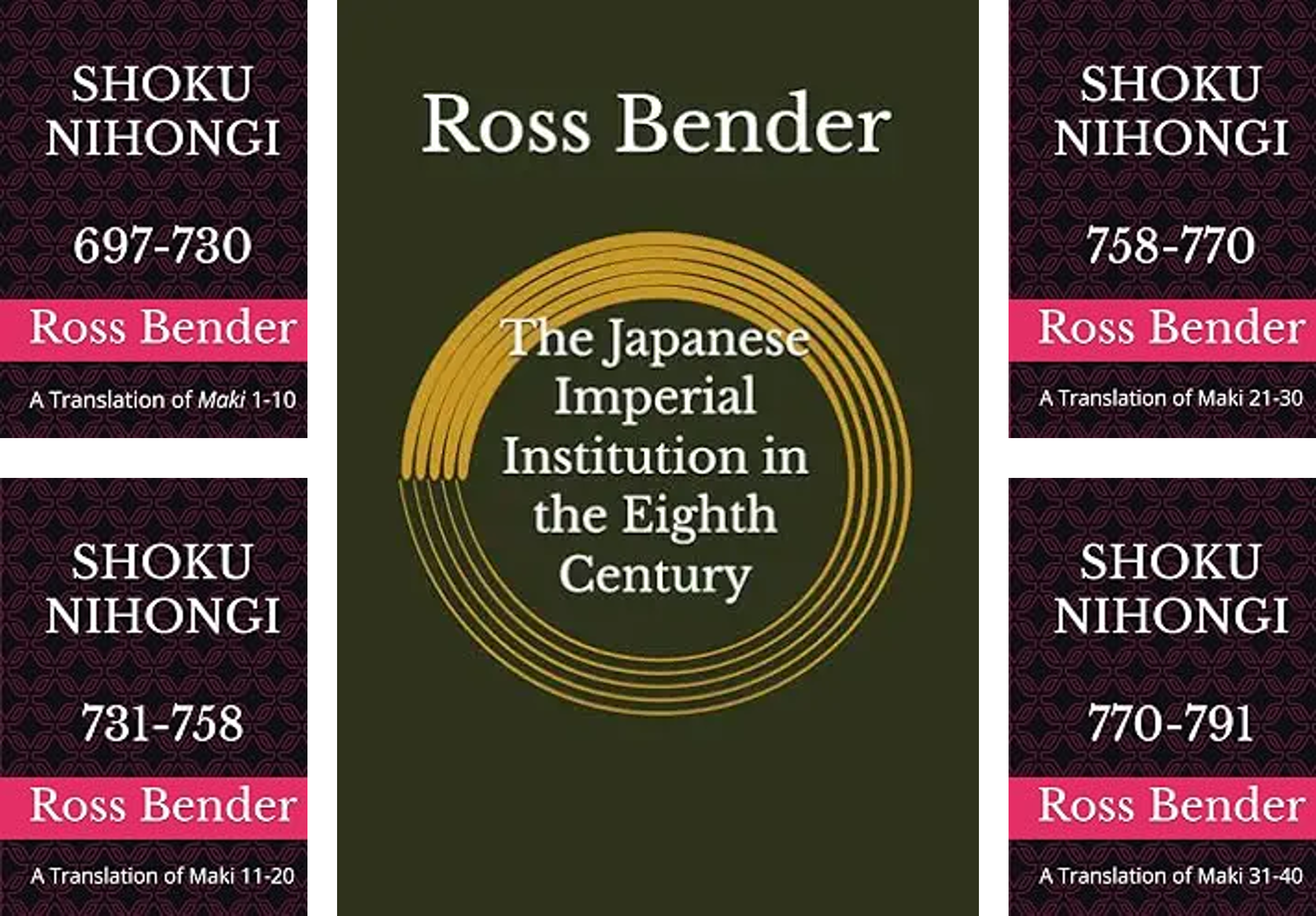
Yeah. So 20 years later, actually, I finished the translation 2025. And then this year in the spring, I did what I- is sort of considered the capstone, the volume: “The Japanese Imperial Institution in the Eighth Century.” That's available as an e-book and also paperback and hardcover. And so there I have about a 75 page overview of the eighth century and then the introductions, not the translations, but the introductions to each of the emperors throughout the period.
I'm very happy with that. And that sort of puts a cap on it. I should mention that that was in memory of Herschel Webb, another one of my great teachers at Columbia. He had done a book way back in 68 called “The Japanese Imperial Institution in the Tokugawa Era”. And so this is sort of an homage to his memory.
J: And we very much thank you for it.
I remember when that came out, and we definitely snapped it up as soon as we saw it.
R: Well, great.
J: [Laughter]
R: Yeah. And you know, it's all available on Amazon. So let me let me make my plug.
J: Absolutely. Absolutely. You mentioned something about the Nihon Kōki. Are you are you serious about taking this project on and moving forward, or is that just kind of something you're toying with?
R: Well, no, I'm actually I've actually made a start. That's an immense document. And what I'm interested in is finishing the reign of Emperor Kanmu. He dies in 806. And so Nihon Kōki begins in 792, and I’m currently up to 799. But I'm not putting as much energy into it. I do maybe an hour a day if I feel like it, but it's slow going.
But there's some really fascinating stuff. So Wake no Kiyomaro died in 799, and they've inserted this immensely long biography of his life at this point, although it was obviously produced later and it's set apart. But that has details of his miraculous trip to the Usa shrine. And, you know, it's not clear if somebody cut his tendons, but he was lame and so he was on his way to Kyūshū, and suddenly a pack of wild boars appeared and sort of escorted him down to the shrine.
It is just a really wonderful story. Then he has a vision of Hachiman, which is not part of the Shoku Nihongi tale. Yeah, I'm trucking along. My ambition is at least to finish the reign of Emperor Kanmu, and then we'll see what time there is beyond that.
J: So do you have any recommendations for current students of Japanese history? Those coming up?
R: Actually, there are some young scholars. I was at the Association for Asian Studies meeting in Columbus, Ohio, which was, I guess, yeah, 2025. And for some reason there were a good number of presentations on eighth and ninth century. So there's a scholar by the name of Nadia Kanagawa. She finished a dissertation at USC on immigrants in the eighth century.
Then Abigail McBain finished up at Columbia, and her dissertation was on specifically Tang Buddhist monks and interchange with Japan. Yeah, so there are some young scholars who are digging in to this. You know, I was just looking the other day at Wikipedia, which is a good start for anyone. I would say, you know, take it with a grain of salt.
But if you want to know the names of the, you know, the famous emperors and the rebels, you know, Tachibana no Naramaro, and Fujiwara no Nakamaro. And just, just the other day I found this amazing thing called ‘Grokipedia’, which apparently is a new. But it's one of those AI things. Yeah, but it had the best summary of the Shoku Nihongi that I've seen.
So with the AI revolution, goodness knows what's going to happen. But yeah, I find that it's possible to dip in and a lot of things are available. For example, the Rikkokushi text is online, it's been online, and it was first published by Asahi Shimbun way back when. But I used that and then that the Oxford project that I mentioned is online -- more and more it's becoming possible to access, you know, original documents.
J: Yeah, combination of making them available online, better online translations.
R: Machine translation is going great guns. Yeah-
J: Yeah. Although I have to admit, it can get you a sense of what the classical Chinese is kind of saying sometimes, but the translation for some of the old stuff just it still has some work to do. I think it's better if you can translate the at least the modern Japanese translation, rather than sometimes going back into this.
It's still tricky.
R: Yeah, well, it's I admit I'm getting old, but this this stuff is getting kind of frightening. This machine translation...
J: It is, yeah.
R: I feel like I’d be out of the job if I had a job.
J: Well, I think there's still a lot of questions to be asked on that. I don't think we need to get into a whole thing on AI right now, but I think there's some great benefits, obviously.
And then, you know, I definitely know there's some concerns too, because every once in a while it can just hallucinate an answer. And you might be going through things that seem absolutely wonderful and then find something that you're like, wait a minute, I never knew that. [laughter]
R: And then it turns out not to be true.
J: Yeah, I don't know if you heard there was one, and I mean, this was a year ago, which already seems, in AI terms, ages and ages, but apparently it hallucinated entire papers and authors.
R: Yes, that's there was I don't know if you follow the PMJS list.
J: Oh yeah.
R: But I think there was a discussion and an example of that. So it's-
J. But the world is going to be different.
J: Things are changing. And I think we will figure out how to use the tools that are useful will hopefully win out. And there's always going to be certain things. For instance, I remember early days, Wikipedia and still, you know, looking at Wikipedia sometimes for certain things around more popular subjects got to be a little more wary, though I have found the Japanese Wikipedia has been great when you're just trying to look for something and go, let me at least get what a common sense of this is so that I know the other things to go research.
R: Well, I was going to say, just to sort of sum up, yeah, we're in a very dynamic time, but the eighth century was very similar because the new technologies were pouring in from the continent and the peninsula, and people were learning these new methods of reading and writing and orality to literacy.
J: So any last thoughts? I do appreciate all your time. But any last thoughts as we finish up here?
R: Not really, but I noticed that yesterday you came up with a long spiel on the UNESCO World Heritage site, and that's exciting. The Asuka region you seem to have links to photographs that took me back to wandering around that area. The Ishibutai, I remember, was something. So party on and keep up the good work.
J: Thank you very much and thank you again. Thank you for your time today, and thank you for all the work that you've put into this. You have made these sources so much more accessible for people in English, and I think that is going to be critical as we move forward. I know for me this is a huge help.
I was looking at Shoku Nihongi going, okay, I know we've got like the first so many years so I can get through that and then I'm really going to have to up my game. Then I saw all the work that you'd been doing and it was like a big load felt lifted off of my back. Now I can, you know, take a look.
But at least with the idea that someone more experience than I has already done some of the really hard labor. I really want to say thank you for all of that.
R: Yeah, you're very welcome.
J: And once again, I would like to say thank you to Doctor Bender and thank all of you for listening. If you think that this is something you would like to see more of, please let us know.
We'll see what we can do. Perhaps we can make it the start of a new interview series. In the meantime, next episodes we get back to our regularly scheduled program. And as always, if you like what we are doing, please tell your friends and feel free to rate us wherever you listen to podcasts. If you feel the need to do more and want to help us keep this thing going, we do have information about how you can donate on Patreon, where we have early and add free episodes for you to listen to.
You can also donate through our Ko-Fi or BuyMeACoffee Sites. Just look up SengokuDaimyo for all of that. You can also find the links over to our main website, SengokuDaimyo.com, where we will also have more discussion on topics from this episode. Finally, feel free to reach out to our Sengoku Daimyo Facebook page. You can also email us at the.Sengoku.Daimyo@gmail.com.
Thank you also to Ellen for their work editing the podcast. And that's all for now. Thank you again and I'll see you next episode on Sengoku Daimyo’s Chronicles of Japan.
References
Simpson, Emily, (2026). “ The Depraved Empress: Sexuality and Womanhood in the Demonization of Empress Shōtoku”. Handbook of Women in Japanese Buddhism. United Kingdom: Routledge. ISBN - 9781041279037
Bender, Ross L. (2026). Emperors Monmu, Genmei, Genshō: Shoku Nihongi 697-724.
Bender, Ross L. (2026). The Japanese Imperial Institution in the Eighth Century. ISBN 979-8249752026
Bender, Ross L. (2025). SHOKU NIHONGI 697-791: A Translation of Maki 1-40.
Bentley, John R. (2025). Nihon Shoki: The Chronicles of Japan. ISBN 979-8-218634-67-4 pb
Farris, W. W. (2020). Heavenly Warriors: The Evolution of Japan’s Military, 500–1300. Netherlands: Brill. ISBN 9781684172979
Bender, Ross L. (2015). The Edicts of the Last Empress, 749-770: A Translation from Shoku Nihongi. ISBN 978-1500896027.
Bender, Ross L. (2009). “Performative Loci of the Imperial Edicts in Nara Japan, 749-70”. Oral Tradition, 24/1 (2009): 249-268. https://journal.oraltradition.org/wp-content/uploads/files/articles/24i/11_24.1.pdf
Farris, W. W. (1995). Heavenly Warriors: The Evolution of Japan’s Military, 500–1300 (1st ed., Vol. 157). Harvard University Asia Center. https://doi.org/10.2307/j.ctt1tfjbcf
Friday, K. F. (1992). Hired Swords: The Rise of Private Warrior Power in Early Japan. United States: Stanford University Press. ISBN 9780804726962
青木, 和夫 (ed). (1989). 続日本紀 全5巻セット. 岩波書店. ISBN 9784002004082.
Bender, Ross (1979). "The Hachiman Cult and the Dōkyō Incident". Monumenta Nipponica. 32 (2): 125–153. doi:10.2307/2384320. JSTOR 2384320.
Bender, R. (1978). “Metamorphosis of a Deity. The Image of Hachiman in Yumi Yawata”. Monumenta Nipponica, 33(2), 165–178. https://doi.org/10.2307/2384124
Aston, W. G. (1972). Nihongi, chronicles of Japan from the earliest times to A.D. 697. London: Allen & Unwin. ISBN 0-80480984-4.