• Home
    • Table of Contents
    • Introduction
    • 1. History of Armor
    • 2. Armour Parts
    • 3. Before Beginning
    • 4. The Kozane
    • 5. The Odoshi
    • 6. The Dō
    • 7. Making a Dō
    • 8. The Kabuto
    • 9. Making a Kabuto
    • 10. The Men Yoroi
    • 11. The Kote
    • 12. The Sode
    • 13. The Haidate
    • 14. The Suneate
    • 15. Misc. Armour
    • 16. Underneath It All
    • 17. Putting It On
    • 18. Chests and Stands
    • 19. Glossary
    • Bibliography
    • Introduction
    • Men's Garments
    • Men's Outfits
    • Men's Accessories
    • Men's Headgear
    • Women's Garments
    • Women's Outfits
    • Garment Construction
    • Fabric Colors
    • Kasane no Irome
    • Table of Contents
    • Introduction
    • About the Text
    • 1 - Fish of the Sea
    • 2- Shore Grass
    • 3 - Fish of the River
    • 4 - Birds
    • 5 - Beasts
    • 6 - Mushrooms
    • 7 - Vegetables
    • 8 - Dashi, Namare, Irizake
    • 9 - Broths (Shiru)
    • 10 - Namasu
    • 11 - Sashimi
    • 12 - Simmered Dishes
    • 13 - Grilled Food
    • 14 - Clear Broths
    • 15 - Savory Sakes
    • 16 - Snacks with Sake
    • 17 - Noodles, Etc.
    • 18 - Sweets
    • 19 - Teas
    • 20 - Misc. Advice
    • Introduction
    • A Brief History of Japan
    • Japanese in the SCA
    • Japanese Names
    • Modes of Address
    • Japanese Heraldry
    • Banners & Flags
    • Etiquette
    • Courts
    • The "Ninja" Thing
    • Calendar and Time
    • Poetry
    • Kai-awase
    • Card Games
    • Go
    • Shōgi
    • Sugoroku
    • Kemari
    • Japanese Campsites
    • Camp Curtains
    • Tents
    • Camp Furniture
    • Tate
    • Tatami
    • Dress & Accessories
    • Swords
    • Inrō
    • Dining
    • Books
    • Heian Estates
    • Forced Affection
    •  Divination, Astrology, and Magic in Ancient China and Japan
    • Introduction
    • Speaking Issues
    • Vocabulary Problems
    • Orthography
    • Stem Elements
    • Adjectives
    • Verbs
    • Paradigm Chart (PDF)
    • Copulas
    • Useful Particles
    • Expressing Concepts
    • Bibliography
  • Podcast
    • Links
    • Anthony J. Bryant
    • Joshua L. Badgley
    • Ko-Fi
    • Patreon
    • Direct Donation
Menu

Sengoku Daimyo

Street Address
City, State, Zip
Phone Number
A resource for Japanese historical studies

Your Custom Text Here

Sengoku Daimyo

  • Home
  • Armor Manual
    • Table of Contents
    • Introduction
    • 1. History of Armor
    • 2. Armour Parts
    • 3. Before Beginning
    • 4. The Kozane
    • 5. The Odoshi
    • 6. The Dō
    • 7. Making a Dō
    • 8. The Kabuto
    • 9. Making a Kabuto
    • 10. The Men Yoroi
    • 11. The Kote
    • 12. The Sode
    • 13. The Haidate
    • 14. The Suneate
    • 15. Misc. Armour
    • 16. Underneath It All
    • 17. Putting It On
    • 18. Chests and Stands
    • 19. Glossary
    • Bibliography
  • Clothing and Accessories
    • Introduction
    • Men's Garments
    • Men's Outfits
    • Men's Accessories
    • Men's Headgear
    • Women's Garments
    • Women's Outfits
    • Garment Construction
    • Fabric Colors
    • Kasane no Irome
  • Ryōri Monogatari
    • Table of Contents
    • Introduction
    • About the Text
    • 1 - Fish of the Sea
    • 2- Shore Grass
    • 3 - Fish of the River
    • 4 - Birds
    • 5 - Beasts
    • 6 - Mushrooms
    • 7 - Vegetables
    • 8 - Dashi, Namare, Irizake
    • 9 - Broths (Shiru)
    • 10 - Namasu
    • 11 - Sashimi
    • 12 - Simmered Dishes
    • 13 - Grilled Food
    • 14 - Clear Broths
    • 15 - Savory Sakes
    • 16 - Snacks with Sake
    • 17 - Noodles, Etc.
    • 18 - Sweets
    • 19 - Teas
    • 20 - Misc. Advice
  • Miscellany
    • Introduction
    • A Brief History of Japan
    • Japanese in the SCA
    • Japanese Names
    • Modes of Address
    • Japanese Heraldry
    • Banners & Flags
    • Etiquette
    • Courts
    • The "Ninja" Thing
    • Calendar and Time
    • Poetry
    • Kai-awase
    • Card Games
    • Go
    • Shōgi
    • Sugoroku
    • Kemari
    • Japanese Campsites
    • Camp Curtains
    • Tents
    • Camp Furniture
    • Tate
    • Tatami
    • Dress & Accessories
    • Swords
    • Inrō
    • Dining
    • Books
  • Essays
    • Heian Estates
    • Forced Affection
    •  Divination, Astrology, and Magic in Ancient China and Japan
  • Classical Japanese
    • Introduction
    • Speaking Issues
    • Vocabulary Problems
    • Orthography
    • Stem Elements
    • Adjectives
    • Verbs
    • Paradigm Chart (PDF)
    • Copulas
    • Useful Particles
    • Expressing Concepts
    • Bibliography
  • Podcast
  • Other
    • Links
    • Anthony J. Bryant
    • Joshua L. Badgley
  • Support Us
    • Ko-Fi
    • Patreon
    • Direct Donation

Episode 120: Journey to the West, Part 1

February 16, 2025 Joshua Badgley

Niches at the ruins of the city of Gaochang that once held Buddhist images—you can still make out traces of the paint that would have decorated the niche and likely the rest of the walls and other areas at the time.

RSS
Previous Episodes
  • December 2025
  • November 2025
  • October 2025
  • September 2025
  • August 2025
  • July 2025
  • June 2025
  • May 2025
  • April 2025
  • March 2025
  • February 2025
  • January 2025
  • December 2024
  • November 2024
  • October 2024
  • September 2024
  • August 2024
  • July 2024
  • June 2024
  • May 2024
  • April 2024
  • March 2024
  • February 2024
  • January 2024
  • December 2023
  • November 2023
  • October 2023
  • September 2023
  • August 2023
  • July 2023
  • June 2023
  • May 2023
  • April 2023
  • March 2023
  • February 2023
  • January 2023
  • December 2022
  • November 2022
  • October 2022
  • September 2022
  • August 2022
  • July 2022
  • June 2022
  • May 2022
  • April 2022
  • March 2022
  • February 2022
  • January 2022
  • December 2021
  • November 2021
  • October 2021
  • September 2021
  • August 2021
  • July 2021
  • June 2021
  • May 2021
  • April 2021
  • March 2021
  • February 2021
  • January 2021
  • December 2020
  • November 2020
  • October 2020
  • September 2020
  • August 2020
  • July 2020
  • June 2020
  • May 2020
  • April 2020
  • March 2020
  • February 2020
  • January 2020
  • December 2019
  • November 2019
  • October 2019
  • September 2019
Archives
 

This episode starts our look at Xuanzang and his famous “Journey to the West”, where he traveled to India and back to Chang’an. Xuanzang, aka Tripitaka Master of the Law, ended up founding a new school of Buddhism—the Faxiang (or Hossō in Japanese) school of Yogacara Buddhism. Amongst his direct students were monks from the Japanese archipelago who brought back his teachings, which would become highly influential in the Nara and early Heian periods. One of the most famous was a monk named Dōshō who went on to teach at Gangōji, the successor to Asukadera in Nara. The records of his journey provide some of the best information of his journey.

This episode covers his departure from Chang’an and his travels out to the kingdom of Gaochang.

Chang’an and Xuanzang’s Departure

Map of Xuanzang’s journey, showing his departure and return routes. From the Shaanxi History Museum.

The "Great" Wall
The "Great" Wall

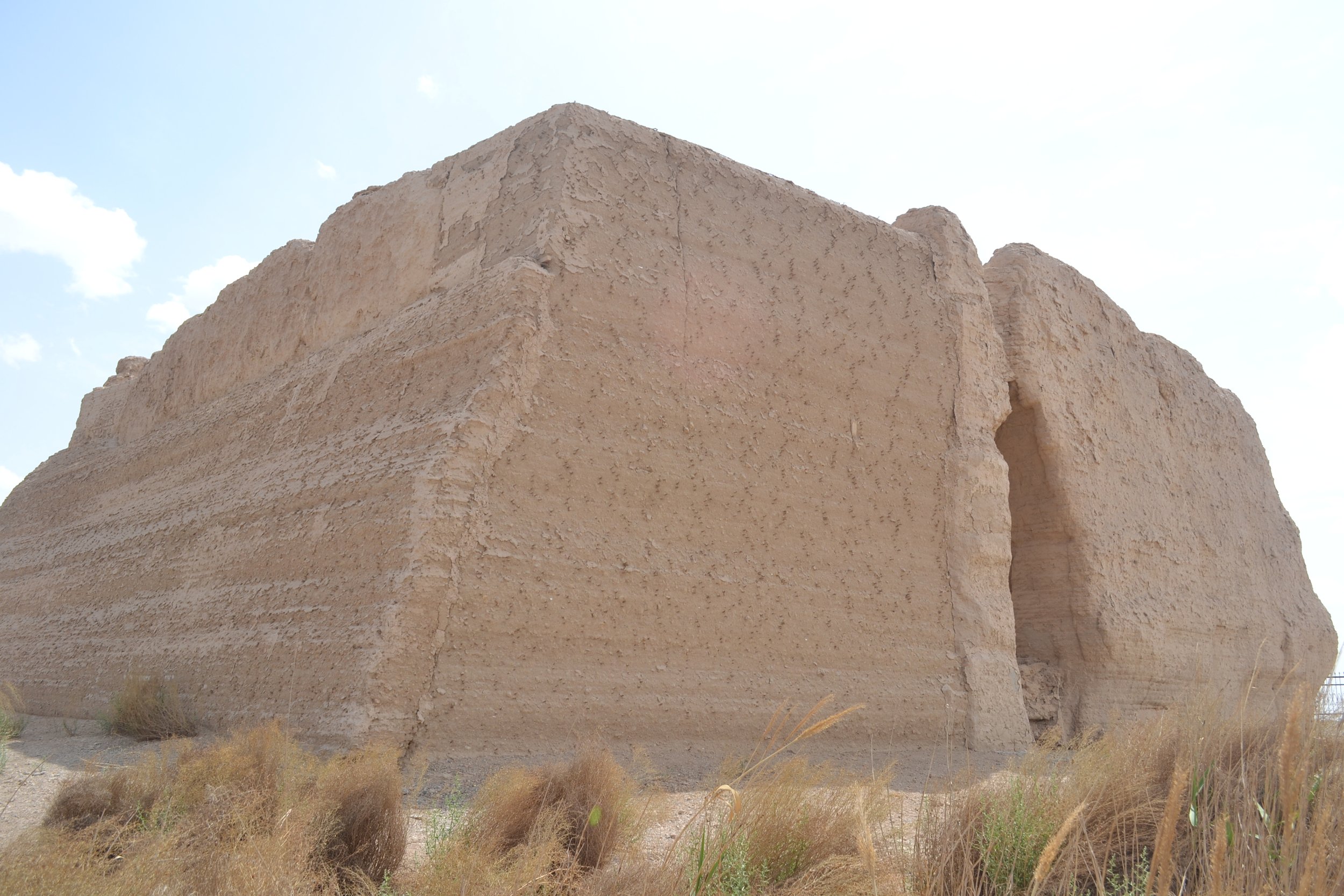
Remnants of the westernmost edge of the “Great Wall” that went back to at least the Han dynasty.

Beacon tower
Beacon tower

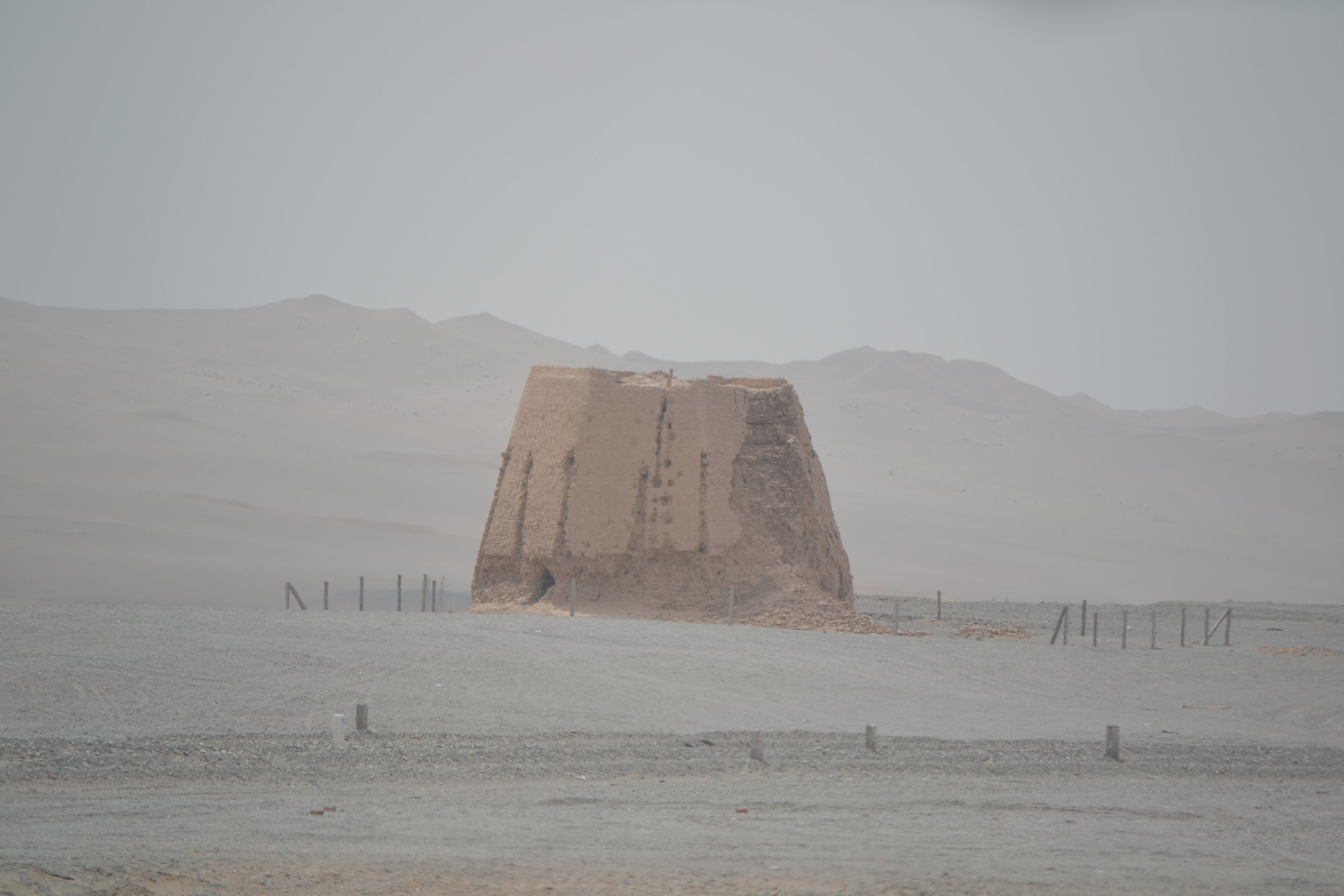
Remnants of a Tang Watchtower near Yumen pass

Yumen Pass
Yumen Pass

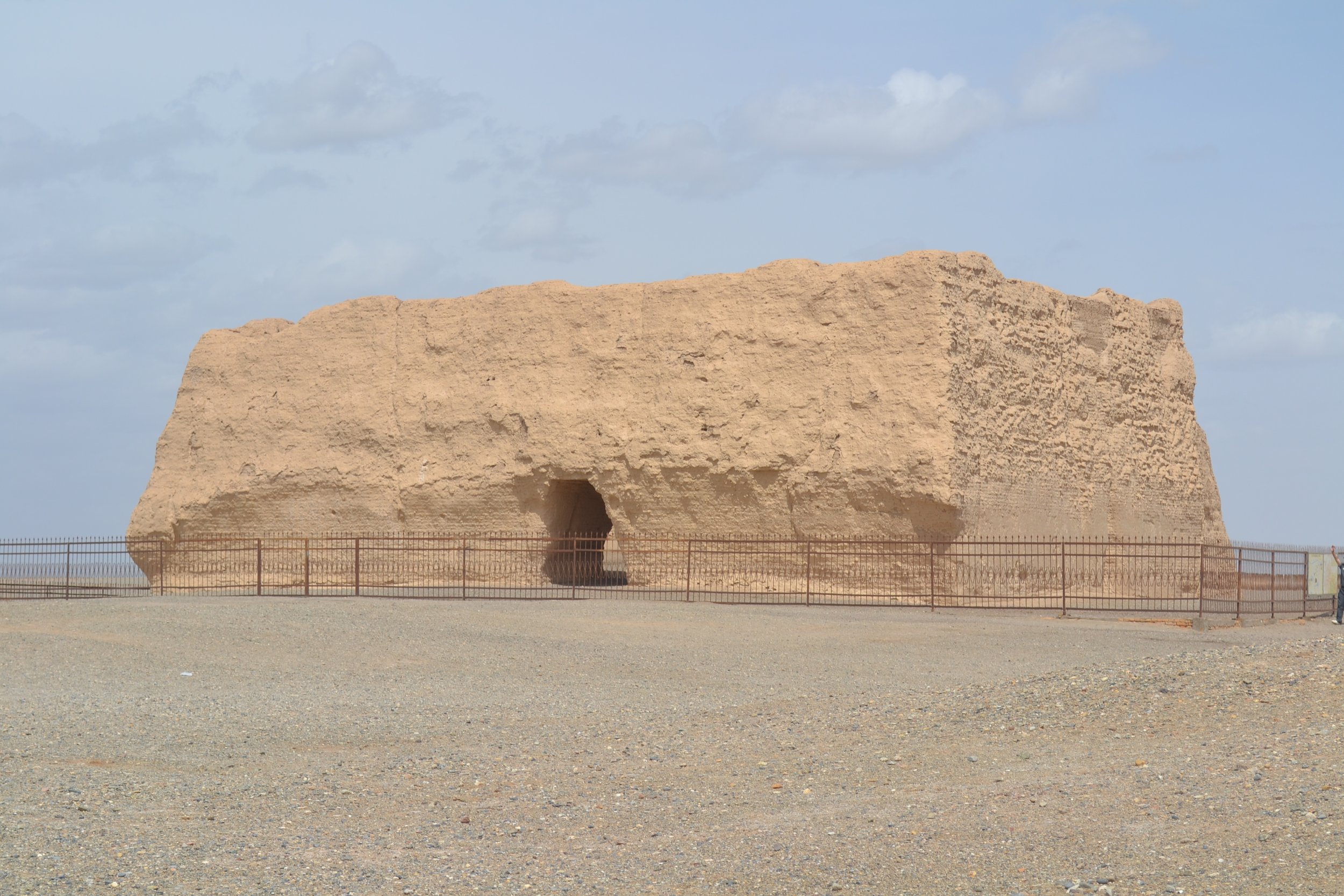
Yumen pass (Yumen Guan), the “Jade Gate”. This would have housed the garrison that checked travelers’ documents coming in and out of the empire.

Yumen Pass
Yumen Pass

Remains of the “Jade Gate”. Xuanzang and Vandak would have seen this off in the distance from the Hulu (now the Shule) river.

The "Great" Wall Beacon tower Yumen Pass Yumen Pass

Xuanzang initially tried to get permission from Tang Taizong to go, but the Emperor had other things to worry about, and never replied. He didn’t expressly forbid the venture, but by not providing his permission Xuanzang did not have a pass to get out of the country. That said, it wouldn’t stop him. He surreptitiously worked his way up to Liangzhou by going on a tour of Buddhist monasteries where he would preach, as though on pilgrimage. When challenged in Liangzhou, he was expressly forbidden from continuing, but did so anyway with the help of a sympathetic Buddhist monk.

With help, he hid from the officials and made his way to Guazhou, last stop before the Western Regions. He hesitated briefly, but when word came that he was to be arrested, he decided to go for it. He enlisted the help of a Sogdian man name Shi Pantuo, aka Vandak of Tashkent, who agreed to help him. With his guide’s help, he was able to get past the walls and guards at Yumenguan, but after that he was on his own.

Funerary Couch of An Jia

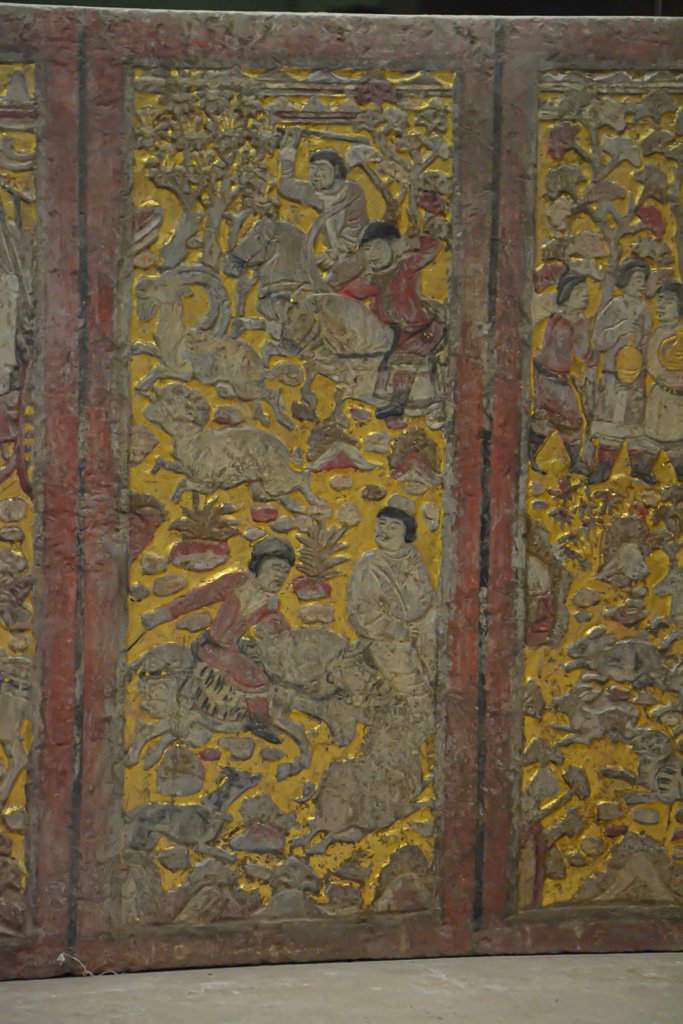
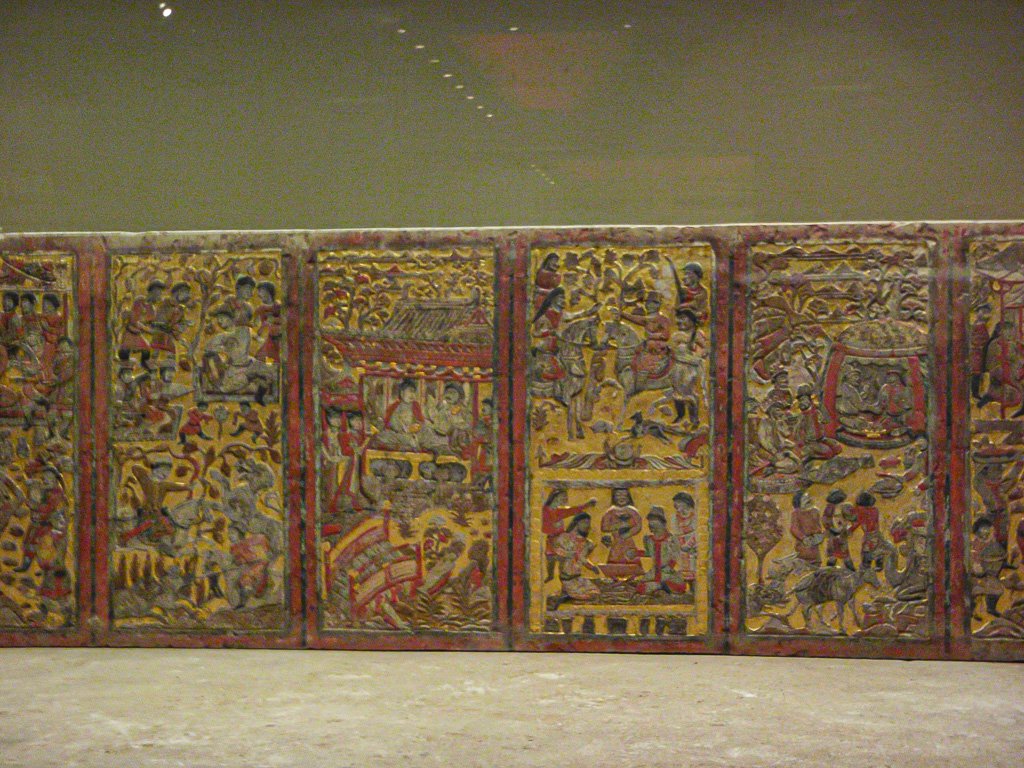
This scene depicts hunters in typical foreign dress—the caftan style with the round collar.

Funerary Couch of An Jia

Back of a funerary couch for An Jia, a Sogdian living in modern Xian who died in 579 CE. An Jia, though of Bukhara descent, himself came from Guzang, modern Wuwei. The scenes give us insight into the life of the Sogdians living in that region. From the Shaanxi History Museum.

Pearl Roundel
Pearl Roundel

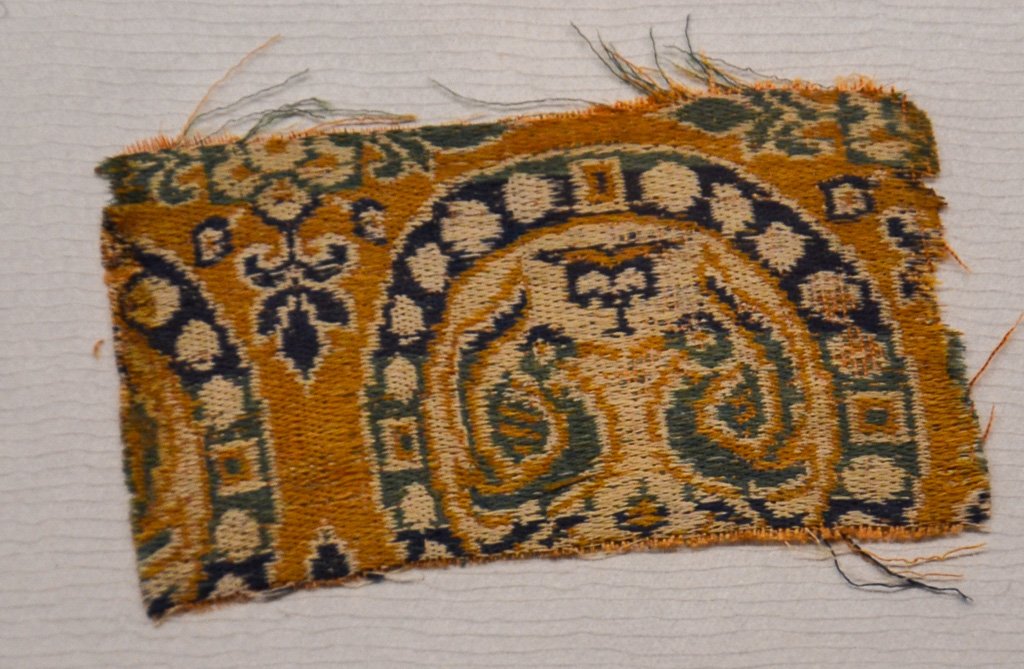
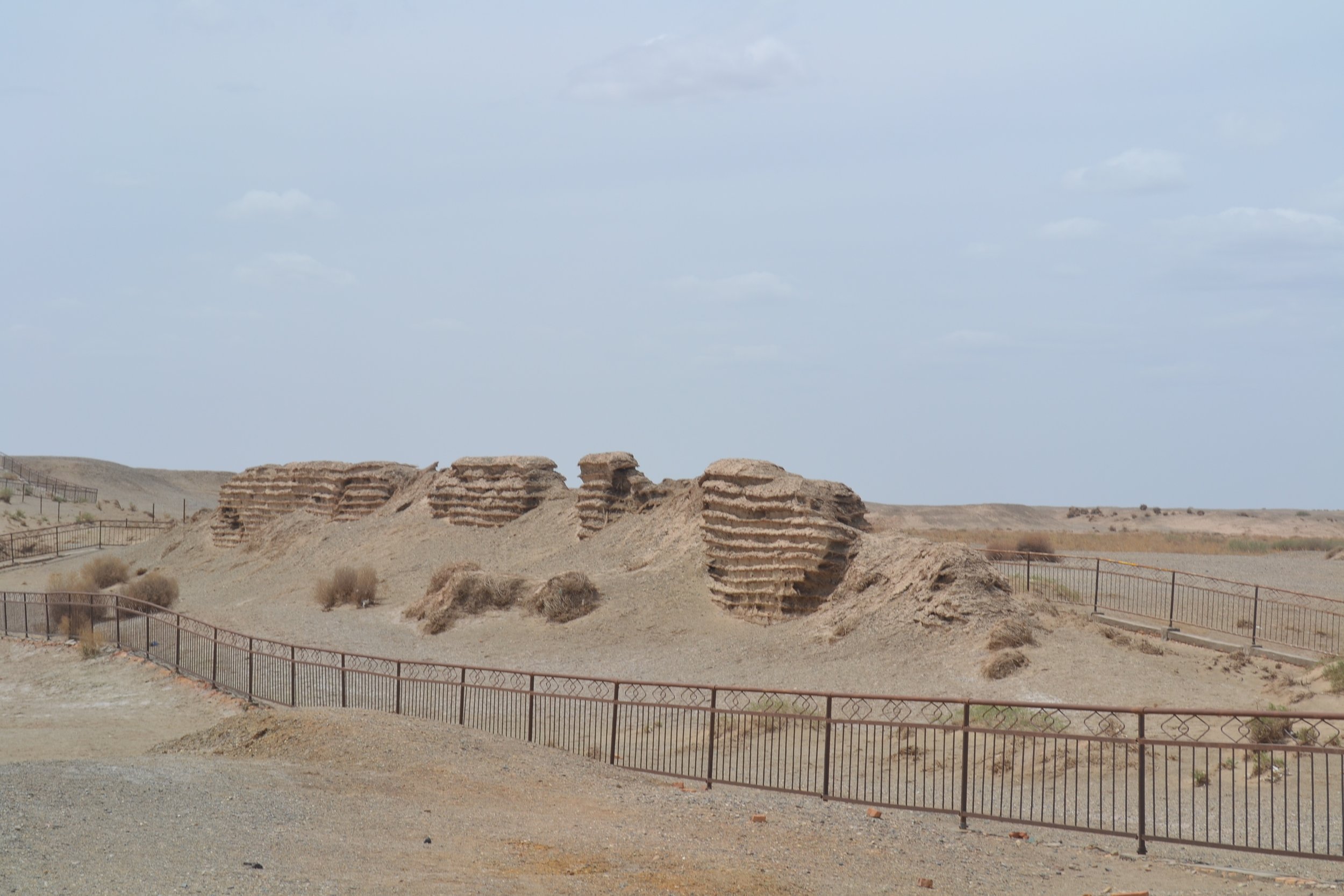
Example of the pearl roundel design that spread along the Silk Road and is often associated with Sogdian merchants. From the Shaanxi History Museum.
Pearl Roundel
Pearl Roundel

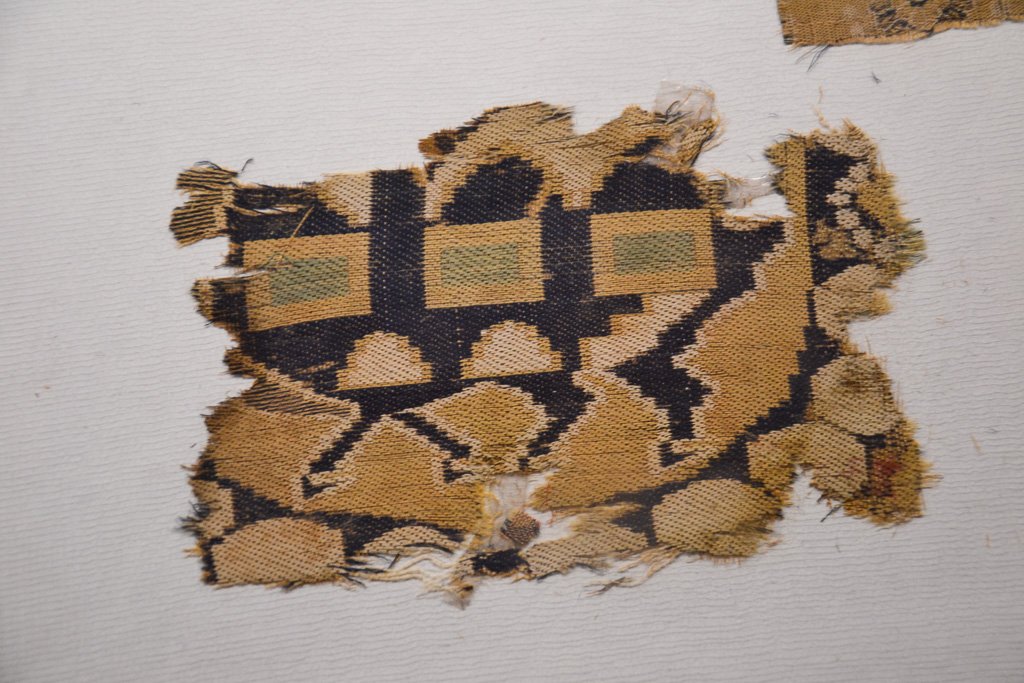
This scrap of silk still shows the distinct circle and pearls of the pearl roundel design. From the Shaanxi History Museum

Funerary Couch of An Jia Funerary Couch of An Jia Pearl Roundel Pearl Roundel

Sogdians

The Sogdians were traders and they spoke an Eastern Iranian language that became the default language of the Silk Road. If you read about a “Persian” person, it is probably a Sogdian unless it is indicated otherwise. Though they came from Transoxania, they lived in communities across the Silk Road—there may even have been Sogdians who visited the Japaense archipelago. Since Sinitic sources didn’t have the ability to adequately capture Sogdian names, they used a few different methods to indicate Sogdian origin. For one, they used a series of seven different “family” names depending on what city-state one claimed ancestry. Then they did their best to translate a person’s given name. Much of this has been further obscured by changes in the pronunciation of Sinitic characters over the ages and in different geographic regions.

Foreign fashion, including the pearl roundel designs that the Sogdians used on their caftans, were quite popular in Chang’an and elsewhere, and we have examples of the design and the caftans making their way all the way to Japan, with some examples in the Shōsōin in Nara.

There is evidence that over time Sogdians in the Tang empire would adapt to a more ethnic Han style of living, a pattern that others may have followed. In at least one tomb we see examples where the names become less Sogdian and more Han over time, suggesting their eventual adoption of the culture.

Aerial view
Aerial view

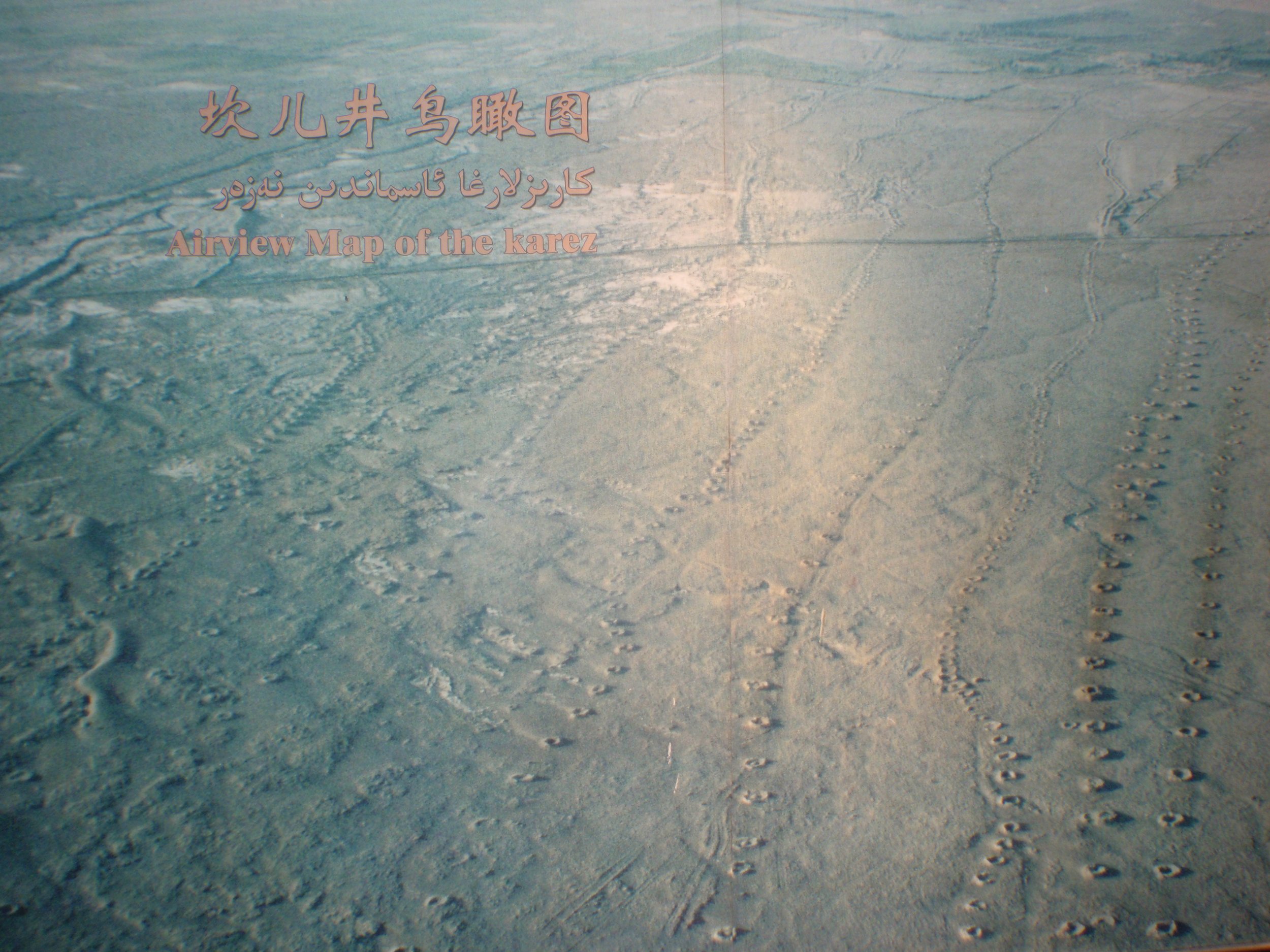
The tracks on the ground are wells dug along the line of the karez. Underneath, each line of wells is connected, to allow for water to be transported underground for miles without risking it evaporating in the hot sun. From a karez educational site in modern Turpan.

Karez well-head
Karez well-head

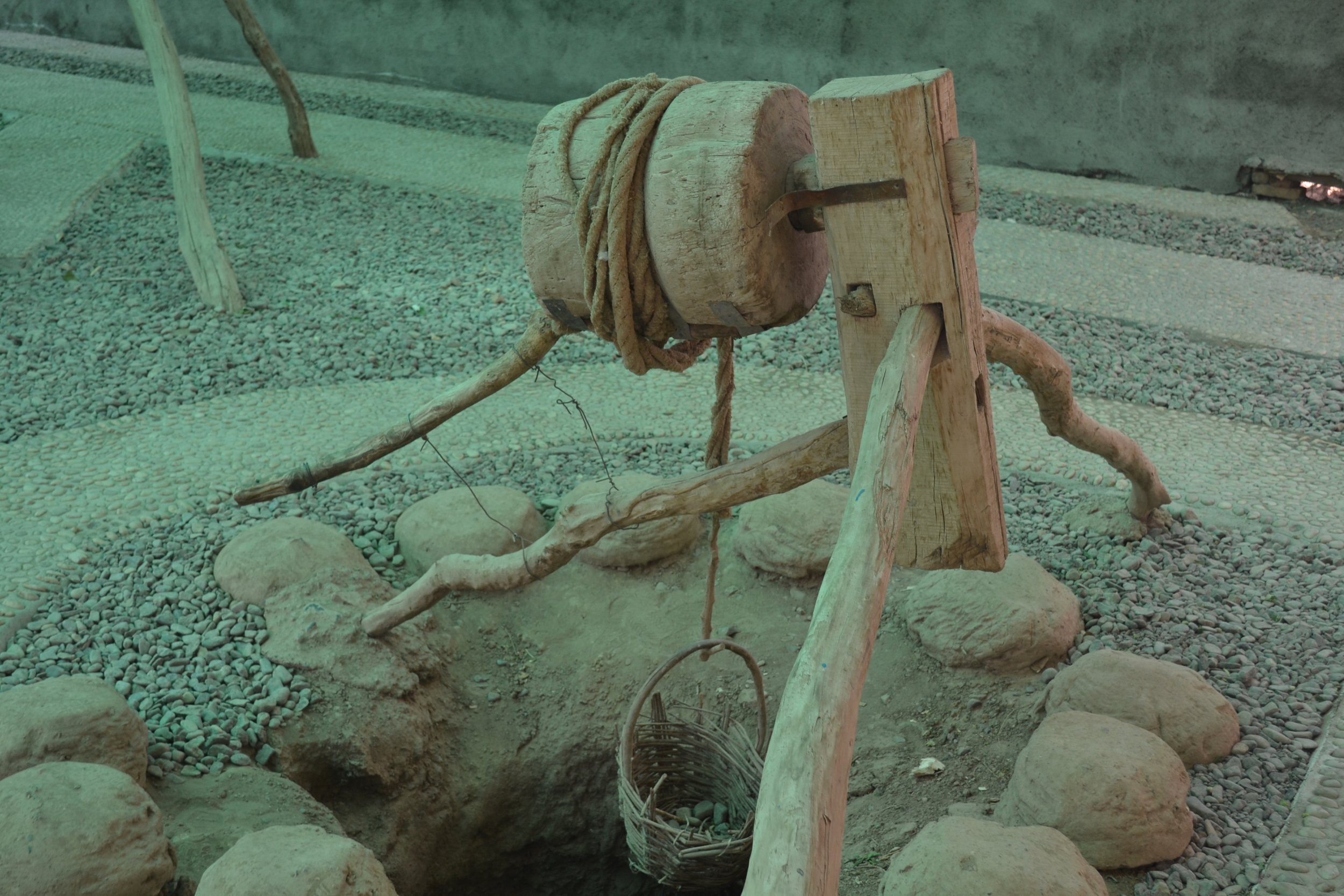
At the top of a karez well there may be something like this to lower down a basket to collect water from below.

Karez Interior
Karez Interior

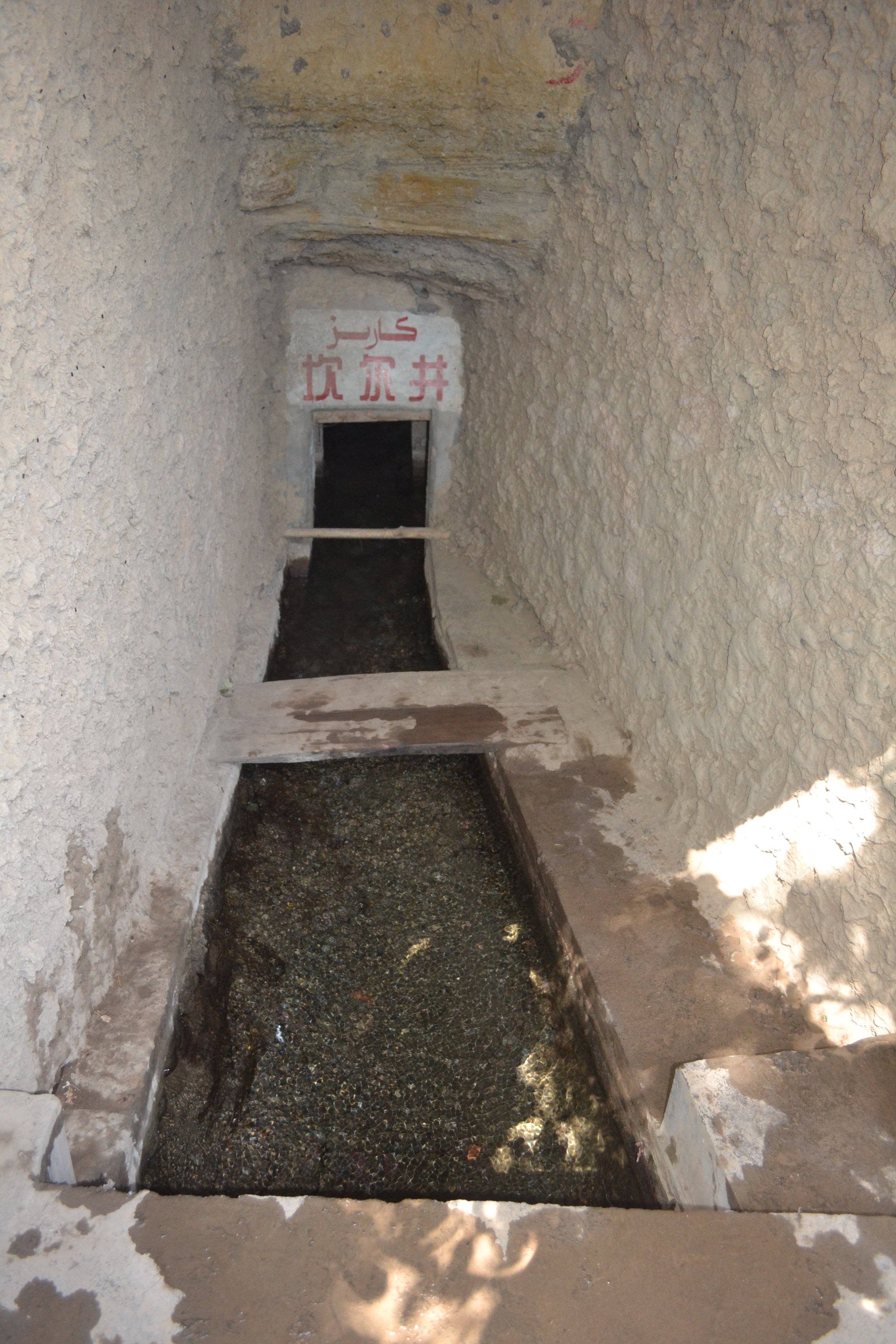
Inside the Karez, you can see how the walls are dug out and a channel of water flows through them from one wall to the next.

Aerial view Karez well-head Karez Interior

Yiwu, aka Hami

After passing through the desert beyond Yumenguan and the five Tang watchtowers, Xuanzang made it to Yiwu, also known as Hami. “Hami” melons are still well-regarded, and can often be found at Asian supermarkets in the US and elsewhere. Hami is on the edge of the Hami-Turpan basin, and a common method of irrigation for agriculture in this region is the Karez system. This probably originated in or near the area of modern Iran and was spread to various areas with arid conditions. Rather than relying on rivers or rain, the karez tap into groundwater near mountains or elsewhere—often miles away—and then transports the water to towns that need it for their crops. These underground aqueducts would provide cold water, even on hot days, and were often even more reliable than rivers or other such natural bodies, whose flows could fluctuate greatly.

Gaochang

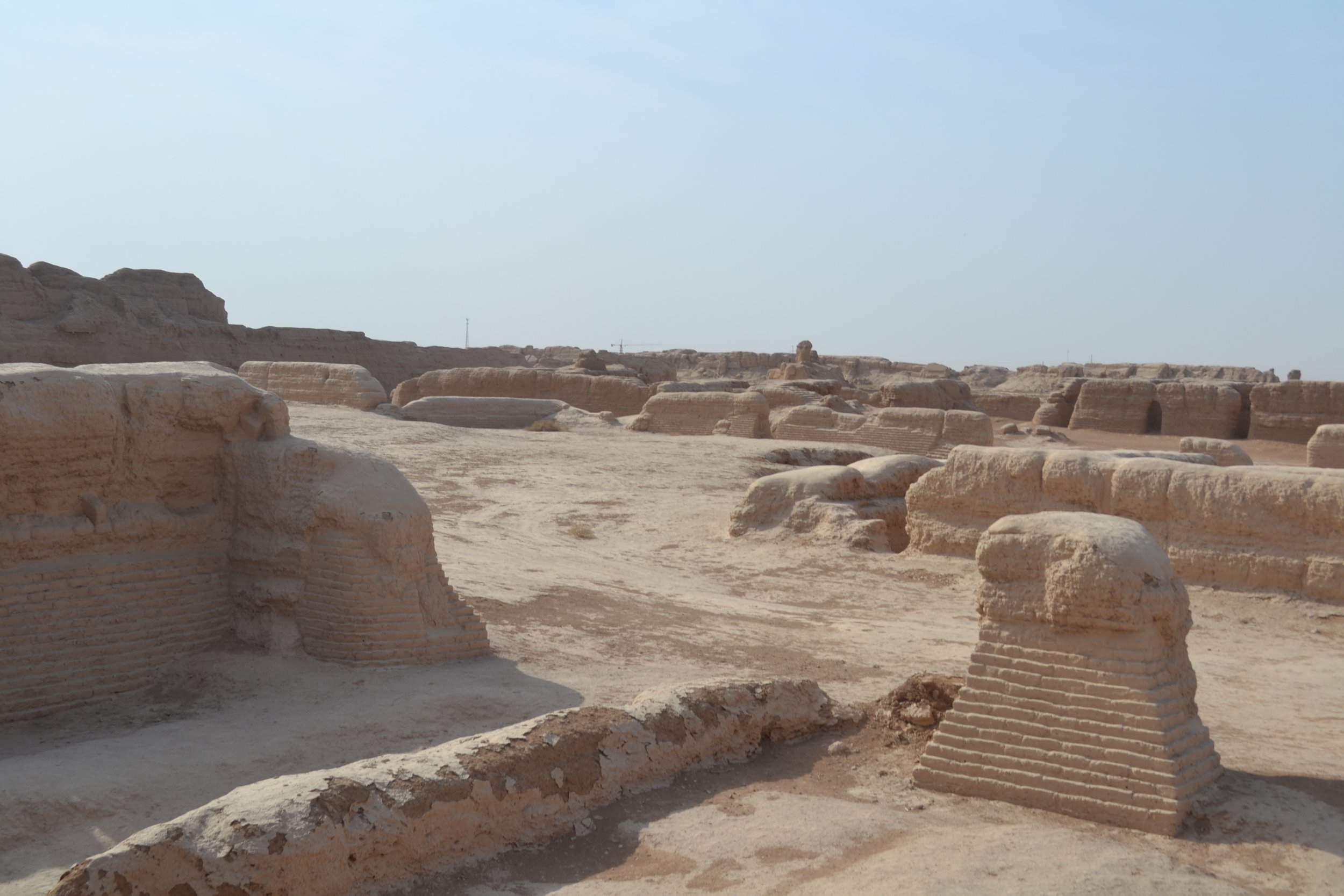
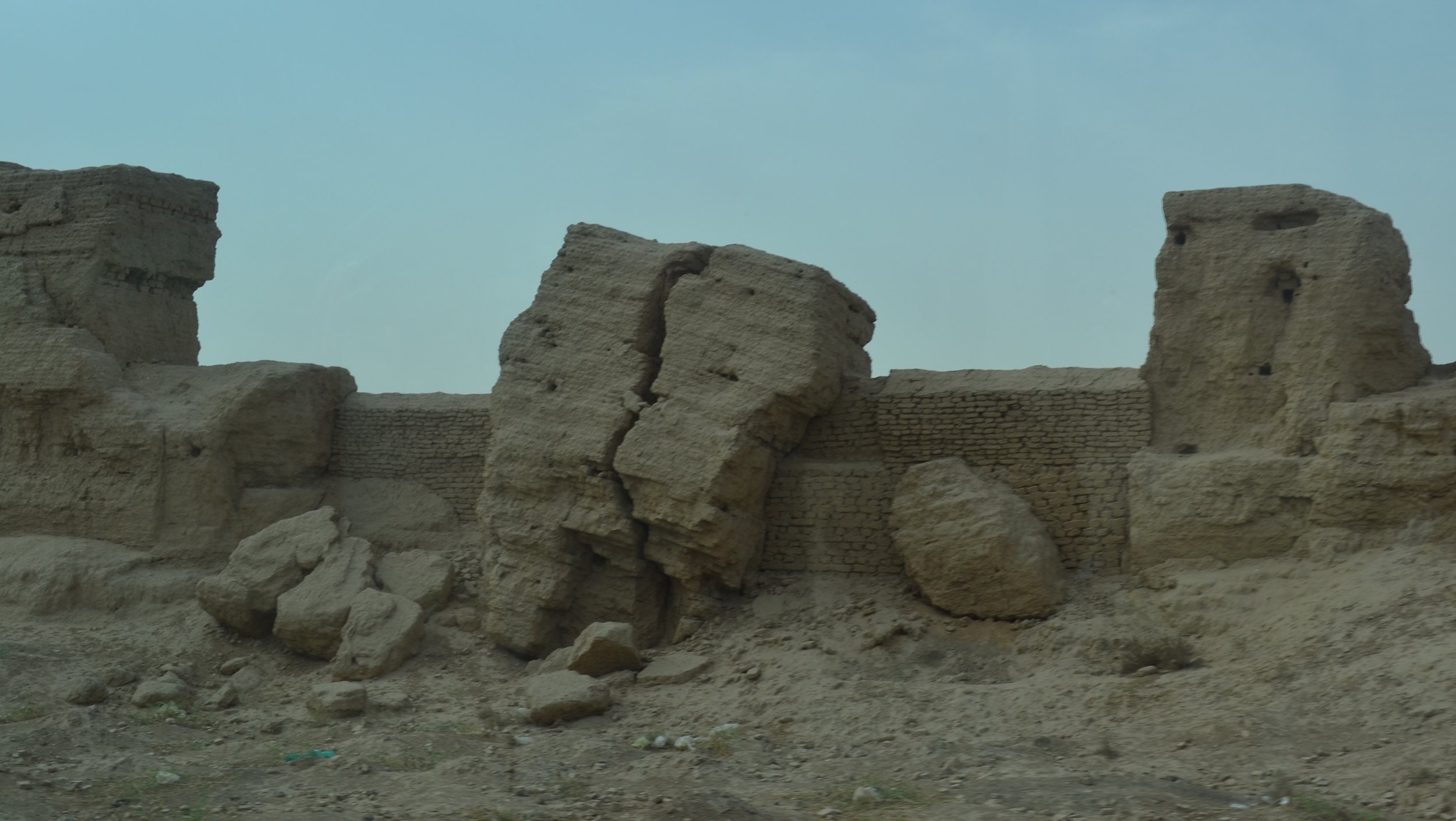
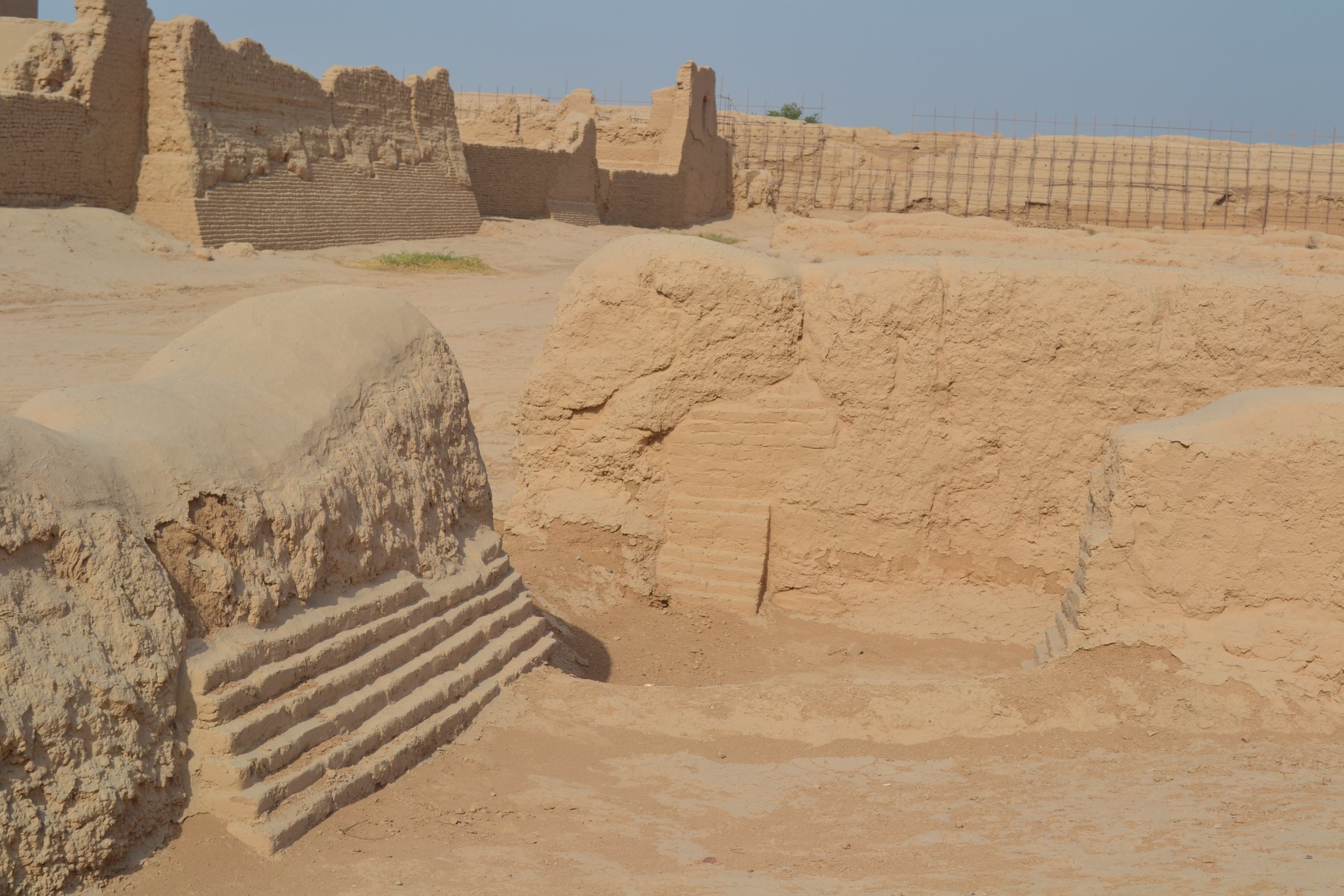
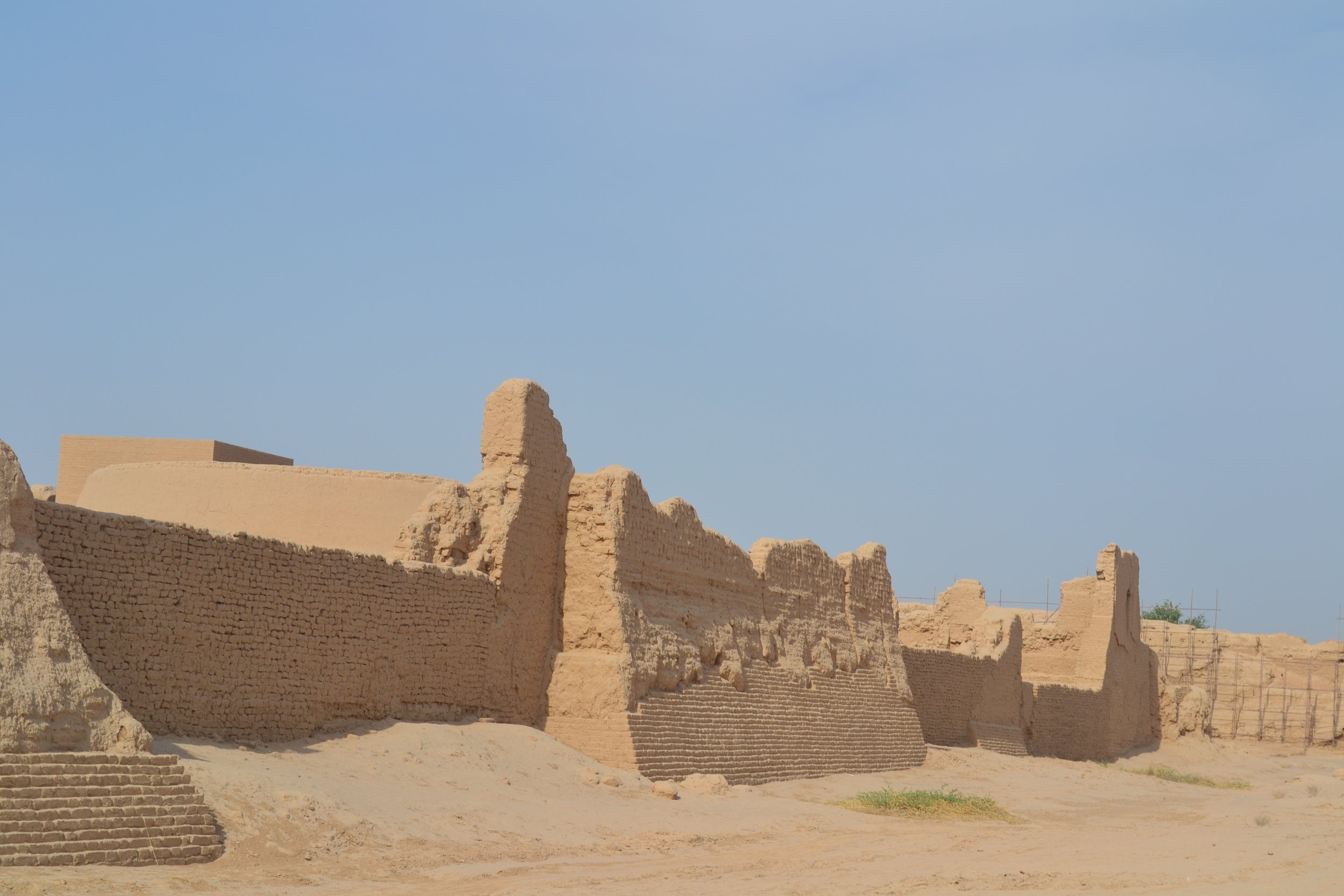
The “kingdom” of Gaochang included the city of that same name, as well as others in and around the Turpan basin. This is the royal city, where Qu Wentai ruled, and where Xuanzang stayed for a time. Today it is mostly ruins, but you can still go and see those ruins, which they are doing their best to preserve. The city had Buddhist temples, but also Zoroastrian and Manichean temples as well. Xuanzang focuses on the Buddhist influence, but these oases were fairly cosmopolitan. Gaochang would be conquered by the Tang empire by the time that Xuanzang returned, and as such gets only the barest of mention in his “Record of the Western Regions”. Fortunately, Xuanzang’s Biography has much more detail about his stay there, and the assistance he got from King Wentai.

Gaochang1.jpg
Gaochang2.jpg
Gaochang3.jpg
Gaochang4.jpg
Gaochang1.jpg Gaochang2.jpg Gaochang3.jpg Gaochang4.jpg
  • Welcome to Sengoku Daimyo’s Chronicles of Japan.  My name is Joshua, and this is Episode 120:  Journey to the West, Part 1

    The monks from far off Yamato were enthralled.  They had journeyed across the waves on a foreign vessel, traversed a greater distance than they probably thought possible growing up in the archipelago, and had finally arrived at the capital of the Great Tang Empire, Chang’an.  They had then been sent north, to a temple where they met others from Yamato.

    They had come to study the Law, the Dharma, with some of the most famous teachers of the Tang dynasty, and there were few more famous than the Tripitaka Master Genjou himself.   Everyone in the monastery knew his story—he had traveled all the way to India, the birthplace of the Buddha, and returned with copies of the sutras in Sanskrit, which he and the other monks were translating.

    In between sessions of meditation, sutra readings, and various lectures, the students would gather round the feet of the master as he recounted his journeys.  The stories themselves were fantastic stories, telling of far off cities and people.  There were stories of bandits, and meetings with kings.  The students must have thought about how it mirrored what they, themselves, had gone through—their own Journey to the West.

    Last episode we talked about Tukara and what that mysterious placename might mean—and where it could be referring to.  For that we traveled all the way to the end of the Silk Road.  In this episode and continuing into the next, we are going to travel that same road with a different perspective, as we take a look at one of the most famous travelers of the Silk Road:  the monk Xuanzang, or Genjou in Japanese.  And as I hinted at in the introduction, if you’re at all familiar with the famous Journey to the West, well, this and the following episodes will explore the actual history behind that story, and how intertwined it is with the history of the archipelago.

    For those who don’t know, Xuanzang was a monk, born Chen Hui near present-day Luoyang in Henan.  He is known by many names, but one of his most famous comes from the title “Sanzang Fashi”, aka “Tripitaka Master of the Law”, from which we get the simplified name in some English sources of just “Tripitaka”.  Sanzang, or “Tripitaka”, literally translates to “Three baskets” or “Three storehouses”, referring to the Buddhist canon.  It is quite fitting, given Xuanzang’s incredibly famous Journey to the Western Regions and, eventually, to India, where he journeyed to obtain the most accurate version of the Buddhist scriptures to ensure that they had the most accurate versions.  On his journey, Xuanzang apparently took detailed records of the trip, and his   “Records of the Western Regions”  provides a lot of what we know of the towns and cultures that existed there back in the 7th century – even if not all of it was experienced firsthand and  may have come through translators and second or third-hand sources. In addition, Xuanzang’s biography and travelogue add a lot more information to his journey, even if they weren’t necessarily written by him, but instead by his fellow monks based on his recitations to them  combined with various records that they had access to at the time.  As such, it isn’t always the most reliable, but it is still highly detailed and informative. 

    Xuanzang would return to China and teach for many years, translating the works that he had brought back, and founding a new school of Yogachara Buddhism, known as Faxiang in Chinese, but “Hossou” in Japan.  The Hossou school was particularly popular in the 8th and 9th centuries, having been transmitted by Yamato students who had actually studied at the feet of the venerable teacher.  These included the monk Doushou, who travelled over to the continent in 653.  In 658, there are two others who came over, named Chitatsu and Chiitsu. They had travelled to the Tang court in the 7th month of that year, where they are said to have received instruction from none other than Xuanzang himself.  If this indeed was in 658, it would have been only 6 years before Xuanzang’s death.

    Their journey had almost not happened.  The year previous, in 657, envoys were sent to Silla to ask that state to escort Chitatsu to the Tang court, along with Hashibito no Muraji no Mimumaya and Yozami no Muraji no Wakugo, but Silla refused.  They must have relented, however, as they apparently were escorting at least the monks a year or so later.

    Chitatsu and Chiitsu would eventually return to Yamato, as would Doushou.  Doushou is also said to have been introduced to a student of the second patriarch of the Chan, or Zen school as well.  He would return to teach at Gango-ji, the later incarnation of Asukadera, spreading the Hossou teachings from master Xuanzang.

    In fact, Xuanzang’s impact would be felt across Asia, and much of the Buddhist world.  He would continue to be known in Japan and in the area of China, Korea, and beyond.  Japanese translations of his journeys were made between the 8th and 10th centuries from texts that had come from Xuanzang’s own monastery.

    Nine centuries after his death, during the Ming Dynasty, Xuanzang would be further immortalized in a wildly popular novel:  Journey to the West. 

    The “Journey to the West” is an incredibly fantastical retelling of Xuanzang’s story.  In it, Xuanzang is sent on his task by none other than the Buddha himself, who also provides three flawed traveling companions.  There is  Zhu Bajie, aka “Piggy”—a half human half pig who is known for his gluttony and lust.  Then there is Sha Wujing, aka “Sandy”—a man with a red beard and blue skin who lived in a river of quicksand.  Despite a rather frightful backstory, he was often the straight man in the story.  And then there is the famous Sun Wukong, aka “Monkey”, the most famous of the three and often more famous than Xuanzang himself.  In fact, one of the most famous English versions of the story is just called “Monkey”, an abridged telling of the story in English by Arthur Waley in 1942.

    “Journey to the West” is perhaps the most popular novel in all of Asia.  It has spawned countless retellings, including numerous movies and tv series.  The character of “Monkey” has further spun off into all sorts of media.  Of course, his addition was all part of the novel, but nonetheless, that novel had an historical basis, which is where we really want to explore.  Because for all of the magic and fantasy of the Ming novel, the real story is almost as fascinating without it.

    We are told that Xuanzang was born as Chen Hui—or possibly Chen Yi—on the 6th of April in 602 CE in Chenliu, near present-day Luoyang.  Growing up, he was fascinated by religious books.  He joined the Jingtu monastery and at the age of thirteen he was ordained as a novice monk.  However, he lived in rather “interesting times”, and as the Sui dynasty fell, he fled the chaos to Chengdu, in Sichuan, where he was fully ordained by the age of 20.

    Xuanzang was inspired reading about the 4th century monk Faxian, whom we mentioned back in Episode 84.  Faxian had visited India and brought back many of the earliest scriptures to be widely translated into Chinese.    However, Xuanzang was concerned, as Faxian had been, that the knowledge of the Chinese Buddhist establishment was still incomplete.  There were still works that they knew about but didn’t have, and there were competing Buddhist theories in different translations of the texts.  He thought that if he could go find untranslated versions of the texts then he could resolve some of the issues and further build out the corpus of Buddhist knowledge.

    Around the age 25 or 27, he began his journey.  The exact date is either 627 or 629, based on the version that one reads.  That has some importance for the events that his story tells, as some of the individuals whom he is said to have met are said to have died by 627 CE, meaning that either the dates of the journey are wrong or the dates we have in other sources are wrong.  As you can imagine, that’s rather important for an accurate history, but not so much for our purposes, as I think that we can still trust the broad brush strokes which paint an image of what the Silk Road was like at the time.

    For context, back in Yamato, this was around the time that Kashikiya Hime—aka Suiko Tenno—passed away, and Prince Tamura was placed on the throne, passing over Prince Yamashiro no Oe, the son of the late Crown Prince, Umayado, aka Shotoku Taishi.  Whoever was on the throne, Soga no Emishi was actually running things, and the Soga family were heavily involved in the establishment of Buddhism in the archipelago.  This is relatively around the time of Episode 103.

    When Xuanzang took off to the West, his intentions may have been pure, but truth be told, he was breaking the law.  Tang Taizong had come to power in 626, and the routes along the Tarim Basin were under the control of the Gokturks, whom the Tang were fighting with.  As such, travel to the Western Regions was strictly controlled.  Xuanzang and several companions had all petitioned Emperor Taizong for permission to leave, but the Emperor never replied. So Xuanzang did not have permission to leave—but he decided to head out, anyway.  His companions, however, lost their nerve, and so he set out alone.

    Of course, he didn’t simply set off for the West.  At first he went city to city, staying at local Buddhist monasteries and sharing his teachings.  To all intents and purposes, this probably seemed like normal behavior for a monk, traveling from monastery to monastery, but it was actually taking him towards the western border.

    And it was going well until he reached Liangzhou—known today as Wuwei.  Li Daliang, governor of Liangzhou, enforced the prohibition that "common" people were not permitted to go to the regions of the western tribes.  Word had spread about Xuanzang, and when the governor caught wind of what was going on, he called Xuanzang into an audience to find out what he was planning to do.  Xuanzang was honest and told him he was going to the West to search for the Dharma, but the governor ordered him to return to Chang'an instead.

    Fortunately, there was a Buddhist teacher, Huiwei, who heard about all of this this and decided to help Xuanzang.  He had two of his own disciples escort Xuanzang to the west.  Since the governor had told him not to go, this was illegal, and so they traveled by night and hid during the day until they reached Guazhou.

    In Guazhou, the governor, Dugu Da, was quite pleased to meet with Xuanzang, and either hadn’t heard about the order for him to return to Chang’an or didn’t care.  From there, Xuanzang’s path was largely obstructed by the deep and fast-flowing Hulu river.  They would have to travel to its upper reaches, where they could go through Yumenguan--Yumen Pass--which was the only safe way to cross, making it a key to the Western regions.

    Beyond Yumenguan there were five watchtowers, roughly 30 miles apart.  These watchtowers likely had means to signal back and forth, thus keeping an eye on the people coming and going from Yumen Pass.  Beyond that was the desert of Yiwu, also known as Hami.

    Xuanzang was not only worried about what this meant, his horse died, leaving him on foot.  He contemplated this in silence for a month.  Before he continued, though, a warrant arrived for his arrest.  They inquired with a local prefect, who happened to be a pious Buddhist.  He showed it to Xuanzang, and then ended up tearing up the document, and urged Xuanzang to leave as quickly as possible.

    Yumenguan lies roughly 80-90 kilometers—roughly 50 miles or so—from the town of Dunhuang, the last major outpost before leaving for the Western Regions.  Dunhuang had a thriving Buddhist community, and the paintings in the Mogao caves are absolutely stunning, even today—one of the most well-preserved of such collections, spanning the 4th to the 14th century.  However, at this point, Xuanzang was a wanted man, and stopping in at Dunhuang might very well have curtailed his journey before it had even begun.  Instead, he would likely need to find a way to sneak across the border without alerting anyone and then, somehow, sneak past five watchtowers, each 30 miles or so apart, with no water except what he could carry or steal at each point.

    At this point, one of Xuanzang's escorts had traveled on to Dunhuang, and only one remained, but Xuanzang wasn't sure his remaining companion was up to the strain of the journey, and he dismissed him, deciding to travel on alone.  He bought a horse, and he fortunately found a guide--a "Hu" person named "Shi Pantuo".  "Hu" is a generic term often translated simply as "foreigner" or "barbarian" from the western lands, and the name "Shi" referred to Sogdians from Tashkent. 

    The Sogdians were a people of Persian descent living in central Eurasia, between the Syr Darya and Amu Darya rivers.  That latter was also known as the Oxus river, hence another name for the region: Transoxiana.  Sogdiana appears as early as the 6th century BCE as a member of the Achaemenid Empire, and the region was annexed by Alexander the Great in 328 BCE.  It continued to change hands under a succession of empires.

    The Sogdian city-states themselves were centered around the city of Samarkand, and while they did not build an empire themselves, the Sogdians nonetheless had a huge impact on cultures in both the east and the west.  Sogdians became famous as traders along the silk roads, and they built tight knit communities in multiple cities along the route.  Families kept in touch over long distances, setting up vast trading networks.  In fact, there were even Sogdian communities living in Chang’an and elsewhere in the Tang Empire.  The Sogdian An Lushan would eventually rise through the ranks of the Tang dynasty court—but that was almost a century after Xuanzang’s travels.

    There are many material items that the Sogdians helped move across the silk road, but perhaps one of the most striking things were a style of patterned textiles.  Sassanid Persia was known for its silk textiles, often woven in images surrounded by a border of pearl-shapes:  Small circles in a circular pattern around a central figure, often duplicated due to the way the fabrics were woven.  This pearl-roundel pattern was especially taken up by the Sogdians, and their fashion sense made it popular across Eurasia.  Large pearl roundel designs were used on caftans, popular throughout the Gokturk qaghanate, and the Tang court would eventually pick up the fashion of these foreigners—generally classified as “hu” by those in Chang’an.  With a round neck, closing at the side, this western-style caftan-like garment eventually found its way into Japan as the people of the Japanese archipelago adopted Tang dynasty clothing and fashion.  In fact, Japan boasts one of the most impressive collections of silk road artifacts at the Shosoin repository of Todaiji temple in Nara, and it includes clothing and fabric that show the influence of Sogdian and Turkic merchants.  The Shosoin collection contains multiple examples of those pearl roundel patterns, for example, and you can even buy reproductions of the design today in Nara and elsewhere.  The garments themselves would continue to influence the fashion of the court, indeed giving rise to some of the most popular court garments of the Nara period, and the design continued to evolve through the Heian period until it was almost unrecognizable from its origins.

    Sogdians were so influential that their language—an Eastern Iranian language known simply as “Sogdian”—was the lingua franca, or the common tongue, through most of the Silk Road.  If you knew Sogdian, you could probably find a way to communicate with most of the people along way.  Today, Sogdian is extinct, with the possible exception of a single language that evolved from a Sogdian dialect.

    Sogdians are often known in Sinitic sources by their names—by the time of the Tang dynasty, it was common practice to give foreigners, whose names didn’t always translate well into Chinese dialects, a family name based on their origin.  For the Sogdians, who were quite well known and numerous, they weren’t just classified with a single name, but rather they were divided up by seven names based on where they were from.  So the name “Shi”, for instance, indicated that someone was from the area of Tashkent, while the name “An” referred to a Sogdian who was descended from people from the Bukhara, and so on.  This was a practice that went at least as far back as the Han dynasty.

    So, returning to the story, Xuanzang’s new Sogdian guide’s name is given as “Shi Pantuo”.  The name "Pantuo", which would have likely been pronounced more like "b'uan d'a" at the time, is likely a version of the name "Vandak", which was indeed a very common Sogdian name meaning something like “servant” and was often used to indicate things like religious devotion, which could be related to his status as a devout Buddhist, though it also might just be coincidental.  Xuanzang was so happy with his guide’s offer to help, that he bought him clothes and a horse for his troubles.

    And so they headed out towards Yumenguan, the Jade Pass or Jade Gate, so called because of the caravans of jade that would head out from the Middle Country ever since the Han dynasty.  In fact, the Jade Gate was originally established as part of the western end of the Han dynasty “Great Wall”.  This was not necessarily the famous Ming Dynasty wall that most people are familiar with, but the Han Dynasty wall would have been impressively high enough, with regular patrols and beacon towers.  So if you tried going over the wall, someone was likely to see you and give chase.  There is also the issue that if you had any amount of supplies you have to bring those as well—this isn’t just hopping a fence.  The wall was augmented by natural features—mountains and deep and fast-flowing rivers, for example, which made walls unnecessary.  And then there was also the fact that in many places, it was just open wilderness, which was its own kind of barrier.  Trying to go off the beaten path meant wandering through uncharted territory, which someone like Xuanzang was probably not prepared to do.  It isn’t like he had GPS and Google Maps to help him find his way, and if you got lost in the desert, then who knows what might happen to you.

    By the way, this was true even in relatively settled places, like the Japanese archipelago, up until modern times.  While there were some areas where it was relatively flat, and you could navigate by certain landmarks, if you left the roads and trails you might easily find yourself lost without access to food or shelter.  Maps were not exactly accurate.  The safest way to travel was to stick to the more well-traveled routes.

    Unfortunately, that meant going through the Yumen Gate itself.  There was a garrison where the road left the territory of the Tang Empire , and that garrison would be responsible for checking the papers of anyone coming into or leaving the empire.  Xuanzang, of course, didn’t have the proper papers, since he didn’t have permission to be there.  Fortunately, he had a guide, who seemed to know the area, and that would allow him to bypass the official checkpoint, which Xuanzang recalls seeing off in the distance.  Together, Xuanzang and Vandak snuck past the Yumen gate, and traveled several miles up the river.  There, they found a spot where the river was only about 10 feet across, near a grove of trees, and so they chopped down a few of them and made an impromptu bridge for them and their horses to cross.

    From that point on, until they reached Yiwu, they would have to get past the watchtowers.  Not only were these watchtowers garrisoned with men of the Tang army, but they were also the only place to get fresh water.  The travelers would need to sneak in at night to steal water from the watchtowers without getting caught.

    The farther they traveled, the more Vandak seemed to be getting cold feet.  Normally, this wouldn’t have been an issue had they been normal travelers, but in trying to avoid the watchtowers they were making themselves into fugitives.  If they were caught they could both be killed.  He protested several times that they should just go back, and at one point Xuanzang seemed worried that Vandak was contemplating how much easier this would be for him if he just killed the old monk.  Finally, Xuanzang told Vandak that he should leave, and solemnly swore that if he was caught he wouldn't rat out Vandak for his help.  Vandak, who had been worried about just such a scenario, nonetheless took Xuanzang’s word and the two parted ways.

    From that point on, Xuanzang recounted that the trail through the desert was marked by nothing but skeletons and horse droppings.  He thought at one point he saw an army in the desert, but it turned out to be a mirage.  Finally, he saw one of the watchtowers he had been warned about.  Not wanting to get caught, he lay down in a ditch and hid there until the sun went down.

    Under cover of darkness, he approached the tower, where he saw water.  He went to have a drink, and maybe wash his hands, but as he was getting out his water bag to refill it and arrow whizzed through the air and he almost took an arrow to the knee.  Knowing the jig was up, he shouted out: "I'm a monk from the capital!  Don't shoot!"

    He led his horse to the tower, where they opened the door and saw he really was a monk.  They woke up the captain, who had a lamp lit so he could see whom it was they had apprehended.  Right away it was clear that this traveler wasn't from around those parts—not that anyone really was, it seems.

    The Captain had heard of Xuanzang, but the report that had been sent said Xuanzang had gone back to Chang'an.  Xuanzang, for his part, showed a copy of the petition he had sent to the Emperor--one that he hadn't actually heard back from.  He then told the captain what he planned to do.  The captain was moved, and decided to look the other way.  He gave him a place to stay for the night and then showed him the way to the fourth watchtower, where the captain's brother was in charge, and would give him shelter.

    Sure enough, Xuanzang made it to the fourth watchtower, but he wasn't sure if he could entirely trust the captain, so again he tried to just secretly steal the water, but again he was caught.  Fortunately, the captain there was also sympathetic.  He let Xuanzang stay and then actually told him how to get around the fifth watchtower, since the captain there might not be as lenient.  He also told Xuanzang about an inconspicuous oasis where he could get water for himself and his horse.

    Reinvigorated, Xuanzang had another challenge to face.  Beyond the watchtowers was a long stretch of desert.  It was a journey of several hundred miles, and it started poorly.  First off, he missed the oasis that the captain of the fourth watchtower had indicated he could use without anyone firing arrows at him.  Then, he dropped his water bag, such that he was left with nothing.  He thought of turning back, but he continued, chanting mantras to himself.   He was dehydrated and exhausted, but he continued onward.  Some days into his journey, his horse suddenly changed course of its own accord.  Despite his efforts, it kept going, eventually coming to a pasture of grass around a pond of clean, sweet water.  That ended up saving him, and he rested there for a day, before traveling on.  Two days later, he arrived at Yiwu, aka Hami.  He had made it.  He was free.

    Or at least, he was until he returned to the Tang empire.  After all, Xuanzang did plan to come back, and when he did, he would have to face the music.  That was a problem for future Xuanzang.  Of course, he was also a lone traveler.  He might be free, but he was far from safe.  He was now entering the Western regions, and he would need to be on the lookout.

    The people of Hami, also known as Yiwu, were known to the Han dynasty as members of the Xiao Yuezhi—the kingdom or coalition that once controlled much of the northern edge of the Tarim basin.  They had been displaced by the Xiongnu, and the area would go back and forth between different hegemons, so that by the time of the Sui and early Tang dynasties they were under the sway of the Gokturks.  Still, as close as it was to the Tang borders, they no doubt had contact, and indeed, Xuanzang was given lodging at a monastery with three other monks who were “Chinese”, for whatever that meant at the time.

    If you’ve heard of Hami today you may know it for something that it was famous for even back in the 7th century:  their famous melons.  You can sometimes find Hami melons in stores to this day. Regarding the melons and other such fruits and vegetables—the area of Hami is a fairly arid land.  Hami does get some water from the Tianshan mountains, but in order to have enough for agriculture they instituted a system that is still found today in Hami, Turpan, and other parts of the world, including arid parts of northwest India and Pakistan through the middle east to north Africa.  It is called a Karez, or in Persian it is called a Qanat, and it is thought to have originated in ancient Persia around the first millennium BCE and spread out through the various trade routes.

    The idea is to basically create underground aqueducts to take water from one place to another.  This would keep them out of the heat and dry air above ground to allow them to continue to flow without losing too much to evaporation.  To do that, however, required manually digging tunnels for the water.  This would be done by sinking wells at regular intervals and connecting the wells to each other with tunnels.  But it wasn’t enough for the tunnels to be connected, they had to also slope slightly downwards, but not too much.  You want enough flow to keep the water clear, but if it flows too quickly or creates waves, the water might erode the underground channels in ways that could cause problems, such as a collapse.  All in all, they are pretty amazing feats of engineering and they can carry water a great distance.  Many are under 5 km, but some are around 70 km long.

    These karez would have been the lifelines of many towns, creating a reliable oasis in the desert.  Rivers were great, but the flow could vary from floods to a mere trickle, and the karez system provided relatively constant flow.  This allowed for agriculture even in the dry areas of the Western Regions, which helped facilitate the various kingdoms that grew up in this otherwise inhospitable region.

    While eating his melons in Hami and chatting it up with his fellow eastern priests, Yiwu was visited by an envoy from the neighboring kingdom of Gaochang.  Now Hami, or Yiwu, sits at the eastern edge of the Turpan-Hami basin, aka the Turfan depression, a large desert, much of which is actually so low that it is below sea level.  In fact, the basin includes the lowest exposed point in the area of modern China at Ayding Lake, which is 158 meters below sea level.  From Yiwu to Gaochang, you would follow the edge of the mountains west, to an area near a small break in the mountain range.  Follow that break northwest, and you would find yourself at the city of Urumqi, the current capital of the Xinjiang Autonomous Region in modern China. Xinjiang covers much of the area known in ancient times as the “Western Regions” that remains within the modern political boundaries of the PRC.

    The envoy from Gaochang heard about Xuanzang, and reported back to his lord, King Qu Wentai, who immediately sent a retinue out to escort the Buddhist monk across the desert to his city.  They included multiple horses for Xuanzang, so he could change at regular intervals.  His own horse was left behind, to be brought along later.   After six days on the road, they came to the city of Paili, and since the sun had already set, Xuanzang asked to stop for the night, but the escorts urged him on to the Royal City, which was not much farther on.

    And so he arrived around midnight, which means he likely couldn’t immediately take in the size of the city.  Gaochang was an immense walled city, and even today, ruined as it is, the site of it is quite formidable, and it is so well preserved it is considered a UNESCO world heritage site.  Perhaps since wood was relatively scarce, this is why so much of the construction was made of brick and earthworks.  Fortunately, this means that many of the walls remain, even today—eroded and crumbling, but still towering over those who come to see them.  In places they have also been rebuilt or reinforced.  And in a few, very rare instances, you can still see some of the traces of paint that would have once been so prevalent throughout a city like this.

     At this time in history, Gaochang, also known as Karakhoja, was under the command of the Qu family.  The population was largely Han Chinese, and it had often been overseen or at least influenced by kingdoms in the Yellow River basin.  But it was also the home of Turks, Sogdian merchants, local Turfanians, and more.  It was even called “Chinatown” by the Sogdians, and yet attempts to further sinicize the region had provoked a coup only a couple of decades earlier. 

    Even though he showed up in the middle of the night, Xuanzang is said to have been welcomed by the ruler of Gaochang, Qu Wentai, as he entered the city.  Perhaps this is why the escorts had been pushing so hard—the King himself was awake and waiting for Xuanzang to make an appearance.  The King and his attendants came out with candles in their hands, and they were ushered behind curtains in a multi-storey pavilion.  The king apparently grilled him through the night, asking about his journey until it was almost daybreak, at which point Xuanzang requested rest.  He was finally shown to a bedroom that had been prepared for him and allowed to sleep.

    The next day king assembled the leading monks of his kingdom before his guest.  These included the monks Tuan Fashi and Wang Fashi.  Tuan Fashi had studied in Chang’an for many years, and he knew his Buddhist scholarship. And Wang Fashi was a superintendent, and it was his duty to look after Xuanzang and butter him up with the hope that he might stay and provide the king with the prestige of having such an esteemed monk.  They put him up at a monastery next to the royal palace—the “daochang”, aka “dojo” in Japanese, which would be a whole different diversion. Ding Wang suggested that this might be the same as the Chongfu Monastery mentioned in a colophon on a 7th century copy of the Sutra of Perfection of Wisdom for Benevolent Kings. It was found by a German expedition at a site in the Turfan basin in the early 20th century, and now sits in the possession of Shitenno-ji, in Osaka—rather appropriate given that Shitenno-ji was around at the same time all of this was happening.  The colophon is attributed to a “Xuanjue”, and a “Xuanjue” from Gaochang, in the Turpan basin, was associated with helping Xuanzang in his later years.  Perhaps this Xuanjue first met Xuanzang during this first trip to Gaochang.

    Qu Wentai tried his best to dissuade Xuanzang from continuing on.  This may be simple platitudes from his biographers, but it also may have been genuine.  Having a learned foreign monk from the Tang dynasty staying at the palace monastery would likely have added to Qu Wentai’s prestige by association, and it would have potentially brought more individuals to the city of Gaochang.

    Speaking of which, all of this first part of the journey—up to Gaochang—comes primarily from Xuanzang’s biography by the monk Huili.  Xuanzang’s own “Records of the Western Regions” didn’t include much on it, probably because by the time that he returned to the Tang empire, Tang Taizong had annexed Yiwu and Gaochang, so all those were now considered part of the empire, rather than foreign regions to the West.

    After staying a month at Gaochang, Xuanzang decided it was time to continue his journey.  Disappointed though Qu Wentai may have been that his guest would be leaving, he nonetheless outfitted him handsomely.  He provided goods, including coins, as well as 24 letters to the 24 countries that he would pass along the road, adding a roll of silk to each as a sign that they came from the King of Gaochang.  He also gave him food, a small retinue, and horses to help carry everything. 

    Letters of introduction would have been important across the Silk Road.  There was, after all, no way to contact someone ahead of time, unless you sent runners. Merchant communities, in particular, would often be connected across long distances through regular caravans, which carried letters to their relatives, facilitating communication across vast distances.  Merchants who were bringing in a caravan of goods would know that there was a friendly community waiting to help them when they arrived, and would likely even have an idea of what was happening and what to bring.

    For someone traveling alone, however, having a letter of introduction would have been important, as they didn’t necessarily have access to those communities by themselves.  The letters would provide introduction and let people know who you were and may even ask for assistance on your behalf.  It may seem a small thing, but it was the kind of gesture that was likely a great help to a traveler like Xuanzang.  Remember, he was not on an official mission from the Tang court—almost expressly the opposite, as he had not been given permission to leave.  So he wouldn’t have had anything identifying him, and after Gaochang he likely couldn’t count on being able to communicate with his native tongue.

    And so he was sent on his way.  As he left the city of Gaochang, the king and others accompanied Xuanzang about 10 li, or about 3 or 4 miles, outside of the city.  As they watched him head off, who could have known if he would complete his quest?  Or would he just end up another ghost in the desert?

    Next episode, we’ll pick up Xuanzang’s story as he strikes out for Agni and beyond.  Until then thank you for listening and for all of your support.

    If you like what we are doing, please tell your friends and feel free to rate us wherever you listen to podcasts.  If you feel the need to do more, and want to help us keep this going, we have information about how you can donate on Patreon or through our KoFi site, ko-fi.com/sengokudaimyo, or find the links over at our main website,  SengokuDaimyo.com/Podcast, where we will have some more discussion on topics from this episode.

    Also, feel free to reach out to our Sengoku Daimyo Facebook page.  You can also email us at the.sengoku.daimyo@gmail.com. 

    Thank you, also, to Ellen for their work editing the podcast.

    And that’s all for now.  Thank you again, and I’ll see you next episode on Sengoku Daimyo’s Chronicles of Japan.

References

  • Wu, Guo. (2020). From Chang'an to Nālandā: The Life and Legacy of the Chinese Buddhist Monk Xuanzang (602?-664) From Chang'an to Nālandā: The Life and Legacy of the Chinese Buddhist Monk Xuanzang (602?-664). Proceedings of the First International Conference on Xuanzang and Silk Road Culture.

  • Beckwith, C.I. (2009) Empires of the Silk Road: A History of Central Eurasia from the Bronze Age to the Present. Princeton University Press, Princeton/Oxford. ISBN 978-0-691-13589-2.

  • Yoshida, Yutaka (2006). “Personal Names, Sogdian i. in Chinese Sources” Encyclopædia Iranica; available online at https://iranicaonline.org/articles/personal-names-sogdian-1-in-chinese-sources (accessed online at 10 February 2025).

  • Boulnois, Luce (2005). Silk Road: Monks, Warriors & Merchants. Hong Kong: Odyssey Books & Guides. pp. 311–335. ISBN 962-217-721-2.

  • Frye, R. N. 1. (1996). The heritage of Central Asia from antiquity to the Turkish expansion. Princeton, Markus Wiener Publishers.

  • Xuanzang, tr. Li Rongji (1996). The Great Tang Dynasty Record of the Western Regions. Berkeley, Calif. Numata Center for Buddhist Translation and Research.

  • Huili, Yancong, & Li, R. (1995). A Biography of the Tripiṭaka Master of the Great Ci’en Monastery of the Great Tang Dynasty. Berkeley, Calif. Numata Center for Buddhist Translation and Research.

  • Aston, W. G. (1972). Nihongi, chronicles of Japan from the earliest times to A.D. 697. London: Allen & Unwin. ISBN0-80480984-4

Comment

Episode 119: The Question of "Tukara"

February 1, 2025 Joshua Badgley

Modern view of ancient Kucha (or Kuqa). Situated at the base of the mountains near a river fed by meltwater along the northern Silk Road, you can still see many of the thick walls, though decoration and much of the wood has long since eroded away. Photo by author.

RSS
Previous Episodes
  • December 2025
  • November 2025
  • October 2025
  • September 2025
  • August 2025
  • July 2025
  • June 2025
  • May 2025
  • April 2025
  • March 2025
  • February 2025
  • January 2025
  • December 2024
  • November 2024
  • October 2024
  • September 2024
  • August 2024
  • July 2024
  • June 2024
  • May 2024
  • April 2024
  • March 2024
  • February 2024
  • January 2024
  • December 2023
  • November 2023
  • October 2023
  • September 2023
  • August 2023
  • July 2023
  • June 2023
  • May 2023
  • April 2023
  • March 2023
  • February 2023
  • January 2023
  • December 2022
  • November 2022
  • October 2022
  • September 2022
  • August 2022
  • July 2022
  • June 2022
  • May 2022
  • April 2022
  • March 2022
  • February 2022
  • January 2022
  • December 2021
  • November 2021
  • October 2021
  • September 2021
  • August 2021
  • July 2021
  • June 2021
  • May 2021
  • April 2021
  • March 2021
  • February 2021
  • January 2021
  • December 2020
  • November 2020
  • October 2020
  • September 2020
  • August 2020
  • July 2020
  • June 2020
  • May 2020
  • April 2020
  • March 2020
  • February 2020
  • January 2020
  • December 2019
  • November 2019
  • October 2019
  • September 2019
Archives
 

This episode we are taking a bit of a tangent as we look into the record of men said to be from “Tukara”. By the way, in modern Japanese this is probably either Tsukara or Tokara. As we’ve mentioned in the past, pronunciations have shifted slightly over time.

There are three major theories that I’ve found for “Tukara”, though I wouldn’t be surprised to find more: Tukhara (aka Tokharistan), the Dvaravati Kingdom, or the Tokara islands of the Ryukyu island chain.

Tukhara and the Tokharoi

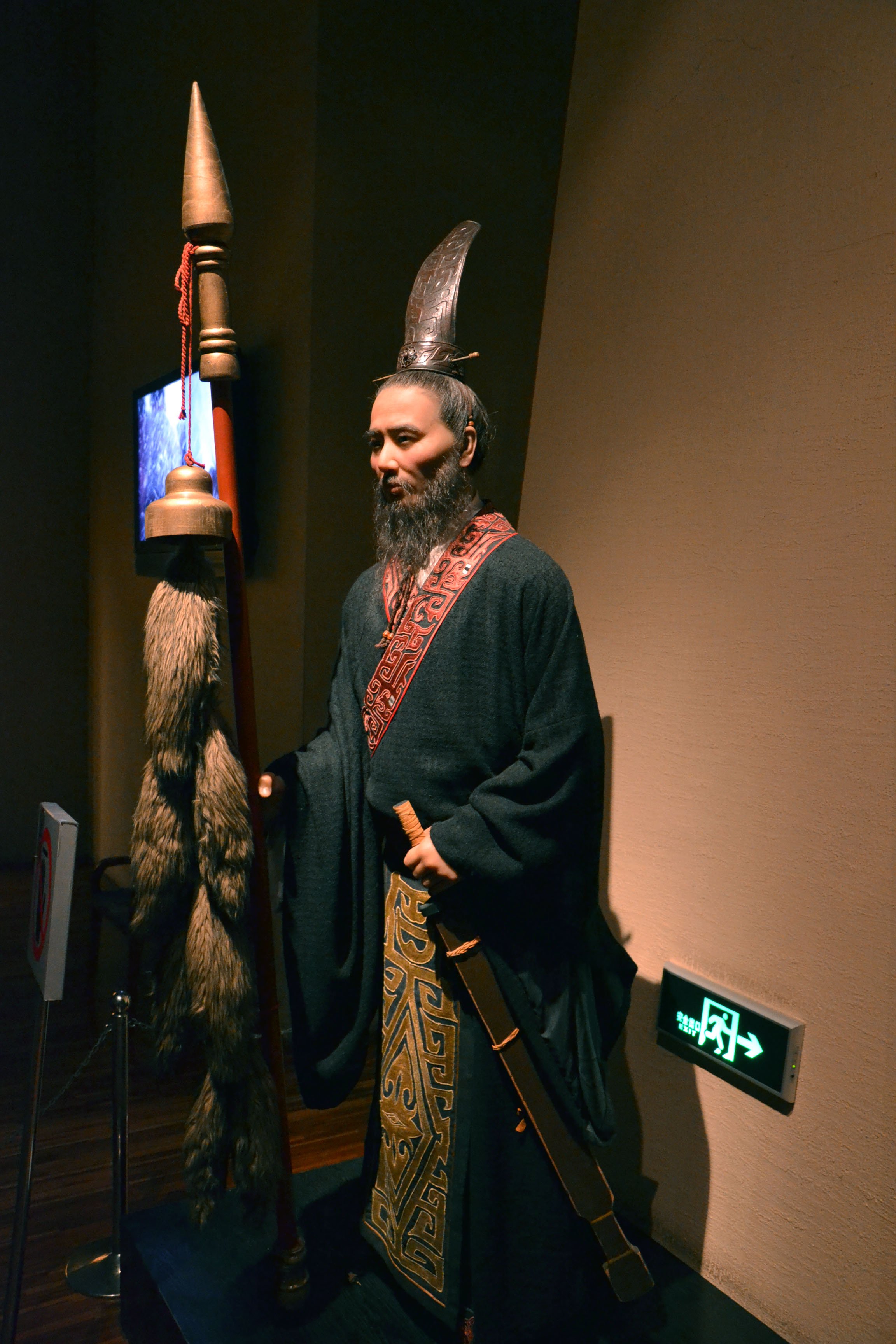
Representation of Zhang Qian and his yak-hair staff at the Shaanxi History Museum. Photo by author.

One location that is said to be “Tukara” is “Tukhara”, sometimes called Tokharistan, home of the “Tokharoi” according to Greek sources. This was at the far end of the Silk Road from the Japanese archipelago, in the area of modern Bactria. It is thought that they were the descendants of the Kushan Empire, themselves founded by members of “Kushana”, one of the polities that made up the confederacy known to the Han dynasty as the Yuezhi. After the Yuezhi were kicked out of the Tarim basin by the Xiongnu, the Han court attempted to send an ambassador, Zhang Qian, to negotiate with them to ally against their common enemy, but the Yuezhi politely refused the request.

Top of a stele in Xian erected during the Tang dynasty praising a new “Shining” religion, aka Christianity. Here you can see a cross etched into the top of the stele, which tells the history of the religion in the east, including mention of people from “Tukhara”. Photo by author.

There has been some speculation that the “Kushan” of the Kushan Empire might be a cognate with “Kucha”, an ancient city along the northern edge of the Tarim basin, in the territory thought to have belonged to the Yuezhi, before the Xiongnu pushed them out. Kucha, it turns out, is also the home of a language that is thought to have been called by in the old Turkic languages of the region, “twγry”, which was thought to be related to the “Tukhara” and the “Tokharoi”. Although that has largely been discredited, the Kuchean and Turfanian languages are still widely known as the “Tocharian” languages—often designated as Tocharian A and Tocharian B.

These languages, themselves, are a bit of a mystery as they are a “Centem” Indo-European language, thought to be similar to Celtic or Italic, while other Indo-European languages in the region—including the Indo-Iranian Bactrian language that was spoke in Tukhara— are “Satem” languages. “Centem” languages adopted the hard “c” or “k” sound for certain words in Proto-Indo-Eueropean, while “Satem” languages adopted the same sound to a sibilant “s” sound.

The possible connection between the “Tocharian” languages and Celtic and Italic further caught the attention of scholars who were also marveling at the well-preserved mummies of the region, some being three to four thousand years old and bearing features more associated with western Eurasia rather than the ethnic Han Chinese or the nomadic steppe people like the Xiongnu are believed to have been. These mummies even bore fabric in a form of plaid design that could have been at home in the ancient Hallstadt region of Central Europe. DNA evidence, however, suggests that they are, in fact, indigenous to the region, being part of an Ancient Northern Eurasian group of people. Truth is, we don’t know what languages they spoke, and many people passed through the Tarim basin over the years.

The Dvaravati Kingdom

Phra Pathom Chedi, originally built during the Dvaravati period, it has been topped with a modern prang.

This theory seems to hold a little less water than the others, but apparently the Sui and Tang new this as the “To-lo-po-ti” kingdom. The Dvaravati kingdom was a powerful ethnic Mon kingdom or confederation that arose in the modern region of Thailand, and it pre-dates the arrival of the Thai people. It lasted from about the 6th to the 12th century, and there is evidence that it traded not only with the Sui and Tang courts, but also with the middle east and even Rome.

Base of an ancient temple or stupa at Pong Tuk, near the site where the Pong Tuk lamp was found. Photo by author.

Besides Arabic and Roman coins, one of the most spectacular finds is a 6th century Byzantine lamp in fields near modern Pong Tuk. This is also known to have been the site of an ancient Dvaravati settlement, with some ruins still visible, even today.

We don’t know precisely what happened to the Dvaravati Kingdom. It may have been a natural collapse over time. There is also some thought that the Gulf of Thailand may have once reached further inland, and as the Chaophraya river brought silt down from the north, this area filled in, and cities that were once on the coast found themselves miles upriver without the same access to ports for commerce and trade.

Tokara Islands

Perhaps the most logical conclusion, however, is that “Tukara” refers to the Tokara Islands. These are the islands between Amami Oshima and Tanegashima, immediately south of Kyushu. It is possible that the terms just used similar characters to phonetically spell out these different areas.

The Tokara islands are part of the larger Ryukyu archipelago, which extends all the way to Taiwan. We know that there has been contact with the Japanese archipelago since at least the Jomon era, but they didn’t follow into the Yayoi and Kofun periods quite as much. The islands closer to the Japanese archipelago saw greater and more immediate influence, but even they have retained a separate character. The islands were populated, at some point, by a Japonic speaking people, as the indigenous Ryukyuan language that evolved is one of the few members of the Japonic language family, including modern Japanese and possibly the language of Hachijo—another group of islands south of Tokyo.

  • Welcome to Sengoku Daimyo’s Chronicles of Japan.  This is episode 119: The Question of “Tukara”


    Traveling upon the ocean was never exactly safe.  Squalls and storms could arise at any time, and there was always a chance that high winds and high waves could capsize a vessel.  Most people who found themselves at the mercy of the ocean could do little but hold on and hope that they could ride out whatever adverse conditions they met with. 

    Many ships were lost without any explanation or understanding of what happened to them.  They simply left the port and never came back home.

    And so when the people saw the boat pulling up on the shores of Himuka, on the island of Tsukushi, they no doubt empathized with the voyagers’ plight.  The crew looked bedraggled, and their clothing was unfamiliar.  There were both men and women, and this didn’t look like your average fishing party.  If anything was clear it was this:  These folk weren’t from around here.

    The locals brought out water and food.  Meanwhile, runners were sent with a message:  foreigners had arrived from a distant place.  They then waited to see what the government was going to do.


    We are still in the second reign of Takara Hime, aka Saimei Tenno.  Last episode we talked about the palaces constructed in Asuka, as well as some of the stone works that have been found from the period, and which appear to be referenced in the Nihon Shoki—at least tangentially.   The episodes before that, we looked at the expeditions the court sent to the far north of Honshu and even past Honshu to Hokkaido.

    This episode we’ll again be looking past the main islands of the archipelago to lands beyond.  Specifically, we are going to focus on particularly intriguing references to people from a place called “Tukara”.  We’ll talk about some of the ideas about where that might be, even if they’re a bit  far-fetched. That’s because Tukara touches on the state of the larger world that Yamato was a part of, given its situation on the far eastern edge of what we know today as the Silk Road.  And is this just an excuse for me to take a detour into some of the more interesting things going on outside the archipelago?  No comment.

    The first mention of a man from Tukara actually comes at the end of the reign of Karu, aka Koutoku Tennou.  We are told that in the fourth month of 654 two men and two women of “Tukara” and one woman of “Sha’e” were driven by a storm to Hiuga. 

    Then, three years later, the story apparently picks up again, though possibly referring to a different group of people.  On the 3rd day of the 7th month of 657, so during the second reign of Takara Hime, we now hear about two men and four women of the Land of Tukara—no mention of Sha’e—who drifted to Tsukushi, aka Kyushu.  The Chronicles mention that these wayfarers first drifted to the island of Amami, and we’ll talk about that in a bit, but let’s get these puzzle pieces on the table, first.  After those six people show up, the court sent for them by post-horse.  They must have arrived by the 15th of that same month, because we are told that a model of Mt. Sumi was erected and they—the people from Tukara—were entertained, although there is another account that says they were from “Tora”.

    The next mention is the 10th day of the 3rd month of 659, when a Man of Tukara and his wife, again woman of Sha’e, arrived.  Then, on the 16th day of the 7th month of 660, we are told that the man of Tukara, Kenzuhashi Tatsuna, desired to return home and asked for an escort.  He planned to pay his respects at the Great Country, i.e. the Tang court, and so he left his wife behind, taking tens of men with him.

    All of these entries might refer to people regularly reaching Yamato from the south, from a place called “Tukara”.  Alternately, this is a single event whose story has gotten distributed over several years, as we’ve seen happen before with the Chronicles.  .  One of the oddities of these entries is that the terms used are not consistent.  “Tukara” is spelled at least two different ways, suggesting that it wasn’t a common placename like Silla or Baekje, or even the Mishihase.  That does seem to suggest that the Chronicles were phonetically trying to find kanji, or the Sinitic characters, to match with the name they were hearing.   I would also note that “Tukara” is given the status of a “kuni”—a land, country, or state—while “sha’e”, where some of the women are said to come from, is just that, “Sha’e”.

    As for the name of at least one person from Tokara, Kenzuhashi Tatsuna, that certainly sounds like someone trying to fit a non-Japanese name into the orthography of the time.  “Tatsuna” seems plausibly Japanese, but “Kenzuhashi” doesn’t fit quite as well into the naming structures we’ve seen to this point.

    The location of “Tukara” and “Sha’e” are not clear in any way, and as such there has been a lot of speculation about them.  While today there are placenames that fit those characters, whether or not these were the places being referenced at the time is hard to say.

    I’ll actually start with “Sha’e”, which Aston translates as Shravasti, the capital of the ancient Indian kingdom of Kosala, in modern Uttar Pradesh.  It is also where the Buddha, Siddartha Gautama, is said to have lived most of his life after his enlightenment.  In Japanese this is “Sha’e-jou”, and like many Buddhist terms it likely comes through Sanskrit to Middle Chinese to Japanese.  One—or possibly two—women from Shravasti making the journey to Yamato in the company of a man (or men) from Tukara seems quite the feat. 

    But then, where is “Tukara”? Well, we have at least three possible locations that I’ve seen bandied about.  I’ll address them from the most distant to the closest option.  These three options were Tokharistan, Dvaravati, and the Tokara islands.

    We’ll start with Tokharistan on the far end of the Silk Road.  And to start, let’s define what that “Silk Road” means.  We’ve talked in past episodes about the “Western Regions”, past the Han-controlled territories of the Yellow River.   The ancient Tang capital of Chang’an was built near to the home of the Qin dynasty, and even today you can go and see both the Tang tombs and the tomb of Qin Shihuangdi and his terracotta warriors, all within a short distance of Xi’an, the modern city built on the site of Chang’an.  That city sits on a tributary of the Yellow River, but the main branch turns north around the border of modern Henan and the similarly sounding provinces of Shanxi and Shaanxi.  Following it upstream, the river heads north into modern Mongolia, turns west, and then heads south again, creating what is known as the Ordos loop.  Inside is the Ordos plateau, also known as the Ordos Basin.  Continuing to follow the Yellow river south, on the western edge of the Ordos, you travel through Ningxia and Gansu—home of the Hexi, or Gansu, Corridor.  That route eventually takes to Yumenguan, the Jade Gate, and Dunhuang.  From there roads head north or south along the edge of the Taklamakan desert in the Tarim basin.  The southern route travels along the edge of the Tibetan plateau, while the northern route traversed various oasis cities through Turpan, Kucha, to the city of Kashgar.  Both routes made their way across the Pamirs and the Hindu Kush into South Asia.

    We’ve brought up the Tarim Basin and the Silk Road a few times.  This is the path that Buddhism appears to have taken to get to the Yellow River Basin and eventually to the Korean Peninsula and eastward to the Japanese archipelago.  But I want to go a bit more into detail on things here, as there is an interesting side note about “Tukara” that I personally find rather fascinating, and thought this would be a fun time to share.

    Back in Episode 79 we talked about how the Tarim basin used to be the home to a vast inland sea, which was fed by the meltwater from the Tianshan and Kunlun mountains.  This sea eventually dwindled, though it was still large enough to be known to the Tang as the Puchang Sea.  Today it has largely dried up, and it is mostly just the salt marshes of Lop Nur that remain.  Evidence for this larger sea, however, can be observed in some of the burials found around the Tarim basin.  These burials include the use of boat-shaped structures—a rather curious feature to be found out in the middle of the desert.

    And it is the desert that was left behind as the waters receded that is key to much of what we know about life in the Tarim basin, as it has proven to be quite excellent at preserving organic material.  This includes bodies, which dried out and naturally turned into mummies, including not only the wool clothing they were wearing, but also features such as hair and even decoration.

    These “Tarim mummies”, as they have been collectively called, date from as early as 2100 BCE all the way up through the period of time we’re currently talking about, and have been found in several desert sites: Xiaohe, the earliest yet discovered; Loulan, near Lop Nur on the east of the Tarim Basin, dating from around 1800 BCE; Cherchen, on the southern edge of the Tarim Basin, dating from roughly 1000 BCE; and too many others to go into in huge detail. The intriguing thing about these burials is that  many of them don’t have features typically associated with people of ethnic Han—which is to say traditional Chinese—ancestry, nor do they necessarily have the features associated with the Xiongnu and other steppe nomads.  In addition they have colorful clothing  made from wool and leather, with vivid designs.  Some bodies near Hami, just east of the basin, were reported to have blonde to light brown hair, and their cloth showed radically different patterns from that found at Cherchen and Loulan, with patterns that could reasonably be compared with the plaids now common in places like Scotland and Ireland, and previously found in the Hallstadt salt mine in Central Europe from around 3500 BCE, from which it is thought the Celtic people may have originated.

    At the same time that people—largely Westerners— were studying these mummies, another discovery in the Tarim basin was also making waves.  This was the discovery of a brand new language.  Actually, it was two languages—or possibly two dialects of a language—in many manuscripts, preserved in Kucha and Turpan.  Once again, the dry desert conditions proved invaluable to maintain these manuscripts, which date from between the late 4th or early 5th century to the 8th century.  They are written with a Brahmic script, similar to that used for Sanskrit, which appears in the Tarim Basin l by about the 2nd century, and we were able to translate them because many of the texts were copies of Buddhist scripture, which greatly helped scholars in deciphering the languages.  These two languages were fascinating because they represented an as-yet undiscovered branch of the Indo-European language family.  Furthermore, when compared to other Indo-European languages, they did not show nearly as much similarity with their neighbors as with languages on the far western end of the Indo-European language family.  That is to say they were thought to be closer to Celtic and Italic languages than something like Indo-Iranian. 

    And now for a quick diversion within the diversion:  “Centum” and “Satem” are general divisions of the Indo-European language families that was once thought to indicate a geographic divide in the languages.  At its most basic, as Indo-European words changed over time, a labiovelar sound, something like “kw”,  tended to evolve in one of two ways.  In the Celtic and Italic languages, the “kw” went to a hard “k” sound, as represented in the classical pronunciation of the Latin word for 100:  Centum.  That same word, in the Avestan language—of the Indo-Iranian tree—is pronounced as “Satem”, with an “S” sound.  So, you can look at Indo-European languages and divide them generally into “centum” languages, which preserve the hard “k”, or “Satem” languages that preserve the S. With me so far?

    Getting back to these two newly-found languages in the Tarim Basin, the weird thing is that they were “Centum” languages. Most Centum languages are from pretty far away, though: they are generally found in western Europe or around the Mediterranean, as opposed to the Satem languages, such as Indo-Aryan, Iranian, Armernian, or even Baltic Slavic languages, which are much closer to the Tarim Basin. 

    So if the theory were true that the “Centum” family of Indo-European languages developed in the West and “Satem” languages developed in the East, then that would seem to indicate that a group of a “Centum” speaking people must have migrated eastward, through the various Satem speaking people, and settled in the Tarim Basin many thousands of years ago.

    And what evidence do we have of people who look very different from the modern population, living in the Tarim Basin area long before, and wearing clothing similar to what we associated with the progenitors of the Celts?

     For many, it seemed to be somewhat obvious, if still incredible, that the speakers of this language were likely the descendants of the mummies who, in the terminology of the time, had been identified as being of Caucasoid ancestry.  A theory developed that these people were an offshoot of a group called the Yamnaya culture, which may have arisen around modern Ukraine as an admixture between the European Hunter Gatherers and the Caucasian Hunter Gatherers, around 3300-2600 BCE.  This was challenged in 2021 when a genetic study was performed on some of the mummies in the Tarim basin, as well as several from the Dzungarian basin, to the northeast.  That study suggested that the people of the Dzungarian basin had genetic ties to the people of the Afanasievo people, from Southern Siberia.  The Afanasievo people are connected to the Yamnayan culture.

    It should be noted that there has long been a fascination in Western anthropology and related sciences with racial identification—and often not in a healthy way.  As you may recall, the Ainu were identified as “Caucasoid” by some people largely because of things like the men’s beards and lighter colored hair, which differ greatly from a large part of the Japanese population.  However, that claim has been repeatedly refuted and debunked.

    And similarly, the truth is, none of these Tarim mummy burials were in a period of written anything, so we can’t conclusively associated them with these fascinating Indo-European languages.  There are thousands of years between the various burials and the manuscripts. These people  left no notes stashed in pockets that give us their life story.   And Language is not Genetics is not Culture.  Any group may adopt a given language for a variety of reasons.  .  Still, given what we know, it is possible that the ancient people of the Tarim basin spoke some form of “Proto-Kuchean”, but it is just as likely that this language was brought in by people from Dzungaria at some point.

    So why does all this matter to us?  Well, remember how we were talking about someone from Tukara?  The Kuchean language, at least, is referred to in an ancient Turkic source as belonging to “Twgry”, which led several scholars to draw a link between this and the kingdom and people called Tukara and the Tokharoi.  This leads us on another bit of a chase through history.

    Now if you recall, back in Episode 79, we talked about Zhang Qian.  In 128 BCE, he attempted to cross the Silk Road through the territory of the Xiongnu on a mission for the Han court.  Some fifty years earlier, the Xiongnu had defeated the Yuezhi.  They held territory in the oasis towns along the north of the Taklamakan dessert, from about the Turpan basin west to the Pamirs. The Xiongnu were causing problems for the Han, who thought that if they could contact the remaining Yuezhi they could make common cause with them and harass the Xiongnu from both sides.  Zhang Qian’s story is quite remarkable: he started out with an escort of some 99 men and a translator.  Unfortunately, he was captured and enslaved by the Xiongnu during his journey, and he is even said to have had a wife and fathered a child.  He remained a captive for thirteen years, but nonetheless, he was able to escape with his family and he made it to the Great Yuezhi on the far side of the Pamirs, but apparently the Yuezhi weren’t interested in a treaty against the Xiongnu.  The Pamirs were apparently enough of a barrier and they were thriving in their new land.  And so Zhang Qian crossed back again through Xiongnu territory, this time taking the southern route around the Tarim basin.  He was still captured by the Xiongnu, who spared his life.  He escaped, again, two years later, returning to the Han court.  Of the original 100 explorers, only two returned: Zhang Qian and his translator.  While he hadn’t obtained an alliance, he was able to detail the cultures of the area of the Yuezhi.

    Many feel that the Kushan Empire, which is generally said to have existed from about 30 to 375 CE,was formed from the Kushana people who were part of the Yuezhi who fled the Xiongnu. In other words, they were originally from further north, around the Tarim Basin, and had been chased out and settled down in regions that included Bactria (as in the Bactrian camel).  Zhang Qian describes reaching the Dayuan Kingdom in the Ferghana valley, then traveling south to an area that was the home of the Great Yuezhi or Da Yuezhi. 

    And after the Kushan empire fell, we know there was a state in the upper regions of the Oxus river, centered on the city of Balkh, in the former territory of the Kushan empire. known as “Tokara”.  Geographically, this matches up how Zhang Qian described the home of the Da Yuezhi.  Furthermore, some scholars reconstruct the reading of the Sinic characters used for “Yuezhi” as originally having an optional reading of something like “Togwar”, but that is certainly not the most common reconstructed reading of those characters.  Greek sources describe this area as the home of the Tokharoi, or the Tokaran People.  The term “Tukhara” is also found in Sanskrit, and this kingdom  was also said to have sent ambassadors to the Southern Liang and Tang dynasties.

    We aren’t exactly certain of where these Tokharan people came from, but as we’ve just described, there’s a prevailing theory that they were the remnants of the Yuezhi and Kushana people originally from the Tarim Basin.  We know that in the 6th century they came under the rule of the Gokturk Khaganate, which once spanned from the Liao river basin to the Black Sea.  In the 7th and 8th centuries they came under the rule of the Tang Empire, where they were known by very similar characters as those used to write “Tukara” in the Nihon Shoki.  On top of this, we see Tokharans traveling the Silk Road, all the way to the Tang court.  Furthermore, Tokharans that settled in Chang’an took the surname “Zhi” from the ethnonym “Yuezhi”, seemingly laying claim to and giving validation to the identity used back in the Han dynasty.


    So, we have a Turkic record describing the Kuchean people (as in, from Kucha in the Tarim Basin) as “Twgry”, and we have a kingdom in Bactria called Tokara and populated (according to the Greeks) by people called Tokharoi.  You can see how this one term has been a fascinating rabbit hole in the study of the Silk Roads and their history.  And some scholars understandably suggested that perhaps the Indo-European languags found in Kucha and Turpan  were actually related to this “Tokhara” – and therefore  should be called “Tocharian”, specifically Tocharian A (Kuchean) or Tocharian B (Turfanian).

    The problem is that if the Tokharans were speaking “Tocharian” then you wouldn’t expect to just see it at Kucha and Turpan, which are about the middle of the road between Tokhara and the Tang dynasty, and which had long been under Gokturk rule.  You would also expect to see it in the areas of Bactria associated with Tokhara.  However, that isn’t what we see.  Instead, we see that Bactria was the home of local Bactrian language—an Eastern Iranian language, which, though it is part of the Indo European language family, it is not closely related to Tocharian as far as we can tell.

    It is possible that the people of Kucha referred to themselves as something similar to “Twgry”, or “Tochari”, but we should also remember that comes from a Turkic source, and it could have been an exonym not related to what they called themselves.  I should also note that language is not people.  It is also possible that a particular ethnonym was maintained separately by two groups that may have been connected politically but which came to speak different languages for whatever reason.   There could be a connection between the names, or it could even be that the same or similar exonym was used for different groups.

    So, that was a lot and a bit of a ramble, but a lot of things that I find interesting—even if they aren’t as connected as they may appear.  We have the Tarim mummies, which are, today, held at a museum in modern Urumqi.  Whether they had any connection with Europe or not, they remain a fascinating study for the wealth of material items found in and around the Tarim basin and similar locations.  And then there is the saga of the Tocharian languages—or perhaps more appropriately the Kuchean-Turfanian languages: Indo-European languages that seem to be well outside of where we would expect to find them.

    Finally, just past the Pamirs, we get to the land of Tokhara or Tokharistan.  Even without anything else, we know that they had contact with the court.  Perhaps our castaways were from this land?  The name is certainly similar to what we see in the Nihon Shoki, using some of the same characters.

    All in all, art and other information suggest that the area of the Tarim basin and the Silk Road in general were quite cosmopolitan, with many different people from different regions of the world.  Bactria retained Hellenic influences ever since the conquests of Alexander of Macedonia, aka Alexander the Great, and Sogdian and Persian traders regularly brought their caravans through the region to trade.  And once the Tang dynasty controlled all of the routes, that just made travel that much easier, and many people traveled back and forth.

    So from that perspective, it is possible that one or more people from Tukhara may have made the crossing from their home all the way to the Tang court, but if they did so, the question still remains: why would they be in a boat? Utilizing overland routes, they would have hit Chang’an or Louyang, the dual capitals of the Tang empire, well before they hit the ocean.  However, the Nihon Shoki says that these voyagers first came ashore at Amami and then later says that they were trying to get to the Tang court.

    Now there was another “Silk Road” that isn’t as often mentioned: the sea route, following the coast of south Asia, around through the Malacca strait and north along the Asian coast.  This route is sometimes viewed more in terms of the “spice” road

    If these voyagers set out to get to the Tang court by boat, they would have to have traveled south to the Indian Ocean—possibly traveling through Shravasti or Sha’e, depending on the route they chose to take—and then around the Malacca strait—unless they made it on foot all the way to Southeast Asia.  And then they would have taken a boat up the coast.

    Why do that instead of taking the overland route?  They could likely have traveled directly to the Tang court over the overland silk road.  Even the from Southeast Asia could have traveled up through Yunnan and made their way to the Tang court that way.  In fact, Zhang Qian had wondered something similar when he made it to the site of the new home of the Yuezhi, in Bactria.  Even then, in the 2nd century, he saw products in the marketplace that he identified as coming from around Szechuan.  That would mean south of the Han dynasty, and he couldn’t figure out how those trade routes might exist and they weren’t already known to the court.  Merchants would have had to traverse the dangerous mountains if they wanted to avoid being caught by the Xiongnu, who controlled the entire region.

    After returning to the Han court, Zhang Qian actually went out on another expedition to the south, trying to find the southern trade routes, but apparently was not able to do so.  That said, we do see, in later centuries, the trade routes open up between the area of the Sichuan basin and South Asia.  We also see the migrations of people further south, and there may have even been some Roman merchants who traveled up this route to find their way to the Han court, though those accounts are not without their own controversy.

    In either case, whether by land or sea, these trade routes were not always open.  In some cases, seasonal weather, such as monsoons, might dictate movement back and forth, while political realities were also a factor.  Still, it is worth remembering that even though most people were largely concerned with affairs in their own backyard, the world was still more connected than people give it credit for.  Tang dynasty pottery made its way to the east coast of Africa, and ostriches were brought all the way to Chang’an.

    As for the travelers from Tukhara and why they would take this long and very round-about method of travel, it is possible that they were just explorers, seeking new routes, or even on some kind of pilgrimage.  Either way, they would have been way off course.

    But if they did pass through Southeast Asia, that would match up with another theory about what “Tukara” meant: that it actually refers to the Dvaravati kingdom in what is now modern Thailand. 

    The Dvaravati Kingdom was a Mon political entity that rose up around the 6th century.  It even sent embassies to the Sui and Tang courts.  This is even before the temple complexes in Siem Reap, such as Preah Ko and the more famous Angkor Wat.  And it was during this time that the ethnic Tai people are thought to have started migrating south from Yunnan, possibly due to pressures from the expanding Sui and Tang empires.  Today, most of what remains of the Dvaravati kingdom are the ruins of ancient stone temples, showing a heavy Indic influence, and even early Buddhist practices as well. 

    “Dvaravati” may not actually be the name of the kingdom but it comes from an inscription on a coin found from about that time.  The Chinese refer to it as  “To-lo-po-ti” in contemporary records.  It may not even have been a kingdom, but  more of a confederation of city-states—it is hard to piece everything together.  That it was well connected, though, is clear from the archaeological record.  In Dvaravati sites, we see coins from as far as Rome, and we even have a lamp found in modern Pong Tuk that appears to match similar examples from the Byzantine Empire in the 6th century.  Note that this doesn’t mean it arrived in the 6th century—similarly with the coins—but the Dvaravati state lasted until the 12th century. If that was the case, perhaps there were some women from a place called “Shravasti” or similar, especially given the Indic influence in the region.

    Now, given the location of the Dvaravati, it wouldn’t be so farfetched to think that someone might sail up from the Gulf of Thailand and end up off-course, though it does mean sailing up the entire Ryukyuan chain or really running off course and finding yourself adrift on the East China sea.  And if they were headed to the Tang court, perhaps they did have translators or knew Chinese, since Yamato was unlikely to know the Mon language of Dvaravati and people from Dvaravati probably wouldn’t know the Japonic language.  Unless, perhaps, they were communicating through Buddhist priests via Sanskrit.

    We’ve now heard two possibilities for Tukara, both pretty far afield: the region of Tokara in Bactria, and the Dvaravati kingdom in Southeast Asia.  That said, the third and simplest explanation—and the one favored by Aston in his translation of the Nihon Shoki—is that Tukara is actually referring to a place in the Ryukyu island chain.  Specifically, there is a “Tokara” archipelago, which spans between Yakushima and Amami-Oshima.  This is part of the Nansei islands, and the closest part of the Ryukyuan island chain to the main Japanese archipelago.  This is the most likely theory, and could account for the entry talking about Amami.  It is easy to see how sailors could end up adrift, too far north, and come to shore in Hyuga, aka Himuka, on the east side of Kyushu. 

    It certainly would make more sense for them to be from this area of the Ryukyuan archipelago than from anywhere else.  From Yakushima to Amami-Oshima is the closest part of the island chain to Kyushu, and as we see in the entry from the Shoku Nihongi, those three places seem to have been connected as being near to Japan.  So what was going on down there, anyway?

    Well, first off, let’s remember that the Ryukyuan archipelago is not just the island of Okinawa, but a series of islands that go from Kyushu all the way to the island of Taiwan.  Geographically speaking, they are all part of the same volcanic ridge extending southward.  The size of the islands and their distance from each other does vary, however, creating some natural barriers in the form of large stretches of open water, which have shaped how various groups developed on the islands.

    Humans came to the islands around the same time they were reaching the Japanese mainland.  In fact, some of our only early skeletal remains for early humans in Japan actually come from either the Ryukyuan peninsula in the south or around Hokkaido to the north, and that has to do with the acidity of the soil in much of mainland Japan.

    Based on genetic studies, we know that at least two groups appear to have inhabited the islands from early times.  One group appears to be related to the Jomon people of Japan, while the other appears to be more related to the indigenous people of Taiwan, who, themselves, appear to have been the ancestors of many Austronesian people.  Just as some groups followed islands to the south of Taiwan, some appear to have headed north.  However, they only made it so far.  As far as I know there is no evidence they made it past Miyakoshima, the northernmost island in the Sakishima islands.  Miyako island is separated from the next large island, Okinawa, by a large strait, known as the Miyako Strait, though sometimes called the Kerama gap in English.  It is a 250km wide stretch of open ocean, which is quite the distance for anyone to travel, even for Austronesian people of Taiwan, who had likely not developed the extraordinary navigational technologies that the people who would become the Pacific Islanders would discover.

    People on the Ryukyu island chain appear to have been in contact with the people of the Japanese archipelago since at least the Jomon period, and some of the material artifacts demonstrate a cultural connection.  That was likely impacted by the Akahoya eruption, about 3500 years ago, and then re-established at a later date.  We certainly see sea shells and corals trade to the people of the Japanese islands from fairly early on.

    Unlike the people on the Japanese archipelago, the people of the Ryukyuan archipelago did not really adopt the Yayoi and later Kofun culture.  They weren’t building large, mounded tombs, and they retained the character of a hunter-gatherer society, rather than transitioning to a largely agricultural way of life.  The pottery does change in parts of Okinawa, which makes sense given the connections between the regions. 

    Unfortunately, there is a lot we don’t know about life in the islands around this time.  We don’t exactly have written records, other than things like the entries in the Nihon Shoki, and those are hardly the most detailed of accounts.  In the reign of Kashikiya Hime, aka Suiko Tennou, we see people from Yakushima, which is, along with Tanegashima, one of the largest islands at the northern end of the Ryukyu chain, just before you hit Kagoshima and the Osumi peninsula on the southern tip of Kyushu.  The islands past that would be the Tokara islands, until you hit the large island of Amami.

    So you can see how it would make sense that the people from “Tokara” would make sense to be from the area between Yakushima and Amami, and in many ways this explanation seems too good to be true.  There are a only a few things that make this a bit peculiar. First, this doesn’t really explain the woman from “Sha’e” in any compelling way that I can see.  Second, the name, Kenzuhashi Tatsuna doesn’t seem to fit with what we generally know about early Japonic names, and the modern Ryukyuan language certainly is a Japonic language, but there are still plenty of possible explanations.  There is also the connection of Tokara with “Tokan”, which is mentioned in an entry in 699 in the Shoku Nihongi, the Chronicle that follows on, quite literally to the Nihon Shoki.  Why would they call it “Tokan” instead of “Tokara” so soon after?  Also, why would these voyagers go back to their country by way of the Tang court?  Unless, of course, that is where they were headed in the first place.  In which case, did the Man from Tukara intentionally leave his wife in Yamato, or was she something of a hostage while they continued on their mission?


    And so those are the theories.  The man from “Tukara” could be from Tokhara, or Tokharistan, at the far end of the Silk Road.  Or it could have been referring to the Dvaravati Kingdom, in modern Thailand. 

    Still, in the end, Occam’s razor suggests that the simplest answer is that these were actually individuals from the Tokara islands in the Ryukyuan archipelago.  It is possible that they were from Amami, not that they drifted there.  More likely, a group from Amami drifted ashore in Kyushu as they were trying to find a route to the Tang court, as they claimed.  Instead they found themselves taking a detour to the court of Yamato, instead.

    And we could have stuck with that story, but I thought that maybe, just maybe, this would be a good time to reflect once again on how connected everything was.  Because even if they weren’t from Dvaravati, that Kingdom was still trading with Rome and with the Tang.  And the Tang controlled the majority of the overland silk road through the Tarim basin.  We even know that someone from Tukhara made it to Chang’an, because they were mentioned on a stele that talked about an Asian sect of Christianity, the “Shining Religion”, that was praised and allowed to set up shop in the Tang capital, along with Persian Manicheans and Zoroastrians.  Regardless of where these specific people may have been from, the world was clearly growing only more connected, and prospering, as well.

    Next episode we’ll continue to look at how things were faring between the archipelago and the continent.

    Until then thank you for listening and for all of your support.

    If you like what we are doing, please tell your friends and feel free to rate us wherever you listen to podcasts.  If you feel the need to do more, and want to help us keep this going, we have information about how you can donate on Patreon or through our KoFi site, ko-fi.com/sengokudaimyo, or find the links over at our main website,  SengokuDaimyo.com/Podcast, where we will have some more discussion on topics from this episode.

    Also, feel free to reach out to our Sengoku Daimyo Facebook page.  You can also email us at the.sengoku.daimyo@gmail.com. 

    Thank you, also, to Ellen for their work editing the podcast.

    And that’s all for now.  Thank you again, and I’ll see you next episode on Sengoku Daimyo’s Chronicles of Japan.

References

  • Zhang, F., Ning, C., Scott, A. et al. The genomic origins of the Bronze Age Tarim Basin mummies. Nature 599, 256–261 (2021). https://doi.org/10.1038/s41586-021-04052-7

  • Hansen, V. (2012). The Silk Road: a new history. Oxford ; New York, Oxford University Press.

  • Beckwith, C.I. (2009) Empires of the Silk Road: A History of Central Eurasia from the Bronze Age to the Present. Princeton University Press, Princeton/Oxford. ISBN 978-0-691-13589-2.

  • Boulnois, Luce (2005). Silk Road: Monks, Warriors & Merchants. Hong Kong: Odyssey Books & Guides. pp. 311–335. ISBN 962-217-721-2.

  • Mallory, J. P., & Mair, V. H. (2000). The Tarim Mummies: Ancient China and the Mystery of the Earliest Peoples from the West. London: Thames & Hudson

  • Barber, E. J. W. (1999). The mummies of Urumchi. New York, W.W. Norton & Company.

  • Frye, R. N. 1. (1996). The heritage of Central Asia from antiquity to the Turkish expansion. Princeton, Markus Wiener Publishers.

  • Brown, Rober L.; MacDonnell, Anna M. (1989), "The Pong Tuk Lamp: A Reconsideration". The Journal of the Siam Society, vol. 77, pt. 2, 1989. pp. 9-20.

  • Aston, W. G. (1972). Nihongi, chronicles of Japan from the earliest times to A.D. 697. London: Allen & Unwin. ISBN0-80480984-4

Comment

Episode 118: Stone Work and Treason

January 16, 2025 Joshua Badgley

Photos of ongoing excavations at the Asuka Palace site. This site saw multiple palaces, including the Itabuki and Later Okamoto Palaces, as well as the Kiyomihara Palace. Photo by author.

RSS
Previous Episodes
  • December 2025
  • November 2025
  • October 2025
  • September 2025
  • August 2025
  • July 2025
  • June 2025
  • May 2025
  • April 2025
  • March 2025
  • February 2025
  • January 2025
  • December 2024
  • November 2024
  • October 2024
  • September 2024
  • August 2024
  • July 2024
  • June 2024
  • May 2024
  • April 2024
  • March 2024
  • February 2024
  • January 2024
  • December 2023
  • November 2023
  • October 2023
  • September 2023
  • August 2023
  • July 2023
  • June 2023
  • May 2023
  • April 2023
  • March 2023
  • February 2023
  • January 2023
  • December 2022
  • November 2022
  • October 2022
  • September 2022
  • August 2022
  • July 2022
  • June 2022
  • May 2022
  • April 2022
  • March 2022
  • February 2022
  • January 2022
  • December 2021
  • November 2021
  • October 2021
  • September 2021
  • August 2021
  • July 2021
  • June 2021
  • May 2021
  • April 2021
  • March 2021
  • February 2021
  • January 2021
  • December 2020
  • November 2020
  • October 2020
  • September 2020
  • August 2020
  • July 2020
  • June 2020
  • May 2020
  • April 2020
  • March 2020
  • February 2020
  • January 2020
  • December 2019
  • November 2019
  • October 2019
  • September 2019
Archives
 

This episode, we are covering more of the events of the second reign of Takara Hime, aka Saimei Tennō, bringing us back to Asuka. This episode we talk about the various constructions in the Asuka area, including various stoneworks that we have found, even today, as well as numerous palaces, the remains of which have also been discovered. Of course, those constructions were not without cost—political as well as monetary.

Saruishi 1.jpg
Saruishi 2.jpg
Saruishi - Actual 1.jpg
Saruishi 3.jpg
Saruishi - Actual 2.jpg
Saruishi 4.jpg
Saruishi 1.jpg Saruishi 2.jpg Saruishi - Actual 1.jpg Saruishi 3.jpg Saruishi - Actual 2.jpg Saruishi 4.jpg

Saruishi Stones

The Saruishi stones are one of the more mysterious carvings. I don’t even know if all “saruishi” stones were by the same engraver or if they come from different hands. The most commonly known appear to be those that were found in the Ikeda field and later placed at the tomb of Kibitsu Hime. At one time they were apparently placed around the tomb attributed to Kimmei Tennō, and as such they may have been stone figures similar to the clay and wooden “haniwa”. However, we haven’t found any other statues like them, as far as I can tell. It is true that there are stone figures adorning some of the tombs in Kyūshū, but these figures do not have a direct correlation, other than being made of stone.

Personally, I tend to wonder if they weren’t part of some mansion or garden complex. It would certainly have made sense. Regrettably, we no longer have their original context, and as such may never know what they were truly for. But what they do show is the skill of the craftspersons of that period, and it goes hand in hand with other carvings in and around the Asuka region.

Kameishi - The Turtle Stone

Another strange stone is the large “turtle” stone. It is possible that it has eroded over time, so that only the “face” is visible, but I also wonder if they didn’t just use the natural stone. I’ve encountered other “kame-ishi” across Japan: stones that look like turtles and were often used as landmarks. This one seems to have been carved to have a face, at the very least. Today it sits along a trail behind modern houses and it is unclear what it was originally for. However, perhaps due to its location, there are some legends around it, including the idea that it sometimes changes directions, and if it ever turns to the west, the entire valley—and beyond—would flood.

Sakafuneishi Ruins

Sakafune-ishi
Sakafune-ishi

Public domain image via Wikimedia Commons

Tortoise shaped basin

Public domain image via Wikimedia Commons

Reconstructed waterworks

At the Asuka Historical Museum

Sakafune-ishi Tortoise shaped basin Reconstructed waterworks

The Sakafuneishi, while not directly described, are probably some of the most obvious ruins to connect to the reading in the Nihon Shoki. They sit on a hill to the east of the Asuka palace site—the location where we are told that stones were brought from Mt. Kaguyama. There we find a strange stone carving called the “sakafune-ishi”. The stone itself is weathered, but has channels that seem to be for liquid—presumably water—to fill one and another. The stone has been weathered and broken over the years, so it is unclear the full extent of its shape. Furthermore, the channels in the stone don’t match anything else we’ve really seen. There are plenty of conspiracies out there as well. I think the key thing to remember is that we are only seeing what is left. If there was any organic—e.g. wooden—structure surrounding it and part of the mechanism, that has long since rotted away.

At the foot of the hill where the sakfune-ishi sits is a tortoise shaped basin fed by a ‘boat’ shaped tank. There is some thought that these were also from the same era as the sakafune-ishi, and likely related to the reign of “Saimei Tennō”. These types of waterworks in Asuka are actually more common than one might think. The Asuka Historical Museum has several replicas of various water features that appear to have been designed in this period, or shortly after.

Mt. Sumera fountain.jpg
Mt. Sumera fountain operation-2.jpg
Mt. Sumera fountain.jpg Mt. Sumera fountain operation-2.jpg

Mt. Sumera Fountain

So this is another example of the engineering ability. This is a reconstructed example, but it is still quite something. Constructions of “Mt. Sumera” show up several times in the Nihon Shoki. It is unclear what they look like, but this was found in Asuka and may be one of those discussed in the Chronicles. Here you can see how the water basin was gravity fed so that if the “tank” was filled, then the water would come out in a small fountain. I imagine that it would need to be refilled, possibly each time it was “on”. But nonetheless, to get the plumbing and everything to work just through carved stone is pretty impressive, in my book. Today they have the replica plumbed with running water so that you can see what it must have looked like back in the day. Though I also wonder if it was left as plain stone or painted, since that was something else that you might have seen at the time.

The Asuka Palaces

The “Asuka” era is often defined as starting with the introduction of Buddhism in the 6th century—commonly thought to be around 538 CE. However, the relatively permanent establishment of the court in Asuka can probably be traced to the Soga hegemons, for whom Asuka was one of their main strongholds. Kashikiya Hime, aka Suiko Tennō, built one of the first long term palaces in the area when she built the Oharida Palace. From what remains, this palace appears to have been a fairly simple, rectangular complex. There was a rear palace area—possibly the more private area—and a front courtyard. It wasn’t extremely elaborate, from what we can tell so far.

Later, the sovereign known as Jomei Tennō (Okinaga no Tarashi-hi Hironuka) and Tarashi Hime (Kōgyoku/Saimei Tennō) would build Okamoto palace. That burned down, and they built Itabuki palace, which is where the Isshi Incident is said to have taken place. During the reign of Karu—Kōtoku Tennō—they built the huge Naniwa palace. But then Tarashi Hime moved back to Asuka and refurbished the Oharida and the Itabuki Palaces. Both had issues, though, and she moved briefly to Kawara Palace before rebuilding Okamoto Palace.

Many of these palaces occupied the same relative space, just south of Asukadera. Various excavations have come across the different walls and structures, demonstrating that they were built on top of each other, but not necessarily to the same plan.

Asuka Capital Model
Asuka Capital Model

This shows Asuka at its height, looking south to north. The palace takes up much of the center, with Tachibanadera in the lower left corner and Kawaradera just north of that. At the far end is Asukadera. As you can see, the mountains and streams hem in the buildings, so that there isn’t much room for buildings other than the palace and nearby temples. Photo taken at the Asuka Historical Museum.

Asuka Palace
Asuka Palace

Remains of a stone lined pond or water feature found at the Asuka palace site, possibly dating back to the Itabuki Palace.

Excavations at Asuka

These show what was found by excavation at Asuka. The first is the Okamoto and Itabuki Palaces. Then the Later Okamoto Palace. Followed by the Kiyomihara Palace. From information at the Asuka Historical Museum.

Palace comparison
Palace comparison

This shows the layout of the Oharida Palace, versus what was found in Asuka, and, at the bottom, the later Naniwa Palace, aka the Toyosaki Palace. You can see the difference in scale, here.

Asuka palace ruins
Asuka palace ruins
Asuka palace ruins
Asuka palace ruins
Asuka Palace ruins
Asuka Palace ruins
Asuka Palace Ruins
Asuka Palace Ruins
Asuka Capital Model Asuka Palace Excavations at Asuka Palace comparison Asuka palace ruins Asuka palace ruins Asuka Palace ruins Asuka Palace Ruins

Kawara Palace and Kawara Temple

Last is the mystery of Kawara temple. This temple is one of the four major temples of Asuka, and yet little seems to be known about its founding, and when the capital moved north, to modern Nara, it was not moved along with the others. It is thought by many that this is also the original site of Kawara no Miya, the temporary palace that Takara Hime inhabited after the Itabuki palace burnt down. We have some artifacts that may be from the period, including things like an old geta—a wooden clog used since ancient times to avoid stepping into the mud, which would have been a common problem in the rice paddies and during the rainy season.

Geta
Geta

Wooden clog from “Kawara no Miya”, the Kawara Palace.

Model of Kawaradera
Model of Kawaradera

Model showing what Kawaradera may have looked like during its heyday.

Kawaradera ruins
Kawaradera ruins

The stone base shows where Kawaradera used to be, with the modern temple of Gufukuji located in the center of where the ancient temple once stood.

Yamadadera Wall
Yamadadera Wall

This remarkably well preserved section of a cloister wall from Yamadadera is likely similar to the walls used at other temples, like Kawaradera, and even in parts of the palace, demonstrating the type of construction techniques in use at the time.

Geta Model of Kawaradera Kawaradera ruins Yamadadera Wall
  • Welcome to Sengoku Daimyo’s Chronicles of Japan.  My name is Joshua and this is episode 118: Stonework and Treason

    Before we dive into the episode, a quick shout out to thank Bodil for supporting us on Ko-Fi.com.  For information on how you can also help support the show, we’ll have information at the end of the episode or go check out our podcast page at SengokuDaimyo.com.

    And now, on with the episode:


    Soga no Akaye’s mansion was busily quiet.  There was plenty of chatter, but it was mostly in hushed tones as servants busied themselves with their work, but wondered what was going on.  They couldn’t help but notice the high ranking visitors that had come.  It was to be expected, though.  After all, their master was in charge while the rest of the court was away on a retreat, comforting the sovereign in her grief.  And so why wouldn’t people be showing up to meet with him?

    But nobody was quite sure what all of these visitors were discussing.  They had all gone into an upper story of the building, but the crowd included some powerful figures, including, some said, a royal prince.  Who’s who and where people stood in the court were always topics of discussion, but especially now.  After all, what they were dealing with was unprecedented:  who had heard of a sovereign stepping down in the first place, let alone stepping back up because they then outlived their successor?  But she was no spring chicken, either.  Surely it would be her son that would finally ascend the throne next, right?  But that was never guaranteed.

    Either way, some of the servants grumbled, a change would be nice.  Ever since the royal family had moved back to Asuka, formally making it the capital again, there had been a flurry of activity. Sure, it meant that a certain amount of prestige returned to that region, and houses that had been in disrepair were suddenly occupied again.  But there was so much more.  Just about all of the available labor pool that wasn’t working the fields was working on this project or that—there was almost nothing left for anyone else.  How was anyone else supposed to get things done when all of the able-bodied people were already toiling on the sovereign’s own vanity projects?  And after building that giant government complex in Naniwa, no less!

    Such was, I imagine, the hushed rumor-mongering going on in the house when suddenly there came a loud “crack” as of a piece of wood snapping in two.  Later they would learn that an old wooden rest had broken, but that wasn’t immediately obvious.  The servants did notice that shortly thereafter, their visitors began to depart, heading back to their own mansions.

    As for Soga no Akaye, he said nothing, but he seemed drained.  He had a heavy look, as though he was bearing an incredible weight.  Soon thereafter, he requested a brush and some paper, and he began to write out a letter…


    So we are talking about the second reign of Takara Hime, who came back to the throne in 655, following the death of her brother, Prince Karu, known as Koutoku Tennou.  For the first time she reigned, the Chroniclers gave her the name “Kougyoku Tennou”, but for her second reign she would be known in the Chronicles as “Saimei Tennou”.

    We already discussed some of what was recorded as happening in the north during Takara Hime’s second reign, with the Emishi and the Mishihase and the expeditions by Abe no Omi no Hirafu.  This episode we are going to focus more on what was going on in the Home Provinces of Yamato—and most specifically the impact that Takara Hime’s reign would have on Asuka.

    I’ve noted in the past how modern Asuka can seem like your typical rural Japanese town.  Roads weave between rice fields, flanked by densely packed neighborhoods at the foot of the green hills or lining the shores of the Asuka river.  To the north, the valley opens onto the vast Nara basin—a largely flat region that is much more heavily populated but still would be considered “inaka”, or rural country, by anyone from a metropolis like Tokyo or Ohosaka.  To the south, the land rises up into mountain peaks.  Beyond that ridge, the land drops into the Yoshino River Valley, but otherwise the rest of the Kii peninsula, to the south, is covered in a sparsely populated mountain range, where small villages carve out a life in the nooks and crannies between the numerous ridges, finding the rare spot of flat land to build houses and plant their fields. 

    Looking at it today, Asuka might seem idyllic, rural, and calm.  And yet, back in Takara Hime’s day, it was anything but.

    When Takara Hime moved back to Asuka, she went on a building spree.  In fact, the Chronicles actually complain about all of the building that she was doing, and we’ll get to that.  Much of this episode is going to revolve around her building projects, as well as her comings and goings.  While we’ll talk about what the Chronicles say, I also want to talk about some of what still remains in Asuka.  Certainly the grand palaces are gone, for the most part leaving little more than post-holes, lying beneath the rice fields.  A bit more obvious are the various kofun, scattered across the landscape, but beyond that there we also see stone works, including numerous carved stones, which range from crude statues, which may have been minimally worked, to elaborate fountains, which would have used natural water pressure to create impressive waterworks.  These latter works demonstrate the sophistication of the masons of the time, and hint at the grandeur of the various palaces, gardens, and mansion complexes that once populated the landscape. 

    And if you want a little feeling of what it is like, I talked a bit about walking through Asuka in a bonus episode back in March of 2024—if you are interested, look up “Traveling Through the Ancient Nara Basin, Part 2.


    So along with what we see in the Chronicles, I want to talk about some of these other features, even if we aren’t entirely sure of when, exactly, they were built.  There are a few, though, that we do suspected were built in this period, by Takara Hime, or at least at her order.  So we’ll talk about those as we get there.

    Her reign wasn’t all about building things, though.  Politics in the Yamato court remained as cutthroat as ever.  Although Prince Naka no Oe, Takara Hime’s son, had been designated as “Crown Prince” he had not taken the throne, despite being of age, and we aren’t told why, though the fact that Takara Hime had previously abdicated because of the events of the Isshi Incident, back in 645 (see Episode XX) may have meant that she was still considered the senior eligible member of the royal line.  Then there was the case of Prince Arima.  Prince Arima was the son of Karu, aka Koutoku Tenno, which made him Naka no Oe’s cousin.  This wouldn’t have meant anything had his father not ascended to the throne.  And under the succession practices of the time, although Naka no Oe was designated as the Crown Prince, that wasn’t a guarantee that he would be next in line, so Prince Arima may have been a potential candidate.  However, there is at least one source that says Prince Arima was not yet of age, but still a teenager.  Still, that was no doubt old enough for some in the court to support him—and as we’ll see in later centuries, age limits could be negotiable.  So we’ll also discuss that, as well.

    So let’s get into it.

    When the royal family first moved back to Asuka, in 653,  they took up residence in the temporary palace of Kahabe no Miya.  Unfortunately, this name doesn’t tell us much about where the palace was located.  There is one theory that the Kawabe no Miya might be at what is known as the Asuka Inabuchi Palace site, up in the Asuka river valley, in the modern Iwaido district, a little south of the famous Ishibutai kofun site.  This is believed to have been a palace—or at least the mansion of some very wealthy family—given its layout, including what appears to be a cobblestone courtyard, and the lack of any roof tiles, which would have been reserved for temples, at that time.

    The term “temporary” palace comes up a lot in the Chronicles.  In most of the cases where it is used, it suggests that there was already a building in place and the sovereign took up residence there, hence the term “temporary” palace.  Often times we see that a temporary palace is said to have been “built”, at which point I have to wonder if that is truly the case—did they actually build a brand new structure to temporarily house the sovereign and the royal family—or does it just refer to the fact that they may have taken an existing compound and perhaps made some slight changes to accommodate the royal dignity?  Unfortunately, the Chronicles don’t really go into much detail.

    Wherever the Kawabe no Miya happened to be, it does seem to have been temporary, as we later see Takara Hime back at the Itabuki palace, and indeed she reascended the throne there in 655.  The Itabuki palace first shows up in Takara hime’s first reign, and seems to be one of at least two royal palaces in Asuka at the time, the other one being the Woharida Palace.  The Woharida palace had been around for a while – it was noted as early as 603, in the reign of Kashikiya Hime, aka Suiko Tenno, and there is the suggestion that it was still around in the time that Karu, aka Kotoku Tenno, was reigning.  We know that Takara Hime took up residence there at some point during her own reign as well.  But in 643 she had the Itabuki palace built, though apparently that didn’t mean that the Oharida palace was completely torn down and abandoned – it just was no longer the primary site of court ritual.  Of course, the Itabuki palace wouldn’t be the seat of the government for long, either, as the Isshi Incident took place there in 645, and Karu would subsequently move the capital to Naniwa, building the Toyosaki palace.

    And so the Itabuki palace remained, but was not exactly kept up, so that when the royal family returned to Asuka, it wasn’t ready for them to inhabit, and likely required extensive renovation.  Nonetheless, it was being inhabited two years later, when Takara hime again ascended the throne.

    A quick note here about the name “Itabuki”, because we think that this likely referred to a very specific style of construction that was used.  Up to this point, as far as we can tell, the primary roofing material for all major buildings was a kind of local thatching – we still see this today on some shrines and other buildings.  “Itabuki”, in contrast, refers to a roof made with wooden boards.  Today, we have buildings with rooves where the roof shingles are overlapping boards of wood or bark from the cypress tree: thin layers stacked one on top of the other.  Even today, the modern Imperial Palace in Kyoto uses wood shingles rather than the curved roof tiles that many people think of when they think of Asian architecture.

    So that’s the Itabuki palace, all spruced up and ready for Takara hime to occupy again.  That said, remember the older Woharida palace, the other one in Asuka? Later in 655, a project was started to update that palace as well.  We are told that as of the 13th day of the 10th month there had been a plan to add roof tiles to one of the buildings at the Woharida palace, but unfortunately much of the timber from the mountains and valleys that was designated for the project was found to be too weak from rot, and so they decided to not go forward with that plan. 

    I would note here that tiled rooves, while they might seen somewhat easier to put together—after all, you only need a layer of interlocking and overlapping tiles—are extremely heavy.  They are known to deform the wooden structures underneath them, and can weigh hundreds of pounds per square foot.  Much of the classic shape of these tiled rooves developed over time to compensate for some of that weight, so this makes me wonder if the wood the palace craftspeople brought in was really that rotten, or if it was just not strong enough for the work that they were trying to do.  After all, were they applying the same techniques as for a temple, or were they simply trying to replace traditional thatching or shingles with clay tiles? 

    Either way, the project failed, even after all of the work that had gone into it.  This is a small entry in the Chronicles, but it would have meant levying corvee labor that had to go out to the designated regions to source the timber, not to mention setting up the kilns to make the tiles, as well as other preparations that would have been necessary.  In other words, a lot of work, for apparently no payoff.

    On top of that, we are told that around that time, in the winter of that year—which would have been the 10th, 11th, or 12th month, roughly corresponding from late November to February of the following year—the Itabuki palace caught fire and burned down, and so the sovereign and her retinue decamped to the temporary palace of Kawara – the River Plain or Field. “Kawara” could theoretically refer to just about any flat area by a river. Aston points out that “Kawara” can also mean “rooftile”, which is interesting given what we just talked about, the entry immediately before that deals with attempting to add new rooftiles to a part of the Oharida palace.

    However, there is some thought that this refers to the Kawara Temple, Kawaradera, and you can find claims that Kawaradera was built on the site of the temporary palace.  There is a reference to Kawaradera in the previous reign, in the year 653, though another source apparently says it was talking about Yamadadera, instead.  There isn’t another mention of “Kawaradera” that I can find until 673, so it is entirely possible that the temple started its life off as a mansion or even a temporary royal palace of some kind, and was later turned into a temple.

    Kawaradera itself is rather interesting.  If you visit the site, today, you can see large stone bases that help to demonstrate the size of the ancient temple.  It was one of the four Great Temples of Asuka, along with Asukadera, Kudara Ohodera, and Yakushiji.  And yet, unlike the other three, we don’t have clear indications about its founding in the Chronicles.  When the capital eventually moved to Heijo-kyo, in Nara city, many of the other temples were removed to the new capital, but not, as far as I can see, Kawaradera.  Donald McCallum suggests that this is because it was replaced, instead, by Koufukuji, a temple with deep ties to the descendants of Nakatomi no Kamatari, the Fujiwara clan.  He suggests that mention of the temple in the official records may have even been suppressed by individuals such as Fujiwara no Fubito.  Kawaradera remained in Asuka.  Eventually it fell to ruin, but there is still a small temple on the site, known as Gu-fuku-ji.

    As for the Kawara Palace, if Kawaradera really was in operation by 653, it is possible that the sovereign took over some of the buildings at Kawaradera, or perhaps the temporary palace was simply somewhere nearby. In any case, they don’t seem to have stayed there for too long—they started work on a new palace the following year.  This was the later Okamoto Palace, and from what we can tell it was built on the same site as the Itabuki Palace, south of Asukadera.  This site would see multiple palaces over the years, and even today you can go and see some of the post-holes that they have found, indicating the size of the complex through the years.

    Based on the layout and size of the Asuka palaces, it seems that these early palaces focused on the “dairi”, the private quarters of the sovereign.  This seems to have ignored the reforms made with the Toyosaki palace design in Naniwa in the early 650s.  That palace, which was built on an incredibly grand scale, consisted of both the private quarters and the public government offices.  But in Asuka the royal family’s “palace” appears to have only consisted of the private quarters, for the most part.  So where was the actual bureaucracy happening?  Were there other facilities we don’t know about?  Or perhaps, the Toyosaki palace itself was overly ambitious, and there wasn’t actually the staff for such a grand complex?  After all, they were just setting up the bureaucracy and perhaps their reach had exceeded their grasp.  Or was it the case that things werestill being run out of the palace complex in Naniwa while the sovereign lived in Asuka?  That seems to have been roughly 10 hours away, by foot, though perhaps only half that by horse.

    The northern end of the Asuka valley is not as well suited to a large palace complex.  Not only was it already full of temples and the like, but the ground itself rises to the south, and the hills on either side start to come together.  It certainly isn’t the kind of place to layout a grand city.  But perhaps that was not the intent—at least not immediately. 

    It didn’t matter much, though, because the Later Okamoto palace, as it came to be known, was not long for this world.  Scarcely had it been built and occupied but that it caught fire and burned down—another expenditure of funds and labor that were once more counted as nothing.

    In fact, Takara hime was apparently on a tear, and went ahead and initiated quite a few projects that happened in 656.  We are told that nearby Tamu Peak was crowned with a circular enclosure, close to where two “tsuki” trees grew.  A “lofty” building was erected and called both Futatsuki no Miya (the Palace of the Two Tsuki) and Amatsu Miya (the Palace of Heaven).  She also had a new palace erected in Yoshino, possibly as a seasonal retreat. 

    And with this she was just getting started. She also had laborers dig a canal all the way from the western end of Mt. Kaguyama all the way to Mt. Isonokami.  We are told that 200 barges were then loaded with stone from Mt. Isonokami and hauled to the mountain east of the palace, where the stones were piled up to form a wall.  This last one had people up in arms.  They called the canal the “mad canal” and said that it wasted the labor of over 30,000 people.  On top of that, she used 70,000 men to build the wall.  To top it all off, the timber for the palace rotted away and the top of the mountain where they were building collapsed.  We are told that people cursed it all, crying out: “May the mound built at Iso no Kami break down of itself as fast as it is built.”

    So, yeah, people weren’t too happy.  We, however, just might be – because all of this building work? It leaves traces in the landscape.

    We aren’t always sure about locations in the Chronicles, as it is very easy for names to shift over time or for things to be renamed at a later date. But what we do know is that there are quite a few examples of stone work in the Asuka region.  There is the kame-ishi stone that looks only vaguely carved—it appears to have two carved eyes, but otherwise appears to use the natural shape of the stone to evoke a tortoise—that sits near the site of Kawaradera and Tachibana-dera.  There are the various saruishi—carved figures that are purportedly based on saru, or monkeys, but are likely meant to represent people.  They may have once adorned an elite family’s garden or similar, and they were since moved to the tomb of Kibitsu hime.  There are various fountains and waterworks.  And then there are the Sakafune-ishi ruins, sitting along a ridge east of the palace site.  This consists of a large stone up on the hill, with carved channels that appear to be made to channel water poured into the grooves.  At the bottom of the hill there is a turtle shaped stone basin, filled from a boat-shaped water tank.  Across the hill is example of stone work, including possible walls.

    Given the apparent age of everything, and its location, it is thought that this may all be part of the Futatsuki no Miya complex that Takara hime built.  Unfortunately, it is still not clear how it was meant to operate.  After Asuka was abandoned as the capital, knowledge of the site also disappeared.  There were some stories that arose about the stone that it was used for some kind of sake-brewing, hence the name, but nothing truly concrete has arisen.  There may have been other structures, perhaps made of wood, that are no longer present, and the stone itself appears to have broken and eroded away over the years.  It may have been meant as a ritual site, or perhaps it was just built as some kind of wonder for the people.  It doesn’t fit into any clear model of any Buddhist or even ancient Shinto practice, nor is it clearly connected to other continental practices.  We certainly know that they did plenty with water, given the number of waterworks and other carved stones, including a model of Mt. Sumera, we are told was built to the west of Asukadera on the 15th day of the 7th month of the following year—657. Maybe these are remnants of that project

    Whatever its purpose, the Sakafune-ishi site does seem to compare favorably with what is described in the Nihon Shoki, and perhaps it was considered such a waste of resources just because it didn’t fit in with the prevailing ritual culture.  Maybe Takara hime was too artistically avant-garde for her time.

    “Wasting resources” would, in fact, become a chief complaint against Takara Hime during her time on the throne.  And that takes us from seemingly harmless construction projects into the court politics of the day.  Now as you should recall, Prince Naka no Oe, Takara Hime’s son, was the Crown Prince at this point, and quite influential.  He was supported by various courtiers, such as Nakatomi no Kamatari, the Naidaijin, but his eventual ascendancy to the throne was not entirely assured.  We’ve seen plenty of examples where someone would seem to be in line for the throne and they didn’t ever make it.  We know that there were several other royal princes at this time.  One of the youngest was Prince Takeru, a grandson of Takara Hime, who was born around 651.  Then there was Prince Naka no Oe’s brother, Prince Ohoama.  He was also one of Takara Hime’s sons, and while we haven’t heard much of him in the narrative, we will definitely see more of him in the future. 

    On top of the two of them, there is Prince Arima, whom I talked about at the beginning of the episode.  Prince Arima was mentioned as the son of Karu and Wotarashi Hime, but his mother was not Karu’s Queen—that was Hashibito, daughter of Okinaga Tarashi-hi Hironuka, aka Jomei Tennou, and Takara Hime.  Yup, Karu basically married his own niece, though that may have been an attempt to keep the most direct connection possible to the royal line.  Arima’s mom Wotarashi Hime, on the other hand, was the daughter of Abe no Kurahashi no Oho-omi—the Minister of the Left, or Sadaijin, during Karu’s reign.  Strictly speaking, based on the way that the succession has been depicted so far, Prince Arima wouldn’t technically meet the requirements.  That said, we’ve seen where that has been bypassed in the past, and no doubt people were aware just how easily it would be to rewrite the history, if they had to.  He was young—but not so young that he couldn’t be involved in the politics of the court.

    Other than a note about his parentage at the start of Karu’s reign, Prince Arima isn’t mentioned again until the ninth month of 657, and right off the bat you can tell where the Chroniclers fall on his personality.  They describe him as deceitful, and claim that he pretended to be insane—a term that doesn’t really show up elsewhere, so it is hard to know what exactly is meant.  Is he the Hamlet of his age?  Arima used this as an excuse to go to Muro Onsen—thought to be modern Shirahama Hot Springs, on the southwestern end of the Kii Peninsula.   When he came back he sang its praises, claiming that “scarce had I seen that region, when my complaint disappeared of itself.”  The Queen wanted to go and see for herself.

    Overall, this hardly seems to be very “deceitful”, though it is suspected that Arima may have feigned an illness to avoid some of the politics around the start of the new reign.  Given his father Karu’s recent death, it would likely have been easy enough to claim that he was greatly depressed.  We aren’t told how long he stayed at Muro Onsen, but presumably it was for some time.

    At the start of the following year, on the 13th day of the first month, Kose no Tokuda no Omi, the Sadaijin, or Minister of the Left, passed away.  This would have no doubt created some ripples, but little more is said—we don’t even have the name of who succeeded him in the position, at least not in the Nihon Shoki.  Four months later, which is to say in the fifth month of that same year, 658, Prince Takeru passed away.  He was only 8 years old, but as the grandson of Takara Hime a temporary tomb was constructed in the Imaki valley.  Takara Hime lamented his death greatly, and in the 10th month, she took Arima’s advice and went to visit the Ki Onsen.  She had several poems composed and handed them to Hata no Ohokura no Miyatsuko no Mari to record them for posterity.

    While she was away, Soga no Akaye no Omi was the acting official in charge.  And several weeks in, he addressed Prince Arima.  He noted that there were three problems with Takara Hime’s government.

    First – She builds treasuries on a great scale, collecting the riches of the people.

    Second – She wastes the public grain revenue in digging long canals.

    Third – She loads barges with stones and transports them to be piled up into a hill.

    This may have been popular opinion, but it was also rather treasonous talk.  Prince Arima simply smiled and said: “I have only now come to an age where I am fit to bear arms.”

    So, yeah, he was basically saying that he was old enough to take up arms—and presumably lead others in a rebellion, if that was the case.

    Two days later, on the fifth day of the 11th month, Prince Arima met Akaye at his mansion.  They went into one of the upper stories, where they wouldn’t be interrupted, and there they conspired together.  Others were also involved, it seems—Mori no Kimi no Oho-ishi, Sakahibe no Muraji no Kusuri, and Shihoya no Muraji no Konoshiro. 

    There are a few different books that claim to record what the plans were.  One says that Soga no Akaye, Shihoya no Konoshiro, Mori no Oho-ishi, and Sakahibe no Kusuri divined the future of their conspiracy by drawing slips of paper, to see how it would turn out.  Another book states that Arima claimed he would burn down the palace and take 500 men to march down south.  There he would waylay Takara Hime at the harbour of Muro.  They were going to exile her to Awaji island, setting up a fleet of ships to ensure she could never leave.

    As they were discussing what to do—no doubt talking about how the Prince could take the throne, a leg-rest that they were using broke.  Another book claims it was an arm-rest, instead, but otherwise the details are the same.  They both agreed that was a bad omen, and decided not to proceed any further with their plans.  Prince Arima returned home, but apparently Soga no Akaye had a change of heart.  He apparently figured that his only way out was to turn in the others and admit everything.  And so, that night, Akaye sent Mononobe no Enowi no Muraji no Shibi, who was in charge of the labourers working on the palace.  They surrounded the palace and then Akaye sent a mounted courier to inform Takara Hime.

    That letter must have laid everything out.  Takara hime had the conspirators arrested and brought to Ki Onsen.  Arima’s servant, Nihitabe no Muraji no Yonemaro, followed them.  Prince Naka no Oe himself questioned Arima about why he plotted treason.  Arima’s answer is a bit cryptic:  “Heaven and Akaye know.” He responded, “I do not understand at all.”

    In the end, all of the conspirators were found guilty, and executed.  Tajihi no Wosaha no Muraji no Kuniso was sent to do the task.  Prince Arima was strangled at the Fujishiro acclivity, along with Shihoya no Konoshiro and Nihitabe no Yonemaro.  Before being executed, Konoshiro made a rather macabre request, asking that—presumably after he was dead—they cut off his right hand and make it a national treasure.  The other two conspirators, Mori no Oho-ishi and Sakahibe no Kusuri, were merely banished, presumably having played less of a role.

    Once again, we must remember that we are only getting one side of the story.  It is definitely convenient for Naka no Oe to have a potential rival out of the way.  At the same time, it is certainly plausible that there was more than a little bit of consternation about how Takara Hime had been spending so much on all of these construction projects.  And yet… were these Takara Hime’s projects, alone?

    Remember, Prince Naka no Oe seems to have had a fair bit of clout.  He orchestrated the original coup, where he killed Soga no Iruka and his father.  And then he declined the throne, but became a major part of the new government.  He was apparently powerful enough that he organized the move back to Asuka against the wishes of Karu no Ohokimi.

    So would all of these projects have been done without his involvement?

    This is an area where I have to admit that I probably need to check my bias.  On the one hand, it is rare enough in patriarchal accounts to see women with agency and in positions of power, and so it is easy enough to make an assumption that any agency they are given in the record, they likely had more than is mentioned.  At the same time, in this particular instance, at least, Takara Hime’s role in this could just as easily be a cover to preserve the image of Naka no Oe, who is certainly portrayed as a hero figure, bringing much needed change and modernization—such as it was—to Yamato.  His enemies are always shown to be in the wrong, and even if he is accused of something horrible—such as the death of Soga no Ishikawa no Maro—it turns out that it was actually the fault of someone else, such as the person who slandered Maro to him in the first place.  So could it be that these unpopular construction projects were actually his doing, all along?  Was the conspiracy simply to overthrow Takara Hime, or was it focused on both her and Naka no Oe, together?

    To be honest, I couldn’t say for certain.  All we have to go on is what the Chroniclers tell us, and they lay the blame fairly firmly at the feet of Takara Hime.  But do remember that Naka no Oe is not necessarily the Shining Prince that he is often made out to be, and that people rarely come to or stay in power in a society like Yamato’s by being nice all the time.  We certainly know what he is capable of from the Isshi Incident, and we shouldn’t forget that in the narrative.

    Now when Takara Hime returned from Ki Onsen after winter ended, in the new year.  We are told that she got back on the third day of the first month of 659.  A couple of months later, on the first day of the third month, she went to Yoshino and held a banquet there—no doubt at the palace she had had constructed.  This may have been at the site of Miyataki Ruins, where excavations have revealed numerous examples of roof tiles and other artifacts that may have come from a building from the Asuka or Nara era.

    The visit to Yoshino must have been quick, however, as we are told that two days later she visited Hira-ura in Afumi, on the shores of Lake Biwa.  Perhaps this only means she left two days later, since that must have been quite the journey back in the day.  Would she have traveled on horseback, or in a carriage or something similar?  No doubt a full procession would take time, and I doubt that the sovereign would push herself.  We also don’t have a reason for her to go, that I can see.  It is an odd entry, to say the least.

    And I think it may be best to end it there.  I do encourage anyone who can to get down to Asuka and plan to spend a couple of days if you really want to get around.  You may want to rent a bike or even a car to get to everything, though you can walk to most things.  There are several museums and cultural centers set up to expound upon Asuka culture, with a focus on the history and archaeology specifically of that period.

    The palace site where Takara Hime ruled would continue to be the location of at least two more palaces, which we’ll talk about in time.  Before that, though, we’ll want to cover a few more things.  Most importantly, we’ll want to talk about the relationship with lands outside of the archipelago.  We’ll discuss the man from Tukhara—who may have simply been from the Ryukyu islands, or possible from as far aways the Dvaravati Kingdom, in modern day Thailand, or even from the western edge of India and Pakistan, having traveled the Silk Road.  Some have even suggested that he may be a Tocharian, and we’ll talk about what that means.  And then, before we finish, we’ll have to talk about everything else going on, including the conclusion of the Tang-Baekje war.

    Until then thank you for listening and for all of your support.

    If you like what we are doing, please tell your friends and feel free to rate us wherever you listen to podcasts.  If you feel the need to do more, and want to help us keep this going, we have information about how you can donate on Patreon or through our KoFi site, ko-fi.com/sengokudaimyo, or find the links over at our main website,  SengokuDaimyo.com/Podcast, where we will have some more discussion on topics from this episode.

    Also, feel free to reach out to our Sengoku Daimyo Facebook page.  You can also email us at the.sengoku.daimyo@gmail.com. 

    Thank you, also, to Ellen for their work editing the podcast.

    And that’s all for now.  Thank you again, and I’ll see you next episode on Sengoku Daimyo’s Chronicles of Japan.

References

  • McCallum, D. F. (2009). The Four Great Temples: Buddhist Art, Archaeology, and Icons of Seventy-Century Japan. University of Hawai’i Press. http://www.jstor.org/stable/j.ctt6wqtwv

  • Aston, W. G. (1972). Nihongi, chronicles of Japan from the earliest times to A.D. 697. London: Allen & Unwin. ISBN0-80480984-4

Comment

New Year's Recap 2025

January 1, 2025 Joshua Badgley

Mt. Fuji from Miho Matsubara. Photo by author.

RSS
Previous Episodes
  • December 2025
  • November 2025
  • October 2025
  • September 2025
  • August 2025
  • July 2025
  • June 2025
  • May 2025
  • April 2025
  • March 2025
  • February 2025
  • January 2025
  • December 2024
  • November 2024
  • October 2024
  • September 2024
  • August 2024
  • July 2024
  • June 2024
  • May 2024
  • April 2024
  • March 2024
  • February 2024
  • January 2024
  • December 2023
  • November 2023
  • October 2023
  • September 2023
  • August 2023
  • July 2023
  • June 2023
  • May 2023
  • April 2023
  • March 2023
  • February 2023
  • January 2023
  • December 2022
  • November 2022
  • October 2022
  • September 2022
  • August 2022
  • July 2022
  • June 2022
  • May 2022
  • April 2022
  • March 2022
  • February 2022
  • January 2022
  • December 2021
  • November 2021
  • October 2021
  • September 2021
  • August 2021
  • July 2021
  • June 2021
  • May 2021
  • April 2021
  • March 2021
  • February 2021
  • January 2021
  • December 2020
  • November 2020
  • October 2020
  • September 2020
  • August 2020
  • July 2020
  • June 2020
  • May 2020
  • April 2020
  • March 2020
  • February 2020
  • January 2020
  • December 2019
  • November 2019
  • October 2019
  • September 2019
Archives

Happy New Year!

Welcome to our 2025 recap. This episode we look back on the past year, but also try to make sure that we prepare for the next year. We’ll cover the big events and then go into some of the major themes that we’ve seen over the year. For that, we’ll also cover some of the previous history that has led up to the start of things this year.

One of the biggest things we’ll do is look at the various forms of power and influence used in the archipelago, based on what we can see in the archaeological record, but also on what we are told by the histories. There is still much that we don’t know, and one of the largest debates between the Chronicles and modern scholarly interpretations of events seems to be just how much control Yamato actually held prior to this period. However, from about the 7th century onwards, there appears to be enough correlation with other events that we have some idea of what was actually happening.

A key fact to remember is that we are in the middle of the 7th century, and the Nihon Shoki’s account ends in 697 CE—about twenty-three years earlier than the date it was published, in 720 CE. So these latter events would have been the ones with the most sources and the most people who probably remembered something about them—or had at least heard stories. In fact, we can imagine that someone who was 80 years old in 720 CE would have been born in 640, and would have been in the prime of their life by 660. So we are now within the period where people actually remembered the events the Chroniclers were writing about.

Chart showing the various lineages with bold outline around those referenced most heavily this year

Isshi Incident and the Taika Era

The majority of this year was focused on the changes that stemmed from the Isshi Incident, which spawned the Taika era—the era of “Great Change.” This is the start of the Ritsuryo era, and the birth of the bureaucratic state that would be used for some time to govern Yamato—and eventually Nihon, aka Japan.

Though it wouldn’t necessarily take a direct path—after building a grand palace in Naniwa, they moved back to Asuka. Still, they had expanded control throughout the archipelago, or so it seemed.

And now here we are: Takara hime is back on the throne, but Prince Naka no Oe is still Crown Prince and still has a lot of influence on the court.

  • Shinnen Akemashite!  Happy New Year and Welcome to Sengoku Daimyo’s Chronicles of Japan.  My name is Joshua, and this is the New Year’s Recap episode for 2025!

    It’s that time again:  we are going to look back at what happened in the episodes this year.  That was only episodes 101 to 117—we’ll skip the travelogue episodes for the time being.  This covered the years of the early to mid-7th century, from roughly 613 to 659.  That is easily within the lifetime of a single individual, and yet a lot was going on.

    At the start of this year, we were at the height of Soga power. In 2023, we covered how back in 587, Soga no Umako had wrested power away from the powerful Mononobe clan, defeating Mononobe no Moriya.  As you may recall, the sovereign known to posterity as Jimmu Tennou was the descendant of the Heavenly Grandchild known as Ninigi no Mikoto, at least according to the Nihon Shoki.  The Mononobe clan claimed descent from none other than Nigi Hayahi, the Other Heavenly Grandchild, whose offspring were said to have been defeated by Jimmu.

    You may recall that scholars generally consider the story of Jimmu, and the nine sovereigns that immediately followed him, as almost certainly a later addition to the story of the royal lineage. So when did the story of Nigi no Hayahi’s defeat enter the picture? And was its inclusion perhaps related to the defeat of the Mononobe by the Soga family?  A family that successfully intermarried with the Royal House, themselves, such that all later sovereigns would trace their ancestry back to the Soga house?

    Of course, under Soga dominance we saw the rise of figures like the Soga descended Kashikiya Hime, aka Suiko Tenno.  During her reign, major reforms were carried out, Buddhism became fully established by the State, and ties with the continent were strengthened. 

    Politics would continue to be dominated by Soga, even after the death of Soga no Umako and Kashikiya Hime, with Soga no Emishi taking up the mantle of Prime Minister, working closely with his son, Soga no Iruka.  The Soga family was so entwined with the politics of rulership that the main rivals of the Soga were… the Soga.  That is to say different Soga-descended lineages, like that of the Prince Umayado, aka Prince Shotoku. Rather than supporting Umayado’s son, Prince Yamashiro no Oe, Soga no Emishi backed another candidate to the throne, Prince Tamura.  , of the royal Okinaga lineage. Tamura came to power as Jomei Tenno, but there is little doubt that Soga no Emishi was the one in control.

    Later, when Tamura passed away in 641, Yamashiro no Oe continued to be passed over.  In fact, Soga no Emishi supported the ascension of Tamura’s wife, Takara hime, over Yamashiro no Oe, and there is evidence that he supported a prince known as Furubito no Oe as the Crown Prince and eventual successor.  All of the evidence—which, to be honest, is rather biased—suggests that the Soga family were setting up a series of puppet rulers who would do their bidding, or at least be pliable to their suggestions.

    There must have been some pushback, though, especially when one considers how strong the cult of Prince Shotoku, aka Umayado, would eventually become.  One imagines that Prince Yamashiro was another pole around which those who opposed the Soga family could rally.  After all, he was the son of Crown Prince Umayado, and likely had just as much of a claim as Tamura and his children.  And so, to counter this threat, Soga no Emishi’s son and successor, Soga no Iruka, took matters into his own hands.

    In a brazen display of the violence of court politics, Soga no Iruka had Yamashiro no Oe accused of plotting against the throne and took an army to arrest him—no doubt in the hope that the prince would resist.  Eventually they cornered Yamashiro and his family, who committed suicide rather than submit.

    This attack was likely targeted to take out the rival to the Soga family’s preferred Crown Prince, Prince Furubito no Oe, but rather than quell any dissent, the move seems to have enflamed the passions of those who wanted to see an end to the Soga house.  Those passions took particular root in none other than Furubito no Oe’s younger brother, Prince Naka no Oe.  Together with the support of his uncle, Prince Karu; the head of the Nakatomi house, Nakatomi no Kamatari; as well as another scion of the Soga house, Soga no Kuroyamada, Prince Naka no Oe staged a coup d’etat.  Using the death of Prince Yamashiro no Oe as an excuse, they engineered a plot to assassinate Soga no Iruka in court, in front of Naka no Oe’s own mother, Takara Hime no Oho-kimi.  After Iruka’s death, Naka no Oe and his supporters then took the fight to Soga no Emishi, who committed suicide and set his own house on fire in what came to be known as the Isshi Incident.

    This shocking assassination caused Takara hime to step down.  The Soga-backed Prince Furubito no Oe, rather than stepping up and taking the throne, retreated to a Buddhist temple and took holy orders, effectively retiring and theoretically taking himself out of court politics.  That left Prince Naka no Oe and his uncle, Prince Karu, as possible candidates.

    We are told that Prince Naka no Oe declined to take the throne himself, instead supporting his uncle, Prince Karu.  Prince Karu took the throne, and is known to us as Kotoku Tenno, today.  Prince Naka no Oe stepped up as the Crown Prince, and with the help of his co-conspirators, such as Nakatomi no Kamatari, Soga no Kurayamada, and others, they began a project to remake the Yamato government, using continental models—specifically the Sui and Tang courts, which were also influencing the governments of the Korean peninsula, such as those of Baekje and Silla.

    This is known as the Taika, or Great Change, era.    There had been previous movements to adopt some of the continental trends, but nothing to this extent, which culminated in a tremendous palace complex built in Naniwa—modern Ohosaka.  Governors were sent out to the east of the country. The old, decentralized system was being replaced by a centralized bureaucracy.

    And yet this wasn’t entirely a smooth transition.  Early on there was a threat by supporters of the previous Crown Prince, Furubito no Oe.  He was killed to put down any possible revolt.  Later, Naka no Oe was hoodwinked into going after his own co-conspirator, Soga no Kurayamada, resulting in Kurayamada’s death and the punishment of his entire family.  A few years later, Naka no Oe moved back to Asuka, taking most of the royal family and the court with him, abandoning the grand government complex that they had built in Naniwa for reasons that remain unclear.

    Shortly thereafter, Karu, aka Kotoku Tenno, passed away.  But rather than Naka no Oe taking the throne—or even Karu’s son, Prince Arima—the throne went back to Naka no Oe’s mother, Takara Hime.  This is the only case we have of a single sovereign reigning twice, and the Chroniclers gave her two separate regnal names—Kogyoku Tenno to refer to her first reign and Saimei Tenno to refer to her second.

    And this is the reign that we are going to start the new year with.

    Beyond what was going on on the archipelago, there was also plenty that we covered on the continent.  We started the year with the Sui dynasty having consolidated control and working to continue to expand their territory north, south, and west, while also connecting the economic areas of the Yangzi and Yellow rivers.

    Unfortunately, through their wars and public works projects they overextended themselves, and the dynasty fell, replaced, in 619, with the Tang dynasty.  The Tang continued to expand, taking control of important points on the Silk Road and becoming a hub of trade and commerce.  At the same time, they were contesting their borders with the Goguryeo, who, themselves, had come under the control of Yeon Gaesomun, an infamous noble and anti-Tang hard-liner, who had staged a coup, murdered the Goguryeo king and any who stood against him, and who had installed a puppet king on the throne.  It is little wonder that the Tang dynasty was courting Goguryeo’s enemy, Silla, to pressure them from the other side.  This eventually kicked off the Tang-Goguryeo war, with the loosely allied Tang and Silla fighting on and off with Goguryeo and their ally, Baekje, who was also invested in stifling Silla’s ambitions on the peninsula.

    So that’s where we are:  The Korean peninsula is currently embroiled in conflict between the three kingdoms on the peninsula and the nearby superpower, the Tang Dynasty.  Meanwhile, Yamato, on the archipelago, is going through a whole… thing.  What that is, we’ll try to get into over the next year.

    Given all of this, let’s go over some of the themes from the past year.  To start with, let’s talk about expanding Yamato influence.

    From what we can tell, Yamato’s influence in the archipelago had peaked around the 5th century, between the creation of giant Daisen Ryo kofun and the reign of Wakatake no Ohokimi, aka Yuryaku Tenno.  Wakatake no Ohokimi had courtiers from as far away as Kyushu and the Kanto plain.  However, from what I can tell, Yamato’s influence appears to have temporarily waned, possibly coinciding with the end of Wakatake’s own dynasty, with a new dynasty coming to power in the 6th century.

    It is possible that Wakatake was simply never quite as powerful as the Chronicles make out, but there are a few other things that make me think that the end of the 5th and early half of the 6th century were a low point in Yamato’s power.  For one thing, we see a drop off in interactions with the continent after 479—or at least anything beyond the tip of the Korean peninsula.  In addition, we see smaller rooms built in the region of the Nara Basin and the Kawachi plain, while more “royal” tombs continue to appear elsewhere in the archipelago.  It isn’t that they stopped, but the size decreased, suggesting that Yamato didn’t have the same labor pool it used to.

    On top of that, we have the dynastic change.  We are told that the line related to Wakatake died out and they had to bring in someone from Afumi and Koshi, who traced their lineage back to the legendary Homuda-wake, aka Ōjin tennō, some five generations back.  Many scholars suggest that this connection was a later merging of the lineages, suggesting that, in reality, an entirely new branch of sovereigns had come to power.

    Finally, we can see the Chronicles focusing more and more on the areas near to Yamato, the area known as the Home Provinces, possibly because Yamato only held direct control over these areas, while control beyond that was only nominal.  Local elites in those regions had a lot of autonomy, and if Yamato did not have anything in particular to offer them, they would not have a reason to necessarily go along with Yamato’s requests.

    This may have even been part of the impetus for the so-called “rebellion” by Iwai, in Kyushu.  As you may recall, in the early 6th century Iwai attempted to ally with Silla against Yamato and Baekje, with the idea of cutting off Yamato’s access to the continent.  This ultimately failed, and Yamato ended up creating what would become the Dazaifu near modern Fukuoka, but the fact that Iwai could contemplate it and gather such support would suggest that Yamato was at least perceived as vulnerable.

    Now up to this point, we see several different policies that were used for increasing the court’s control.  Early on, this was done by doling out various elite goods.  We also see Yamato soft power in the form of spiritual authority and the expansion of local Yamato cultic practices out into the other lands of the archipelago.  There was also the tradition of monumental tombs, and especially the royal keyhole style tombs, which spread out from Yamato and was likely as much an indication that those regions saw Yamato practices as worthy of emulation, at the least, and perhaps saw Yamato as a cultural nexus on the archipelago.

    To all of this, they eventually added the “Be” system.  This appears to have been copied from systems being used on the Korean peninsula, and it focused on creating familial units to organize various industries, with family heads responsible for reporting and funneling necessary goods up to the court.  This eventually included the noble “uji” clans, with their power bases in various geographic regions.

    Yamato extended its influence through a variety of methods, including various public works projects.  These included things like the building of ponds, or reservoirs, which would have been critical to the wet-rice paddy agriculture that was the economic backbone of the Yamato government. 

    Another means of extending government control was the “miyake”, or Royal Granaries.  Originally we see these set up in the Nara basin, but during the current dynasty they had been extended all the way out to Kyushu. Ostensibly, they were there to collect rice for taxes, but they appear to have acted as government offices, providing a presence for Yamato even out in the hinterlands.  Eventually they would turn the area in Kyushu, the Dazai, into its own, semi-autonomous extension of the Yamato government, as well.

    In the past year of the podcast, we’ve seen many of those older forms of government control replaced with a new bureaucratic system.  This included an upgrade to the rank system, which was a way for the government to both organize the bureaucracy while also creating a means to award individuals.  Early rank systems had initially been granted at the family level, but following a continental model meant that the new system was based solely on the individual.  Thus they could hand out rank to various kings and chieftains across the archipelago and entice them into the Yamato orbit, a trick they had been doing previously as well with various types of recognition.  Those that took the titles and rank that Yamato handed out gained a certain amount of legitimacy, locally, but since that legitimacy was tied to the Yamato court, it also helped solidify Yamato’s own influence on those areas.

    That doesn’t mean that all expansion was peaceful.  Yamato contested on their eastern and northern border with the people referred to as the Emishi, which eventually included contests as far north as the island of Hokkaido with the Mishihase people.

    There was another form of soft power used by the court in the way that it supported Buddhism, which was still a new religion at this point, having arrived in the early part of the 6th century.  Patronage of Buddhism would lead to the building of temples and otherwise claiming some authority in the spiritual realm, beyond simply the court’s control of the Mt. Miwa site.  Furthermore, the state itself took particular interest in Buddhist institutions, and cracked down heavily on the clergy, ensuring that they reported up to the court, formally solidifying the connection between temples and the State.

    But then they went a bit further and instituted actual governors.  They were appointed by the Yamato government, and they were particularly installed in the Eastern lands—referred to as provinces.  These governors reported to the court, and appear to have initially been separate from locally recognized elites, who were known as the Kuni no Miyatsuko.  The governors were to take stock of the areas under their authority and report up information such as a summary of the lands and local census information.  This meant that Yamato did not need to rely on local elites to administer an area, they would have greater insight into what was actually going on.

    This was all combined with the institution of new laws on taxes, corvee labor, and more, while eliminating traditional practices such as the Miyake and even royal tomb-building.  The latter was likely affected by the various public works projects, but also the fact that more work was going into the building of things like Buddhist temples.

    As we noted back in the previous year, Buddhist temple building appears to have had a hand in the end of the prolific kofun building, at least in Yamato proper.  Kofun were memorials—meant to carry on the memory of an individuals well after their death.  They were ritual sites, and families were set up to care for them.

    Temples, likewise, were erected with certain memorial qualities.  Donating to build a temple was thought to increase one’s karma, and thus do wonders for your next life.  Temple patrons would be remembered, and services were carried out, but temples also had a certain public aspect to them, as well.  On top of that, they were new, and no doubt exotic, with their tiled rooves, intricate carvings, and colorful buildings.  Much of the labor that would have built tombs appears to have been co-opted, instead, to build temples.

    Some of the temples founded in this period include Asuka dera, aka Hokoji, built on or near the Soga family compound, as well as other Asuka temples, such as Yamadadera, Kawaradera, Toyouradera, and Kudaradera.  There was also Houryuji, erected by Prince Umayado near his house, and the ancient temple of Shitennouji, erected in Naniwa.  Of these, both Horyuji and Shitennoji continue, today, at or near their original with some of the oldest extant buildings in Japan.  Asukadera was moved to its modern site of Gangoji, in Nara city proper, but there is still a smaller Asukadera on the original site, with what may be one of the original images, though the buildings have been rebuilt after numerous fires and disasters over the years.

    Of course, a big part of all of these foreign ideas, such as Buddhism but also Confucian thought as well, was the growing influence of the continent, whether in the form of Baekje, Silla, Goguryeo, or beyond.  While there had been influence ever since the Yayoi period—and arguably even during the Jomon, in some instances—there seems to have been an acceleration once Yamato began to import Buddhism, which was likely connected with all of the learning and texts that were also being imported around that time.  Then, during the Sui and Tang dynasties—both of which the Chronicles simply label as the “Great Tang”—the court sent several embassies to the Sui and Tang emperors, bringing back individuals with actual experience in the way things were happening outside of the archipelago.

    And we should not discount the various embassies to and from the Korean peninsula.  Yamato was increasing its involvement in peninsular affairs.  They continued to be concerned with the state of Nimna, also known as Imna or Mimana, which had been assimilated by Silla, along with the rest of Gaya, or Kara, by the early to mid-6th century, with many accounts dealing with attempts to reinstate Nimna as a separate and sovereign entity. Along with this, Yamato continued their relationship with Baekje, who sent Prince Pung to reside at the Yamato court.  This continued a long-standing tradition that is portrayed as a type of diplomatic hostage, though there have been several times that princes at the Yamato court came back to Baekje to rule after the king died or was killed. 

    All of this to say that not only did ambassadors from Yamato go to these countries, but ambassadors also traveled to Yamato, while various immigrants from these areas of Baekje, Silla, and even Goguryeo occasionally settled in Yamato.  This further increased the number of individuals with knowledge and experience of continental concepts and technology, and we can see their influence in numerous different ways.

    This was all part of what led to the Yamato government’s adoption of Tang style law codes, though it should be noted that the law codes were not taken wholecloth.  Rather, they were adapted specifically to the issues of the archipelago.  This was the beginning of what came to be known as the Ritsuryo system, literally the system of laws and punishments.

    Under this system, the government went from a single Oho-omi, or great minister, to two Great ministers, one of the left and one of the right.  These would come to be known as the Sadaijin and the Udaijin.  Nakatomi no Kamatari was afforded a special place as the third minister, the minister of the center, or Naidaijin, possibly referring to his responsibilities with the interior of the royal household, while the ministers of the left and right would have had particular ministries beneath them - eight ministries in total, with various departments underneath them.  They would be assigned to report either to the Minister of the Left or the Minister of the Right, each one overseeing, effectively, half of the government portfolio.

    This system, combined with the governors and the Tomo no Miyatsuko in the provinces, meant that Yamato had much more granular control over the workers and the means of production.  They organized households into villages, and villages into districts.  There were lower level officials who reported up the chain all the way to the great ministers, the Daijin, or Oho-omi.  This meant that they effectively abolished the Be and Uji system, at least as it had been set up.  These familial groups continued to operate as families, or perhaps more appropriately as “clans”, given how the groups had come to be.

    These officials were granted rank and, more importantly, stipends from the government.  A portion of taxes, which were paid in rice, went to various officials.  This meant that officials not only relied on the government for their status, but for their incomes as well.

    This went along with an attempt to implement something known as the “equal field system”, imported, again, from the continent.  This determined who would work what fields, and was another way that the government was involved down to the actual labor producing the rice that was the economic engine of the State.

    And that covers most of what we’ve been up to this past year.  There have been individual accomplishments that we didn’t get into, but there is plenty there if you want to listen to it.

    So that covers the past year in the podcast—a little over half of the 7th century.  It really was a time of dramatic change—whether or not “Taika” was the name given to part of it, it certainly feels appropriate.  Even though the court eventually moved to Naniwa, this is the height of the Asuka period, and the start of the Ritsuryo state.  It would form the foundations for what was to come, and themes from this period will continue to show up again and again.

    In this next year, we are going to continue to look at Takara Hime’s reign and beyond.  We’ll see the resolution of the Tang-Goguryeo war, and the impact of all the continental fighting on the archipelago.  We’ll also see continued developments within the archipelago itself, hopefully getting through to the end of the 7th century.

    We are actually reaching the end of the material in the Nihon Shoki.  This does not mean that we are running out of material, though.  The Chronicles end in 697—less than 40 years out from our current place in the Chronicles.  From there, we have the Shoku Nihongi, which covers 95 years, until 797 CE.  Translation of much of the Shoku Nihongi is available through the work of Dr. Ross Bender, and you can find his work online if you want to get a leg up on the reading, though that is a ways out.  For now, we can still comfortably continue with the Nihon Shoki, at least through the reign of Temmu Tennou.

    Until then, Happy New Year!  As usual, thank you for listening and for all of your support.  Thanks also to my lovely wife, Ellen, for her continued work at helping to edit these episodes!

    Remember, if you like what we are doing, please tell your friends and feel free to rate us wherever you listen to podcasts.  If you feel the need to do more, and want to help us keep this going, we have information about how you can donate on Patreon or through our KoFi site, ko-fi.com/sengokudaimyo, or find the links over at our main website, SengokuDaimyo.com/Podcast, where we will have some more discussion on topics from this episode.

    Also, feel free to Tweet at us at @SengokuPodcast, or reach out to our Sengoku Daimyo Facebook page.  You can also email us at the.sengoku.daimyo@gmail.com. 

    And that’s all for now.  Thank you again, and I’ll see you next episode on Sengoku Daimyo’s Chronicles of Japan.  


References

  • Zaman, M., Charbonneau, L., & Maruyama H. (2022). Critiquing the Colonialist Origins of the New National Museum Upopoy. FOCUS Asia-Pacific, March 2022 Vol 107. 9-12. https://www.hurights.or.jp/archives/focus/section1/focus107.pdf

  • Bauer, M. (2020). The History of the Fujiwara House: A Study and Annotated Translation of the Toshi Kaden. Amsterdam University Press. https://doi.org/10.2307/j.ctv125jv4q

  • Hudson, M. J., lewallen, ann-elise, & Watson, M. K. (Eds.). (2014). Beyond Ainu Studies: Changing Academic and Public Perspectives. University of Hawai’i Press. http://www.jstor.org/stable/j.ctt6wqw7k

  • Kim, P., & Shultz, E. J. (2013). The 'Silla annals' of the 'Samguk Sagi'. Gyeonggi-do: Academy of Korean Studies Press.

  • Kim, P., Shultz, E. J., Kang, H. H. W., & Han'guk Chŏngsin Munhwa Yŏn'guwŏn. (2012). The Koguryo annals of the Samguk sagi. Seongnam-si, Korea: Academy of Korean Studies Press.

  • Lewis, Mark Edward (2009). China’s Cosmopolitan Empire: The Tang Dynasty. The Belknap Press of Harvard University Press, Cambridge, Massachusetts / London, England. ISBN 978-0-674-03306-1

  • Van Goethem, E. E. M. A. (2009). Capital and Countryside in Japan, 300-1180: Japanese Historians Interpreted in English (Joan R. Piggott, ed.). Journal of Asian Studies, 68(3), 988–90.

  • Como, Michael (2008). Shōtoku: Ethnicity, Ritual, and Violence in the Japanese Buddhist Tradition. ISBN 978-0-19-518861-5

  • Matsuo, K. (13 Dec. 2007). A History of Japanese Buddhism. Leiden, The Netherlands: Brill. doi: https://doi.org/10.1163/ej.9781905246410.i-280

  • Best, J. (2006). A History of the Early Korean Kingdom of Paekche, together with an annotated translation of The Paekche Annals of the Samguk sagi. Cambridge (Massachusetts); London: Harvard University Asia Center. doi:10.2307/j.ctt1tg5q8p

  • Kiyotaka Tanikawa, Mitsuru Sōma (2004). On the Totality of the Eclipse in AD 628 in the Nihongi. Publications of the Astronomical Society of Japan. Vol. 56, Issue 1, 25 February 2004. pp. 215–224. https://doi.org/10.1093/pasj/56.1.215

  • Benn, Charles (2002). China’s Golden Age: Everyday Life in the Tang Dynasty. Oxford University Press. ISBN 0-19-517665-0

  • Hudson, M. J. (1999). Ainu Ethnogenesis and the Northern Fujiwara. Arctic Anthropology, 36(1/2), 73-83. http://www.jstor.org/stable/40316506

  • Yamaura, K. (1998). The Sea Mammal Hunting Cultures of the Okhotsk Sea with Special Reference to Hokkaido Prehistory. Arctic Anthropology, 35(1), 321-334. http://www.jstor.org/stable/40316472

  • Piggott, Joan R. (1997). The Emergence of Japanese Kingship. Stanford, Calif : Stanford University Press. ISBN9780804728324

  • Hanihara, K. (1990). Emishi, Ezo and Ainu: An Anthropological Perspective. Japan Review, 1, 35-48. http://www.jstor.org/stable/25790886

  • Kracke, E. A. (1976). Early Visions of Justice for the Humble in East and West. Journal of the American Oriental Society, 96(4), 492–498. https://doi.org/10.2307/600081

  • Kiley, C. J. (1973). State and Dynasty in Archaic Yamato. The Journal of Asian Studies, 33(1), 25–49. https://doi.org/10.2307/2052884

  • Aston, W. G. (1972). Nihongi, chronicles of Japan from the earliest times to A.D. 697. London: Allen & Unwin. ISBN0-80480984-4

  • Philippi, D. L. (1968). Kojiki. Princeton, N.J.: Princeton University Press. ISBN4-13-087004-1

  • Befu, H., & Chard, C. S. (1964). A Prehistoric Maritime Culture of the Okhotsk Sea. American Antiquity, 30(1), 1-18. https://doi.org/10.2307/277625

  • Kitagawa, J.M. (1961). Ainu bear Festival (Iyomante). History of Religions, 1(1), 95-151. http://www.jstor.org/stable/1061972

  • Knox, George William (1903). The Early Institutional Life of Japan, a Study in the Reform of 645 A. D. By K. ASAKAWA, Ph.D. The American Historical Review, Volume 11, Issue 1, October 1905, Pages 128–129

In Podcast Tags Yamato, Japan, Japanese History, Suiko, Kashikiya Hime, Rank, Shotoku Taishi, Legal Codes, Ankan, Senka, Yomei, Kinmei, Buddhism, Uji-kabane, Sui, Silla, Baekje, Goguryeo, New Year's, Soga, Mononobe, Sujun, Bidatsu
Comment

Episode 117: The People of the North, Part Two

December 16, 2024 Joshua Badgley

A 19th century depiction of Abe no Hirafu in the far north, in the winter, fighting a bear. In truth, most of the dates we have put his expeditions in the summer time, but of course the snow and cold are what most people picture. To be fair, some of the entries in the Nihon Shoki do not actually give an actual date, so they could have been in the winter, but that seems unlikely. This print is from 1878, by the artist Tsukioka Yoshitoshi. It is in the public domain, and found via Wikimedia Commons.

RSS
Previous Episodes
  • December 2025
  • November 2025
  • October 2025
  • September 2025
  • August 2025
  • July 2025
  • June 2025
  • May 2025
  • April 2025
  • March 2025
  • February 2025
  • January 2025
  • December 2024
  • November 2024
  • October 2024
  • September 2024
  • August 2024
  • July 2024
  • June 2024
  • May 2024
  • April 2024
  • March 2024
  • February 2024
  • January 2024
  • December 2023
  • November 2023
  • October 2023
  • September 2023
  • August 2023
  • July 2023
  • June 2023
  • May 2023
  • April 2023
  • March 2023
  • February 2023
  • January 2023
  • December 2022
  • November 2022
  • October 2022
  • September 2022
  • August 2022
  • July 2022
  • June 2022
  • May 2022
  • April 2022
  • March 2022
  • February 2022
  • January 2022
  • December 2021
  • November 2021
  • October 2021
  • September 2021
  • August 2021
  • July 2021
  • June 2021
  • May 2021
  • April 2021
  • March 2021
  • February 2021
  • January 2021
  • December 2020
  • November 2020
  • October 2020
  • September 2020
  • August 2020
  • July 2020
  • June 2020
  • May 2020
  • April 2020
  • March 2020
  • February 2020
  • January 2020
  • December 2019
  • November 2019
  • October 2019
  • September 2019
Archives
 

This is Part Two of our discussion on the people known as the Emishi and the Mishihase, and if you haven’t already listened to Part One, you may wish to do that, first. This episode deals mainly with what we see in the Chronicles. A large part of that is focused on Abe no Hirafu and his expeditions in Tohoku and Hokkaido.

I do wonder if any of this would even be mentioned if it weren’t for the role that Abe no Hirafu will later play in the conflicts on the continent, leading one of the most famous naval assaults in ancient Japanese history as Yamato was attempting to support their ally, Baekje. Given that, we can see how the Chroniclers may have wanted to give a little backstory on him—not that they bothered with anyone else.

There is an issue, though, in the way they tell the story, as the expeditions all sound quite similar. There is some conjecture that there were three different sources that the Chroniclers were drawing from, and rather than try and conflate them into one or use the “other books say…” format we’ve seen elsewhere, they instead decided to put each one in as a separate instance. They all seem to follow similar stories: Abe no Hirafu goes to Tohoku and meets with the Emishi—often mentioning a feast of some sort—and then he goes further north to fight with the Mishihase. Only one account actually gives us any details about the fighting.

If we assume that he actually only went north once, we can see how it may have been the case that the Emishi had actually asked Yamato for assistance. The Mishihase appear to have been pushing south—we’ve seen accounts of them as far south as Sado island—and it is quite likely that they and the Emishi in Hokkaido were in conflict with one another over various resources. It may have been such a conflict that led the Emishi to reach out to their southern neighbors for assistance.

Much of that is conjecture, however. Similarly, it is unclear just how much they actually submitted themselves to Yamato. Certainly Yamato would claim that they had earned governance over at least all of Honshu, but we’ve seen that movie before, where the Chronicles made it seem as though Yamato was “ruling” over places like Izumo and Kibi, though clearly those places had a fair degree of autonomy. I suspect that for those on the fringes, any “submission” at this point was similar—they weren’t entirely suborning themselves and they weren’t re-arranging their culture—at least not those on the far outer edge.

The Emishi closer in—who may have even been ethnically or culturally “Wa” for all intents and purposes—would have more easily been able to assimilate into the rice-growing culture of Yamato.

The Abe family—or a branch of it, anyway—would go on to have quite the influence in the Tohoku region, and at one point were, themselves, considered “Emishi”, though that reference is centuries from out current point in the story, and it is unclear to me if they had any actual ties to Abe no Hirafu or if they had simply appropriated the name. Either way, it will show up more, eventually.

  • Welcome to Sengoku Daimyo’s Chronicles of Japan.  My name is Joshua and this is episode 117: The People of the North, Part 2

    Abe no Hirafu gazed out at the sea, waiting for his opponents to appear.  He had traveled with a fleet to the far north, into a land that was unlike anything that most of his men had ever seen.  They were far away from the rice fields of their home villages.  Up here, the people made their way by hunting and fishing, and the land was much more wild.  Besides the people, the land was also home to giant bears, much larger than anything back in the Home Provinces.  Giant beasts with paws the size of a man’s head.  They were truly incredible, but they were not his target this time.

    As he watched the waves, he saw his prey emerge.  They rowed their ships around the cape, coming out from the defensive position they had previously established.  Where Hirafu’s men flew banners made of silk, his opponents had created flags made of feathers, which they hoisted high in their boats.  They were small in number, but they knew this land and these waters.  They were comfortable traveling in the cold and unforgiving seas, and they no doubt had reinforcements.  Hirafu may have had the upper hand, but he knew he couldn’t get too cocky.

    It was probably too much to hope for that the size of his fleet alone would cause them to submit.  If they could be bought off, then perhaps that was best, but Hirafu knew that was probably unlikely.  This was going to be a fight, and Hirafu and his men were ready for it.

    Before we jump into the episode proper, a quick thank you to Hakucho for donating to support Sengoku Daimyo.  We always appreciate any support, and there is information at the end of each episode on how to help out if you would like to join them.

    Last episode we introduced the Emishi and the Mishihase and talked about them and their connections to the Yamato and Japanese state, as well as to the modern Ainu people.  We went over a lot of the archaeological findings, and talked about how the Jomon period, uninterrupted in northern Honshu and Hokkaido, eventually gave way to the Epi-Jomon and Satsumon cultures, while the Ohokotsk Sea Culture is observed from around the 5th to 9th centuries, and we talked about how these existed in the lands we know as being connected to the Emishi and the Mishihase people mentioned in the Chronicles.

    This episode we are going to rely a lot more on the narrative found in the Nihon Shoki, but I wanted to make sure that we had that discussion about the archaeology, first, so that people would have a background.  If you haven’t already done so, I highly recommend going back and giving Part 1 a listen.

    So let’s back up a bit, and let’s set the scene on the peninsula and the archipelago, and see what led up to this moment.

    In 654, the sovereign of Yamato, Karu, aka Kotoku Tennou, had passed away in his palace in Naniwa.  His sister, Takara Hime, and other members of the royal family had gathered once more in Naniwa when they caught word of his illness, but their visit was brief.  Karu passed away on the 1st day of the 10th month, and a little over two months later he was buried.  After that, rather than taking up residence again in Naniwa, the court moved back to the old capital of Asuka, where Takara Hime re-ascended the throne. 

    It was now the year 655, almost a decade since Crown Prince Naka no Oe had orchestrated the murderous coup that had seen the powerful scions of the Soga family cut down in front of Takara Hime and others, causing her to abdicate.  And now, well, perhaps Naka no Oe was comfortable controlling things from behind the scenes, because Takara Hime was once again the one in power—or at least the one sitting on the throne.  And there’s a LOT that would go on during this reign according to the chronicles.

    On the peninsula at this point, the Tang-Goguryeo war was in full swing, with the Tang dynasty regularly harassing Goguryeo.  Goguryeo was at least nominally allied with Baekje, whose ruling family also claimed descent from a shared Buyeo ancestor, and Baekje was, of course, a long time ally of Yamato.  Meanwhile, Silla had thrown their lot in with the Tang dynasty, though as alliances went it was not exactly an alliance of equals – and most alliances came and went as the political winds changed throughout the peninsula.

    Over time, we’ll see some resolution coming to the situation on the peninsula.  But overall, one of the biggest trends is that during Takara Hime’s second reign, Yamato was reaching out to a much wider world than it had in the past.  This included connections to the south—to those on the Ryukyu islands, and possibly beyond.  And there were continued efforts to reach out to the Tang empire, with varying degrees of success.  Those that did go would sit and learn at the feet of some of the most famous scholars in the world, including the Buddhist priest, scholar, and traveler, Xuanzang, someone I cannot wait to get into in a future episode, as he really demonstrates just how connected the world had become at this time in a way that is often hard for us to comprehend, today.

    But there is also plenty happening in the archipelago, and even just in Asuka.  In fact, regardless of what the Chronicles say, there are a lot of ancient monuments and archaeological finds in the Asuka region that aren’t directly mentioned in any historical record, but can be generally traced to this era - reminders of this period that are literally carved in stone.  We still have plenty of questions as to just what was going on, but we’re starting to see more and more lasting physical traces.

    Our first relevant entry in the Nihon Shoki for the topic of this episode comes from the 7th month of 655, the year that Takara Hime had taken the throne.  We are told that 99 Northern Emishi and 99 Eastern Emishi were entertained at the court of Naniwa—presumably using the government facilities built during Karu’s time.  At the same time, there were 150 envoys from Baekje who were likewise feted.  Caps of honor, of two grades in each case, were bestowed on nine Emishi of Kikafu and six Emishi of Tsugaru.  This is an interesting record, and let’s explore what it means for Yamato’s view of itself and its own authority. 

    First, the Baekje and the Emishi are being streated similarly—they both appear to be groups that are from outside Yamato conducting some kind of diplomacy with the court.  That said, it is quite clear from the way that the Chronicles deal with them that Yamato viewed each group as distinctly different.  Baekje was Yamato’s continental ally, and their primary means through which they could access the continent and all that it had to offer.  They had helped bring Buddhism to the archipelago, and were clearly seen as a civilized country.  The Emishi, on the other hand, were Yamato’s own “barbarians”.  They were outside and Yamato clearly saw them as less civilized. 

    In many ways Yamato viewed the Emishi similar to how the Tang court likely viewed Yamato.  After all, just as Tang literature talked about the differences between the quote-unquote “civilized” center of the empire and the so-called “barbaric” lands beyond their borders, Yamato could place itself in a similar position, simply by placing the Nara Basin at the “Center” and with the Emishi helping define that which was outside.  So in an odd way, this may have been uplifting for Yamato’s own self-image.

    And just as the Tang court enticed border states into their sphere of influence with the promise of imperial titles, the Yamato court similarly was bestowing rank upon the Emishi, making themselves the granter of prestige and recognition.  By being a part of the system, you were rewarded with recognition of your status, something that likely appealed to many.

    As to the places referenced – Kikafu and Tsugaru – Aston isn’t certain about Kikafu, but Tsugaru seems quite obvious as the northernmost tip of Honshu, in modern Aomori prefecture, where the islands of Honshu and Hokkaido are separated by none other than the Tsugaru strait.

    The fact that the Chroniclers differentiated between the Eastern and Northern Emishi likewise suggests that this was not a monolithic state.  Yamato saw a difference between the Emishi in one part of the archipelago versus the other.

    Three years later, in the 4th month of 658, Yamato sent one of the largest expeditions against the northeast.  Abe no Omi—other entries name him as Abe no Omi no Hirafu—took 180 ships up north on an expedition to the Emishi.  We are told that he met with the Emishi in the districts of Aita and Nushiro, believed to be in modern Akita prefecture.  Akita prefecture is on the western side of Tohoku, towards the very northern tip.  It is opposite Iwate prefecture on the east, and just below Aomori prefecture, which, at the time, was known as Tsugaru.  This was on the extreme end of Honshu.

    Both Aita and Nushiro quickly submitted to the Yamato mission.  Still, Abe drew up his ships in order of battle in the bay of Aita, where an envoy from the Emishi named Omuka came forward and made an oath.  He swore that they had no ill-intentions.  The fact that the Emishi were armed with bows and arrows was not because they were at war, but because up in that area of Tohoku, they were all hunters, and so it was their regular tool.  They swore to the gods of Aita bay that they had not raised arms against Yamato, but they were willing to submit to Yamato rule.

    For his part, Omuka was granted court rank, and local governors were established at Nushiro and Tsugaru—likely meaning they recognized local chieftains and made them responsible for representing the others.  Finally, they summoned the Emishi of Watari no Shima to the shores of Arima, and a great feast was provided.  After that, they all returned home.

    The  term “Watari no Shima” seems to almost undoubtedly refer to the island of Hokkaido.  “Watari” means to cross, so referring to the “Emishi of Watari no Shima” likely referred to the Emishi on Hokkaido vice those in the Tohoku region.

    The entire entry seems a bit suspect.  Abe no Hirafu takes an armed party up north and then they all… just sit down and have tea together?  There seems to be a lot of missing context.  Of course, from Yamato’s perspective, they were the civilized center.  Does that mean that any violence they committed was simply swept under the rug of history?  Or did they truly meet with such quick submission that only a show of force was necessary?

    There is one other entry for 658, relative to all of this. It isn’t given a specific date, so it is unclear when, exactly it occurred, but it may shed some light.  That entry states that Abe no Hikida no Omi no Hirafu, warden of the land of Koshi, went on an expedition not against the Emishi, but against the Mishihase, or Su-shen.  He is said to have brought back from this trip two live “white bears”, or “shiguma”.

    So was his expedition really against the Emishi, or was his actual goal to fight the Mishihase, which means he didn’t just stop at the end of Honshu, but he continued on to Hokkaido—Watari no Shima—and up at least to Central Hokkaido, where he would have met with the people of the Okhotsk Sea culture—likely the Mishihase of the Chronicle?  Or was he sailing against both?

    This also leads to numerous other theories as to just what was going on.  While Yamato was pushing on the Emishi from the south, were these Mishihase likewise encroaching on the Emishi in the north?  Were they pushing them south or absorbing those in the farthest north?  There seems to have clearly been a difference and some conflict between them, as evidenced by later entries, which we’ll cover in a bit.

    Quickly, though, I do want to touch on the idea that they brought back two “white bears”.  “Shiguma” appears to refer to a “white bear”, and at its most simplistic understanding, this would seem to refer to a polar bear, but that seems quite a stretch.  Today, polar bears largely live in the arctic regions, out on the permanent sea ice, where they are able to hunt.  They are considered an aquatic animal, living mainly in the ocean, though they will come ashore to hunt, on occasion.  Still, they are mostly adapted to life on the sea ice.

    While the climate of the 700s was different, I don’t know that the sea ice extended that far south.  It is possible that polar bears had been captured much further north, and then sold to people further south, through the extensive trade networks that ran up through Kamchatka, Siberia, and even across the Aleutian chain, but as far as I can tell, polar bears would not have been living in Hokkaido or even in the Kuril or Sakhalin islands at that time.

    It is much more likely that the “Shiguma” was one of the Hokkaido brown bears.   They may have been albino, but more likely it was simply an easy designation to distinguish them from the bears of the rest of the archipelago—the Asian black bear.  These are clearly black bears, though their fur can appear lighter in some instances.  Meanwhile, although brown bears can be a very dark brown, their fur can vary to almost a blond, and if you look at many photos you can see how they might be considered “white”, especially compared to the black bear that was the norm in Yamato.  I suspect that this is actually the species that Hirafu brought back, and which would be referenced in later entries, where “shiguma” furs appear to be have been quite plentiful, suggesting it wasn’t just a rare mutation.

    In addition, I can’t help but note that the presence of bears, here, seems to also further connect with modern traditions of the Ainu of Hokkaido.  Most notably in their reverence for bears, including the traditional Iyomante ceremony.  There is also evidence of the importance of bears in what we see of the Okhotsk Sea Culture.  It is hard to tell if there is more from this interaction, but it still raises some questions.

    But I digress.  While there are still a lot of gaps, we can see that the Emishi were being brought into the fold, as it were, while the Mishihase were apparently the threat that Yamato would be fighting.  In fact, I can’t help but wonder if the threat posed by the Mishihase didn’t help encourage the Emishi to ally themselves with Yamato in an attempt to protect themselves.

    Whatever happened, the relationship with the Emishi, from that point, seems to place them as subjects of Yamato.  We are told that three months later, over 200 Emishi visited the Yamato court, bringing presents for the sovereign.  These were not just the Emishi of the far reaches of Tohoku, but seems to have included Emishi from several different regions.  We are also told that the entertainment and largess provided by the court was even greater than any time before, no doubt presenting the carrot in contrast to Abe no Hirafu’s stick.

    One of the carrots handed out was court rank,  We are told that two Emishi of the enigmatic Kikafu region each received one grade of rank while Saniguma, the Senior governor of Nushiro, was granted two steps in rank, making him Lower Shou-otsu in the rank system of the time, and he was given the superintendence of the population register—likely meaning he had a charge similar to the other governors dispatched to take a census and let the court know just how many people there were in the region.  His junior governor, Ubasa, received the rank of Kembu, the lowest rank in the system.

    Meanwhile, Mamu, the Senior governor of Tsugaru was granted the rank of Upper Dai-otsu and Awohiru, the Junior governor of Tsugaru, was granted the rank of Lower Shou-out.

    At the same time, two ranks were granted on the Miyatsuko of the Tsukisara Barrier and one rank was granted to Inadzumi Ohotomo no Kimi, Miyatsuko of the Nutari Barrier.  These last two appear to have been members of Yamato rather than Emishi, but clearly all related to the issue of the borders and beyond.

    And so we are given three different locations.  We are not told the names of the Emishi from Kikafu, but we are given the names of the senior and junior governors—likely local chieftains co-opted into the Yamato polity—of Nushiro and Tsugaru.  Together with the name “Omuka” we have some of our earliest attestations to possible Emishi names—though whether these were names, titles, or something else I could not say.  We have Saniguma, Ubasa, Mamu, and Awohiru.  None of these are given with family names, which seems to track with the fact that formal “family” names appear to have been an innovation of the Kofun culture, rather than an indigenous phenomenon.

    I would also note that I am not sure if these ranks came with any kind of stipend: after all, much of that region wasn’t exactly suited to rice-land, so where would the stipend come from?  That said, there were certainly more practical gifts that were laid out for them as well.  The governors of Nushiro and the governors of Tsugaru were each given 20 cuttle-fish flags—likely a banner similar to the koi nobori, or carp banners, in use today—as well as two drums, two sets of bows and arrows, and two suits of armor.  This seems to be one for the Senior and one for the Junior governor.  In addition, Saniguma was commanded to “investigate” the Emishi population as well as what Aston translates as the “captive” population—by which I suspect they mean those living in bondage within the Emishi communities.   It is interesting to me that even though the senior governor of Tsugaru was given a higher rank, this last duty was only given to the governor of Nushiro.

    And there you have it.  With all of that the Emishi were at least nominally subject to the Yamato court.  They were still, however, cultural outsiders.  It is quite likely that they spoke a different language, and given the number of placenames in Tohoku that seem to correspond with the modern Ainu language, it is quite likely that a language at least related to modern Ainu was spoken in the Emishi controlled areas.

    A similar pattern to the year 658 took place in the entries for the following year.  Once again, Abe no Hirafu went north with 180 ships on what we are told, at least in Aston’s translation, was an expedition against the Emishi.  He assembled a selection of the Emishi of Akita and Nushiro, totaling 241 people, with 31 of their captives, as well as 112 Emishi of Tsugaru with 4 of their captives, and 20 Emishi of Ifurisahe.  Once he had them all at his mercy he then… feasted them and gave them presents.  Is this really what an expedition against the Emishi looked like?  It almost sounds more like a diplomatic mission.

    We are told that after feasting and giving the assembled Emishi presents, Abe no Hirafu made an offering to the local gods of a boat and silk of various colors. He then proceeded to a place called “Shishiriko”, where two Emishi from a place called Tohiu, named Ikashima and Uhona, came forward and told him that Yamato should create an outpost at Shiribeshi, on the west coast of Hokkaido, which would be the seat of local Yamato government.  This sounds not entirely dissimilar from the idea of the Dazai in Kyushu.  Abe no Hirafu agreed and established a district governor there.

    Relevant to this, between the 7th and 8th centuries, we see clusters of pit dwellings in Hokkaido largely in the areas corresponding to the modern sub-prefectures of Sorachi, Ishikari, and Iburi, with many of them clustered near modern Sapporo, and a very small number near Rumoi, further north along the western coast.

    Once more it is another account, not the main narrative of the Nihon Shoki, where we might see what was really going on.  That entry claims that Abe no Hirafu went north to fight with the Mishihase and, on his return, he brought back some 49 captives.  So was this what all of this was really about?  Was he going up there to fight the Emishi, or was he perhaps fighting with the Emishi against the Mishihase?

    When Abe no Hirafu finally returned, it seems that the provincial governors of Michinoku—pretty much the whole of Touhoku—and Koshi, which was also a land known for being home to Emishi, were granted two grades of rank.  Their subordinates, the district governors and administrators, each received one grade of rank.

    We are also told that on the 17th day of the 3rd month of 659, that a copy of Mt. Meru was constructed on the riverbank east of Amakashi no Oka and that Emishi of Michonoku and Koshi were both entertained there.  Little more is given, and, again, it isn’t clear if this is before or after Hirafu’s expedition of that year.

    Mt. Meru—read as Shumisen, today—is the mountain at the center of the world, according to some Buddhist traditions.  Building a copy would have been a statement, creating a copy of the mountain and bringing the center of the universe to you.  This was probably a feature in a garden—at least that is how it was conceived of during the reign of Kashikiya Hime.  This second one may have been made with a pile of stones, and there have even been found some features in Asuka that some think could be remnants of this ancient model of the universe, but they aren’t without controversy.

    In any case, that same year that the Emishi were brought to Asuka to view this Buddhist monument, in 659, a mission was sent to the Tang court.  We’ll talk about the mission at some other time, but for now I want to focus on the fact that they brought with them an Emishi man and a woman to show the Tang emperor.  Regrettably, we don’t know their names, and we don’t know their status in Emishi society.  Were these captives, possibly enslaved?  Or were these volunteers, who had gone willingly with the envoys to see the lands beyond their home.  They likely had heard of the Tang empire from Yamato, and so it wouldn’t be so surprising if they decided to go see it for themselves.

    Where it is of particular interest to us right now is that we have an apparent eyewitness account of the description given to the Tang Emperor about the Emishi by the Yamato envoys.  Be aware that the envoys were not necessarily experts in Emishi culture, and may not have met any other than their travel companions, but the description, given by none other than Yuki no Hakatoko, who was apparently there, at the Tang court, when it happened, gives us invaluable insight into how Yamato viewed the Emishi.

    The entire thing is a bit of a question and answer session as the Tang Emperor, Tang Gaozong, inquired about the Emishi and who they were.  In response to his questions, the envoys assured him that Yamato and the Emishi were at peace with each other.  They further noted that there were three different groups of Emishi.  Those farthest from Yamato were the Tsugaru Emishi.  Next, slightly closer to Yamato, were the Ara-Emishi.  “Ara” in this case means “soft”, and was probably a reference to the fact that those Emishi closer to Yamato were seen as more compliant.  Finally ,there are the “Nigi-Emishi”, living right on the borders.  “Nigi” in this case seems to refer to them being the “Gentle” or even “Civilized” Emishi.  I suspect that those living closest to Yamato were also the ones doing things like farming, and possibly building burial mounds.  They may have even mixed with some of the border communities, and may have included Wa communities that were outside of Yamato’s influence.  After all, it isn’t entirely obvious that “Emishi” referred to a single ethnic identity.

    In providing further answers to the emperor’s questioning, we are told that the Emishi, at least according to the Yamato envoys, didn’t farm, but instead they sustained themselves through hunting and fishing.  Furthermore, we are told that they didn’t live in houses, but instead they dwelt under trees and in the recesses of the mountains.  This one is a little more questionable, after all, we have evidence of pit houses and villages all the way up to Aomori and back to Jomon times.  However, it is quite possible that Yamato was often encountering hunting parties, which very likely may have been using makeshift shelters or utilizing natural features like caves when they were out traveling.  Some of this, though, may have been built around ideas and concepts of how quote-unquote “barbaric” people lived, focusing on the exceptional, exotic, and sensationalist instances rather than on the more mundane day-to-day details. 

    Finally, the emperor himself commented on the “unusual appearance” of the Emishi.  We know that the Japanese terms for the Emishi refer to them as hairy barbarians, and if they were anything like modern Ainu, they were likely a good deal more hirsute than their Yamato neighbors.  This was no doubt a stereotype, as, again, Emishi may have also included some members of the Wa in their numbers, but they also appear to have included groups of people that were quite physically distinct.  Some DNA evidence also bears this out, and even today many people with deep ancestral ties to the Tohoku region demonstrate closer ties to ancient Jomon populations than to the succeeding Yayoi population that came over from the continent with their rice farming techniques.

    And so that gives us mostly what we know about the Emishi, except that they seem to have left out the Emishi of Watari no Shima—the Emishi of Hokkaido.  They would have been beyond the Tsugaru Emishi, unless they were considered similar, and painted with the same brush.

    And speaking of Watari no Shima, we have one more entry before we bring things to a close, and that is from the third month of the year 660.  Once more, Abe no Omi, who must have been getting his frequent sailor miles in by this point—or at least one hopes he had been invited to the Captain’s circle at least.  Anyway, Abe no Omi was sent on yet another expedition, this time with 200 ships, and this time quite specifically against the Mishihase.  He made a stop in Michinoku on the way up where he brought some of the Emishi on his own boat—possibly as translators and guides.  They then continued northern until they reached a large river—Aston suggests that it was possibly the Ishikari river, north of modern Sapporo.  There they found a thousand Emishi of Watari no Shima encamped.

    Upon seeing the Yamato forces, two men came out from the camp to let Hirafu and his men know that the Mishihase had arrived in their own fleet, threatening to kill all of them.  And so they asked permission to cross the river over to Hirafu and join him.  Specifically we are told they asked to “serve the government” suggesting that they were willing to suborn themselves if Hirafu would assist with driving off the Mishihase.

    Hirafu had the two spokespersons come aboard his ship and then show him where the enemy was concealed.  They showed him where, telling him that the Mishihase had some 20 ships.

    Hirafu sent for the Mishihase to come and face him, but they refused.  And so instead he tried a different tactic.  He piled up colored silk cloth, weapons, iron, etc., in sight of the Mishihase, hoping that their curiosity and greed would get the better of them.  Sure enough, they drew up in their boats, which were decorated with feathers tied on poles like a flag.  Their vessels were powered with oars, and they brought them to the shallows.  From there, they sent two older men out to inspect the pile.  The men came out, and when they saw what was there, they exchanged their clothes for some from the pile and took some of the silk cloth and then returned to their ship.  After some time, they came back out, took off the exchanged garments and laid them down with the silk.  With that, they then boarded their ship and departed.

    Aston suggests that this behavior mimics an aspect of something called an “unseen trade” which he claims had been common in the region of Hokkaido until recently.  I hadn’t found anything specifically about that, but it does make a kind of sense, especially if groups are possibly hostile and perhaps don’t speak the same language.

    So does that mean that, for all of his military might, Hirafu was basically just buying off the Mishihase?

    In any case, it seems they did not take it.  They left the garments and the silk, which seems to have indicated that they had no deal, and they departed.  Hirafu pursued the Mishihase, and tried to get them to come out again—presumably looking for a stand up fight between his 200 ships and the MIshihase’s 20, but instead the Mishihase headed to the island of Herobe, in another part of Watari no Shima.  After a while of being holed up, the Mishihase did sue for peace, but by that point, Abe no Hirafu was having none of it.  So they took themselves to their palisades and there they tried to hold out against Abe no Hirafu’s forces.  Noto no Omi no Mamukatsu was slain in the fighting, as we can only suspect that others were as well, but over time the Yamato forces began to wear them down.

    Finally, when it seemed there was no way they could win or escape, the MIshihase took the drastic step of killing their own women and children, perhaps fearing what the Yamato soldiers would do to them if they were caught.

    And with that, it was over.  There are only a few mentions of the Mishihase, or even the Emishi, in the rest of the Nihon Shoki.  Granted, as we will eventually see, the people of Yamato were no doubt pre-occupied with what was going on to the west, where the Baekje-Tang war would be soon coming to a close.  Abe no Hirafu would be called on, once more, in that famous conflict, but we are going to save that for another day.

    For now, I think we can end things here.  Or just about.  I would be remiss if I didn’t mention that there is a theory that many of these expeditions were actually the same thing, but recorded slightly differently in different ways, with some confusion about the actual dates.  Even if that was the case, it doesn’t necessarily discount the overall information provided, and that information seems to at least somewhat conform to what we know about the archaeological record, as far as I can tell.  Granted, this is still the story as told by outsiders.  Since the people labeled “Emishi” didn’t leave us with any records of this time, themselves, we don’t exactly have their side of things, which is something we should keep in mind.

    This isn’t the last time the Emishi will pop up in Japanese history.  Even if they were being granted rank, the Emishi remained a group apart.  Succeeding generations of Japanese would settle in the Tohoku region, eventually absorbing or pushing out the Emishi, or Ezo, while on Hokkaido, the people we know as the Ainu, who were likely an amalgamation of both Okhotsk Sea people and Epi-Jomon and Satsumon cultures, would eventually become dominant across the island of Hokkaido—at least until the 19th century.

    But that is for much later episodes.  For now, we’ll continue to stick with our small, but active corner of the 7th century.  There is still a lot more to explore in this reign.  Next episode will be our annual New Year’s recap, and then we will continue on with more from this episode in the following year.

    Until then thank you for listening and for all of your support.

    If you like what we are doing, please tell your friends and feel free to rate us wherever you listen to podcasts.  If you feel the need to do more, and want to help us keep this going, we have information about how you can donate on Patreon or through our KoFi site, ko-fi.com/sengokudaimyo, or find the links over at our main website,  SengokuDaimyo.com/Podcast, where we will have some more discussion on topics from this episode.

    Also, feel free to reach out to our Sengoku Daimyo Facebook page.  You can also email us at the.sengoku.daimyo@gmail.com. 

    Thank you, also, to Ellen for their work editing the podcast.

    And that’s all for now.  Thank you again, and I’ll see you next episode on Sengoku Daimyo’s Chronicles of Japan.

References

  • About Upopoy. https://ainu-upopoy.jp/en/about/

  • Zaman, M., Charbonneau, L., & Maruyama H. (2022). Critiquing the Colonialist Origins of the New National Museum Upopoy. FOCUS Asia-Pacific, March 2022 Vol 107. 9-12. https://www.hurights.or.jp/archives/focus/section1/focus107.pdf

  • Hudson, M. J., lewallen, ann-elise, & Watson, M. K. (Eds.). (2014). Beyond Ainu Studies: Changing Academic and Public Perspectives. University of Hawai’i Press. http://www.jstor.org/stable/j.ctt6wqw7k

  • Hudson, M. J. (1999). Ainu Ethnogenesis and the Northern Fujiwara. Arctic Anthropology, 36(1/2), 73-83. http://www.jstor.org/stable/40316506

  • Yamaura, K. (1998). The Sea Mammal Hunting Cultures of the Okhotsk Sea with Special Reference to Hokkaido Prehistory. Arctic Anthropology, 35(1), 321-334. http://www.jstor.org/stable/40316472

  • Hanihara, K. (1990). Emishi, Ezo and Ainu: An Anthropological Perspective. Japan Review, 1, 35-48. http://www.jstor.org/stable/25790886

  • Befu, H., & Chard, C. S. (1964). A Prehistoric Maritime Culture of the Okhotsk Sea. American Antiquity, 30(1), 1-18. https://doi.org/10.2307/277625

  • Kitagawa, J.M. (1961). Ainu bear Festival (Iyomante). History of Religions, 1(1), 95-151. http://www.jstor.org/stable/1061972

  • Aston, W. G. (1972). Nihongi, chronicles of Japan from the earliest times to A.D. 697. London: Allen & Unwin. ISBN0-80480984-4

Comment

Episode 116: The People of the North, Part One

December 1, 2024 Joshua Badgley

Examples of Satsumon pottery at the Upopoy National Museum in Shiraoi. Photo by author.

RSS
Previous Episodes
  • December 2025
  • November 2025
  • October 2025
  • September 2025
  • August 2025
  • July 2025
  • June 2025
  • May 2025
  • April 2025
  • March 2025
  • February 2025
  • January 2025
  • December 2024
  • November 2024
  • October 2024
  • September 2024
  • August 2024
  • July 2024
  • June 2024
  • May 2024
  • April 2024
  • March 2024
  • February 2024
  • January 2024
  • December 2023
  • November 2023
  • October 2023
  • September 2023
  • August 2023
  • July 2023
  • June 2023
  • May 2023
  • April 2023
  • March 2023
  • February 2023
  • January 2023
  • December 2022
  • November 2022
  • October 2022
  • September 2022
  • August 2022
  • July 2022
  • June 2022
  • May 2022
  • April 2022
  • March 2022
  • February 2022
  • January 2022
  • December 2021
  • November 2021
  • October 2021
  • September 2021
  • August 2021
  • July 2021
  • June 2021
  • May 2021
  • April 2021
  • March 2021
  • February 2021
  • January 2021
  • December 2020
  • November 2020
  • October 2020
  • September 2020
  • August 2020
  • July 2020
  • June 2020
  • May 2020
  • April 2020
  • March 2020
  • February 2020
  • January 2020
  • December 2019
  • November 2019
  • October 2019
  • September 2019
Archives
 

This episode is the start of a two-parter on the people living north—or perhaps more appropriately, northeast—of Yamato. This includes the people that are referred to by Yamato as the “Emishi” as well as the “Mishihase”.

The actual ethnic make-up of these two groups is not clear cut, but it would seem that the Emishi territory includes areas where we find evidence of the Epi-Jomon and later Satsumon cultures, and descriptions of the Mishihase seem to correspond well with what we know as the Okhostk Sea Culture.

In this first episode we talk at a high level about what we know from the archaeological record, as well as the potential connection to indigenous Ainu people.

Below, we’ll include references for people who want to seek out more information.

  • Welcome to Sengoku Daimyo’s Chronicles of Japan.  My name is Joshua and this is Episode 115: Red Banquets, Fashion Disasters, and Other Continental Adventures


    It was the year 642, and the hall was decked out in the finest, with banners hung and tables set.  The scene was awash in gold and silk and silver.  The guests were no less opulently adorned: The crème de la crème of Burana, aka Pyongyang, capital of the state of Goguryeo.  The tables were piled high with food, and there was a low murmur as the assembled guests talked quietly as they waited for their host.

    These guests were among the highest nobles in the land.  180 members of the most powerful families.  As they mingled, they talked.  Much of it was gossip, the currency of court politicians everywhere. They discussed who was up and down in the constant fight for favor.  Who had made a misstep, or was seen talking to the wrong person?  Or how about that time that someone wore the wrong clothes, or misspoke in court?

    Other conversations focused outward, on the threats from beyond the border.  But the majority of conversation had to do with their host, a striking individual. The murmurs continued as they waited for him to arrive..  Yeon Gaesomun was a hard-liner, pushing his agenda for stronger defenses against Tang encroachment.  That might be understandable for someone stationed out east, as he had been, but the King himself and his supporters felt that relations needed a more diplomatic touch.  Now that Gaesomun was back in the capital of Pyongyang, would he change his approach?

    The conversation continued apace as people ate and drank.  The whole time they remained blissfully unaware of what was happening just outside.  Drowned out by the sound of the banquet, troops were quietly assembling just outside, girding themselves for what would soon be an irrevocable step forward.  As orders came down the line, they drew their weapons, and then they burst through the doors…


    Last episode we talked through much of the Hakuchi era, from 650 to 654.  This episode I want to finish out the era, in order to do so we’re once again going to touch on what was happening over on the continent. Some of these events we’ve talked about already: Last time we did a deep dive into this subject, back in Episode 104, we focused primarily on the Tang dynasty and its rise.  We also talked somewhat about Yamato’s conflicts with Tang, Goguryeo, and others in Episode 107.  But at this point it’s useful to go back and put that Continental narrative together a little bit more clearly, to set the stage for what will be happening in Yamato in the next reign after Karu. This episode we are going to go back over some of that info, but I want to center the narrative a bit more on the peninsula, rather than on the Tang dynasty.

    As you may recall, the Tang dynasty started in approximately 618, taking over from the Sui.  By 628, the Tang had defeated the Gökturks, and they continued to expand.  They conquered Turpan and Gaochang, in the Western Regions, and their control over the Silk Road was substantial, opening up tremendous trade routes that brought in wealth and more.  The capital of Chang’an became a true center of learning, and the government instituted a national university that was attended by elites from both in and outside the empire.

    This episode, though, we are going to focus more on the area of the Korean and Liaodong peninsulas, where the countries of Goguryeo, Baekje, and Silla contended with each other.  Goguryeo was the largest and perhaps even the most powerful of the three, but it was also on the border with the Tang empire, who were nothing to sneeze at given their own string of military victories.  So Goguryeo was beset from all sides, and needed a sizeable force on their western border.  Everything was in a tenuous balance, of sorts.

    When it came to the Tang empire, Goguryeo walked a delicate line.  On the one hand, they wanted access to the trade goods and the knowledge that was accumulating in the Tang empire and making it the envy of most other nations in the region.  On the other hand, they had to be constantly on the lookout for a possible invasion, and so needed to show their strength.  This wasn’t without some confidence.  After all, Goguryeo had defeated attempts by the Sui dynasty to invade, and so they had proved up to the challenge—at least so far.

    In 619, on the eve of the Tang dynasty’s founding, King Yeongnyu of Goguryeo, whose personal name was Geonmu, sent a tribute mission to the Tang, to encourage good relations.  By 622, Goguryeo was responding to the Tang dynasty’s request to return soldiers captured during the attempted invasions by the Sui.  They kept sending missions on an annual basis, playing the part of a friendly tributary.

    Further on the peninsula, Baekje and Silla were likewise reaching out to the Tang dynasty, similarly hungry for the trade goods available in the markets of Chang’an.  Baekje, sitting on the coast of the Bohai sea, had direct routes to the mainland; to both the Yellow river and Yangzi river deltas.  They may not have had an overland border, but the sea was open to them.

    Silla, on the other hand, was not so quite so fortunate.  They were mainly situated on the east side of the peninsula, and though they had some access through the Han river, near modern Seoul, their access was constantly threatened by both Baekje and Goguryeo.  In 626, a Silla mission to the Tang complained about this very thing, claiming that Goguryeo was attacking them.  In response, the Tang requested peace, and Goguryeo apologized and backed down.

    That said, it is unclear if the Tang would have taken much action.  They were, at that point, more focused on the Gökturks and others.  That military action ended with the defeat of the Gökturks in 628, however, a victory for which Goguryeo sent congratulations.  One has to imagine, however, that the congratulations were a bit mixed.  After all, without the Gökturks to hold their attention, what was to keep the Tang dynasty from looking at further conquest?

    The question of how to react to the Tang Empire seems to be one that split the Goguryeo court.  Some members of the court wanted to appease the giant on their doorstep, with offers of tribute and nominal submission, with the goal of making it clear that they were not a threat and that military conquest was unnecessary.  They could all live in harmony, one with the other.  To that end, they would not want to be too blatant about building up their forces or defenses in an act that could be seen as a prelude to military action.

    On the other side were the hard-liners: members of the court that felt that they had to maintain a strong military defense against the likely possibility of a Tang offensive.  To these hawks, military strength was the deterrent, as power only truly respected power.  To be seen as weak and submissive would be to seem vulnerable, and an easy target.

    Still, there seems to have been relative, if uneasy, peace for a time.  Goguryeo continued to build their relation as a tributary state, and most of the action seems to have actually been taking place in the peninsula.  For Silla, 632 was a banner year, as Queen Seondeok came to the throne.  She was the eldest daughter of her father, who had no sons to inherit, and so she came to the throne.  She is said to have been quite intelligent, and the Samguk Sagi gives various accounts of her Holmsian powers of deduction.  For example, upon seeing a picture of flowers, she immediately concluded that, though they were beautiful, they had no fragrance.  She noted the lack of bees and butterflies around the flowers, and based on that observation she deduced that the flowers must have no scent to attract them.

    Queen Seondeok would oversee Silla in a time when they were growing closer to the Tang and also seeing increased pressure from Baekje and Goguryeo.  We mentioned how, in 626, Goguryeo had blocked Silla’s mission to the Tang court.  Then, in 636, a Baekje general led 500 troops to Mt. Doksan, to attack the Silla position there.  Two years later, Silla defeated Goguryeo troops outside Jiljung Fortress.

    This wasn’t constant warfare, but it did mean that the armies had to be on a constant wartime footing.  You never knew when your neighbor might sense a moment of weakness and try to take advantage of it.  Of course, as the old adage goes, “the enemy of my enemy is my friend”.  Baekje and Goguryeo were more directly on the Tang Empire’s borders.  And so we see Silla cultivating a special relationship with the Tang.

    This is nothing new, by the way.  Various dynasties in the Yellow River basin had used similar tactics for generations.  Immediate border countries were often treated more severely, with threats of punitive expeditions if they did not fall in line or give themselves over completely to become a direct vassal of the empire.  Countries just beyond the border were often treated with a lighter touch, luring them into complacency and even friendship with access to elite trade goods, and more.  As borders shifted, so too did the relationship between the empire and those on its borders.

    Goguryeo and Baekje fell into the former category, while Silla seems to have been in the latter—at least for now.  And yet all three were still trying to get what they could. 

    In 640, Seondeok sent her sons to enroll in the Guoxue, or National University, that Tang Taizong had set up in Chang’an.  This university had gathered Confucian scholars from all corners of the world.  The school is described as having some 1200 bays, with 3,260 students.  Besides Silla, Goguryeo and Baekje also sent their princes, who mingled with elites from Gaochang, Turpan, and elsewhere.  It was opportunities like this that made Chang’an so attractive: a place where the elites of Silla, Goguryeo, and Baekje, could mingle with the members of the Tang Court and the western regions, beyond, sharing ideas and learning about the wider world.

    The following year, in 641, there are two items of note.  One is the inspection by Chen Dade of the Tang-Goguryeo border.  We talked about this back in episode XXX.  Under the pretense of a diplomatic mission, Dade arrived at the border with numerous gifts of silk, presenting them to the various fortress commanders and then asking to be shown around.  The Commanders were more than happy to show Dade their impressive fortifications, and they were exceedingly polite, but little did they know that Dade’s true purpose was to scout for weaknesses in Goguryeo’s defensive line.  His report back to Tang Taizong would be critical in what was to come.

    Also in this year, King Uija of Baekje came to the throne.  We talked about how Uija had sent his son, Prince Pung, to Yamato, and we’ve touched on him a few times here and there.  Uija was clearly a proponent of the alliance with Yamato, and, as we’ll see, he was no friend to Silla.  The following year, in 642, Ujia’s forces attacked Silla, capturing 40 strongholds, and pushing Silla’s expanding borders back to the Nakdong river, retaking much of the area that had been under the control of the various Kara, or Gaya, confederacy.  This likely included places like Nimna and Ara, though we can’t know for certain.  We do know that Baekje forces took Taeya fortress in the south of the peninsula, which gives us an idea of the extent of Baekje’s victories.

    In response to Baekje’s brazen attacks, Silla went  to a seemingly unlikely ally.  They reached out to Goguryeo.  In fact, they sent none other than Kim Ch’unch’u.

    Kim Ch’unch’u was the grandson of the 25th king of Silla, King Jinji.  Though his father, Kim Yonsu, had lost any claim to the throne when King Jinji was overthrown, he was still of “seonggol”, or “Sacred” bone rank, a concept somewhat similar to the kabane of Yamato, though in this case the “Sacred bone rank” indicated nobles specifically descended from the royal family.  These would have likely been the various Royal Princes and their families in the Yamato hierarchy.  Kim Ch’unch’u, in particular, seems to have been well regarded by the Silla court of his day, and since his own daughter had been killed by Baekje, he had a personal stake in the matter.  And so he led the embassy to Goguryeo’s capital at Pyongyang to request that they send troops to aid Silla.

    There was only one problem.  Goguryeo was still fuming about territory that they had lost to Silla many years ago.  They agreed to send troops, but only if Silla would agree to a little quid pro quo.  Silla would need to return the Chungnyung pass and cede everything northwest of it back to Goguryeo.  This would return much of Goguryeo’s territory north of the Han river and modern Seoul.

    Kim Ch’unch’u  rebuked their offer, calling it a threat against Silla.  This angered King Yeongnyu, and Kim Ch’unch’u was jailed for his disrespect.  Ch’unch’u was able to get word out of his imprisonment, however, and Queen Seondeok sent what the Samguk Sagi calls a “Death Squad” of 10,000 soldiers with the aim of breaking him out of prison.  As soon as Goguryeo heard that these troops were on the move, they decided that holding onto Ch’unch’u wouldn’t be worth it, and they released him rather than fight.  Kim Ch’unch’u was returned safely, but without the support that he wanted.

    That said, there may have been other things going on in Goguryeo. The pro-appeasement camp and the hard-liners were fuming, and things in the court were coming to a head.  The two sides pulled against each other in the way that they shaped policy.  For the most part, King Yeongnyu was pro-appeasement, but there were powerful figures in the hard-liner camp, such as Yeon Gaesomun.  At 46 years old, he was a descendant of at least two previous “Magniji” court officials—a title roughly equivalent to that of a Prime Minister, and one of the most powerful roles a non-royal court noble could aspire to.  Gaesomun himself was the Western Governor, directly responsible for the fortresses that defended the border with the territory of the Tang Empire.  As such, it is little wonder that he may have been a bit more focused on the threat that they posed, and he likely held the loyalty of not a few troops.

    And perhaps this is why King Yeongnyu started to suspect him of being a problem, and why he plotted to have him killed.  Word of the King’s plot reached Gaesomun, however, and he decided to take matters into his own hands.

    Returning to Pyongyang in 642, Gaesomun let it be known that he was throwing a lavish banquet to celebrate his rise to the position of Eastern governor.  He invited over one hundred of the opposing court nobles under this pretence.  But that is all it was.

    When the nobles had gathered at the banquet site, Gaesomun struck.  He had loyal forces rush in and kill all of his opponents, and then, before an alarm could sound, he rushed his troops over to the palace and murdered King Yeongnyu.  It was the Goguryeo’s own Red Wedding, and it would hold a particular place of infamy in Korean history, which said  that the troops dismembered the corpse and discarded it without ceremony.

    In place of King Yeongnyu, Gaesomun propped up Yeongnyu’s nephew, King Bojang.  Gaesomun then appointed himself the Dae Magniji, the Great Prime Minister, or perhaps more fittingly “Generalissimo”.  Though King Bojang sat upon the throne there was no question that it was Gaesomun who now ruled Goguryeo.

    Gaesomun’s legacy is complicated.  Under the Confucian values of the time, many early historians vilified him for murdering the king, and blamed him and his harsh policies for the eventual downfall of the kingdom.  He is portrayed as a man lusting after power. We are given examples of his harsh demeanor, and the Annals state that when he got off of his horse he had high ranking nobles and military officials lie on the ground so that he could step on them, rather than touching the ground.  Of course, some of this we should likely take with a grain of salt, given the Chroniclers’ generally dim view of him in general. 

    On the other hand, some modern histories believe that he wanted Goguryeo to take a tougher stance against the Tang.  Early Korean nationalists rehabilitated him, exalting him for taking such a hard stance against the Tang, or, in their eyes, China.  I suspect that he was a little of both.  A tyrant and a despot—as many rulers of the time were—but also dedicated to the defense of his nation.

    We mentioned this briefly back in Episode 107, but I wanted to touch on it here in more detail as it really leads to where we want to discuss.  A very brief mention of this lies in the Nihon Shoki, where it says that “Irikasumi” the “Prime Minister” of Goguryeo slew the king and over 180 others.  For the most part it tracks, though it does say that it happened in 641, which may easily just be a simple scribal error.

    The general narrative from here is that the Tang dynasty used Gaesomun’s usurpation as a pretext for war against Goguryeo, but the narrative seems a bit more complex, and when we are reading we should keep in mind that none of the players in this drama knew the outcome beforehand.  And so, as is often the case, things are quite as straightforward as they may seem when we zoom out and take a look at the macro level of historical events, where we’ve already decide what events we believe to be important and which were less so, often based on knowing the outcomes.  Of course, the Chroniclers would have had similar narratives, but they were still trying to catalogue the events of each year as best they could.

    And that brings us to the year 643.  In this year, Silla went to the Tang dynasty to ask them for assistance against both Baekje and Goguryeo, who were planning to cut off Silla’s access to the Tang court.  Tang Taizong agreed to help, but only if Silla would accept a Tang official who would come and oversee Silla.  Taizong’s reasoning is given, which follows a typically misogynistic logic:  “Because your country has a woman as a ruler, neighboring states belittle it.  As you have lost the authority of the ruler, thus inviting the enemy to attack, no year will enjoy peace.”  He basically said that Silla needed a big strong man to help out, and he was willing to send someone—along with troops—to do just that.  Of course, I think we can all see how that was likely to end up, and any thoughts Silla had of being an equal partner in such an arrangement were nothing more than fantasies.  Tang Taizong was agreeing to assist, if Silla became a protectorate of the Tang court.

    The Silla envoy, for his part, took a very political stance.  No doubt knowing just how bad this was for Silla, but not wanting to disrespect the Tang emperor, whose assistance they still needed, he acknowledged the emperor’s words without accepting the terms, returning without the promised help, but also without completely subordinating his country to the Tang empire.

    Although the troops were not forthcoming, the envoy’s mission still had a positive impact.  Having heard that the envoy was traveling to the Tang court, King Uija of Baekje proactively withdrew the troops he had that were planning to attack with Goguryeo and cut off Silla’s access to Chang’an.  Thus, Silla’s corridor was maintained.

    Goguryeo, for their part, continued to attack Silla’s border, but even though Gaesomun was one of the hard-liners when it came to Goguryeo-Tang relations, his initial envoys to the Tang court took a conciliatory stance towards the Tang empire.  Gaesomun promoted Daoism over Buddhism, and had his emissaries request and bring back 8 Daoist sages from the Tang court.

    Many historians feel that this was actually something of a show.  Sure, they would get knowledge and learning from the sages, but more importantly was to put the Tang at ease and hopefully allow Goguryeo a chance to annex Silla before the Tang war machine got up and running.

    For their part, the Tang were already considering their next moves against Goguryeo, with some suggesting that they use proxies, like the Khitan and the Malgal, to make an attack.  Emperor Taizong’s advisors suggested that the best course of action would be to lull Goguryeo into a false sense of security prior to a massive assault.  And so there were no major attacks that year.

    In 644, however, the Tang sent a message to Baekje and Goguryeo that they would need to stop invading Silla, and that if they didn’t do so, the Tang would attack.  Gaesomun was actually leading troops in an attack on Silla when news of the messenger arrived at Goguryeo’s court in Pyongyang.  Gaesomun’s response was that he was simply trying to reclaim the territory that Silla had previously stolen from them many years earlier.  Along with their excuses, they sent along gold and 50 hostages from the Goguryeo court, but they were refused by the Tang.  It was probably pretty clear at this point that things were coming to a head—and diplomatic relations finally broke down in 645.

    That year the Tang dynasty—in conjunction with Silla, the Samguk Sagi tells us—launched a massive invasion of Goguryeo.  The pretext of which was, as I mentioned, Gaesomun’s usurpation of the throne, but let’s not kid ourselves:  The Tang dynasty were not shy about pushing out their borders.

    The Tang troops, who had been preparing for the past year, invaded in a two prong attack.  An overland attack struck at Gaemo—modern Shenyang—while naval forces landed on the Liaodong peninsula.  These forces initially swept through the border fortresses along the Liaodong penninsula with seeming ease.  Remember Chen Dade and his little factfinding mission?  No doubt all of his work came in quite handy. 

    Things were going well, and Tang Taizong himself joined the campaign. Still, each fortress took time, so that even though the invasion started in April, they reached Ansi by June.

    We are told that Goguryeo had amassed over 150,000 forces at Mt. Jipul, near Ansi, a walled fortress town with an estimated population of around 100,000.  Those numbers may be exaggerations, but the context is clear:  This was not just a small fortress and Goguryeo sent a lot of troops to reinforce the area.

    On the other side, Goguryeo was facing odds that were probably more like 3 to 1, with a massive Tang invasion force, which, since they had split, were attacking from two different directions.  Sure enough, the Tang were able to catch the defenders out of position, with the troops that had crossed the sea assaulting from the front while the overland forces attacked Goguryeo’s rear.  It is estimated that over 50,000 Goguryeo troops were killed or captured in the battle.

    And that left only the fortress of Ansi, with a garrison of maybe 5,000 troops, to face the Tang, who had otherwise swept through previous defenses in relatively short order.  It would have been understandable had they capitulated.  There were still other fortresses between the Tang armies and the capital of Goguryeo at Pyongyang, not to mention the extremely mountainous terrain between the Liaodong and Korean peninsulas.  And yet, the Ansi garrison refused to give in.  The Tang forces, for their part, knew they could not leave an enemy to their rear, and so rather than continuing on, they set a siege to the fortress town.

    Although we are told that the Tang forces brought siege engines with them, the garrison at Ansi held out.  In fact, they held out for three months, and fall was beginning to turn to winter.  Winter in northeast Asia would bring snow and mud.  Furthermore, the Tang supply lines themselves were fairly long at this point.  Eventually, the defenders won out, and the Tang forces turned back.  On the march back towards Chang’an, Tang Taizong and his troops were caught in an early winter blizzard, which killed more of the soldiers.  Emperor Taizong founded Minzhong Temple—known today as Fayuan Temple, in modern Beijing—to commemorate his fallen soldiers.

    Although the Tang forces retreated, it is hard to say that Goguryeo was truly victorious in the outcome of the war.  Many Gogouryeo troops perished in the fighting, while Tang could now regroup.  Goguryeo was unlikely to be a major and immediate threat to Silla, as they would need to continue to maintain troops and rebuild the fortresses taken by the Tang, but that didn’t mean that Silla was off the hook, either.

    Through this all, Baekje had taken the opportunity to harass Silla’s western border.  They sent wave after wave against Silla, whose forces in that area were under the command of general Kim Yusin.  The Samguk Sagi mentions that his forces would turn back one attack, and he’d be almost back home, when another attack would come and he would have to go back out.  In one particularly poignant moment, he even got so close as to see his house, but he could not stop, and so he marched straight past the gates as he prepared to repel yet another invasion from Baekje.

    Winter brought a pause to the fighting, and in 646, things seem to have been relatively calm, if still quite tense, as all sides recovered from the events of the previous year.  Nonetheless, this is seen as the start of what is known as the Goguyreo-Tang war, a series of conflicts that would continue for approximately the next 20 years.  Goguryeo, for their part, attempted to normalize relations with the Tang, even sending two women—specifically the Annals state that they were two beautiful women—as a peace offering.  Tang Taizong politely refused them, however, claiming he wouldn’t dare to separate them from their families.  In reality, he was rebuilding his forces, preparing for another assault, but that would take time.  In the meantime, diplomatic channels remained open, which really demonstrates the political situation in general, at the time.  Even if two sides were attacking one another, diplomatic envoys were still being exchanged.  Furthermore, though the trade routes may have been slightly less stable, trade continued, regardless.

    The following year, 647, Emperor Taizong launched fresh assaults against Goguryeo.  This time, rather than a larger army, he instead had them focus on small-scale attacks that would weaken the kingdom of Goguryeo, forcing them to constantly be on guard and to pour resources into supporting their borders.  At the same time, Silla suffered tragedy as Queen Seondeok died, and Queen Chindeok took the throne.  Later in that year, Baekje troops attacked three Silla fortresses.  They were pushed back, but the Silla troops took heavy casualties.  As we can see, the fighting continued throughout the peninsula.

    Meanwhile, over on the Japanese archipelago, they were busy incorporating the new reforms.  Envoys from Silla, Baekje, and Goguryeo would continue to travel to the Yamato court, which one imagines made for some rather tense State dinners.

    The year after that, in 648, while Tang forces continued to harass Goguryeo, Baekje attacked and took ten Silla fortresses.  Upon hearing this, Silla general Kim Yusin rallied the troops, counterattacked, and destroyed the invading forces.  Silla’s Prince Ch’unch’u himself, the one who had previously gone to Goguryeo to ask for support against Baekje, traveled to the Tang court in Chang’an.  There he requested assistance against Baekje’s continual harassment of Silla’s borders.

    It is unclear how firmly Baekje and Goguryeo were allied together and coordinating attacks, but  it does seem clear that they were aligned in their goals.  Baekje may not have been in direct conflict with the Tang, but their attacks on Silla likely kept Silla from further harassing Goguryeo, who was actively involved in defending against Tang attacks.  So whether there were formal treaties or not, lines were drawn, but these were still independent states with their own goals and aspirations.

    And so, when Ch’unch’u’s ship was returning from Chang’an and ran into a Goguryeo patrol, one can understand their apprehension.  Ch’unch’u was known to Goguryeo, and if we was captured it is unlikely that he would live long enough to be rescued by an elite Silla death squad once again.  And so, his men devised a plan, and a man named On Kunhae put on the clothes of a high official—possibly Ch’unch’u’s own.  When the Goguryeo patrol captured the ship, they killed him, believing he was a Silla noble or at least an important envoy.  Unbeknownst to them, Ch’unch’u himself had been transferred to a smaller, less assuming ship, which quietly made its way past the patrol and back to Silla controlled territory.

    And so, once again, we see us how dangerous things were getting at this point.  Travel was risky at the best of times, but now, with the possibility of being intercepted by a hostile country’s forces, who knew what might happen.

    Hostilities continued until 649.  That year, Tang Taizong passed away, and shortly before he did, he pulled back the troops.  His death only brought a brief pause, however, as his son and heir, Tang Gaozong, took the throne and would launch his own series of wars against both Goguryeo and Baekje.  In 650, Gaozong received Prince Kim Ch’unch’u once again as an ambassador from Silla, this time with a poem penned by Queen Chindeok herself.  In the form of poetic verse, she asked for help against Baekje, who had continued their attacks.  Throughout the previous year attacks had continued back and forth.  Silla general Kim Yusin again managed to push back and defeat the Baekje forces, but one can only imagine the toll this was taking on Silla’s ability to defend itself over time.  This was the content of the note.

    Prior to this, Silla really had gone all in on strengthening their ties with the Tang dynasty, going so far as to institute Tang court dress—both in their robes and caps.  This point had been specifically negotiated by Prince Ch’unch’u with the previous emperor, Tang Taizong.  It sounds as if Silla was trying to have the Tang court recognize their own court nobles and put themselves in a place to receive Tang court rank, though how, exactly, they received said rank is unclear—did it come from the Tang or was it granted by the Queen of Silla.

    Either way, it was clearly seen by other nations—or at least Yamato—as an unwelcome statement.  In 651, Silla envoys arrived at Tsukushi—modern day Kyushu—wearing their new Tang style clothing and they were turned away.  Specifically the Dazaifu sent them back claiming that they weren’t dressed as envoys from Silla should be.  On top of this, we are told that Kose no Omi then suggested that rather than go to war over this, they should just make a show of force when the envoys came back.  And let me reiterate that: according to the Nihon Shoki this was such an affront that Yamato was considering whether they should launch a punitive military strike against Silla for sporting the wrong fit.  Talk about a fashion disaster!

    In the end, they took Kose no Omi’s advice, which was that the next time Silla arrived they would have ships lined up all along the Seto Inland Sea as the envoys made their way to Yamato so that there was no doubt in the envoys’ minds about just what Yamato could do.

    This is a great demonstration of how something we might consider innocuous was clearly a Big Deal for the people at the time.  I suspect that there were at least two possible reasons for why this was, besides just considering themselves the arbiters of fashion.  For one, remember that Yamato considered Silla to be subordinate to them, at least in their worldview.  Just like they had been concerned about at least maintaining the fiction that Nimna was still an active and independent entity, this broke the illusion that Silla was a tributary of Yamato.

    At the same time, it may have just been that they were putting on airs and it was seen as impersonating and even speaking for the Tang court.  After all, if a Tang envoy showed up, I doubt that Yamato would turn them away.

    In either instance, we can see the lines being drawn, with Silla taking a clear stance in connecting themselves with the Tang court while Goguryeo, Baekje, and even Yamato were still in contact with them, but from a more independent capacity.  In 652, for instance, we know that Goguryeo again sent tribute to the Tang court, no doubt in an attempt to normalize relations.  Still, the alliances were firming up.

    In 653 we have two items of interest:  one from the Samguk Sagi and one from the Nihon Shoki.  In the Samguk Sagi it explicitly mentions that Baekje and Wa formed an alliance.  This is significant in that the Samguk Sagi really doesn’t mention Wa nearly as often as we would expect it to, while the Nihon Shoki is constantly discussing Baekje and Yamato relations.  I imagine that there must have been a significant escalation of Wa involvement around this time for the Samguk Sagi to mention it.

    On the other hand, the Nihon Shoki doesn’t really mention it.  Sure, there are annual tributes mentioned from Baekje and Silla—and occasionally Goguryeo—but they were more focused on another event: an embassy that the Yamato court sent to the Tang dynasty.  This was the first embassy to be sent in some time—at least according to the Nihon Shoki—but it was quite the affair.

    Two ships were prepared.  The first ship was led by Kishi no Nagani and his assistant, Kishi no Koma, along with the envoy, Nunobara no Mita.  They were accompanied by numerous students and student priesets, all sons of court nobility, including Jou’e, the son of none other than Nakatomi no Kamatari the “Naidaijin” or central prime minister.  In total, there were 121 people on board the ship.

    The other ship was led by Takada no Nemaro and his assistant, Kamori no Womaro, as well as their accompanying envoy, Hashi no Yatsute.  Along with various students, they had 120 on board the ship.  Two ships, each with an individual in charge of the particular embassy, meant that even if they met with an accident along the way, they would have someone to carry on the mission.  And that foresight proved unfortunately necessary when the ship carrying Takada no Nemaro sank in the straits of Takashima off the coast of Satsuma.  The ship went down and only five men survived, largely by lashing themselves to a plank and drifting ashore at Takashima island.  There, one of the survivors, Kadobe no Kogane, gathered bamboo and made a raft, by which they made it to Shitojishima.  They surived six days and nights without any food, but they made it.  When he heard about it, the sovereign congratulated Kogane and rewarded him with rank and various presents for his work to bring people back home.

    Another mission, launched the following year, shows that being lost at sea wasn’t the only danger for international travelers back in the day.  In the 2nd month of 654, Takamuku no Kuromaro led another embassy to the Tang court.  He was the Controlling Envoy, though the Chief Ambassador was Kahabe no Maro, assisted by Yenichi no Kusushi, a name that Aston suggests translates to something like “Doctor Yenishi”.  A list of other names are given as well of those who were also on the mission.  More sobering is the outcome of the mission, where we are told what happened to everyone.  Though they reached the Tang court, not everyone would make it back.  According to the author Yuki no Hakatoko—an interesting tidbit in that they seem to be giving us the author of one of the accounts that they used in the compilation of the Nihon Shoki, and we’ll come back to him in a later episode—according to Hakatoko, the student priest Enmyou died in Tang, while the student priests Chisou and Chikoku both died at sea.  Another person named Chisou, but using different characters, returned in a Silla ship in 690.  Gakusho died in Tang and Gitsu died at sea.  Joye returned in 665 in the ship of Liu Tekao.  And then others—about 12 total—along with two individuals who were considered Japanese born abroad, came back in 654 with returning envoys.  We are even told that Takamuku no Kuromaro, one of the figures who helped set up the government and played a major role in diplomatic relations with the continent, passed away on this mission as well.

    So going on one of these missions may have given you some awesome opportunities to see the world like nobody else, but they were anything but guaranteed.  For many people, it was a one way ticket, and we should keep that in mind when we hear about the people going on them.

    There were other intricacies to deal with as well—including navigating the pathways to the Tang court.  You may remember that Yamato was allied with Baekje in some way.  And yet the 654 mission we are told went by way of Silla and then anchored in Laichou, on the Shandong peninsula.  Later that same year, the previous mission, with Kishi no Nagani and others, returned to Yamato escoted by envoys from both Silla and Baekje.  While the narrative largely focuses on what they obtained, one imagines there were probably some tensions in all of that.  After all, just a year before we are told that Baekje and allied with Wa—which is to say Yamato—against Silla.  So had Silla not yet heard about the alliance?  Or was that just considered par for the course at the time?

    The year 654 would have more direct considerations for all concerned, however.  In that year, Queen Chindeok of Silla died, as did Karu of Yamato.  In Silla, the new King was none other than Prince Kim Ch’unch’u, known to history as King Muyeol.  As we touched on, earlier, Ch’unch’u was intimately familiar with the Tang court and had spoken directly with the Tang emperor, so this likely only further cemented ties between the Tang and Silla.  Meanwhile, in Yamato, Queen Takara Hime, aka Kyougyoku Tennou -slash- Saimei Tennou, was re-ascending the throne, rather than making way for Prince Naka no Oe, a truly interesting state of affairs.

    Moving forward, the alliances would continue to solidify, though diplomatic missions would continue to travel between the various countries.  After all, they didn’t exactly have many other means of communicating with each other—no email or telephones back then.

    Tang Gaozong would continue to attack and harass Goguryeo, though Yeon Gaesomun would continue to fend off attacks, while Baekje and Silla would continue their struggles as well.  Both Goguryeo and Baekje would ally against Silla, who in turn would call upon the might of the Tang empire.  All in all, it was a time of great conflict, generally known as the Tang-Goguryeo War, and it was a long-term conflict punctuated with times of peace in betwetween the various offensives.   Yamato was less directly involved, but still affected.  After all, they were closely aligned with Baekje, and they had to wonder what would happen if Silla came out victorious.  Would they be cut off from the continent entirely?  Or would they be forced into a new state of having to send tribute to Silla as an inferior country if they wanted access to continental goods and knowledge?  While we know how it played out, today, at the time the outcomes were far from certain.

    All of that will continue to provide a backdrop for the second reign of Takara Hime, aka Saimei Tennou.  A part of me wonders if this wasn’t also part of the reason to move the capital back into Asuka, in the Nara Basin.  I imagine that a capital sitting on the edge of the water, relatively speaking, while good for trade and foreign relations, also felt rather exposed if anyone were to sail a fleet down the Seto Inland Sea.  Or it may have just been a return to the more familiar lands of Asuka.

    As conflict on the continent continued to escalate, Yamato would not be able to stay unaffected.  The question is whether or not they would be ready when and if anything came their way.  It was a tense period, certainly.

    And we’ll get more into that as we move forward in the next episode with the second reign of Takara-hime, aka Saimei Tennou. Until then thank you for listening and for all of your support.

    If you like what we are doing, please tell your friends and feel free to rate us wherever you listen to podcasts.  If you feel the need to do more, and want to help us keep this going, we have information about how you can donate on Patreon or through our KoFi site, ko-fi.com/sengokudaimyo, or find the links over at our main website, SengokuDaimyo.com/Podcast, where we will have some more discussion on topics from this episode.

    Also, feel free to reach out to our Sengoku Daimyo Facebook page.  You can also email us at the.sengoku.daimyo@gmail.com. 

    Thank you, also, to Ellen for their work editing the podcast.

    And that’s all for now.  Thank you again, and I’ll see you next episode on Sengoku Daimyo’s Chronicles of Japan.

References

  • About Upopoy. https://ainu-upopoy.jp/en/about/

  • Zaman, M., Charbonneau, L., & Maruyama H. (2022). Critiquing the Colonialist Origins of the New National Museum Upopoy. FOCUS Asia-Pacific, March 2022 Vol 107. 9-12. https://www.hurights.or.jp/archives/focus/section1/focus107.pdf

  • Hudson, M. J., lewallen, ann-elise, & Watson, M. K. (Eds.). (2014). Beyond Ainu Studies: Changing Academic and Public Perspectives. University of Hawai’i Press. http://www.jstor.org/stable/j.ctt6wqw7k

  • Hudson, M. J. (1999). Ainu Ethnogenesis and the Northern Fujiwara. Arctic Anthropology, 36(1/2), 73-83. http://www.jstor.org/stable/40316506

  • Yamaura, K. (1998). The Sea Mammal Hunting Cultures of the Okhotsk Sea with Special Reference to Hokkaido Prehistory. Arctic Anthropology, 35(1), 321-334. http://www.jstor.org/stable/40316472

  • Hanihara, K. (1990). Emishi, Ezo and Ainu: An Anthropological Perspective. Japan Review, 1, 35-48. http://www.jstor.org/stable/25790886

  • Befu, H., & Chard, C. S. (1964). A Prehistoric Maritime Culture of the Okhotsk Sea. American Antiquity, 30(1), 1-18. https://doi.org/10.2307/277625

  • Kitagawa, J.M. (1961). Ainu bear Festival (Iyomante). History of Religions, 1(1), 95-151. http://www.jstor.org/stable/1061972

  • Aston, W. G. (1972). Nihongi, chronicles of Japan from the earliest times to A.D. 697. London: Allen & Unwin. ISBN0-80480984-4

Comment

Episode 115: Red Banquets, Fashion Disasters, and Other Continental Adventures

November 16, 2024 Joshua Badgley

Ambassadors from the Korean peninsula and the Western Regions meet with members of the Tang court. From a 706 mural in the tomb of Li Xian, son of Emperor Gaozong. Photo by author.

RSS
Previous Episodes
  • December 2025
  • November 2025
  • October 2025
  • September 2025
  • August 2025
  • July 2025
  • June 2025
  • May 2025
  • April 2025
  • March 2025
  • February 2025
  • January 2025
  • December 2024
  • November 2024
  • October 2024
  • September 2024
  • August 2024
  • July 2024
  • June 2024
  • May 2024
  • April 2024
  • March 2024
  • February 2024
  • January 2024
  • December 2023
  • November 2023
  • October 2023
  • September 2023
  • August 2023
  • July 2023
  • June 2023
  • May 2023
  • April 2023
  • March 2023
  • February 2023
  • January 2023
  • December 2022
  • November 2022
  • October 2022
  • September 2022
  • August 2022
  • July 2022
  • June 2022
  • May 2022
  • April 2022
  • March 2022
  • February 2022
  • January 2022
  • December 2021
  • November 2021
  • October 2021
  • September 2021
  • August 2021
  • July 2021
  • June 2021
  • May 2021
  • April 2021
  • March 2021
  • February 2021
  • January 2021
  • December 2020
  • November 2020
  • October 2020
  • September 2020
  • August 2020
  • July 2020
  • June 2020
  • May 2020
  • April 2020
  • March 2020
  • February 2020
  • January 2020
  • December 2019
  • November 2019
  • October 2019
  • September 2019
Archives
 

This episode we go back to the continent for a bit to see how things are going.  Hint:  not well.  While Yamato was building its new bureaucratic state, Goguryeo, Baekje, and Silla were battling it out while the Tang empire and their ambitions loomed over them all.  Yamato is about to get pulled into the conflicts, but before that, let's look at what was happening from the point of view of the various penninsular polities.

This episode goes back over some of the information in Episodes 107 and 109, but mainly to place it in context of what was happening in Goguryeo, Baekje and Silla as opposed to simply viewing it from the rise of the Tang Empire or the occasional mentions in the Nihon Shoki.  Much of it relies on what we have in the Samguk Sagi, the Korean annals of the Three Kingdoms.

Who’s Who

Goguryeo

First thing to note is that “Goguryeo” is actually “Goryeo” or “Guryeo”, but we need to distinguish it from the later kingdom of “Goryeo”.

Pyongyang

The capital of Goguryeo. It was probably originally something like “Burana”, but the meaning is something like “Flat Land”. This was converted to Sinitic ideographs that were then pronounced with a Sino-Korean pronunciation, which we know, even today, as “Pyongyang”. This would be the capital of Goguryeo, of the later Goryeo, and similarly at different times in history.

King Yeongnyu

The King of Goguryeo during the early rise of the the Tang empire. He was largely a proponent of appeasement towards their aggressive neighbor. He was born “Geonmu”.

Yeon Gaesomun

Descended from various “Magniji”, or Prime Ministers, he was the Western and then Eastern Governor, and eventually the Dae Magniji, with “Dae” meaning “Great”. His name is based on modern Korean pronunciations of the Sinitic characters used in the annals. In the Nihon Shoki his name is “Iri Kasumi”. It is thought that his acutal name may be something like “Eol Kasum”. He was a hard-liner against the Tang empire.

King Bojang

The nephew of King Yeongnyu, who came to the throne after his father passed. During his reign, he was largely a puppet figurehead at the mercy of the Dae Magniji, Yeon Gaesomun.

Silla

Queen Seondeok

Reigned 632-647. She was the queen of Silla, and appreciated for her intelligence and perceptive nature. Still, she was not always taken seriously by patriarchal societies like the Tang empire. Even in Silla, she only came to the throne because there was no available male heir.

Queen Jindeok

Reigned 647-654. She followed Queen Seondeok and reached out to the Tang Empire with a poetic request for assistance.

Kim Yusin

Silla general who regularly fought against Baekje, with numerous victories against Baekje incursions.

Kim Ch’unch’u, aka king Muyeol

A grandson of King Jinji, who was still of “sacred bone” rank, although his line had been delegitimized when King Jinji was deposed. Still, he was a major supporter and diplomat for Silla. When Queen Jindeok passed away, he took the throne and would be known as King Muyeol

Baekje

King Uija

King Uija came to the Baekje throne in 641 and almost immediately launched military attacks on Silla. He was also an ally of Yamato.

  • Welcome to Sengoku Daimyo’s Chronicles of Japan.  My name is Joshua and this is Episode 115: Red Banquets, Fashion Disasters, and Other Continental Adventures


    It was the year 642, and the hall was decked out in the finest, with banners hung and tables set.  The scene was awash in gold and silk and silver.  The guests were no less opulently adorned: The crème de la crème of Burana, aka Pyongyang, capital of the state of Goguryeo.  The tables were piled high with food, and there was a low murmur as the assembled guests talked quietly as they waited for their host.

    These guests were among the highest nobles in the land.  180 members of the most powerful families.  As they mingled, they talked.  Much of it was gossip, the currency of court politicians everywhere. They discussed who was up and down in the constant fight for favor.  Who had made a misstep, or was seen talking to the wrong person?  Or how about that time that someone wore the wrong clothes, or misspoke in court?

    Other conversations focused outward, on the threats from beyond the border.  But the majority of conversation had to do with their host, a striking individual. The murmurs continued as they waited for him to arrive..  Yeon Gaesomun was a hard-liner, pushing his agenda for stronger defenses against Tang encroachment.  That might be understandable for someone stationed out east, as he had been, but the King himself and his supporters felt that relations needed a more diplomatic touch.  Now that Gaesomun was back in the capital of Pyongyang, would he change his approach?

    The conversation continued apace as people ate and drank.  The whole time they remained blissfully unaware of what was happening just outside.  Drowned out by the sound of the banquet, troops were quietly assembling just outside, girding themselves for what would soon be an irrevocable step forward.  As orders came down the line, they drew their weapons, and then they burst through the doors…


    Last episode we talked through much of the Hakuchi era, from 650 to 654.  This episode I want to finish out the era, in order to do so we’re once again going to touch on what was happening over on the continent. Some of these events we’ve talked about already: Last time we did a deep dive into this subject, back in Episode 104, we focused primarily on the Tang dynasty and its rise.  We also talked somewhat about Yamato’s conflicts with Tang, Goguryeo, and others in Episode 107.  But at this point it’s useful to go back and put that Continental narrative together a little bit more clearly, to set the stage for what will be happening in Yamato in the next reign after Karu. This episode we are going to go back over some of that info, but I want to center the narrative a bit more on the peninsula, rather than on the Tang dynasty.

    As you may recall, the Tang dynasty started in approximately 618, taking over from the Sui.  By 628, the Tang had defeated the Gökturks, and they continued to expand.  They conquered Turpan and Gaochang, in the Western Regions, and their control over the Silk Road was substantial, opening up tremendous trade routes that brought in wealth and more.  The capital of Chang’an became a true center of learning, and the government instituted a national university that was attended by elites from both in and outside the empire.

    This episode, though, we are going to focus more on the area of the Korean and Liaodong peninsulas, where the countries of Goguryeo, Baekje, and Silla contended with each other.  Goguryeo was the largest and perhaps even the most powerful of the three, but it was also on the border with the Tang empire, who were nothing to sneeze at given their own string of military victories.  So Goguryeo was beset from all sides, and needed a sizeable force on their western border.  Everything was in a tenuous balance, of sorts.

    When it came to the Tang empire, Goguryeo walked a delicate line.  On the one hand, they wanted access to the trade goods and the knowledge that was accumulating in the Tang empire and making it the envy of most other nations in the region.  On the other hand, they had to be constantly on the lookout for a possible invasion, and so needed to show their strength.  This wasn’t without some confidence.  After all, Goguryeo had defeated attempts by the Sui dynasty to invade, and so they had proved up to the challenge—at least so far.

    In 619, on the eve of the Tang dynasty’s founding, King Yeongnyu of Goguryeo, whose personal name was Geonmu, sent a tribute mission to the Tang, to encourage good relations.  By 622, Goguryeo was responding to the Tang dynasty’s request to return soldiers captured during the attempted invasions by the Sui.  They kept sending missions on an annual basis, playing the part of a friendly tributary.

    Further on the peninsula, Baekje and Silla were likewise reaching out to the Tang dynasty, similarly hungry for the trade goods available in the markets of Chang’an.  Baekje, sitting on the coast of the Bohai sea, had direct routes to the mainland; to both the Yellow river and Yangzi river deltas.  They may not have had an overland border, but the sea was open to them.

    Silla, on the other hand, was not so quite so fortunate.  They were mainly situated on the east side of the peninsula, and though they had some access through the Han river, near modern Seoul, their access was constantly threatened by both Baekje and Goguryeo.  In 626, a Silla mission to the Tang complained about this very thing, claiming that Goguryeo was attacking them.  In response, the Tang requested peace, and Goguryeo apologized and backed down.

    That said, it is unclear if the Tang would have taken much action.  They were, at that point, more focused on the Gökturks and others.  That military action ended with the defeat of the Gökturks in 628, however, a victory for which Goguryeo sent congratulations.  One has to imagine, however, that the congratulations were a bit mixed.  After all, without the Gökturks to hold their attention, what was to keep the Tang dynasty from looking at further conquest?

    The question of how to react to the Tang Empire seems to be one that split the Goguryeo court.  Some members of the court wanted to appease the giant on their doorstep, with offers of tribute and nominal submission, with the goal of making it clear that they were not a threat and that military conquest was unnecessary.  They could all live in harmony, one with the other.  To that end, they would not want to be too blatant about building up their forces or defenses in an act that could be seen as a prelude to military action.

    On the other side were the hard-liners: members of the court that felt that they had to maintain a strong military defense against the likely possibility of a Tang offensive.  To these hawks, military strength was the deterrent, as power only truly respected power.  To be seen as weak and submissive would be to seem vulnerable, and an easy target.

    Still, there seems to have been relative, if uneasy, peace for a time.  Goguryeo continued to build their relation as a tributary state, and most of the action seems to have actually been taking place in the peninsula.  For Silla, 632 was a banner year, as Queen Seondeok came to the throne.  She was the eldest daughter of her father, who had no sons to inherit, and so she came to the throne.  She is said to have been quite intelligent, and the Samguk Sagi gives various accounts of her Holmsian powers of deduction.  For example, upon seeing a picture of flowers, she immediately concluded that, though they were beautiful, they had no fragrance.  She noted the lack of bees and butterflies around the flowers, and based on that observation she deduced that the flowers must have no scent to attract them.

    Queen Seondeok would oversee Silla in a time when they were growing closer to the Tang and also seeing increased pressure from Baekje and Goguryeo.  We mentioned how, in 626, Goguryeo had blocked Silla’s mission to the Tang court.  Then, in 636, a Baekje general led 500 troops to Mt. Doksan, to attack the Silla position there.  Two years later, Silla defeated Goguryeo troops outside Jiljung Fortress.

    This wasn’t constant warfare, but it did mean that the armies had to be on a constant wartime footing.  You never knew when your neighbor might sense a moment of weakness and try to take advantage of it.  Of course, as the old adage goes, “the enemy of my enemy is my friend”.  Baekje and Goguryeo were more directly on the Tang Empire’s borders.  And so we see Silla cultivating a special relationship with the Tang.

    This is nothing new, by the way.  Various dynasties in the Yellow River basin had used similar tactics for generations.  Immediate border countries were often treated more severely, with threats of punitive expeditions if they did not fall in line or give themselves over completely to become a direct vassal of the empire.  Countries just beyond the border were often treated with a lighter touch, luring them into complacency and even friendship with access to elite trade goods, and more.  As borders shifted, so too did the relationship between the empire and those on its borders.

    Goguryeo and Baekje fell into the former category, while Silla seems to have been in the latter—at least for now.  And yet all three were still trying to get what they could. 

    In 640, Seondeok sent her sons to enroll in the Guoxue, or National University, that Tang Taizong had set up in Chang’an.  This university had gathered Confucian scholars from all corners of the world.  The school is described as having some 1200 bays, with 3,260 students.  Besides Silla, Goguryeo and Baekje also sent their princes, who mingled with elites from Gaochang, Turpan, and elsewhere.  It was opportunities like this that made Chang’an so attractive: a place where the elites of Silla, Goguryeo, and Baekje, could mingle with the members of the Tang Court and the western regions, beyond, sharing ideas and learning about the wider world.

    The following year, in 641, there are two items of note.  One is the inspection by Chen Dade of the Tang-Goguryeo border.  We talked about this back in episode XXX.  Under the pretense of a diplomatic mission, Dade arrived at the border with numerous gifts of silk, presenting them to the various fortress commanders and then asking to be shown around.  The Commanders were more than happy to show Dade their impressive fortifications, and they were exceedingly polite, but little did they know that Dade’s true purpose was to scout for weaknesses in Goguryeo’s defensive line.  His report back to Tang Taizong would be critical in what was to come.

    Also in this year, King Uija of Baekje came to the throne.  We talked about how Uija had sent his son, Prince Pung, to Yamato, and we’ve touched on him a few times here and there.  Uija was clearly a proponent of the alliance with Yamato, and, as we’ll see, he was no friend to Silla.  The following year, in 642, Ujia’s forces attacked Silla, capturing 40 strongholds, and pushing Silla’s expanding borders back to the Nakdong river, retaking much of the area that had been under the control of the various Kara, or Gaya, confederacy.  This likely included places like Nimna and Ara, though we can’t know for certain.  We do know that Baekje forces took Taeya fortress in the south of the peninsula, which gives us an idea of the extent of Baekje’s victories.

    In response to Baekje’s brazen attacks, Silla went  to a seemingly unlikely ally.  They reached out to Goguryeo.  In fact, they sent none other than Kim Ch’unch’u.

    Kim Ch’unch’u was the grandson of the 25th king of Silla, King Jinji.  Though his father, Kim Yonsu, had lost any claim to the throne when King Jinji was overthrown, he was still of “seonggol”, or “Sacred” bone rank, a concept somewhat similar to the kabane of Yamato, though in this case the “Sacred bone rank” indicated nobles specifically descended from the royal family.  These would have likely been the various Royal Princes and their families in the Yamato hierarchy.  Kim Ch’unch’u, in particular, seems to have been well regarded by the Silla court of his day, and since his own daughter had been killed by Baekje, he had a personal stake in the matter.  And so he led the embassy to Goguryeo’s capital at Pyongyang to request that they send troops to aid Silla.

    There was only one problem.  Goguryeo was still fuming about territory that they had lost to Silla many years ago.  They agreed to send troops, but only if Silla would agree to a little quid pro quo.  Silla would need to return the Chungnyung pass and cede everything northwest of it back to Goguryeo.  This would return much of Goguryeo’s territory north of the Han river and modern Seoul.

    Kim Ch’unch’u  rebuked their offer, calling it a threat against Silla.  This angered King Yeongnyu, and Kim Ch’unch’u was jailed for his disrespect.  Ch’unch’u was able to get word out of his imprisonment, however, and Queen Seondeok sent what the Samguk Sagi calls a “Death Squad” of 10,000 soldiers with the aim of breaking him out of prison.  As soon as Goguryeo heard that these troops were on the move, they decided that holding onto Ch’unch’u wouldn’t be worth it, and they released him rather than fight.  Kim Ch’unch’u was returned safely, but without the support that he wanted.

    That said, there may have been other things going on in Goguryeo. The pro-appeasement camp and the hard-liners were fuming, and things in the court were coming to a head.  The two sides pulled against each other in the way that they shaped policy.  For the most part, King Yeongnyu was pro-appeasement, but there were powerful figures in the hard-liner camp, such as Yeon Gaesomun.  At 46 years old, he was a descendant of at least two previous “Magniji” court officials—a title roughly equivalent to that of a Prime Minister, and one of the most powerful roles a non-royal court noble could aspire to.  Gaesomun himself was the Western Governor, directly responsible for the fortresses that defended the border with the territory of the Tang Empire.  As such, it is little wonder that he may have been a bit more focused on the threat that they posed, and he likely held the loyalty of not a few troops.

    And perhaps this is why King Yeongnyu started to suspect him of being a problem, and why he plotted to have him killed.  Word of the King’s plot reached Gaesomun, however, and he decided to take matters into his own hands.

    Returning to Pyongyang in 642, Gaesomun let it be known that he was throwing a lavish banquet to celebrate his rise to the position of Eastern governor.  He invited over one hundred of the opposing court nobles under this pretence.  But that is all it was.

    When the nobles had gathered at the banquet site, Gaesomun struck.  He had loyal forces rush in and kill all of his opponents, and then, before an alarm could sound, he rushed his troops over to the palace and murdered King Yeongnyu.  It was the Goguryeo’s own Red Wedding, and it would hold a particular place of infamy in Korean history, which said  that the troops dismembered the corpse and discarded it without ceremony.

    In place of King Yeongnyu, Gaesomun propped up Yeongnyu’s nephew, King Bojang.  Gaesomun then appointed himself the Dae Magniji, the Great Prime Minister, or perhaps more fittingly “Generalissimo”.  Though King Bojang sat upon the throne there was no question that it was Gaesomun who now ruled Goguryeo.

    Gaesomun’s legacy is complicated.  Under the Confucian values of the time, many early historians vilified him for murdering the king, and blamed him and his harsh policies for the eventual downfall of the kingdom.  He is portrayed as a man lusting after power. We are given examples of his harsh demeanor, and the Annals state that when he got off of his horse he had high ranking nobles and military officials lie on the ground so that he could step on them, rather than touching the ground.  Of course, some of this we should likely take with a grain of salt, given the Chroniclers’ generally dim view of him in general. 

    On the other hand, some modern histories believe that he wanted Goguryeo to take a tougher stance against the Tang.  Early Korean nationalists rehabilitated him, exalting him for taking such a hard stance against the Tang, or, in their eyes, China.  I suspect that he was a little of both.  A tyrant and a despot—as many rulers of the time were—but also dedicated to the defense of his nation.

    We mentioned this briefly back in Episode 107, but I wanted to touch on it here in more detail as it really leads to where we want to discuss.  A very brief mention of this lies in the Nihon Shoki, where it says that “Irikasumi” the “Prime Minister” of Goguryeo slew the king and over 180 others.  For the most part it tracks, though it does say that it happened in 641, which may easily just be a simple scribal error.

    The general narrative from here is that the Tang dynasty used Gaesomun’s usurpation as a pretext for war against Goguryeo, but the narrative seems a bit more complex, and when we are reading we should keep in mind that none of the players in this drama knew the outcome beforehand.  And so, as is often the case, things are quite as straightforward as they may seem when we zoom out and take a look at the macro level of historical events, where we’ve already decide what events we believe to be important and which were less so, often based on knowing the outcomes.  Of course, the Chroniclers would have had similar narratives, but they were still trying to catalogue the events of each year as best they could.

    And that brings us to the year 643.  In this year, Silla went to the Tang dynasty to ask them for assistance against both Baekje and Goguryeo, who were planning to cut off Silla’s access to the Tang court.  Tang Taizong agreed to help, but only if Silla would accept a Tang official who would come and oversee Silla.  Taizong’s reasoning is given, which follows a typically misogynistic logic:  “Because your country has a woman as a ruler, neighboring states belittle it.  As you have lost the authority of the ruler, thus inviting the enemy to attack, no year will enjoy peace.”  He basically said that Silla needed a big strong man to help out, and he was willing to send someone—along with troops—to do just that.  Of course, I think we can all see how that was likely to end up, and any thoughts Silla had of being an equal partner in such an arrangement were nothing more than fantasies.  Tang Taizong was agreeing to assist, if Silla became a protectorate of the Tang court.

    The Silla envoy, for his part, took a very political stance.  No doubt knowing just how bad this was for Silla, but not wanting to disrespect the Tang emperor, whose assistance they still needed, he acknowledged the emperor’s words without accepting the terms, returning without the promised help, but also without completely subordinating his country to the Tang empire.

    Although the troops were not forthcoming, the envoy’s mission still had a positive impact.  Having heard that the envoy was traveling to the Tang court, King Uija of Baekje proactively withdrew the troops he had that were planning to attack with Goguryeo and cut off Silla’s access to Chang’an.  Thus, Silla’s corridor was maintained.

    Goguryeo, for their part, continued to attack Silla’s border, but even though Gaesomun was one of the hard-liners when it came to Goguryeo-Tang relations, his initial envoys to the Tang court took a conciliatory stance towards the Tang empire.  Gaesomun promoted Daoism over Buddhism, and had his emissaries request and bring back 8 Daoist sages from the Tang court.

    Many historians feel that this was actually something of a show.  Sure, they would get knowledge and learning from the sages, but more importantly was to put the Tang at ease and hopefully allow Goguryeo a chance to annex Silla before the Tang war machine got up and running.

    For their part, the Tang were already considering their next moves against Goguryeo, with some suggesting that they use proxies, like the Khitan and the Malgal, to make an attack.  Emperor Taizong’s advisors suggested that the best course of action would be to lull Goguryeo into a false sense of security prior to a massive assault.  And so there were no major attacks that year.

    In 644, however, the Tang sent a message to Baekje and Goguryeo that they would need to stop invading Silla, and that if they didn’t do so, the Tang would attack.  Gaesomun was actually leading troops in an attack on Silla when news of the messenger arrived at Goguryeo’s court in Pyongyang.  Gaesomun’s response was that he was simply trying to reclaim the territory that Silla had previously stolen from them many years earlier.  Along with their excuses, they sent along gold and 50 hostages from the Goguryeo court, but they were refused by the Tang.  It was probably pretty clear at this point that things were coming to a head—and diplomatic relations finally broke down in 645.

    That year the Tang dynasty—in conjunction with Silla, the Samguk Sagi tells us—launched a massive invasion of Goguryeo.  The pretext of which was, as I mentioned, Gaesomun’s usurpation of the throne, but let’s not kid ourselves:  The Tang dynasty were not shy about pushing out their borders.

    The Tang troops, who had been preparing for the past year, invaded in a two prong attack.  An overland attack struck at Gaemo—modern Shenyang—while naval forces landed on the Liaodong peninsula.  These forces initially swept through the border fortresses along the Liaodong penninsula with seeming ease.  Remember Chen Dade and his little factfinding mission?  No doubt all of his work came in quite handy. 

    Things were going well, and Tang Taizong himself joined the campaign. Still, each fortress took time, so that even though the invasion started in April, they reached Ansi by June.

    We are told that Goguryeo had amassed over 150,000 forces at Mt. Jipul, near Ansi, a walled fortress town with an estimated population of around 100,000.  Those numbers may be exaggerations, but the context is clear:  This was not just a small fortress and Goguryeo sent a lot of troops to reinforce the area.

    On the other side, Goguryeo was facing odds that were probably more like 3 to 1, with a massive Tang invasion force, which, since they had split, were attacking from two different directions.  Sure enough, the Tang were able to catch the defenders out of position, with the troops that had crossed the sea assaulting from the front while the overland forces attacked Goguryeo’s rear.  It is estimated that over 50,000 Goguryeo troops were killed or captured in the battle.

    And that left only the fortress of Ansi, with a garrison of maybe 5,000 troops, to face the Tang, who had otherwise swept through previous defenses in relatively short order.  It would have been understandable had they capitulated.  There were still other fortresses between the Tang armies and the capital of Goguryeo at Pyongyang, not to mention the extremely mountainous terrain between the Liaodong and Korean peninsulas.  And yet, the Ansi garrison refused to give in.  The Tang forces, for their part, knew they could not leave an enemy to their rear, and so rather than continuing on, they set a siege to the fortress town.

    Although we are told that the Tang forces brought siege engines with them, the garrison at Ansi held out.  In fact, they held out for three months, and fall was beginning to turn to winter.  Winter in northeast Asia would bring snow and mud.  Furthermore, the Tang supply lines themselves were fairly long at this point.  Eventually, the defenders won out, and the Tang forces turned back.  On the march back towards Chang’an, Tang Taizong and his troops were caught in an early winter blizzard, which killed more of the soldiers.  Emperor Taizong founded Minzhong Temple—known today as Fayuan Temple, in modern Beijing—to commemorate his fallen soldiers.

    Although the Tang forces retreated, it is hard to say that Goguryeo was truly victorious in the outcome of the war.  Many Gogouryeo troops perished in the fighting, while Tang could now regroup.  Goguryeo was unlikely to be a major and immediate threat to Silla, as they would need to continue to maintain troops and rebuild the fortresses taken by the Tang, but that didn’t mean that Silla was off the hook, either.

    Through this all, Baekje had taken the opportunity to harass Silla’s western border.  They sent wave after wave against Silla, whose forces in that area were under the command of general Kim Yusin.  The Samguk Sagi mentions that his forces would turn back one attack, and he’d be almost back home, when another attack would come and he would have to go back out.  In one particularly poignant moment, he even got so close as to see his house, but he could not stop, and so he marched straight past the gates as he prepared to repel yet another invasion from Baekje.

    Winter brought a pause to the fighting, and in 646, things seem to have been relatively calm, if still quite tense, as all sides recovered from the events of the previous year.  Nonetheless, this is seen as the start of what is known as the Goguyreo-Tang war, a series of conflicts that would continue for approximately the next 20 years.  Goguryeo, for their part, attempted to normalize relations with the Tang, even sending two women—specifically the Annals state that they were two beautiful women—as a peace offering.  Tang Taizong politely refused them, however, claiming he wouldn’t dare to separate them from their families.  In reality, he was rebuilding his forces, preparing for another assault, but that would take time.  In the meantime, diplomatic channels remained open, which really demonstrates the political situation in general, at the time.  Even if two sides were attacking one another, diplomatic envoys were still being exchanged.  Furthermore, though the trade routes may have been slightly less stable, trade continued, regardless.

    The following year, 647, Emperor Taizong launched fresh assaults against Goguryeo.  This time, rather than a larger army, he instead had them focus on small-scale attacks that would weaken the kingdom of Goguryeo, forcing them to constantly be on guard and to pour resources into supporting their borders.  At the same time, Silla suffered tragedy as Queen Seondeok died, and Queen Chindeok took the throne.  Later in that year, Baekje troops attacked three Silla fortresses.  They were pushed back, but the Silla troops took heavy casualties.  As we can see, the fighting continued throughout the peninsula.

    Meanwhile, over on the Japanese archipelago, they were busy incorporating the new reforms.  Envoys from Silla, Baekje, and Goguryeo would continue to travel to the Yamato court, which one imagines made for some rather tense State dinners.

    The year after that, in 648, while Tang forces continued to harass Goguryeo, Baekje attacked and took ten Silla fortresses.  Upon hearing this, Silla general Kim Yusin rallied the troops, counterattacked, and destroyed the invading forces.  Silla’s Prince Ch’unch’u himself, the one who had previously gone to Goguryeo to ask for support against Baekje, traveled to the Tang court in Chang’an.  There he requested assistance against Baekje’s continual harassment of Silla’s borders.

    It is unclear how firmly Baekje and Goguryeo were allied together and coordinating attacks, but  it does seem clear that they were aligned in their goals.  Baekje may not have been in direct conflict with the Tang, but their attacks on Silla likely kept Silla from further harassing Goguryeo, who was actively involved in defending against Tang attacks.  So whether there were formal treaties or not, lines were drawn, but these were still independent states with their own goals and aspirations.

    And so, when Ch’unch’u’s ship was returning from Chang’an and ran into a Goguryeo patrol, one can understand their apprehension.  Ch’unch’u was known to Goguryeo, and if we was captured it is unlikely that he would live long enough to be rescued by an elite Silla death squad once again.  And so, his men devised a plan, and a man named On Kunhae put on the clothes of a high official—possibly Ch’unch’u’s own.  When the Goguryeo patrol captured the ship, they killed him, believing he was a Silla noble or at least an important envoy.  Unbeknownst to them, Ch’unch’u himself had been transferred to a smaller, less assuming ship, which quietly made its way past the patrol and back to Silla controlled territory.

    And so, once again, we see us how dangerous things were getting at this point.  Travel was risky at the best of times, but now, with the possibility of being intercepted by a hostile country’s forces, who knew what might happen.

    Hostilities continued until 649.  That year, Tang Taizong passed away, and shortly before he did, he pulled back the troops.  His death only brought a brief pause, however, as his son and heir, Tang Gaozong, took the throne and would launch his own series of wars against both Goguryeo and Baekje.  In 650, Gaozong received Prince Kim Ch’unch’u once again as an ambassador from Silla, this time with a poem penned by Queen Chindeok herself.  In the form of poetic verse, she asked for help against Baekje, who had continued their attacks.  Throughout the previous year attacks had continued back and forth.  Silla general Kim Yusin again managed to push back and defeat the Baekje forces, but one can only imagine the toll this was taking on Silla’s ability to defend itself over time.  This was the content of the note.

    Prior to this, Silla really had gone all in on strengthening their ties with the Tang dynasty, going so far as to institute Tang court dress—both in their robes and caps.  This point had been specifically negotiated by Prince Ch’unch’u with the previous emperor, Tang Taizong.  It sounds as if Silla was trying to have the Tang court recognize their own court nobles and put themselves in a place to receive Tang court rank, though how, exactly, they received said rank is unclear—did it come from the Tang or was it granted by the Queen of Silla.

    Either way, it was clearly seen by other nations—or at least Yamato—as an unwelcome statement.  In 651, Silla envoys arrived at Tsukushi—modern day Kyushu—wearing their new Tang style clothing and they were turned away.  Specifically the Dazaifu sent them back claiming that they weren’t dressed as envoys from Silla should be.  On top of this, we are told that Kose no Omi then suggested that rather than go to war over this, they should just make a show of force when the envoys came back.  And let me reiterate that: according to the Nihon Shoki this was such an affront that Yamato was considering whether they should launch a punitive military strike against Silla for sporting the wrong fit.  Talk about a fashion disaster!

    In the end, they took Kose no Omi’s advice, which was that the next time Silla arrived they would have ships lined up all along the Seto Inland Sea as the envoys made their way to Yamato so that there was no doubt in the envoys’ minds about just what Yamato could do.

    This is a great demonstration of how something we might consider innocuous was clearly a Big Deal for the people at the time.  I suspect that there were at least two possible reasons for why this was, besides just considering themselves the arbiters of fashion.  For one, remember that Yamato considered Silla to be subordinate to them, at least in their worldview.  Just like they had been concerned about at least maintaining the fiction that Nimna was still an active and independent entity, this broke the illusion that Silla was a tributary of Yamato.

    At the same time, it may have just been that they were putting on airs and it was seen as impersonating and even speaking for the Tang court.  After all, if a Tang envoy showed up, I doubt that Yamato would turn them away.

    In either instance, we can see the lines being drawn, with Silla taking a clear stance in connecting themselves with the Tang court while Goguryeo, Baekje, and even Yamato were still in contact with them, but from a more independent capacity.  In 652, for instance, we know that Goguryeo again sent tribute to the Tang court, no doubt in an attempt to normalize relations.  Still, the alliances were firming up.

    In 653 we have two items of interest:  one from the Samguk Sagi and one from the Nihon Shoki.  In the Samguk Sagi it explicitly mentions that Baekje and Wa formed an alliance.  This is significant in that the Samguk Sagi really doesn’t mention Wa nearly as often as we would expect it to, while the Nihon Shoki is constantly discussing Baekje and Yamato relations.  I imagine that there must have been a significant escalation of Wa involvement around this time for the Samguk Sagi to mention it.

    On the other hand, the Nihon Shoki doesn’t really mention it.  Sure, there are annual tributes mentioned from Baekje and Silla—and occasionally Goguryeo—but they were more focused on another event: an embassy that the Yamato court sent to the Tang dynasty.  This was the first embassy to be sent in some time—at least according to the Nihon Shoki—but it was quite the affair.

    Two ships were prepared.  The first ship was led by Kishi no Nagani and his assistant, Kishi no Koma, along with the envoy, Nunobara no Mita.  They were accompanied by numerous students and student priesets, all sons of court nobility, including Jou’e, the son of none other than Nakatomi no Kamatari the “Naidaijin” or central prime minister.  In total, there were 121 people on board the ship.

    The other ship was led by Takada no Nemaro and his assistant, Kamori no Womaro, as well as their accompanying envoy, Hashi no Yatsute.  Along with various students, they had 120 on board the ship.  Two ships, each with an individual in charge of the particular embassy, meant that even if they met with an accident along the way, they would have someone to carry on the mission.  And that foresight proved unfortunately necessary when the ship carrying Takada no Nemaro sank in the straits of Takashima off the coast of Satsuma.  The ship went down and only five men survived, largely by lashing themselves to a plank and drifting ashore at Takashima island.  There, one of the survivors, Kadobe no Kogane, gathered bamboo and made a raft, by which they made it to Shitojishima.  They surived six days and nights without any food, but they made it.  When he heard about it, the sovereign congratulated Kogane and rewarded him with rank and various presents for his work to bring people back home.

    Another mission, launched the following year, shows that being lost at sea wasn’t the only danger for international travelers back in the day.  In the 2nd month of 654, Takamuku no Kuromaro led another embassy to the Tang court.  He was the Controlling Envoy, though the Chief Ambassador was Kahabe no Maro, assisted by Yenichi no Kusushi, a name that Aston suggests translates to something like “Doctor Yenishi”.  A list of other names are given as well of those who were also on the mission.  More sobering is the outcome of the mission, where we are told what happened to everyone.  Though they reached the Tang court, not everyone would make it back.  According to the author Yuki no Hakatoko—an interesting tidbit in that they seem to be giving us the author of one of the accounts that they used in the compilation of the Nihon Shoki, and we’ll come back to him in a later episode—according to Hakatoko, the student priest Enmyou died in Tang, while the student priests Chisou and Chikoku both died at sea.  Another person named Chisou, but using different characters, returned in a Silla ship in 690.  Gakusho died in Tang and Gitsu died at sea.  Joye returned in 665 in the ship of Liu Tekao.  And then others—about 12 total—along with two individuals who were considered Japanese born abroad, came back in 654 with returning envoys.  We are even told that Takamuku no Kuromaro, one of the figures who helped set up the government and played a major role in diplomatic relations with the continent, passed away on this mission as well.

    So going on one of these missions may have given you some awesome opportunities to see the world like nobody else, but they were anything but guaranteed.  For many people, it was a one way ticket, and we should keep that in mind when we hear about the people going on them.

    There were other intricacies to deal with as well—including navigating the pathways to the Tang court.  You may remember that Yamato was allied with Baekje in some way.  And yet the 654 mission we are told went by way of Silla and then anchored in Laichou, on the Shandong peninsula.  Later that same year, the previous mission, with Kishi no Nagani and others, returned to Yamato escoted by envoys from both Silla and Baekje.  While the narrative largely focuses on what they obtained, one imagines there were probably some tensions in all of that.  After all, just a year before we are told that Baekje and allied with Wa—which is to say Yamato—against Silla.  So had Silla not yet heard about the alliance?  Or was that just considered par for the course at the time?

    The year 654 would have more direct considerations for all concerned, however.  In that year, Queen Chindeok of Silla died, as did Karu of Yamato.  In Silla, the new King was none other than Prince Kim Ch’unch’u, known to history as King Muyeol.  As we touched on, earlier, Ch’unch’u was intimately familiar with the Tang court and had spoken directly with the Tang emperor, so this likely only further cemented ties between the Tang and Silla.  Meanwhile, in Yamato, Queen Takara Hime, aka Kyougyoku Tennou -slash- Saimei Tennou, was re-ascending the throne, rather than making way for Prince Naka no Oe, a truly interesting state of affairs.

    Moving forward, the alliances would continue to solidify, though diplomatic missions would continue to travel between the various countries.  After all, they didn’t exactly have many other means of communicating with each other—no email or telephones back then.

    Tang Gaozong would continue to attack and harass Goguryeo, though Yeon Gaesomun would continue to fend off attacks, while Baekje and Silla would continue their struggles as well.  Both Goguryeo and Baekje would ally against Silla, who in turn would call upon the might of the Tang empire.  All in all, it was a time of great conflict, generally known as the Tang-Goguryeo War, and it was a long-term conflict punctuated with times of peace in betwetween the various offensives.   Yamato was less directly involved, but still affected.  After all, they were closely aligned with Baekje, and they had to wonder what would happen if Silla came out victorious.  Would they be cut off from the continent entirely?  Or would they be forced into a new state of having to send tribute to Silla as an inferior country if they wanted access to continental goods and knowledge?  While we know how it played out, today, at the time the outcomes were far from certain.

    All of that will continue to provide a backdrop for the second reign of Takara Hime, aka Saimei Tennou.  A part of me wonders if this wasn’t also part of the reason to move the capital back into Asuka, in the Nara Basin.  I imagine that a capital sitting on the edge of the water, relatively speaking, while good for trade and foreign relations, also felt rather exposed if anyone were to sail a fleet down the Seto Inland Sea.  Or it may have just been a return to the more familiar lands of Asuka.

    As conflict on the continent continued to escalate, Yamato would not be able to stay unaffected.  The question is whether or not they would be ready when and if anything came their way.  It was a tense period, certainly.

    And we’ll get more into that as we move forward in the next episode with the second reign of Takara-hime, aka Saimei Tennou. Until then thank you for listening and for all of your support.

    If you like what we are doing, please tell your friends and feel free to rate us wherever you listen to podcasts.  If you feel the need to do more, and want to help us keep this going, we have information about how you can donate on Patreon or through our KoFi site, ko-fi.com/sengokudaimyo, or find the links over at our main website, SengokuDaimyo.com/Podcast, where we will have some more discussion on topics from this episode.

    Also, feel free to reach out to our Sengoku Daimyo Facebook page.  You can also email us at the.sengoku.daimyo@gmail.com. 

    Thank you, also, to Ellen for their work editing the podcast.

    And that’s all for now.  Thank you again, and I’ll see you next episode on Sengoku Daimyo’s Chronicles of Japan.

References

  • Kim, P., & Shultz, E. J. (2013). The 'Silla annals' of the 'Samguk Sagi'. Gyeonggi-do: Academy of Korean Studies Press.

  • Kim, P., Shultz, E. J., Kang, H. H. W., & Han'guk Chŏngsin Munhwa Yŏn'guwŏn. (2012). The Koguryo annals of the Samguk sagi. Seongnam-si, Korea: Academy of Korean Studies Press.

  • Best, J. (2006). A History of the Early Korean Kingdom of Paekche, together with an annotated translation of The Paekche Annals of the Samguk sagi. Cambridge (Massachusetts); London: Harvard University Asia Center. doi:10.2307/j.ctt1tg5q8p

  • Aston, W. G. (1972). Nihongi, chronicles of Japan from the earliest times to A.D. 697. London: Allen & Unwin. ISBN0-80480984-4
Comment

Episode 114: Public Land and Remote Work

November 1, 2024 Joshua Badgley

Photo of Kawaradera ruins, in Asuka. Today, there is a much smaller, modern temple, called Gufukuji, on the site, but you can see the extent of the ancient temple. This was one of the great temples of the Asuka period. Photo by author.

RSS
Previous Episodes
  • December 2025
  • November 2025
  • October 2025
  • September 2025
  • August 2025
  • July 2025
  • June 2025
  • May 2025
  • April 2025
  • March 2025
  • February 2025
  • January 2025
  • December 2024
  • November 2024
  • October 2024
  • September 2024
  • August 2024
  • July 2024
  • June 2024
  • May 2024
  • April 2024
  • March 2024
  • February 2024
  • January 2024
  • December 2023
  • November 2023
  • October 2023
  • September 2023
  • August 2023
  • July 2023
  • June 2023
  • May 2023
  • April 2023
  • March 2023
  • February 2023
  • January 2023
  • December 2022
  • November 2022
  • October 2022
  • September 2022
  • August 2022
  • July 2022
  • June 2022
  • May 2022
  • April 2022
  • March 2022
  • February 2022
  • January 2022
  • December 2021
  • November 2021
  • October 2021
  • September 2021
  • August 2021
  • July 2021
  • June 2021
  • May 2021
  • April 2021
  • March 2021
  • February 2021
  • January 2021
  • December 2020
  • November 2020
  • October 2020
  • September 2020
  • August 2020
  • July 2020
  • June 2020
  • May 2020
  • April 2020
  • March 2020
  • February 2020
  • January 2020
  • December 2019
  • November 2019
  • October 2019
  • September 2019
Archives
 

This episode we are mainly talking about the Equal Fields System that they implemented with the early Taika edicts, and then we’ll look at why this wasn’t the “Naniwa Era”.

Well Field System

In the episode we talk about the “Well” Field system. This is so named because of the character for well: 井 You can see that it looks similar to #.

PRIVATE
PRIVATE
PRIVATE
PRIVATE
PUBLIC
PRIVATE
PRIVATE
PRIVATE
PRIVATE

This system appears to work, in theory, with the middle field being used for the common good, such as storing away for periods of drought or famine. However, as the Zhou dynasty fell apart, so did this system.

“Equal Fields” were a little different. Each individual would get an “equal” amount of fields to work, with standard taxes.

  • Welcome to Sengoku Daimyo’s Chronicles of Japan.  My name is Joshua and this is Episode 114: Public Lands and Remote Work


    In the early evening, Karu paced through the halls of the inner palace.  The grand scale of the construction was impressive, and it was built and furnished with the finest materials available.  In all aspects it was the shining jewel.  The center of the Yamato world.  The entire thing still felt new.

    And yet, for all of that, it now felt strangely empty.  So many of those who had previously graced its halls were only memories.  Karu looked over the halls and wondered:  Was it worth it?    He had worked with his nephew and others to build a Kingdom worthy of the name.  They had instituted reforms to model themselves after the major powers of the day.  They had a built a palace to last the test of time.  This wasn’t just another place to be abandoned—this was meant to be the bedrock on which the new State would stand.  It was the center of ritual and of the government.

    But was it?  The government was more than just buildings.  It was the people who made up the offices and the ministries.  It was the entire royal family.  It was the scholars and the officials, debating just how things should work.

    What would happen when Karu was gone?  Would this system last the test of time?  Or would it disappear, to be replaced by something new?  For centuries, every sovereign had made a new home for themselves every time the previous sovereign passed away.  Is that what would happen to Karu as well?

    As the sun set, and darkness set in, Karu could only wonder what the future might hold.

    So here we are in the Hakuchi era, during the reign of Karu, aka Ame Yorodzu Toyohi, which is to say between the years 650 and 654.  The era of Great Change was now the era of the White Pheasant – listen to our last couple of episodes to understand why -- and all of the changes weve been discussing were starting to really come together.  Front and center of those changes was the Nagara Toyosaki Palace, a physical manifestation of the new bureaucratic system of government that the sovereign, Karu; the Crown Prince, Naka no Oe; and others had put into place.  The work of this government was happening on a stage much grander than anything that had previously been seen in the islands.

    This was the start of what we know as the Ritsuryo Era, and it was finally coalescing.  In this episode we’ll talk about how, in the Hakuchi era, we see the implementation of the continental system known as the “Equal Field System”, and how the bureaucratic government was extended down to the individual household. 

    This was all part of what we’ve come to know as the Ritsuryo state, which we talked about back in Episode 108 as we started all of these changes.  We are now seeing the foundations of that new state, and we are several years into its implementation, seeing those early edicts finally starting to bear fruit.All of this, of course, was focused on the seat of government in Naniwa.

    And yet, spoiler alert, this is not called the “Naniwa Era”.  We are still in what many refer to as the Asuka Era.  So what happened?  Towards the end of the episode we’ll talk about what happened as the era came to a close, or at least as much as we know.

    To kick us off, let’s talk about where we stand in the Hakuchi era, and look at the culmination of these early Ritsuryo changes we’ve been talking about. Whatever else had happened, various good omens, crises, and so on – the work of the government was continuing.  Once again, we see records of various envoys from the continent —and we’ll get into the international situation, later—but for now, let’s focus on what was going on in the archipelago itself. 

    Specifically, I want to talk about something called the Equal Field System, another innovation that Karu and his administration introduced to Yamato. The Equal Field System goes back to at least the Northern Wei dynasty, over on the continent, in the late 5th century.  It attempted to solve several issues regarding how the government could make sure that land was being worked—and that the government was also getting its cut.  To that end, let’s back up a bit and talk about concepts of public versus private land, and how they apply to Yamato at the time.

    The concept of “private” land may seem simplistic, as we have an idea of what it means today.  Your “private” land is land you own, of course.  “Public” land belongs to the government.  But in Japan—and in much of East Asia—those concepts weren’t necessarily the same.  In many early theories of land ownership, all land belonged to the State—individuals were simply using it.  To a certain degree, even today, land is often held only so long as you have a deed or other proof of ownership that is recognized by the State, but concepts like eminent domain can supercede that ownership.

    So for our purposes, here, Private land was land where all the produce went to a private individual or private interest,  such as a family—or even a temple or shrine.  If it was truly privately-owned land, then all of the produce of that land went to the owner.  Even if the government technically owned the land, the land could still be considered private, meaning that it wasn’t  considered taxable by the government – whoever controlled the land got all the produce.

    In contrast to that, public land was land where the government was owed some or all of the produce.  It might have been worked by individuals, but was still taxable in part or full. 

    An early system that goes back to at least the Zhou dynasty was known as the Well Field System.  In this system, land was ideally divided into nine squares.  The eight squares of land on the outside of the square would all be held and worked by private farmers, who were able to keep whatever they produced on the land.  In return, they were to provide labor on the public land in the center, the produce of which went to the State, which could then be stashed away in case of famine or used to help increase the State’s coffers and thus pay for other amenities.

    Of course often it just went into the pockets of various aristocrats.  I also wonder just how much effort was actually put in to working the public land in the Well Field System.

    That name, by the way, comes from how the whole schematic looked when drawn out.  The hanzi, or kanji, for a “well”—as in a place where you draw water—is much like a modern hashtag mark.  Think two horizontal and two vertical lines, like a tic-tac-toe board.  This comes from the fact that wells were often square or rectangular holes, the sides of which could be reinforced with wood.  At the top, the well frame was often formed with overlapping wooden beams, forming a shape similar to a hashtag.  And so in the Well Field System, the center of the tic-tac-toe board was the public land, and everything else was private. 

    This system fell apart with the fall of the Zhou during the Summer and Autumn periods, though there were attempts to revive it.  After all, it had been mentioned in the Book of Rites, the Liji, and it was praised by Mengzi—the famous scholar and philosopher we known to the West by his latinized name of  “Mencius”.  As such, it was officially documented as a “good idea” and so there were often attempts to revive it.

    The Northern Wei, however, took a slightly different approach.  In the late 5th century, they were looking for a way to curb the power of aristocratic families.  Since the Qin dynasty and onwards, they had seen the growth of families accumulating land and thus wealth and power.  These powerful families were both necessary and a threat, as they held the power to prop up or tear down a government.  Farmers would need to rent land from the powerful landowners, paying them a portion of their harvest as rent.

    To counter this, the Northern Wei instituted the Equal Field system.  Under this system, they claimed government ownership of vast swaths of land and then provided equal parts of that government land to every adult person.  Upon a person’s death, their land would revert back to the government, who could then redistribute it to others.  The peasants would then be expected to provide a portion of the harvest as tax—they would provide food-rent for the land, as well as payment in cloth and a set number of days of corvee labor.  The key was that all of this payment was due to the government, and not to private aristocratic families.

    After the Northern Wei fell, the Equal Field system was reinvigorated by the Sui and Tang dynasties, who extended the system across their territories—or at least within the Yellow River and Yangzi River basins.  The system did have some allowances for inheritance—especially in instances like mulberry groves, which would be maintained by successive generations.  In general, however, most of the land was to be reclaimed by the government upon a person’s death or at the point that they reached 60 years of age, and then it would be redistributed.

    This is still a relatively simplistic overview, and there were plenty of different adjustments and changes to the system over the years.  Key for us, though, is looking at the adoption of the Equal Field concept in the archipelago.

    Up to this point, land ownership in Yamato, such as it was, fell under various family groups.  They would own the land and whatever was produced on it, so it was truly private land.  “Yake” were set up by the families as central storehouses and administrative centers.  In this case, the royal family was, in many ways, just another landowner, and their “yake” are indicated in the Chronicles with the royal “mi” honorific—hence the “miyake”.

    As the reformers went about making changes in the period between 645-650, they adopted the concept of the Equal Field System.  Prominent figures such as Naka no Oe himself gave up their private fields, and the royal lands were turned into government lands.  They instituted the concept that all land in the archipelago nominally belonged to the State, and that others worked it at the Sovereign’s pleasure.

    As we talked about in the past several episodes, this made the Sovereign and the State more prominent in people’s lives, and it built bonds with the peasants in that they were granted land on which to work and make a livelihood.  They didn’t necessarily have to work out a separate arrangement with some noble family, and the fields and taxes were “equal” for every person.

    Of course, surveying the land, taking a census, and distributing the land to the people didn’t happen overnight, and it isn’t even clear how well it occurred outside of the lands originally owned by the royal family, at least initially.  We are told that even though the project had kicked off years earlier, back in 646, it wasn’t until the second month of 652 that we are told that the distribution of rice-land had been completed.  30 paces of land—Aston notes that it was 30 paces long by 12 paces wide—made up a single TAN of rice-land, and 10 TAN made up a CHOU.  Each TAN or land a person was granted was expected to provide back to the government a sheaf and a half of rice, with each CHOU providing 15 sheaves.

    This effort simplified taxation, in a way—everyone owed the same thing, based on their household and how much land they had been granted.  However, it also would have required an enormous bureaucratic engine.  Scribes would have been in high demand—anyone who could read and write.  Without modern computers, they would need to hand count everything in a given district, then send those numbers up to the governor, and then send them again to the capital.  Hence the giant government complex set up in Naniwa to oversee all of this and to ensure that the government worked as intended.

    In the fourth month of 652, the work continued.  We are told that the registers of population were prepared—presumably based on the information that had been previously acquired from around the provinces and sent to the court.  The earlier edicts from 646 that outlined this system—which we mentioned back in Episode 109—was finally put in force. 

    As we noted back in that episode, 50 houses made up a township, or RI—the character used is also pronounced “SATO”, today, and often refers to a village.  Each RI had an appointed elder, or head, using the term “CHOU”.  This term is still found today in modern parlance:  The head of a company, or “KAISHA” is the “SHACHOU”, while the head of a division, or BU, within said company would be the BUCHOU.  KAICHOU is the head of an association, or “KAI” and the “GAKUCHOU” is the head of a “DAIGAKU”, a university—basically the University President.  In this case the “CHOU” of the “RI” would be the “RICHOU”, using the Sino-Japanese On’yomi pronunciation, though in the vernacular they probably would have been called the “Sato-osa”.  All of this just means village head or village chief.

    So 50 houses made up a RI, with one RICHOU at the head.  In addition, each house would have a senior member appointed as the official head of household, or KACHOU.  From there, houses were associated together in groups of five for mutual protection, with one head, or CHOU, per group of five. 

    And okay, so they were creating groups of people for administrative purposes?  Who cares?  Well, the thing about this is that it was encoded into the new legal system, and it had several implications.  Chief among them was the implication of primogeniture: Since the most senior person was made the KACHOU or head of household (and by “person” I think we can assume that “man” was a given, unless there were no men in the house for some reason), this meant that the eldest person in the household was automatically the one who inherited that position, along with the status and control that came with it.  As we’ve seen, up to this point, it was not necessarily the case that the most senior person would inherit in ancient Yamato tradition.  Inheritance could pass from a younger brother to an older brother, or to a younger son of a younger son.  While there was some apparent concern over lineage and making sure that the individual was of the proper bloodline, at least for royal inheritance, there was not an automatic assumption of precedence for who would inherit.

    Of course, as we’ve seen, this set off all sorts of disputes and problems, especially among the elite where wealth and power was involved.  However, I think it is fair to assume that these problems weren’t relegated purely to the upper levels of society.  Inheritance is always tricky, even in cases where it seems like it should be straightforward.

    I imagine that the institution of primogeniture as a legal concept would have had consequences beyond just inheritance.  It set up ideas of who was “important” in the family, and the family is often a microcosm of society at large.  Primogeniture meant that age and masculinity were both valued over youth and femininity.  That isn’t to say that pre-Taika Ritsuryo was a bastion of equality, but we do see more instances where men and women seem to be on closer to equal footing.

    In the concept of primogeniture, I believe we can also see the institution of Confucian values—not surprising as this whole thing is cribbed from the continent, with a lot of it being taken from the Tang court.  We’ve discussed Confucian concepts of filial piety and how that fed into patriarchal—and frankly monarchical—ideas.  The Father and Son, the Ruler and Subject, the Husband and Wife, Elder Brother and Younger Brother, etc.  These were the relationships that were important and they defined much of the way people were expected to interact.

    As the new system being instituted copied the form of continental government, it would have also been preaching many of its values, as well. 

    Scholars will continue to debate how widespread the changes actually were.  Did the equal-fields system exist all the way out to the edge of Emishi territory?  Did it cover the mountainous regions of Honshu?  How about to the West of Yamato?  We don’t know, but nonetheless, we do see both the expansion and centralization of Yamato power, so there seems to be something to it.

    By all accounts, the work that had taken place in this era appears to have been a smashing success.  The Taika reforms had taken hold, and the Ritsuryo state seemed to be off to a roaring start.  At the center of it was the newly built Nagara Toyosaki Palace, a giant stage for carrying out the business and ritual of the State.  One would think that the founders of this new State would have been overjoyed.  Naka no Oe, Nakatomi no Kamatari, and the sovereign, Karu, among them.  And yet, the story doesn’t seem quite that simple.

    The first Ministers of the Right and Left had already passed away.  Abe no Oho-omi had passed of what appears to be natural causes, but Soga no Oho-omi, aka Ishikawa no Maro, was undone by slander, accused of treason, and took his own life rather than being killed by the government forces sent after him.  And in the 6th month of 653, the sovereign was told that the Priest Min had passed away.

    Min—Aston sometimes transcribes it as “Bin”—was one of the sources for much of the information about the continental systems of government.  We’ve mentioned him on and off for the last 5 or 6 episodes, though you may not have always caught the reference.  Also, since even Aston switches between pronunciations at times, I apologize if I haven’t been consistent.  If I said Priest “Min” or “Bin”, we’re talking about the same person.  He was a Buddhist priest who had traveled to the Sui dynasty in 608, spending 24 years there, witnessing the change from the Sui to the Tang, returning to Yamato in 632.  He was consulted on various omens, and he and Takamuko Kuromaro, who had also been made a State Scholar, or Hakase, at the same time, both worked to set up the eight ministries of the state, the core of the Ritsuryo bureaucracy.

    The death of Min was felt across the organs of state.  Both the Queen Dowager and Naka no Oe, the Crown Prince, sent messengers to offer condolences.  The sovereign commanded the painters, Koma no Tachibe no Komaro, Funado no Atahe, and others to make a large number of figures of the Buddha and Boddhisatvas.  They were to be placed in the temple of Kawaradera, though other sources say Yamadadera.  Both of these are in Asuka—although the capital had moved to Naniwa, and there was the temple of Shitennoji there, just south of the palace, I can’t help but notice that many of the established temples remained in and around the old capital at Asuka.

    653 saw something else, which also seems a bit odd, given the apparent success of the government.  We see that in this year the Crown Prince, Naka no Oe, petitioned his uncle, the Sovereign, to move the royal residence back to the Yamato capital, which is to say Asuka—in the heartland of Yamato as opposed to outside the Nara Basin, like Naniwa. 

    This is quite the request.  They had just finished establishing a large palace complex in Naniwa.  Why would they pull up stakes and move everything back to Asuka? So the sovereign, Karu, denied Naka no Oe’s petition.  Regardless, Naka no Oe took his mother, the Queen Dowager, as well as Karu’s own Queen, Hashibito and the younger royal princes, and he moved all of them back to Asuka, moving into the temporary palace of Kawabe.  The ministers and the various Daibu all followed him.  He basically moved the royal family and the court back to Asuka, without Karu’s permission, and everyone followed him.

    We aren’t told why this happened.  Was there a falling out between Naka no Oe and the Sovereign?  Was there some other issue that caused Naka no Oe to want to abandon the capital they had worked so hard to build?

    Karu was understandably upset by this apparent betrayal.  He expressed himself in a poem which he sent to his wife:

    KANAKITSUKE / AGAKAFU KOMA WA / HIKIDESEZU

    AGAKAFU KOMA WO / HITO MITSURAMUKA

    The pony which I keep/ I put shackles on / And led it not out

    Can anyone have seen / The pony which I keep?

    And if it wasn’t enough that the people had left. We see once more, on the New Year’s Day of 654, that the rats likewise left Naniwa and migrated towards Asuka.  This last one I certainly question as to whether or not it happened, but the meaning and symbolism is clear.  The Chroniclers are telling us that the effective capital was moving back to Asuka.  The time in Naniwa was limited.

    This doesn’t appear to have negatively affected the fortunes of Naka no Oe and his supporters.  On the contrary: Nakatomi no Kamatari no Muraji, on this same New Year’s Day, was granted the Shikwan, the purple cap, and his fief was increased.  The Toushi Kaden, the History of the Fujiwara House, says that it was increased by 8,000 households.

    It seems that the business of the government continued apace through 654, though it is a bit unclear just how things worked, given the split between Asuka and Naniwa.  Was Karu left alone in the giant complex he had built?  Or was it still where all of the government work happened?  If so, just how much were the high ministers missed, or were they working remotely, via messenger and post-horse?

    Whatever the situation, it would resolve by the end of the year.  On the 1st day of the 10th month, Naka no Oe learned that his uncle, the Sovereign, had taken ill.  Naka no Oe and the entire court returned to Naniwa to see him.  Nine days later, on the 10th day of the 10th month, Karu passed away in the state bedchamber he was around 57 or 58 years old.  He was temporarily interred in the southern courtyard, and Mozu no Hashi no Muraji no Doutoko oversaw the palace of temporary interment.  He would be buried in the Ohosaka Shinaga Tomb, which was built near the site of tombs associated with Kashikiyahime and others, south of the Yamato river, on the west side of the mountains that separate the Kawachi plain from the Nara basin.

    Two months later, Naka no Oe and his mother made it official, and formally moved to the temporary palace of Kawabe in Asuka.  Naka no Oe’s mother, Takara Hime, would come to the throne on the third day of the first month of the new year, 655.  It would be her second time on the throne.   Since she reigned twice, the Chroniclers actually gave her two posthumous regnal names.  For the first reign they named her “Kougyoku Tennou”.  In the second reign they named her “Saimei Tennou”, to distinguish from her first reign on the throne.  As far as I know this has only happened twice—the second time being with Kouken, aka Shoutoku, Tennou in the late 8th century.

    Why she took the throne again is not addressed.  She had been the sovereign, stepping down during the Isshi Incident, when Soga no Iruka was killed in front of her.  At that time, Naka no Oe had been urged to take the throne, but he decided against it.  After all, Furubito no Oe was still around at that time, and seems to have had his own claim.  Naka no Oe couldn’t take the throne while Furubito was still alive and, at the same time, claim to be the filial person that Confucian theory said he should be.  And so his uncle, Karu, took the throne, since nobody could really say anything against it.  Now, though, Furubito no Oe and Karu were both deceased.  Why didn’t Naka no Oe, the Crown Prince, ascend the throne? 

    Again, we aren’t given an answer.  There is one other thing that is possibly worth noting, however: Karu had a son.  This may be whom they are referring to as the “younger princes” who were brought to Asuka when everyone moved there.  This was Prince Arima.  He is believed to have been born in 640, so he would have been about 15 years old at the time of his father’s death.  Naka no Oe was the Crown Prince, but did Arima also have a claim?  He was, after all, the male son of the most recent sovereign, Karu, and his queen, Hashibito hime.  This is something that we will definitely look at in a future episode.

    It should be noted that Naka no Oe was born in 626.  He would have been 18 or 19 years old during the time of the Isshi incident, and was only ten years old, 29 years old, when his mother took the throne for the second time, in 655.  She, on the other hand, was about 62 years old when she took the throne the second time.  The consensus is that even though she reigned as sovereign, the true power continued to rest with the young Naka no Oe and his clique, and they would continue to direct the government for the next several decades.

    And with that we largely bring to a close the Hakuchi era.  The era ended with Karu’s death, and no new era was declared for Takara Hime’s reign.  The period from the Hakuchi era to the start of the Nara period is often referred to as the Hakuho period.  An unofficial name taken from the names of the nengo on either side of it.  It often is used specifically to reference the art of the period, as more and more continental influence continued to pour in.

    Next episode, we’ll take a look at the various interactions with the continent and go a little more into the politics of the time.  Takara Hime’s second reign—for which she was posthumously given the name “Saimei Tennou”—dealt a lot with the continent, among other things.  Things on the Korean peninsula were heating up, and the Tang was continuing to push against those on their borders, both along the Silk Road to the West, but also against states like Goguryeo, in the northeast.  And yet it wasn’t a time of constant warfare, either.  We’ll do our best to look at what was happening.

    Until then thank you for listening and for all of your support.

    If you like what we are doing, please tell your friends and feel free to rate us wherever you listen to podcasts.  If you feel the need to do more, and want to help us keep this going, we have information about how you can donate on Patreon or through our KoFi site, ko-fi.com/sengokudaimyo, or find the links over at our main website, SengokuDaimyo.com/Podcast, where we will have some more discussion on topics from this episode.

    Also, feel free to reach out to our Sengoku Daimyo Facebook page.  You can also email us at the.sengoku.daimyo@gmail.com. 

    Thank you, also, to Ellen for their work editing the podcast.

    And that’s all for now.  Thank you again, and I’ll see you next episode on Sengoku Daimyo’s Chronicles of Japan.

References

  • Aston, W. G. (1972). Nihongi, chronicles of Japan from the earliest times to A.D. 697. London: Allen & Unwin. ISBN0-80480984-4

Comment

Episode 113: The White Pheasant

October 16, 2024 Joshua Badgley

A model of the Early Naniwa Palace (likely the Nagara Toyosaki Palace) at the Osaka History Museum, which sits near the Naniwa palace ruins site, which is also near Osaka castle and about 3km due north of Shitennoji temple. This view is from the southern end, just inside the Suzaku gate, looking at the gate for the Chodoin and the Dairi beyond that. Photo by author.

RSS
Previous Episodes
  • December 2025
  • November 2025
  • October 2025
  • September 2025
  • August 2025
  • July 2025
  • June 2025
  • May 2025
  • April 2025
  • March 2025
  • February 2025
  • January 2025
  • December 2024
  • November 2024
  • October 2024
  • September 2024
  • August 2024
  • July 2024
  • June 2024
  • May 2024
  • April 2024
  • March 2024
  • February 2024
  • January 2024
  • December 2023
  • November 2023
  • October 2023
  • September 2023
  • August 2023
  • July 2023
  • June 2023
  • May 2023
  • April 2023
  • March 2023
  • February 2023
  • January 2023
  • December 2022
  • November 2022
  • October 2022
  • September 2022
  • August 2022
  • July 2022
  • June 2022
  • May 2022
  • April 2022
  • March 2022
  • February 2022
  • January 2022
  • December 2021
  • November 2021
  • October 2021
  • September 2021
  • August 2021
  • July 2021
  • June 2021
  • May 2021
  • April 2021
  • March 2021
  • February 2021
  • January 2021
  • December 2020
  • November 2020
  • October 2020
  • September 2020
  • August 2020
  • July 2020
  • June 2020
  • May 2020
  • April 2020
  • March 2020
  • February 2020
  • January 2020
  • December 2019
  • November 2019
  • October 2019
  • September 2019
Archives
 

So the year 649 was so bad that they went and changed the whole calendar to forget about it!  In 650 a white pheasant is brought to the court, and they sieze on that as a chance to rename the era from Taika to Hakuchi.  That should make things better, right?

This episode we talk about this event--their reasoning, as well as what is recorded as having happened.  We also take a look at the completion of the Ajifu no Miya and how it was renamed to the Naniwa no Toyosaki no Nagara no Miya, or the Toyosaki Nagara Palace of Naniwa.  This is thought to be what we know today as the Early Naniwa Palace, and it was a real change, and, in many ways, the physical manifestation of the Taika era reforms.

Palaces

A big part of this episode deals with palaces and the palace layout. So let me try to cover some of that here, too, especially as the names can get tricky.

Naniwa Toyosaki Palace (難波豊碕宮) - Declared in 645, but not occupied, as far as we can tell, until

The “Detached” Palace of Koshiro (子代離宮) - Likely referring to the buildings of the government offices for the Miyake of Koshiro in Sayabe, in Naniwa, which were torn down and built into a temporary palace.

The Temporary (or Detached) Palace of Kahadzu ( 蝦蟇行宮 / 蝦蟇離宮)

Wogohori Palace (小郡宮) - Site that was pulled down and a palace erected. See also “Ohogohori”

Ohogohori (大郡) - Site where visiting dignitaries would stay in Naniwa. Also the site that the sovereign occupied before moving to the Toyosaki Nagara Palace.

Temporary Palace of Muko (武庫行宮) - Stayed there after coming back from Arima Onsen, around the time that the Crown Prince’s palace burned down

Ajifu Palace (味經宮) - Used for the New Year’s Celebration on the first day of the first month of 650, but they immediately returned, indicating that the sovereign didn’t stay there.

Naniwa Nagara Toyosaki Palace (難波長柄豊碕宮) - The name given to the “new” palace—presumably Ajifu Palace, but possibly just an update of Toyosaki?

645 - Karu comes to the throne and decides to move to the Toyosaki Palace in Naniwa
646 - 1st month - The sovereign moves to the Koshiro Detached Palace
646 - 2nd month, 22nd day - The sovereign returns from the Koshiro Detached Palace
646 - 9th month - The sovereign occupies the Kahadzu Temporary Palace
646 - During this year, the government offices at Wogohori are torn down to build the Wogohori palace
647 - 12th month, last day - The sovereign occupies the Muko Temporary Palace
648 - 1st month - The sovereign celebrates the new year at the Naniwa Toyosaki Palace
650 - 1st month, 1st day- New Year’s Celebrations are held at Ajifu Palace
650 - 10th month - Aratawi no Atahe no Hirafu sets the boundary posts of “the Palace”
651 - 12th month, last day - 2100 monks and nuns assembled to read the “Issaikyo” at the Ajifu Palace. At the end of chanting the sutras, the Palace is renamed the “Naniwa Nagara Toyosaki Palace”
652 - 1st month, 1st day - After the New Year’s celebrations, the sovereign returned to the Ohogohori Palace.
652 - 3rd month, 9th day - The sovereign moved back to the “Palace” [The Naniwa Nagara Toyosaki Palace?]
652 - 9th month - The “Palace” construction was complete.

Palace layout

Dairi (内裏) - The “Inner Palace” where the sovereign lives. It resides at the northernmost end of the palace compound. In the Early Naniwa Palace, the Dairi was about 10 acres in total size.

Daigokuden (大極殿) - In later palaces it is the main audience hall, where major ceremonies, feasts, etc. would be performed. The Early Naniwa Palace had a “Front Hall” at the southern end of the Dairi, but the Daigokuden would typically be placed at the northern end of the Chodoin.

Chodoin (朝堂院) - Literally the Court Hall Compound. It is a large, rectangular area south of the Dairi. The center is largely open space, and it is surrounded by court halls, or chodo.

Chodo (朝堂) - A court hall, usually set up for one of the offices of the government, where the head of the office would sit and direct the functions of the office. The Early Naniwa Palace had 14—seven on either side of the Chodoin. They were of different sizes, likely based on some ranking of the offices and their functions. Later palaces would standardize on only 8 halls to 12 halls.

Choshuden (朝集殿) - South of the Chodoin was an area with the Choshuden, the court gathering halls. These were areas where the court officers could change into (or out of) their official clothing. It was a waiting area for high ranking officials where they could gather prior to various court ceremonies.

Suzakumon (朱雀門) - The gate at the southern end of the court complex is the Suzaku-mon, named for Suzaku, the vermillion bird of the south.

  • Welcome to Sengoku Daimyo’s Chronicles of Japan.  My name is Joshua, and this is Episode 113: The White Pheasant.


    The officials of the court stood sentinel at the palace gates, a formidable line of authority draped in flowing, vibrant robes that signified their rank. Each step down the line revealed a cascade of colors, a living tapestry of power and prestige. Only the envoys from distant shores stood apart, their unique uniforms adding an exotic flair to the proceedings, as well as a certain legitimacy as outside witnesses.


    The air crackled with anticipation as the crowd waited, their breath held, until four figures emerged, bearing aloft a magnificent litter adorned with intricate decorations that shimmered as they caught the sun’s rays.


    Upon that litter rested a cage, and within it,a dazzling white pheasant, plucked from the untamed wilds of Anato. Whispers rippled through the throng; some questioned the significance of this fragile creature, while others dared to see it as a divine omen. Was this bird as pure as the tales had promised? The capital had buzzed with rumors ever since its unexpected arrival, and those in the back stretched their necks, desperate for a glimpse of this rare marvel.


    The past year had cast a shadow over the Yamato court, leaving the air thick with uncertainty. Yet, this ethereal bird, shimmering with the promise of renewal, seemed to herald a shift—an opportunity for rebirth that everyone craved.  At the very least it was a much needed distraction from everything that had previously occurred.


    As the litter glided past, the courtiers bowed deeply in reverence, forming two disciplined lines that followed through the grand gates. Together, they marched into the palace, hearts pounding with hope. They were not just entering a building; they were stepping into a new era, one that, with a whisper of fate, could rise above the struggles of the past.


    This episode we kick off the start of a new era—the Hakuchi era, or the era of the White Pheasant.  It followed the Taika era, and it does have a different feel.  It is less about new edicts and more about how things were shaking out and coming together.  And one of the things that was coming together was the Nagara no Toyosaki palace, which is believed to be the same one known to archaeologists as the “Early Naniwa Palace” unearthed in Ohosaka and dated to the mid-7th century.  We’ll actually start with a look at this palace, continuing our discussion from last episode, as our sovereign, Karu, aka Koutoku Tennou, seems to have been a bit crazy about all of his palaces, and figuring out just which is which can be an issue in and of itself.

    We’ll also touch on the start of this new era, and look at why and what it meant to come up with a new era name—a new “nengou”—in the middle of a reign like this. 

    And so we catch ourselves at the start of the year 650, still, technically, in the Taika era.  The year started well enough, with the sovereign celebrating the new year at the Ajifu palace and then coming straight back—the Ajifu palace was apparently yet another new palace and it seems construction had only recently begun. 

    Now, There is some confusion between the Ajifu palace and the Toyosaki palace.  The Ajifu palace is traditionally thought to have been located on the opposite side o f the Yodo river, in the area of modern Settsu city, on the site of what became the Ajifu Shrine.  Others have suggested that it was actually on the Kanimachi plateau, which is where the Toyosaki palace was.  Notably the “Toyosaki” palace is not located anywhere near the modern area of “Toyosaki” with which it seems to share a name.  From what little information we have, it seems to have been quite the complex.  As to why he would need yet another palace, I could not say.  And yet, later we see that the Ajifu Palace is eventually named the Nagara Toyosaki Palace.  So are they one and the same?  Did they move the Toyosaki Palace?  Or did they build the Toyosaki Palace and then rebuild it as the Ajifu Palace—aka the Nagara Toyosaki Palace?

    At this point the way that the Chronicles talk about it, the Ajifu palace site seems to have been almost purely conceptual, while previous accounts seem to indicate that the Toyosaki Palace was already in use.  That would have made for an interesting New Year’s celebration, probably in temporary buildings erected quickly amongst the grass and fields, with some nearby tomb mounds that would need to be leveled or moved to make room, we are later told.  It seems they were still surveying the site, but I guess Karu really was looking for a change.  And so he celebrated the new year at the Ajifu palace, but quickly returned back to wherever the work of the government was actually occurring.

    As to where that was, well, we talked last episode about all of Karu’s meanderings from one palace to the other.  The Nihon Shoki text itself is not exactly clear, as I read it.  It doesn’t help that the term for palace, or “miya”, appears to refer to both a complex and a single residence, without a clear distinction given between the two.  And so, though I mentioned it last episode, let’s recap what we know about the palaces this reign.

    So in 645, we are told that Karu decided upon Naniwa and we are told that this is the “Toyosaki” palace.  Then in 646, Karu took up residence in the “detached” palace of Koshiro in Sayabe, Naniwa.  This was likely him repurposing the Miyake, the government offices with the royal granaries.  He was only there for about two months, though, before he returned.  Then, in the third month of 646, he issues an amnesty claiming to have taken up residence in the new palace—but we aren’t told which one.

    In 647, two years into the reign, the government offices at Wogohori are torn down and a palace was built there.  Now this is somewhat confusing because there appear to be two government districts:  Wogohori and Ohogohori.  You’ll probably notice how similar these two sound, though it may have been more like “wogopori” and “opogopori”. Back in the day.  Wo-gohori, or the “Small District”, is mentioned once, but mainly just as a place name.  Ohogohori, or the “Big District” has previously shown up as the place with government offices for the envoys from overseas.   Confusing matters, in a later entry, Karu eventually moves out of the palace at Oho-gohori and into the palace that would be known as the Nagara Toyosaki palace.  So was he at Wogohori and then later at Ohogohori?  Or was there some scribal error such that the two got confused?

    And then in 648 we are told that Karu moved into the Toyosaki palace in Naniwa.  Two years later, in 650, and he is now celebrating New Year’s at the Ajifu palace, which may refer to a location on the other side of the Yodo river, but is likely in the spot we now think of as the Nagara Toyosaki Palace.  We then know that in 651 they were still building a palace.  And it isn’t until the last day of 651 that Karu would formally move from Ohogori into the Ajifu palace, which we are told was then renamed the Nagara no Toyosaki no Miya---the Nagara Toyosaki Palace.

    I have several thoughts on all of this.  One, is that there may have been two “Toyosaki” palaces—there was the Toyosaki palace that he first moved into, and then there is the Nagara Toyosaki Palace.  “Nagara” appears to mean something like “Long Handle”, but other than that, I don’t know that there is a good translation.  It may refer to the fact that it was meant to last longer, or that it was even larger than the previous palace.  It may even be that the original Toyosaki Palace was just a few of the buildings, and that eventually it grew into the larger Nagara Toyosaki Palace, but if that is the case, what is up with term “Ajifu”?  Was that just one building in the larger palace?  Or are earlier mentions of “Toyosaki” anachronistic, and perhaps it wasn’t until the entire thing was complete that they gave it that name?  Many modern accounts appear to conflate the Toyosaki palace with the Nagara no Toyosaki Palace, saying it just took that long to build.  That would imply that the Ajifu palace really was there on the Kamimachi plateau, at the known Naniwa palace site.  Alternatively, “Nagara” could possibly have been a reference to the fact that the Ajifu palace was an extension of the larger Toyosaki complex, possibly built out of the government offices of either Wogohori or Ohogohori.

    For all that we don’t know exactly what was happening here, we have a pretty good idea in the archaeological record about at least one of the palace sites on the Kamimachi plateau.  This site has been identified as the Toyosaki palace of Karu, aka Koutoku Tennou, and it would actually be reused at a later date.  Sure enough, there are remains of at least two palace complexes on the site, with the one from our period known as the “Early Naniwa Palace” site.

    Based on its size and layout, this Early Naniwa palace was the first of its kind.  Previous palaces in Asuka had not dissimilar designs in terms of the general arrangement, but this clearly made use of the structure of continental style palace complexes, and was likely intended to be a new, permanent capital.

    The north of the palace complex consisted of a rectangular, walled section 185 meters east to west and 200 meters north to south, making up the “dairi”.  That’s almost 10 acres of enclosed space, set aside as the sovereign’s personal living quarters. South of that was a smaller area with the front hall, one of the largest for its time.  It was 36 meters east to west and 19 meters north to south.  This would have been the hall called the “Daigokuden” in later palaces, where official rituals would take place.  There was a gate between it and the Dairi, to the north, as well as a gate to the south, flanked by two octagonal buildings, which led to the Chodoin, the main working area of the court complex.

    This is part of what sets this palace apart from others, and why it likely took a while to build.  It may also explain all the different palace names as there was probably a lot of construction for a long time.  In previous instances, as far as we can tell, the sovereign’s palace was both their home and the building where state business was conducted.  Think, perhaps, of the White House, in the US, and then imagine that the White House, the Capitol Building, and the Supreme Court were all part of the same compound, with only the barest of concessions to privacy between them.  In this new layout, the dairi was reserved to the sovereign, there was a small area for the official throne room, and then south of that was the Chodoin, the court hall complex.

    This was a huge change to how things had operated in the past.  While the main audience hall was still nominally part of the dairi, so the “private” areas of the palace weren’t entirely “private”, it was still leaps and bounds more separated than in the previous palaces we’ve uncovered.  Sure, the idea of lining up buildings from the front gate to the larger buildings towards the back, making people approach successively larger and more impressive buildings, generally seems to have been a thing as far back as the Makimuku Palace near Mt. Miwa, back in the third century, but even then, there is no clearly defined separation between the public and private spaces of the sovereign.  There does seem to have been restrictions on who could enter what parts of the compound, with the sovereign’s personal quarters being the most restricted, but now there were walls and gates and guards separating one area from another.

    The Chodoin itself, the main “business” or “public” area of the court, appears to have been about 262.8 meters north to south and 233.6 meters east to west—a little over 15 acres.  Most of that was open space between the 14 “choudou” halls lined up symmetrically, 7 on either side.  These were the individual buildings where the various government officials were to meet and conduct business, as well as conduct rituals, feasts, etc.  There was a southern gate that provided the entrance to the Chodoin and led to another large area with the Choshuden, the buildings where officials could change into and out of their formal court uniforms, and otherwise prepare for or close out the day.  South of that was the main gate for the entire compound, the Suzaku gate, named for Suzaku, the red bird of the south, one of the four directional guardian spirits.

    We know the buildings largely from their post holes.  They were made of wood, and it is likely that most of them were thatched.  They may have been painted white, vermillion, and green—classic paints that were based on continental styles and which were said to help prevent the wooden pillars from rotting too quickly.  It is unsurprising that this would have taken years—but it is also possible that they built some quarters for the sovereign and then built out from there.  This also would have been key to a lot of the governmental reforms, providing an actual location for the work that the reforms were directing.

    Of course, there was a lot of work to be done, and the halls in the palace were limited, so two areas to the east and west of the complex were set aside and appear to have been built up with other government offices, suitable for carrying out the day to day minutiae that was required.

    There is still a question of whether or not they also instituted the larger grid system city layout around the palace complex.  Currently we have no evidence for that, though perhaps they were considering it, eventually.  Unfortunately, with all of the construction in Osaka over time, I don’t know if we could be able to find or discern such a layout if we did find it.  For now, we will stick with what we know:  an absolute unit of a court complex that took them several years to build.

    Getting back to the Chronicles: Our next entry in the Nihon Shoki, after the New Years celebration, tells us that in the second month, Kusakabe no Muraji no Shikofu, the governor of Anato Province, brought a white pheasant to the court.  The report claimed that it had been caught by Nihe, a relative of Obito, the Kuni no Miyatsuko of Anato, on the 9th day of the first month, on Mt. Wonoyama.

    For reference, the land of Anato was at the far western end of Honshu, part of the San’yodo, itself a designation for the lands along the Seto Inland Sea coast from Harima, modern Hyogo prefecture, out to Anato, modern Yamaguchi prefecture.  It was on the Honshu side of the Shimonoseki strait, which was the main entrance from the Korean Strait and the Japan Sea to the Seto Inland Sea.  The area would later be known as Nagato, which would eventually be called Choshu, an area which any students of the fall of the Tokugawa shogunate are sure to recognize.

    We discussed back in Episode 94 how white or albino animals—assuming they weren’t normally white—were considered particularly auspicious.  So in 598, the land of Koshi sent a white deer they had found to the court of Kashikiya Hime, which is to say Suiko Tenno. 

    And so the white pheasant from Anato was clearly seen as an omen—but was it truly auspicious.  Here we see the court investigating this, and how exactly they go about that is somewhat enlightening as to how the court thought in general.

    First, they made inquiry of the lords of Baekje—I would suspect this referred to those recognized as Baekje nobility residing in the archipelago, rather than sending a correspondence to the peninsula and back.  That they went to someone from Baekje would seem to indicate the importance they placed on Baekje as a conduit for continental learning.  Indeed, the answer they got back—whether from a single, unnamed individual or a group of Baekje nobility—was that White Pheasants were recorded in the 11th year of Yongping, which would be 68 CE to us, during the reign of Ming of the later Han dynasty.  Han Mingdi, aka Emperor Ming of Han was born Liu Yang and also known as Liu Zhang, reigned from 57 to 75 CE.  Ming and his son, Emperor Zhang oversaw a period of particular prosperity for the Eastern Han dynasty.  On the other hand, there was an attempt to curse Emperor Ming in 67 CE, which ended with the death of the ambitious Prince Jing of Guanglin.  Then, in 70, Prince Ying of Chu was also convicted of using magic to try and secure blessings while he fomented revolution against the emperor, and he was exiled, where he committed suicide.  So I don’t know if this marks the pheasant as particularly auspicious or not.

    Asking the Buddhist priests, who frequently studied not just Buddhist canon, but other continental texts, they mostly drew a blank—at least on the specifics of a white pheasant.  They did recommend that a general amnesty would not be amiss, as it would bring joy to the people.  I guess if you aren’t sure about the nature of an omen you can certainly do something to help it out.

    And while they weren’t specifically sure about a white pheasant in Buddhist scripture, a couple of priests did have suggestions. The Priest Doutou recounted a story from Goguryeo, when the court there wished to build a new Buddhist temple, but could not divine a suitable and auspicious site.  When someone witnessed a white deer, they chose that spot for the temple, which was then called the Temple of the Park of the White Deer.  According to Doutou, this temple established Buddhism in Goguryeo.

    Furthermore, he recounted, when a white sparrow was seen on the farmstead of another temple, or when a dead crow with three legs had been brought back from the Tang dynasty, the people had proclaimed both of these to be good omens.  So given all of that, Priest Doutou concluded, a white pheasant must be especially auspicious.

    The Priest Bin agreed.  Bin, you may recall, had been heavily relied upon for his knowledge in setting up the new governmental structure, which would seem to indicate that he was quite well-versed in continental ideas, and he had even traveled there himself.  He provided the court several different reasons that a white pheasant might appear.

    First, it might appear when a ruler extended his influence to all four quarters.

    Second, it might appear when the sovereign’s sacrifices are appropriate, and when his banquets and clothing are in due measure.

    Third, it might appear when the sovereign cultivates frugality.

    Finally, it might appear when the sovereign was humane.

    He didn’t provide any specific examples of how he arrived as his conclusions—at least nothing was recorded—and so he may have been relying on his own expertise.  However, he did recount one tale in particular.  It was a story from the time of Emperor Cheng Wang of the Zhou dynasty.  Cheng Wang is said to have reigned in the 11th century BCE, from 1042 to 1021, and so take that how you will.  Important to us is not what happened so much as what the Yamato court believed had happened—what was the historical truth that they were workin with at the time?

    According to Bin, during Cheng Wang’s reign, the Yuehshang family brought a white pheasant to the court.  Apparently it had been three years without any exceptional storms or rains, and neither the rivers nor seas had flooded.  Apparently the old men found this an extremely long time to go without some kind of disaster, indicating that the pheasant was clearly an auspicious omen in deed.

    Priest Bin also mentioned other accounts, but the Chroniclers omitted them from the record.

    Whatever they were, the court had heard enough.  The White Pheasant was declared auspicious, and a new era was declared:  the Hakuchi, or White Pheasant, era.  They let the white pheasant loose in the royal garden, presumably with clipped wings or otherwise kept from flying off, and then preparations were made  immediately to officially inaugurate the new era 6 days later, on the 15th day of the 2nd month of 650.

    Before we get into that, though, I want to pause and take a look at something here:  The authority of precedent.  Time, as conceived of in the continental model, was cyclical.  There was the cycle of day and night.  The cycle of the year and the repeating seasons.  Likewise the planets and heavens all had their own cyclical periods.  In addition, there was the idea that the Yin and Yang forces in the universe likewise cycled through predictable patterns—the sexagenary cycle, or cycle of 60 years, being an example of a longer term cycle.  And then there was the Buddhist cycle or death and rebirth, at least as long as one remained tied to this mortal plane of existence.

    If time is cyclical, then one can look to the past to predict the present.   Stories of the past were seen as holding authority over similar events in the present.  Understanding these historical stories and being able to pull from them provided its own kind of power and authority.  Rather than attempting to reason from first principles, precedent was often a more convincing argument.

    Being able to read and right and recall all of these stories gave scholars the ability to influence events.  Of course, who had time to do all that other than people like Buddhist priests or the doctors of the court?

    This is also one of the reasons that people would have had to write down histories and, eventually, to keep diaries and accounts of what happened.  Those accounts would, over time, become essential records to invoke for moments like this—and even a record like the Nihon Shoki or the Kojiki would have similar significance.  In many ways, it is propaganda, but not just in how it describes the past as the Chroniclers wished it to be, but it set the precedent for succeeding eras to look back on.  While we may challenge that view, today, for many from the 8th century onward the events described in the Nihon Shoki were considered the gospel truth in more ways than one.

    Of course, all that aside, we’ve had plenty of auspicious events before, but why, now, would they be enough to trigger a new era?  Why not just note them and move on?

    Well, to start with, let’s face it, nobody is likely to name 649 as the greatest year ever, any time soon, and certainly not the Yamato court.  The Crown Prince, Naka no Oe, had been tricked into thinking that his co-conspirator, Soga no Kurayamada no Ishikawa no Maro, was a traitor.  To be fair, Maro had been more than complicit in the murderous takedown of his own relatives to set up the current government, and history has time and again suggested that those who put someone on the throne can just as easily take them off it.  That’s why they are often either brought deeper into the inner circle, or removed—either physically or more euphemistically.  In this case, though, it seems that fears of Naka no Oe and others were unjustified, and they sent the royal troops after an innocent man; or at least a man as innocent as any of the other elites at that time.  After all, the wealth of the elites came from the rice fields that they owned—or that were at least designated for their stipends—and they certainly weren’t working those fields themselves, so make of that what you will.

    All of that had led to the death of Maro, his family, and the rest of his household.  That, in turn, led to the death of his daughter, Miyatsuko Hime, who was married to Naka no Oe himself.  When they finally did realize what had happened, the best justice they could figure out was to send the scandal-mongering Soga no Musa out to Tsukushi in a form of luxurious banishment.  Demotion by promotion, as he was made the Viceroy of Tsukushi, the top man of the court at the edge of the archipelago.

    To say that the year 649 had been a bust is an understatement.  Don’t get me wrong, it was a far cry from the worst year that the archipelago had ever experienced—or would in the future, for that matter.  But that was scant comfort to the folks living in it.

    And so it was with some relief, I suspect, that the court welcomed news from the far flung land of Anato, because they really needed a distraction.

    With that in mind, let us move on to the events of the 15th day of the 2nd month of the year 650, describing how they inaugurated the new era.  Now, if the Chronicles are to be believed, this is not the first time they inaugurated a new era—we are told that year 645 was considered the first year of Taika, or Great Change.  But, assuming that did happen, and that it wasn’t just named after the fact, the era would have started at the same time as a new reign.  Previously, from everything we can tell, dates were based regnal years.  Things are recorded as happening in the X year of Y sovereign.  Some of the oldest accounts seem to even note it more as X year of the sovereign who reigned from the Y palace, as the palace was likely more distinct a feature than the names and titles that they used, and the posthumous names, like “Koutoku Tennou” were not actually used until the end of the 7th or early 8th century.

    It is possible that Hakuchi is actually the first true nengo—or era name—and the first one that appears in the middle of a reign—though even here some say that the instantiation of “Hakuchi” is anachronistic.

    Personally, I see no harm in taking it at face value, at least for now, while acknowledging that everything in the Nihon Shoki is suspect.  Still, we are approaching a time when the events being written down may have still been in the living memory of people alive at that time.  720 is only 70 years away, and the project started even before then, so unless there are obvious discrepancies or supernatural events, we can probably assume that the Chronicles at this point are largely truthful, if possibly embellished.

    And so it is we are told of what happened.  To begin with, the court lined the ministers of the left and right and all of the functionaries in four lines outside the “purple” gate, as they would during a New Year’s reception, like the one they had just had at the Ajifu palace.  The “Purple” gate was probably a reference to the southern gate

    The fact that the courtiers lined up at the south gate in the same way that they would have during a New Year’s reception would seem to indicate that this was seen as the start of a new year.  It was no longer a Taika year—starting on that day it was now the first year of Hakuchi.  The month and day would not change, however, so it was still the 15th day of the 2nd month.  That means that technically the first year of Hakuchi would only have ten and a half months in the year—maybe eleven and a half, if there was an extranumerary month.  Likewise, the last year of Taika would only have one and a half months.  And if you are thinking that must make Japanese dates really tricky around the start or end of year, you don’t know the half of it.  Sometimes events will get placed in the wrong “era” because they happened a few months before or after the change, and people forget that when they are translating to and from western dates.  It also means era names can’t just give you the years of the era, but really need to give you the month and date it starts and ends.  Fortunately, most people are quite understanding about the occasional mistake.

     But anyway, I digress.

    The courtiers were lined up as though for new years, and then they watched as Ahata no Omi no Ihimushi and three others bore a litter with the pheasant on it and went ahead through the gates.  The others followed in rank order—with the Ministers of the Left and Right leading the various functionaries.  The Baekje prince Pungjang and his uncle, Sesyeong Chyungseung, whom we mentioned back in Episodes 105 and 107, as well as Mochi, the physician to the King of Goguryeo, a scholar attached to the court of Silla, along with other important persons all advanced as well into the Central court of the palace.

    The pheasants litter was taken up by Mikuni no Kimi no Maro, Wina no Kimi no Takami, Miwa no Kimi no Mikaho, and Ki no Omi no Maro, who brought it to the front of the hall.  There, the ministers of the left and right then took the front of the litter, while the Prince of Ise, Mikuni no Kimi no Maro, and Kura no Omi no Woguso took hold of the rear.  Together, they placed it in front of the throne.  The sovereign, Kura, and the Crown Prince, Naka no Oe, examined the pheasant together.

    The Crown Prince then backed away, and the new Minister of the Left, Kose no Omi, presented a congratulatory address. He gave thanks to the sovereign and claimed that the pheasant was a sign that the sovereign would rule for one thousand autumns and ten thousand years across the Great Eight Islands—the Ohoyashima—of the archipelago and the four quarters of the earth.  Effectively, this is a long-winded version of “Banzai”, the congratulatory wish of ten thousand years of life for an emperor.

    Karu responded to this address by quoting auspicious times that white animals had been omens of good rule.  He then gave credit to the ministers and functionaries, and urged them to continue to provide good service.  Then he declared a general amnesty, forgiving various offenses, and noted that the era name would change to “Hakuchi”.

    Karu then directed presents to be handed out to the Ministers, the Daibu, the officials of lower rank, all the way down to the clerks.  Each received gifts commensurate with their rank.  Finally, Kusakabe no Muraji no Shikofu, the governor of Anato, was commended, and granted the rank of Daisen along with what we are told were a goodly number of presents.  In addition, the commuted taxes and corvees of Anato were remitted for three years, meaning that Anato would be allowed to keep all of the rice and product for themselves—something that was likely quite significant, though it is unclear whether this means that it was felt down at the level of basic workers or it just meant that the governor was able to keep what he taxed from the people for himself.

    And with that, we enter a new era.  Forget the unfortunate bloodshed and regrettable decisions of the previous year, this was a new start.  And that is often how these eras were seen.  Whether it was a new reign or things were just going so poorly that the court felt there needed to be a new start, future nengo would often follow a similar pattern.   And there was no set time for how long an era would last.  In fact, here’s a little trivia for you:  The shortest nengo in Japanese history was “Ryakunin”, and it lasted just under two and a half months from late 1238 to the start of 1239.  It really shows how important it was to come up with a good name of these eras, as “ryakunin”, which seems to mean something like “humane period”, could also be written with characters meaning “abbreviated person”.  So they decided to abbreviate the era, instead, changing the era name again.

    This first year of the new era of Hakuchi continued relatively normally.  In the fourth month there were envoys from Silla—another source, according to the Nihon Shoki, claimed that Goguryeo, Baekje, and Silla sent envoys every year from this reign onward.  Then, in the tenth month, we see more work being done on the palace—presumably the Ajifu palace.  We are told that presents were given out in respect to tombs that had been demolished to make room for the new construction, as well as for the people who had been moved off their land.  Then Aratawi no Atahe no Hirafu was sent to place the boundary posts, no doubt marking out the outer extremities of the new palace precincts.

    In addition, that month work began—no doubt at the court’s direction—on a giant tapestry, or mandala, with a sixteen foot tall Buddha image, attendant Boddhisatvas, and figures of all eight classes of beings according to the Buddhist cosmology.  That includes Heavenly beings, such as Devas; dragons; demonic Yaksha, Gandharva, and Asura; the bird-like Garuda and Kimnara; and the snake-like Mahoraga.  All told, there were some 46 figures.  It doesn’t seem to say where it was to be installed, though it may have been made for the new palace complex.

    Also in that year we are told that the court ordered Aya no Yamaguchi no Atahe no Ohoguchi to carve one thousand images of Buddha—but once again, we aren’t told where they resided.  We do know that the 16 foot tall embroidered Buddha was completed in the 3rd month of 651: it had taken them approximately five months.  The day after they were completed, the Dowager Queen, Takara no Himemiko, aka the former sovereign, Kougyoku Tennou, who had stepped down in 645, invited ten Buddhist teachers and prepared a feast and entertainment, likely to bless and show off the completed images.

    At the end of 651, the palace itself was finally complete.  We are told that over 2100 priests were invited to the Ajifu palace to read the Issaikyo on  the last day of the year.  The Issaikyo is the entirety of the Buddhsit canon, and so this was probably done in the abbreviated tendoku style, with priests just reading the chapter headings and flipping through the sutras, though with 2100 it is possible they just each red a different portion, all at the same time.  As it grew dark, the palace courtyard was kept bright with 2700 lights while we are told that the Antaku and Dosoku sutras were read. 

    Aston notes that these “sutras” of Antaku and Dosoku don’t appear to reference any actual sutras that we know of, and posits that they may simply be rituals for home safety and the like.  Given what we know about the fate of so many of these old wooden palaces, it makes sense.

    After the sutras were read, the sovereign, Karu, formally moved from his residence in Ohogohori into the new palace, which was called Naniwa no Nagara no Toyosaki no Miya.  As I noted at the beginning, it is unclear if this was the Ohogohori or Wogohori, and it is even somewhat murky as to whether or not it was considered a palace.  Not to mention that after the New Year’s ceremonies were completed, the royal chariot—which would have been carrying the sovereign—went back to Ohogohori.  I guess things weren’t quite ready yet.  He would return on the 9th day of the third month, and even then we don’t see a note that the palace was completed until the 9th month of 652..

    There is a lot here where we see things that appear to be scheduled so that they can occur on auspicious days, even if everything else isn’t quite ready.  So, for example, reading the sutras and formally “moving” into the palace on the last day of the year so that one could host the New Year’s celebration there the next day.  That seems like something that was done purely for ceremonial purposes.  You may recall that in 650 they did the same thing.

    There are a few more references to the palace.  On the 15th of the 4th month of 652, the Buddhist ascetic E’on was invited into the Dairi to explain the Muryouju Sutra, also known as the Sukhavati Vyuha sutra.  E’on was made a lecturer, and there were said to be 1,000 ascetics in the audience, listening to his teachings.  That apparently went on for five days, being discontinued on the 20th day.  And the power of the sutras, and E’on’s teachings, is shown in the weather, because the Chronicles claim that large rains began to fall in a monsoon that lasted for nine days.  This wasn’t a gentle “water your crops” kind of rain.  This was more like a “demolish your buildings and destroy your fields” kind of rain.  There must have been massive flooding as men, horses, and cattle were caught up in the water and drowned.

    Given the way this is written, I’m not entirely certain of the takeaway.  Were the sutras that powerful that they brought rain, and E’on didn’t understand his own strength?  Or was it a punishment for stopping E’on from continuing his lecture?  Or was it the rains that caused the lectures to stop, perhaps making it untennable for people to sit out in the courtyard and listen as the rains came down?  My rational brain suspects the latter, but I’m not sure how it was read by the people of the 8th century.

    On the last day of 652, priests and nuns from around the country were invited to the dairi, to the interior of the palace, and entertained and given a feast.  Alms were given and lights kindled to celebrate the new year.

    But that’s the last entry I really see for the palace, as such.  There was plenty more happening through the era, and we’ll touch on that.  We start to see Silla and Tang dynasty getting chummy, and we also see some of the reforms still working their way across the land.  We also have Yamato’s own expeditions out to the Great Tang dynasty.  But we’ll save that for the next episode, as we continue to dive into the Hakuchi era.

    And so, until next time, thank you for listening and for all of your support.

    If you like what we are doing, please tell your friends and feel free to rate us wherever you listen to podcasts.  If you feel the need to do more, and want to help us keep this going, we have information about how you can donate on Patreon or through our KoFi site, ko-fi.com/sengokudaimyo, or find the links over at our main website, SengokuDaimyo.com/Podcast, where we will have some more discussion on topics from this episode.

    Also, feel free to reach out to our Sengoku Daimyo Facebook page.  You can also email us at the.sengoku.daimyo@gmail.com. 

    Thank you, also, to Ellen for their work editing the podcast.

    And that’s all for now.  Thank you again, and I’ll see you next episode on Sengoku Daimyo’s Chronicles of Japan.

References

  • Aston, W. G. (1972). Nihongi, chronicles of Japan from the earliest times to A.D. 697. London: Allen & Unwin. ISBN0-80480984-4
Comment

Episode 112: End of an Era

October 1, 2024 Joshua Badgley

Wooden wall found at the site of Yamadadera, in Asuka. Construction on Yamadadera was started in 641, and monks moved in not long after, but the events of 649 briefly halted construction until it was revived again in the 8th century. Unfortunately the temple burned down in the 12th century, but this section of wall fell down and was recovered by archaeologists and is on display at the Asuka Historical Museum. Photo by author.

RSS
Previous Episodes
  • December 2025
  • November 2025
  • October 2025
  • September 2025
  • August 2025
  • July 2025
  • June 2025
  • May 2025
  • April 2025
  • March 2025
  • February 2025
  • January 2025
  • December 2024
  • November 2024
  • October 2024
  • September 2024
  • August 2024
  • July 2024
  • June 2024
  • May 2024
  • April 2024
  • March 2024
  • February 2024
  • January 2024
  • December 2023
  • November 2023
  • October 2023
  • September 2023
  • August 2023
  • July 2023
  • June 2023
  • May 2023
  • April 2023
  • March 2023
  • February 2023
  • January 2023
  • December 2022
  • November 2022
  • October 2022
  • September 2022
  • August 2022
  • July 2022
  • June 2022
  • May 2022
  • April 2022
  • March 2022
  • February 2022
  • January 2022
  • December 2021
  • November 2021
  • October 2021
  • September 2021
  • August 2021
  • July 2021
  • June 2021
  • May 2021
  • April 2021
  • March 2021
  • February 2021
  • January 2021
  • December 2020
  • November 2020
  • October 2020
  • September 2020
  • August 2020
  • July 2020
  • June 2020
  • May 2020
  • April 2020
  • March 2020
  • February 2020
  • January 2020
  • December 2019
  • November 2019
  • October 2019
  • September 2019
Archives
 

This episode puts the cap on the Taika era, filling in the rest of what went on. A brief rundown of some of what you’ll find:

  • Missions to and from Silla—the tribute from Nimna was cancelled, but Silla agreed to send diplomatic hostages

  • Archery, and a description of the related game of “pitch-pot”

  • Reinforcing the northeast with barriers and towns to defend the borders against raids by the Emishi

  • Public works projects gone awry

  • A work off-site to a popular ancient resort area

  • Many, many palaces—most of them unburnt

  • Deadly politics and regrets

  • Welcome to Sengoku Daimyo’s Chronicles of Japan.  My name is Joshua and this is episode 112: The End of an Era

    The Crown Prince, Naka no Oe, was fast asleep in his chambers when he awoke to a commotion.  In the dark he could hear people running and yelling.  Taking in a deep breath, he could smell smoke in the air.  In a time when light was provided by burning oil or wood, the smell of smoke would not have been uncommon, but this was different—it was something more.  Furthermore, there was a strange glow, almost like an early dawn, but from the wrong direction.  Leaping from his bed, Naka no Oe ran outside into the corridor, where he was met with servants who hurried him and the other members of the household outside.  There, the Crown Prince could see the flames rising up from the building.

    How the fire itjad started wouldn’t didn’t matter much.  Perhaps an oil lamp washad been knocked over by the wind, or a stray ember had caught a piece of the thatch on the roof.  Once the fire was too large to put out, they could only do so much.  Servants grabbed what they could, trying to rescue it from the flames.

    Even though he was probably the most powerful man in all of Yamato, the Crown Prince was powerless in front of the rising flames.  They consumed his palace, and he could do little more than watch.

    Fire is a terrible and frightening natural force, which humans often feel like they have control over, at least in small doses—candles, cookfires, and the like.  A small ember, though, can cause an entire house to go up in smoke.

    And houses are not the only man-made thing that can be destroyed by a tiny spark.  Institutions, and relationships, can likewise be laid low by something small: new ideas can up-end tradition, and slanderous rumors can be fanned into flames that bring nothing but destruction. This is not too dissimilar from our human institutions.  They can also be put at risk, though not always in such a physical way.  In a politically charged environment, however, a stray word can be just like that ember, and if it isn’t caught quickly, the damage it can do can be immense.

    This episode we are going to try and finish up the Taika period.  This first official nengo, or official era name, and it covers the period from 645 to 650.  We’ve mostly been covering the various edicts from this period, which were bringing major changes to the way that the Yamato government was structured and extended its reach much more concretely down to the lowest levels of society.  There are still a lot of questions about how complete Yamato state control was, and time and again we will see that in an age before modern vehicles and communication there was always some level of independence at the periphery, especially as politics tended to turn the attention of the elites away from the rural countryside and more towards the court and the capital.  Nonetheless, I think we can say that the state of Yamato really had come together and established itself and its institutions across the entire archipelago.

    This episode, however, we are going to go beyond what the edicts tell us, and look at the rest of what was going on across that very same archipelago as all of this was happening—or at least what was recorded by the Chroniclers.  This includes diplomatic missions from the Korean peninsula, to the west, as well as defenses set up against the Emishi in the northeast.  There was an epic work off-site for the court.  And also, there was tragedy.  Even as the court became more structured, and many of the older traditions were changing, the politics of the elite were still as deadly as ever.

    ….

    We’ll start in the ninth month of 646, just after the court abolisheding the practice of allowing elites to create their own family units, which we talked about in the last episodeepisode XXX.  That month we are told that the sovereign, Karu, took up residency in the temporary or detached palace of Kawazu—possibly pronounced “Koudzu”, according to Aston, who thought it could be in the same area where Ohosazaki no Ohokimi, aka Nintoku Tenno, is said to have had his digs back in the day.

    This move may have to do with the Toyosaki palace still being under construction.  We know that heKaru moved the capital to Toyosaki, in Naniwa, back at the end of 645, and in the third month of 646 we are told that the general amnesty given out was because of the rites involved with moving into a new palace—presumably the one at Toyosaki.  However, it isn’t clear if he moved in to the Toyosaki palace, or if he did sojust resided there temporarily just to make it officially the palace and then moved out as construction continued—or perhaps they needed to make renovations.  HeKaru is said to have built another palace at Wogohori in 647, and then he occupied the palace of Kawazu, and later he would occupy the temporary palace of Muko.  In fact, it isn’t until the start of 648 that we are next told that he occupied the palace of Toyosaki.  , and tThe reasons for all of this moving around are incredibly vague to non-existent as far as the Chronicles are concerned.  They are all in or around Naniwa, however.

    Speaking of moving capitals, Finally, in a month that was turning out to be quite the end to summer—and the last entry for that entire year—there was a note about the rats in the province of Koshi heading off to the east.  You may recall from Episode XXX109 that in the year XXX645, rats were said to have taken flight in the direction of the new capital, Naniwa, and it seems that it was a particularly popular meme at this time.  With all of Karu’s moving around, after all, it was doubtful that the rats had any time to unpack.  Koshi wasn’t exactly nearthe the capital though, so what could the rats be indicating hereit mean?  Well in the following year, 647, we see that the Nutari Barrier was constructed, with a local settlement to support it, presumably as an outpost to defend against possible attacks and incursions by the Emishi.  There is some suggestion that the flight of rats was an omen, talking about the creation of athis new settlement—even if not a new capital—to the east of Koshi.

    But with those rats, we close out 646.  Heading into 647 we pick back up on the 15th day of the first month.  While the courtiers were playing archery, we are briefly told that messengers from Goguryeo and Silla came with tribute.

    First a note about playing archery at court: archery had long been a sport of the elites, from what we can tell, especially with their penchant for hunting.  It was also something encouraged by Confucius as a way to maintain martial training.  Certainly archery demonstrations, at the very least, would be something that one would see at court, and the twang of a bow was said to chase away evil spirits.

    Even in the time of Confucius, however, there was another game, known in modern Putonghua as “tou hu”, or “toko” in Japanese, or “pitch-pot” in Englilsh.  This was a game that often took the place of archery, where arrows weren’t shot out of a bow at a target, but instead they were thrown, by hand, at a narrow-mouthed pot that had two rings on either side of the mouth of the jar.  This game is still practiced in some places, usually as part of a celebration of some kind.

    As this was a kind of “arrow play”, it was considered by some to be just as good as archery—particularly for court nobles that didn’t really want to have to go through all the effort of actually drawing a bow.  This game was something you could do in your court clothing and just about anywhere.  Points were given based on whether the arrow landed in the pot, in the ears, or various other conditions.

    The game was known in Japan from early times, and we have an extant pitch-pot in the Shosoin repository—one of the many items donated to Todaiji temple by Shomu Tenno in the 8th century and still preserved today.  It is quite possible, therefore, that pitch-pot was known and even played in the Asuka era courts.

    That said, the terms used in the Nihon Shoki do refer to “shooting” archery, suggesting that the courtiers were was actually using bow and arrow—a much more popular courtly pastime in Japan than the continent, at least. 

    Anyway, on to the fact that Goguryeo and Silla envoys arrived during the archery fun-times. 

    First off,To summarize a little bit of the continental politics at the this time:  Goguryeo was currently fighting the Tang dynasty on their western border.  This conflict would continue, and eventually the Tang dynasty would enlist the help of Silla, though alliances on the peninsula were fickle, and it is common to see various states switch alliances at the drop of a hat, if it suited their needs.  At the very least, by sending tribute, Goguryeo was likely courting assistance of some kind from Yamato, but the details are sparse, as per usual.

    As for Silla, even though the entry at the beginning of 647 doesn’t give us much info, we do have an entry at the end ofanother entry also dated to 647 regarding a mission that may have been this one or perhaps one that came later in the year—the fact  that it was not given a specific date but stuck on the end makes it somewhat difficult to place, chronologically.  We are told that Silla sent Kim Chyunchyu, who is noted to be a “superior minister” with the rank of “Greater Ason”.  Aston notes that Chyunchyu is mentioned in the 15th century history of the Korean peninsula, the Dongguk Tonggam, giving us some assurances that he may have actually existed..  They were apparently coming backKim Chyunchyu was accompanied by two of Yamato’s emissaries, who had left for Silla on the 9th month of the previous year. a previous mission to Silla, headed by  This was Takamuku no Kuromaro as well asand Nakatomi no Oshikumia (named Nakatomi no Muraji no Oshikuma).  Those twoey had left in the 9th month of the previous year, 646crossed the strait, with the goal of acquiring a diplomatic hostage from Silla, much as Baekje had apparently done.  The answer seems to have been toAnd so now Silla sentd Kim Chyunchyu, who was taken as a diplomatic hostage.  It is also noted, though, that with this embassy to Silla, they cancelled the tribute from Nimna.  Given the timing, I suspect that was part of the negotiations that they had, which, from Silla’s perspective, meant that they didn’t have to divvy everything up into two bucketscontinue the polite fiction that Nimna was still an independent country. 

    That said, even if Silla was sending a hostage, they did also thesendt tribute other diplomatic gifts from Silla was still there—a parrot and a peacock, we are told: exotic birds from faraway lands, which would no doubt have been quite the sight in Yamato.  How well they dealt with the climate in the archipelago is something the Chroniclers do not comment on.

    Before leaving this whole exchange, I’d like to briefly go back to the note on archery, which we told they were performing at court in the first month, when the envoys from Goguryeo and Silla arrived: archery had long been a sport of the elites, from what we can tell, especially with their penchant for hunting.  It was also something encouraged by Confucius as a way to maintain martial training.  Certainly archery demonstrations, at the very least, would be something that one would see at court, and the twang of a bow was said to chase away evil spirits.

    Even in the time of Confucius, however, there was another game, known in modern Putonghua as “tou hu”, or “toko” in Japanese.  This was a game that often took the place of archery, where arrows weren’t shot out of a bow at a target, but instead they were thrown, by hand, at a narrow-mouthed pot that had two rings on either side of the mouth of the jar.  As this was a kind of “arrow play”, it was considered by some to be just as good as archery—particularly for court nobles that didn’t really want to have to go through all the effort of actually drawing a bow.  This game, known in English as “pitch-pot”, was something you could do in your court clothing and just about anywhere.  Points were given based on whether the arrow landed in the pot, in the ears, or various other conditions.

    The game was known in Japan from early times, and we have an extant pitch-pot in the Shosoin repository—one of the many items donated to Todaiji temple by Shomu Tenno in the 8th century and still preserved today.  It is quite possible, therefore, that pitch-pot was known and even played in the Asuka era courts.

    That said, the terms used in the Nihon Shoki do refer to “shooting” archery, suggesting that it was actually bow and arrow—a much more popular pastime in Japan, at least.  However, I couldn’t help but digress a bit to talk about pitch-pot, a game that is still practiced in some places, usually as part of a celebration of some kind.

    You may recall from Episode XXXthe last episode that 647 seemed to be getting off to quite a start.  You may recall that this is also when new edicts for how the court would operate were made—including showing up for work literally at the crack of dawn.  In addition, the Chronicles tell us about  we are told about Yamato no Aya no Atahe no Aratawi no Hirafu.  Hirafu had apparently been charged by the court to dig a canal, but there was some kind of a mistake as ithe dug it was dug  towards Naniwa and we are told that it caused “distress” among the people.  We aren’t, told what kind of distress this wasit caused—it could just be that people were upset about being called up for labor, especially if they didn’t think itthe canal was necessary.  Or perhaps they were upset because it disrupted fields and perhaps even caused flooding.  Whatever the reason, the complaints made it to the ear of the sovereign, who said they had mistakenly taken Hirafu’s advice—effectively throwing him under the ox-cart, as it were—and that the canal had been dug without an actual purpose, and so they discontinued the work.

    I like this entry in part because it shows an apparent mistake, but also talks about the kinds of corvee labor that people would be called up for.  Digging canals was certainly something that the various governors were empowered to do, though it was supposed to be based on local advice.  I suspect that this entry was intended to demonstrate that the sovereign was listening to the people, though I do wonder how many other projects continued despite people complaining, since you can’t please everyone.

    And I imagine that all of this was rather stressful.  Which is perhaps why, in the 10th month of the 647, the sovereign and high ministers, including the ministers of the Left and Right, all went to Arima Onsen.

    We’ve mentioned Onsen before, and Arima is certainly one of the oldest that we know of.  It is positioned just over the mountains to the northwest of Naniwa—modern Ohosaka—and it continues to be a resort town to this day.  The natural hot springs have been a draw for centuries, clearly, and they .  It must have been particularly relaxing at that time, which is listed as the 10th through 12th months, but was probably more like the modern months of late November to January, assince the lunar calendar started about a month and change later than ours today.  That means they sovereign and court would have been up in the hot spring area during the turn to the colder months—as the maple leaves were turning color, and possibly enjoying a bit of snowfall, if the weather cooperated.  They spent over a month up in the hot spring area: talk about the ultimate work off-site.

    Unfortunately, the relaxing vacation ended on a bit of a sour note.  Returning to Naniwa on the 30th day of the twelfth month, the last day of the lunar year, we are told that the Palace of the Crown Prince, i.e. Prince Naka no Oe, caught fire, which shocked everyone.  Perhaps this is why the sovereign, Karu, chose to stay in the temporary palace of Muko, or maybe they were unrelated.

    Fires were not entirely uncommon in a world of wooden houses. , though that doesn’t make them any less destructive and dangerous.  If you wanted light in the dark or at night, you had few options, and all of them required some kind of flame.  There were stone and bronze lanterns from at least the 6th century onwards, but inside you still neededhad some kind of fuel and a flame, with buildings built almost entirely of wood.  In outdoor spaces you might have even had open metal baskets with wood and pitch which burned bright, but could also lead to dangerous embers floating on the wind.  And if something did catch fire, your options to put it out were limited: .  Bbucket brigades to help bring water, or you could trying to pull down the burning part of the structure in hopes to contain it.  There were no firetrucks or extinguishers like we have today.

    ThisThe fire at the princely palace must have been quite a loss, and yet it didn’t stop the work of the government -- .  Thatthat  had to carry on.  We aren’t told where Naka no Oe took up residence next—he may have just had his palace rebuilt on the same site, or perhaps took up residence at another palace.  This must have been a massive loss for him, personally, though.

    Moving on to 648, we are told that the courty celebrated the new year, Karu moved into the Toyosaki palace, and then, in the second month, student priests were sent from Yamato to the peninsula, presumably to get a better handle on their Buddhist studies.  A few days later, Abe no Ohoomi, the Sadaijin, or Minister of the Left, arranged a special ceremony at the temple of Shittennoji.  We are told that he invited the “Four Classes”, which likely was a reference to all members of the Sangha, or Buddhist community, and he enshrined four images of Buddha in the main pagoda.  He then piled up drums, one on top of the other, to simulate Vulture Peak.

    Vulture Peak, or Griddhrakūta, sometimes called “Holy Eagle Peak” is a peak in modern Bihar, and is said to have been one of the historical Buddha’s favorite places.  Its name is derived from the shape of the mountain, which was thought to look like a vulture—or I guess one could say an eagle—with its wings folded by its side.  This is where the Buddha is said to have given many of his the Buddha’s sermons were said to have occurred, including those written down as the Lotus Sutra, the Heart Sutra, and others.  The Lotus Sutra even mentions it Vulture Peak by name, so it would have likely been well known to the Buddhist community.

    I would note that this is different from another mountain that often shows up in Buddhist iconography:  Mt. Sumeru, or just Mt. Meru.  That five-peaked mountain is considered the center of the universe, and it shares this pride of place in Buddhist, Hindu, and Jain tradition.  However, whereas Vulture Peak is identified with a particular geographic feature, Mt. Meru is more theoretical, and as far as I can tell there is not single location agreed upon as Mt. Meru by the various traditions.

    Two months after Abe builtding his drum-mountain, on the first day of the fourth month, the old cap rankss were discontinued, though the Sadaijin and Udaijin, the ministers of the Left and Right, continued to wear theirs.  Of course, in the following year, on the second month of 649, 19 new cap ranks would be established, which we discussed last episode.

    Other than that, we aren’t given a lot more details on the fifth through twelfth months of 648, other than to say that another Silla envoy apparently came with tribute—which I’m presuming isn’t the one that had arrived with Kim Chyunchyu.  And then there was another barrier and barrier settlement built at Ihabune, with subjects from both Koshi and Shinano moved there to support the border station.

    649 kicks off with another new year’s festival, and then the creation of new ranks and the 8 Ministries and 100 bureaus, which we discussed last episode.  We are also told that there was a mission this year from the Queen of Silla—but we aren’t told exactly when it occurred, .  Jjust that Kim Tasya was sent as a hostage with a household of over 30 people, presumably as a replacement for Kim Chyunchyu.  His household included a Buddhist priest, various officials, artists, an interpreter, and sixteen servants to look after him and his household.  All of them would presumably stay with Kim Tasya throughout his time as a diplomatic hostage. 

    A few months into the new year, on the 17th day of the third month, we are told that Abe no Oho-omi passed away. 

    I suspect that this is connected, in a way, to the extravagant celebration he threw at Shittenoji; if he were old and sickly, it is quite possible that Abe no Ohomi was trying to make sure that he had banked enough good karma before moving on to his next life.

    That His death would have changed the power dynamics within the court.  The Sadaijin was the more senior position.  The Udaijin, or Minister of the Right, was none other than Soga no Kuroyamada no Ishikawa no Maro. As you may recall, he had been enlisted to assist Naka no Oe with the overthrow of Maro’s own kinsmen, Soga no Iruka and Soga no Emishi, and as a reward he had been granted one of the highest positions in the court.  Along with Abe no Oho-omi, he had been helping Naka no Oe and his best bud, Nakatomi no Kamatari, implement their vision for a new Yamato.  Being at the top, however, is bound to garner you some enemies, and in Soga no Maro’s case, the call was coming from inside the house.

    Soga no Hiuga, also known as Soga no Musashi or, apparently, Soga no Musa, was apparently not much of a fan of his fellow Soga family member, : his elder brother and reluctant father-in-law, Soga no Maro.  Presuming they are the same person—not always a guarantee in the Chronicles—As we noted in Episode 106, Musa no Omi, or more properly Soga no Omi no Musashi, or Soga no Musa,  had taken Soga no Maro’s eldest daughter and eloped with her after she had been betrothed to marry Naka no Oe.  Soga no Maro’s alliance with the Crown Prince had only been saved by his youngest daughter offering herself up in her sister’s stead.  Given that Soga no Musashi had run away with Soga no Maro’s eldest without asking permission suggests that the two were not on the best of terms, and it seems that Soga no Musashi once again saw a chance to turn the tables against his unwilling father-in-law shortly after the death of Abe no Oho-omi.

    For you see, one week later, Soga no Musashi went to Crown Prince Naka no Oe and told him that his elder brother, Soga no Maro, was waiting for the Crown Prince to go to the seaside so that he could do some sort of “mischief”—presumably against the Crown Prince.  This alarmed Naka no Oe, who went to his uncle, the sovereign.  Karu sent Ohotomo no Koma no Muraji, Mikuni no Maro no Kimi, and Hodzumi no Kurafu no Omi to question Maro about these accusations.  Maro, however, refused to say anything to them.  Perhaps it was his pride—after all, he was the Minister of the Right, and only a handful of people sat higher in the court hierarchy.  In any normal situation, he would have had no reason to explain himself to those beneath him.  He told them that he would only talk directly to the sovereign, in a face-to-face interview.

    Hearing this, Karu sent Mikuni no Maro and Hodzumi no Kurafu back to try and investigate, despite objections from Soga no Maro.  He gave them the same answer as before and sent them on their way.

    I cannot begin to fathom what Soga no Maro’s thoughts were.  Perhaps he didn’t trust the intermediaries to properly report up.  He was, after all, being accused of treason.  To the sovereign and the crown prince, however, it looked as though these were the actions of a guilty man.

    Karu began preparations to build up an armed force, with the intention of surrounding Soga no Maro’s residence, but before that could happen, Soga no Maro fled via Chinu towards the boundary of the province of Yamato—which is to say the Nara basin.  He took with him his two sons, Hoshi and Akagoma. 

    Maro had a third, eldest son at this point who had moved out.  This son, Soga no Koshi, was staying in the Yamada area of Yamato, building a temple—possibly Yamadadera.  When he heard that his father was fleeing the capital, he went out to the great Tsuki tree in Imaki to meet him and his brothers, and then they took refuge in the temple.

    Koshi demanded the opportunity to stand and face the royal army that was following on his father’s heels.  He offered to advance straight on them and oppose them, presumably with men of his own, but Soga no Maro would not allow it.

    That evening, Soga no Koshi came up with the idea of burning the royal palace at Woharida, and started the process of assembling troops, despite his father’s insistence that he do no so thing.  When his father found out, he was furious.  He berated his son, and the priests of Yamada Temple.  As Aston translates it he said to them:  “Shall one who is in the position of vassal contrive treason against his Lord?  Shall the duty of a son to a father be brought to nothing?  This temple was originally built, not for me personally, but under a vow for the sake of the Sovereign.  I have now been slandered by Musashi, and I fear that I shall be unjustly put to death.  With so near a preospect of the yellow springs, I would withdraw from life still cherishing fidelity in my bosom, and the object of my coming to the Temple is that my last moments may be made easier.”

    Essentially, he had already consigned himself to the fact that he was probably going to die, but if that happened he was going to do it on his terms, with a clear conscience that he, at least, had remained loyal.

    As for the Royal Army, they were getting ready to attack.  Ohotomo no Koma and Soga no Musashi were at the head of the army.  However, as they came upon Yamadadera, they were approached by two figures:  Hashi no Omi no Mu and Uneme no Omi no Onimaro, who had just come from Yamada temple.  They told the arriving army what had just happened, and how Soga no Maro and seven of his family members, including his three sons and one daughter, had strangled themselves, rather than submitting to the kind of royal death penalty he figured he had waiting.  After learning this, the generals turned the army around and headed back and encamped at Tajihi no Saka as they figured out what to do next.

    The following day, the 25th day of the third month of 649, the royal army approached the temple and rounded up all of the Minister’s men.  The generals had cangues placed around the necks of the Minister’s supporters—large, wooden boards that would be placed around the neck as a form of public humiliation—and their hands were tied behind them.  Mononobe no Futsuta no Shiho was ordered to demean and cut off Soga no Maro’s head, presumably as proof of his death.  Several days later, those considered loyal to Soga no Maro were also put to death.  Fourteen were executed, while nine were strangled and fifteen were banished.

    Later, as messengers were sent to take over Soga no Maro’s property, they were going through his mansion when they found several things with inscriptions indicating that they were valuable items that were noted as belonging to Prince Naka no Oe.  When this was reported back, the Crown Prince realized that he had made a mistake—Soga no Maro had not been committing treason, and he apparently held Naka no Oe in such high regard that he considered those things passed down by the Crown Prince had been consideredto be particularly special.

    Unfortunately, regret cannot undo the past.  Naka no Oe realized that Soga no Musashi must have been misleading him all this time, but there wasn’t actually any hard evidence for this, and so he couldn’t justify executing him.  Thus, Naka no Oe took the next best step:  He appointed Soga no Musashi as the viceroy of Tsukushi.

    Now this would seem to be anything but a punishment.  After all, the Viceroy of Tsukushi oversaw all of the island of Kyushu, a seemingly prestigious position.  However, even the people of the time realized that this gift was a white elephant.  After all, it would mean that Soga no Musashi would be expected to move all the way to Tsukushi—about as far from the court and center of politics as was possible.  This was, as the people of the time even figured out, a stealth banishment.  This same tactic would be used not infrequently to move political rivals out of the court, where their influence would then be greatly reduced.

    The tragedy didn’t end there, however.  As you may recall, Naka no Oe’s own wife, Miyatsuko-hime, was the daughter of Soga no Maro.  When she heard that heer had been decapitated by Shiho, she took it deeply to heart.  She was so distraught that the word “Shiho” would trigger her.  Even the mention of salt—also pronounced Shiho—caused her grief, and her attendants used another word to refer to it in her presence:  Kitashi.  Eventually, we are told that Miyatsuko-hime’s grief overwhelmed her and she passed away.  When the Crown Prince, Naka no Oe, heard that, he found himself grieved and shocked.

    Nunaka Kawara no Fubito no Mitsu, seeing the Prince’s grief, came forward and presented two verses of poetry, which Aston translates as:

    On a mountain-stream

    Two mandarin-ducks there be,

    Well matched together:--

    But the wife who was a like mate for me

    Who is it that has taken away?

    That first verse makes a reference to mandarin ducks, who were observed to mate for life, and were often considered a symbol of marital fidelity.  The other verse is a bit more direct:

    Though on every tree

    The flowers are blooming,

    How can it be that

    My darling wife

    Does not blossom again?

    These verses touched the Crown Prince, reflecting as they did his own deep despair.  He praised them, and gave Mitsu his own lute to sing them on.  He also presented silk, cloth, and even silk floss—lavish gifts for the impromptu bard’s words.

    Words would not change the fact that both the Minister of the Right and of the Left were now both dead and gone.  On the 20th day of the 4th month, Kose no Tokodako no Omi was raised up as Minister of the Left, or Sadaijin, and Ohotomo no Nagatoko no Muraji, also called Umakai, was made the Minister of the Right.

    The positions may have been filled, but this episode must have had a traumatic effect on the court.  That This was a lot of people to be killed or banished in a short time, many of them from the upper echelons of society.  And perhaps that is why, with the close of the year 649, we also see the close of the Taika era. 

    TThe era had certainly brought great change—and much of it would shape the direction of history for centuries to come.  However, it ended on something of a sour note, with the presumably natural death of the Minister of the Left, and then the unjust slander and death of the Minister of the Right.  One can only imagine that these were uneasy times for the court.

    And perhaps that is why, starting in 650, we’ll get a new era name:  Hakuchi.  But that is something we will touch on in future episodes.

    And so, until next time, thank you for listening and for all of your support.

    If you like what we are doing, please tell your friends and feel free to rate us wherever you listen to podcasts.  If you feel the need to do more, and want to help us keep this going, we have information about how you can donate on Patreon or through our KoFi site, ko-fi.com/sengokudaimyo, or find the links over at our main website, SengokuDaimyo.com/Podcast, where we will have some more discussion on topics from this episode.

    Also, feel free to reach out to our Sengoku Daimyo Facebook page.  You can also email us at the.sengoku.daimyo@gmail.com. 

    Thank you, also, to Ellen for their work editing the podcast.

    And that’s all for now.  Thank you again, and I’ll see you next episode on Sengoku Daimyo’s Chronicles of Japan.

References

  • Aston, W. G. (1972). Nihongi, chronicles of Japan from the earliest times to A.D. 697. London: Allen & Unwin. ISBN0-80480984-4

  • Knox, George William (1903). The Early Institutional Life of Japan, a Study in the Reform of 645 A. D. By K. ASAKAWA, Ph.D. The American Historical Review, Volume 11, Issue 1, October 1905, Pages 128–129

Comment
← Newer Posts Older Posts →

This page and all contents copyright ©2019 by Sengoku Daimyo, LLC and the authors.
Copying or transmission in all or part without express written permission is forbidden.

POWERED BY SQUARESPACE