• Home
    • Table of Contents
    • Introduction
    • 1. History of Armor
    • 2. Armour Parts
    • 3. Before Beginning
    • 4. The Kozane
    • 5. The Odoshi
    • 6. The Dō
    • 7. Making a Dō
    • 8. The Kabuto
    • 9. Making a Kabuto
    • 10. The Men Yoroi
    • 11. The Kote
    • 12. The Sode
    • 13. The Haidate
    • 14. The Suneate
    • 15. Misc. Armour
    • 16. Underneath It All
    • 17. Putting It On
    • 18. Chests and Stands
    • 19. Glossary
    • Bibliography
    • Introduction
    • Men's Garments
    • Men's Outfits
    • Men's Accessories
    • Men's Headgear
    • Women's Garments
    • Women's Outfits
    • Garment Construction
    • Fabric Colors
    • Kasane no Irome
    • Table of Contents
    • Introduction
    • About the Text
    • 1 - Fish of the Sea
    • 2- Shore Grass
    • 3 - Fish of the River
    • 4 - Birds
    • 5 - Beasts
    • 6 - Mushrooms
    • 7 - Vegetables
    • 8 - Dashi, Namare, Irizake
    • 9 - Broths (Shiru)
    • 10 - Namasu
    • 11 - Sashimi
    • 12 - Simmered Dishes
    • 13 - Grilled Food
    • 14 - Clear Broths
    • 15 - Savory Sakes
    • 16 - Snacks with Sake
    • 17 - Noodles, Etc.
    • 18 - Sweets
    • 19 - Teas
    • 20 - Misc. Advice
    • Introduction
    • A Brief History of Japan
    • Japanese in the SCA
    • Japanese Names
    • Modes of Address
    • Japanese Heraldry
    • Banners & Flags
    • Etiquette
    • Courts
    • The "Ninja" Thing
    • Calendar and Time
    • Poetry
    • Kai-awase
    • Card Games
    • Go
    • Shōgi
    • Sugoroku
    • Kemari
    • Japanese Campsites
    • Camp Curtains
    • Tents
    • Camp Furniture
    • Tate
    • Tatami
    • Dress & Accessories
    • Swords
    • Inrō
    • Dining
    • Books
    • Heian Estates
    • Forced Affection
    •  Divination, Astrology, and Magic in Ancient China and Japan
    • Introduction
    • Speaking Issues
    • Vocabulary Problems
    • Orthography
    • Stem Elements
    • Adjectives
    • Verbs
    • Paradigm Chart (PDF)
    • Copulas
    • Useful Particles
    • Expressing Concepts
    • Bibliography
  • Podcast
    • Links
    • Anthony J. Bryant
    • Joshua L. Badgley
    • Ko-Fi
    • Patreon
    • Direct Donation
Menu

Sengoku Daimyo

Street Address
City, State, Zip
Phone Number
A resource for Japanese historical studies

Your Custom Text Here

Sengoku Daimyo

  • Home
  • Armor Manual
    • Table of Contents
    • Introduction
    • 1. History of Armor
    • 2. Armour Parts
    • 3. Before Beginning
    • 4. The Kozane
    • 5. The Odoshi
    • 6. The Dō
    • 7. Making a Dō
    • 8. The Kabuto
    • 9. Making a Kabuto
    • 10. The Men Yoroi
    • 11. The Kote
    • 12. The Sode
    • 13. The Haidate
    • 14. The Suneate
    • 15. Misc. Armour
    • 16. Underneath It All
    • 17. Putting It On
    • 18. Chests and Stands
    • 19. Glossary
    • Bibliography
  • Clothing and Accessories
    • Introduction
    • Men's Garments
    • Men's Outfits
    • Men's Accessories
    • Men's Headgear
    • Women's Garments
    • Women's Outfits
    • Garment Construction
    • Fabric Colors
    • Kasane no Irome
  • Ryōri Monogatari
    • Table of Contents
    • Introduction
    • About the Text
    • 1 - Fish of the Sea
    • 2- Shore Grass
    • 3 - Fish of the River
    • 4 - Birds
    • 5 - Beasts
    • 6 - Mushrooms
    • 7 - Vegetables
    • 8 - Dashi, Namare, Irizake
    • 9 - Broths (Shiru)
    • 10 - Namasu
    • 11 - Sashimi
    • 12 - Simmered Dishes
    • 13 - Grilled Food
    • 14 - Clear Broths
    • 15 - Savory Sakes
    • 16 - Snacks with Sake
    • 17 - Noodles, Etc.
    • 18 - Sweets
    • 19 - Teas
    • 20 - Misc. Advice
  • Miscellany
    • Introduction
    • A Brief History of Japan
    • Japanese in the SCA
    • Japanese Names
    • Modes of Address
    • Japanese Heraldry
    • Banners & Flags
    • Etiquette
    • Courts
    • The "Ninja" Thing
    • Calendar and Time
    • Poetry
    • Kai-awase
    • Card Games
    • Go
    • Shōgi
    • Sugoroku
    • Kemari
    • Japanese Campsites
    • Camp Curtains
    • Tents
    • Camp Furniture
    • Tate
    • Tatami
    • Dress & Accessories
    • Swords
    • Inrō
    • Dining
    • Books
  • Essays
    • Heian Estates
    • Forced Affection
    •  Divination, Astrology, and Magic in Ancient China and Japan
  • Classical Japanese
    • Introduction
    • Speaking Issues
    • Vocabulary Problems
    • Orthography
    • Stem Elements
    • Adjectives
    • Verbs
    • Paradigm Chart (PDF)
    • Copulas
    • Useful Particles
    • Expressing Concepts
    • Bibliography
  • Podcast
  • Other
    • Links
    • Anthony J. Bryant
    • Joshua L. Badgley
  • Support Us
    • Ko-Fi
    • Patreon
    • Direct Donation

Episode 143: Temmu's Monumental Projects

February 16, 2026 Joshua Badgley

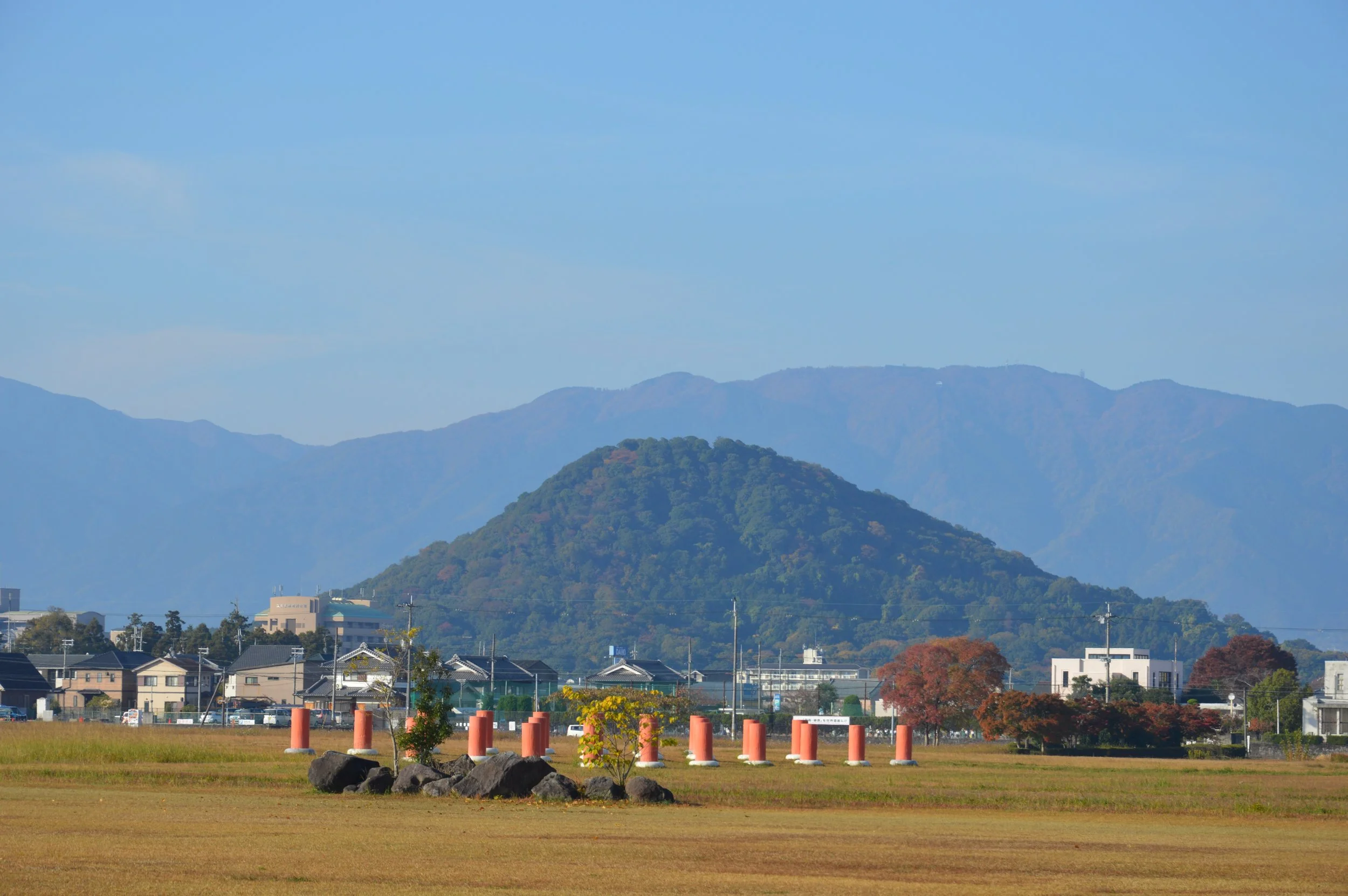
Indication of the location of pillar traces found in excavations of the Fujiwara Palace in Kashihara, at the Fujiwara capital site. Photo by author.

RSS
Previous Episodes
  • February 2026
  • January 2026
  • December 2025
  • November 2025
  • October 2025
  • September 2025
  • August 2025
  • July 2025
  • June 2025
  • May 2025
  • April 2025
  • March 2025
  • February 2025
  • January 2025
  • December 2024
  • November 2024
  • October 2024
  • September 2024
  • August 2024
  • July 2024
  • June 2024
  • May 2024
  • April 2024
  • March 2024
  • February 2024
  • January 2024
  • December 2023
  • November 2023
  • October 2023
  • September 2023
  • August 2023
  • July 2023
  • June 2023
  • May 2023
  • April 2023
  • March 2023
  • February 2023
  • January 2023
  • December 2022
  • November 2022
  • October 2022
  • September 2022
  • August 2022
  • July 2022
  • June 2022
  • May 2022
  • April 2022
  • March 2022
  • February 2022
  • January 2022
  • December 2021
  • November 2021
  • October 2021
  • September 2021
  • August 2021
  • July 2021
  • June 2021
  • May 2021
  • April 2021
  • March 2021
  • February 2021
  • January 2021
  • December 2020
  • November 2020
  • October 2020
  • September 2020
  • August 2020
  • July 2020
  • June 2020
  • May 2020
  • April 2020
  • March 2020
  • February 2020
  • January 2020
  • December 2019
  • November 2019
  • October 2019
  • September 2019
Archives

This episode talks about two projects that were started—but hardly finished—in the current reign. One of these was what Bentley describes as an “historiographical project” and the other was nothing less than the creation of the first permanent capital city: The city of Fujiwara-kyō

The Temmu-Jitō Historiographical Project

In 681, the sovereign gave orders to a group of Princes and high ministers to collect the various historical documents. There are many that believe this was the start of what would become the Kojiki and the Nihon Shoki, though given the differences, it seems like these works may have each leveraged some part of the effort, but may have been later works that put the historical details this effort gathered into context.

The group putting everything together included:

  • Royal Prince Kawashima - Second eldest son of Naka no Ōe (Tenji Tennō). He wouldn’t see the project through, either—or at least not the

  • Royal Prince Osakabe - Non-inheriting son of Ōama. He would also be involved with the Taihō Ritsuryō

  • Princes Hirose, Takeda, Kuwada, and Mino - Four non-royal princes, meaning that they were considered descendants of some prior sovereign, but their parents were not sovereigns, themselves. Unfortunately, these all appear to be locative titles, meaning they are names that come from locations that are passed to different individuals, making it difficult to determine who is who without more information. Still, it is key that they are outside of the ministerial class, and given some deference as being part of the extended royal family.

  • Kamitsukenu (Kōzuke) no Kimi no Michiji (Lower Daikin Rank) - The only one on the list with the “Kimi” kabane and the highest ranked official at Lower Daikin. In previous portions of the Chronicles, one would assume that that “Kimi” meant that they were the lords of Kōzuke, and the family seems to have had influence in the region. Unfortunately, they would pass away later the same year that they started the project.

  • Imbe no Muraji no Kobito (Middle Shōkin Rank) - A longtime supporter of the sovereign, he had joined the Yoshino side and defended Asuka, removing the planks from the bridges and building barricades to help defend from the Ōmi court. His kabane would later go from Muraji to Sukune under the new system.

  • Adzumi no Muraji no Inashiki (Lower Shōkin Rank) - Inashiki was a minister under the old Ōmi court, but not mentioned as directly fighting against Ōama, and would be among those pardoned by him. There must not have been too much distrust as he was clearly trusted with this task.

  • Naniwa no Muraji no Ōgata (no rank mentioned) - This individual is something of a mystery as no rank at all is mentioned and there seems to be no further mention of them in the Chronicles. We know that he was of the Naniwa family, which were previously the Naniwa no Kishi before they were given the status of Muraji. My assumption is that he was Lower Shōkin rank and they were just not restating it in the list.

  • Nakatomi no Muraji no Ōshima (Upper Daisen Rank) - Though a member of the powerful Nakatomi family, Ōshima’s position appears to have been that of scribe, helping to keep a record of what happened. This seemed to be the start of quite the career for Ōshima. He was a member of the Nakatomi house, but would later be listed as Fujiwara no Ōshima, from about 685 to 690. It is unclear if he took this name, or it was given to him—there is a bit of confusion around the name “Fujiwara” and which members of the Nakatomi clan would use it. This is something we should address at a later point in the story.

  • Heguri no Omi no Kobito (Lower Daisen Rank) - Another member of a prestigious family, but we don’t have much more to go on. Kobito itself is a fairly common given name in the Chronicles.

The Fujiwara Capital

We are going to discuss this more when we get into the next reign and they are actually occupying it, but the Fujiwara capital is the first time we’ve seen the state attempt to build an entire city. Previously we’ve seen “capitals” built, but it is mostly the palace, and we don’t necessarily see the larger infrastructure that was built around it. It may be that outside of the sovereign’s palace compound it was considered to be on the various ministerial families to figure out their own residences and lodging. However, in this instance it was full on large scale roads and blocks that were then divvied out amongst the ministerial families.

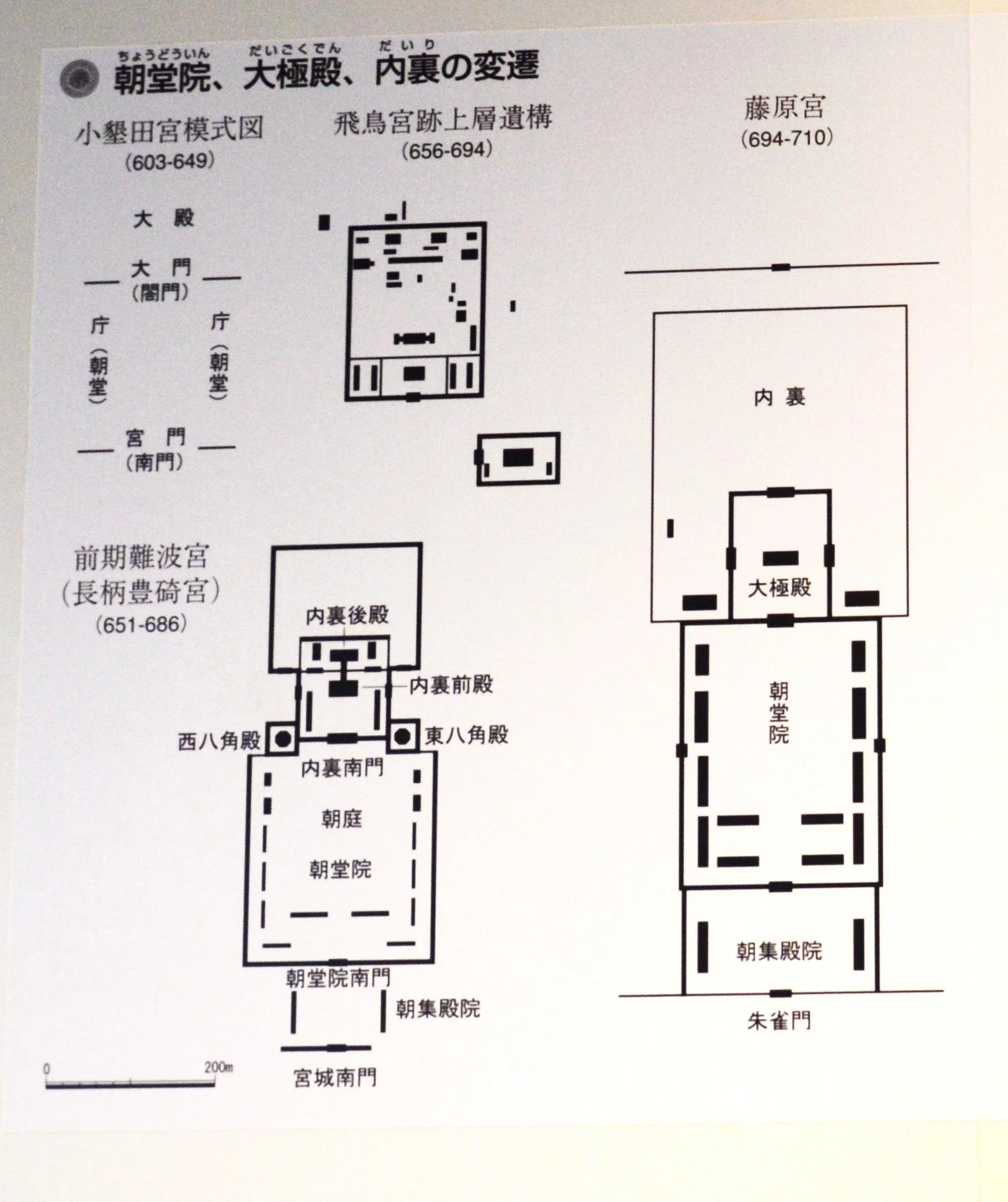
Palace comparisons
Palace comparisons

Oharida Palace (603-649)
Naniwa Toyosaki Palace (651-686)
Kiyomihara Palace (656-694)
Fujiwara Palace (694-710)

From the Exhibition Room of the Fujiwara Palace Site. Photo by author.

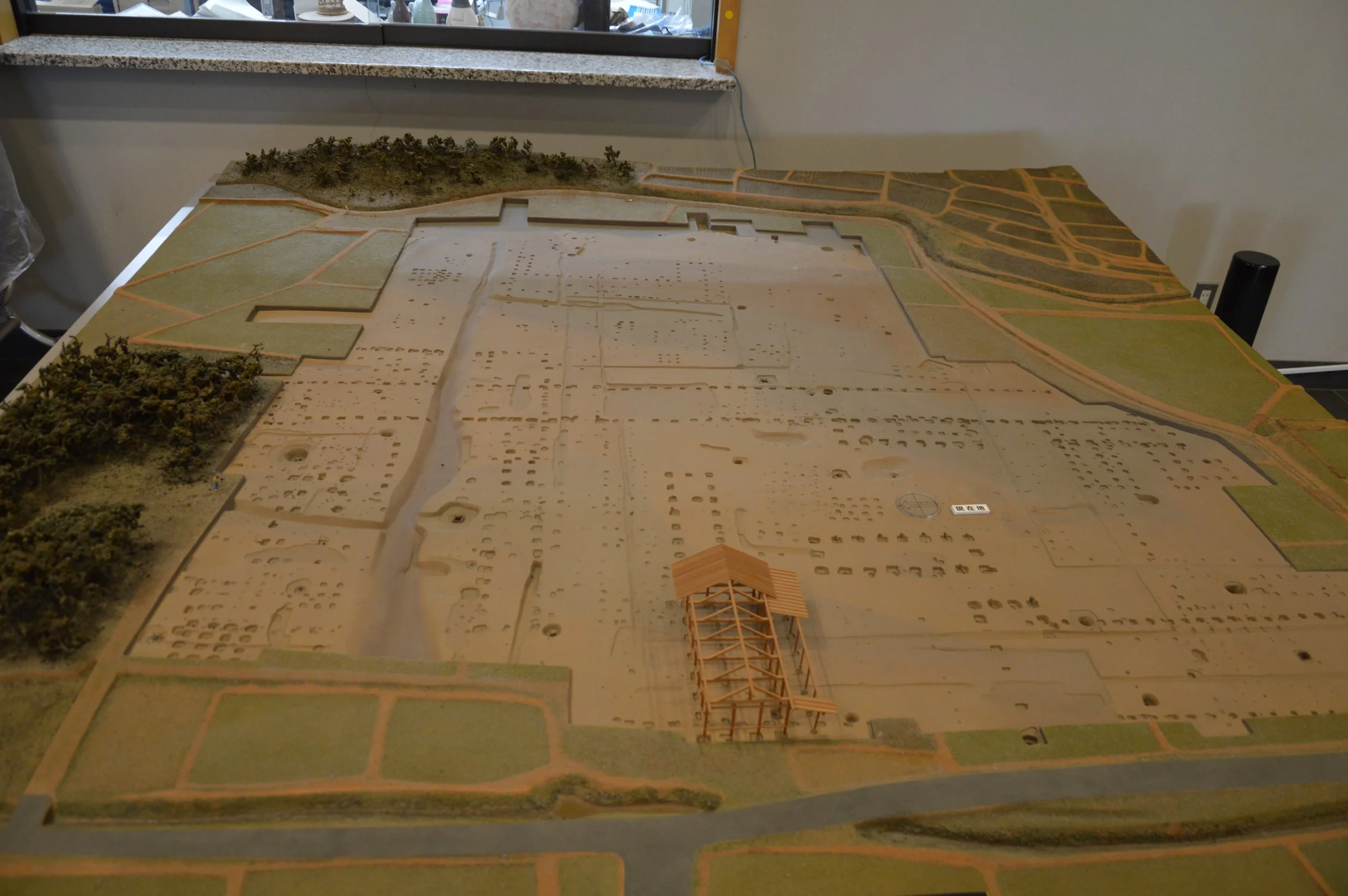
Excavation of the Palace site

From the Exhibition Room of the Fujiwara Palace Site. Photo by author.

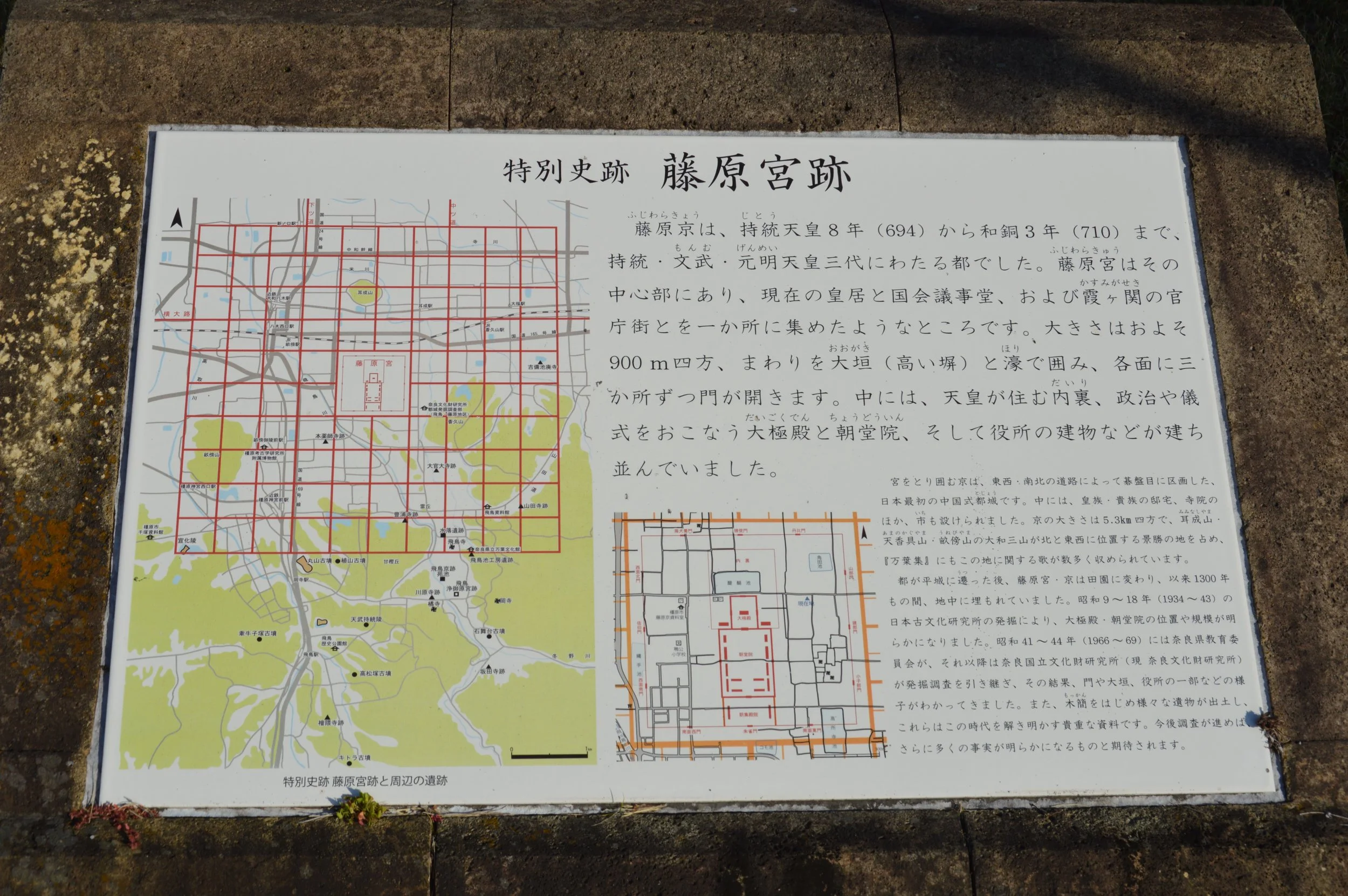
Layout of the city
Layout of the city

From the Fujiwara capital site. Photo by author.

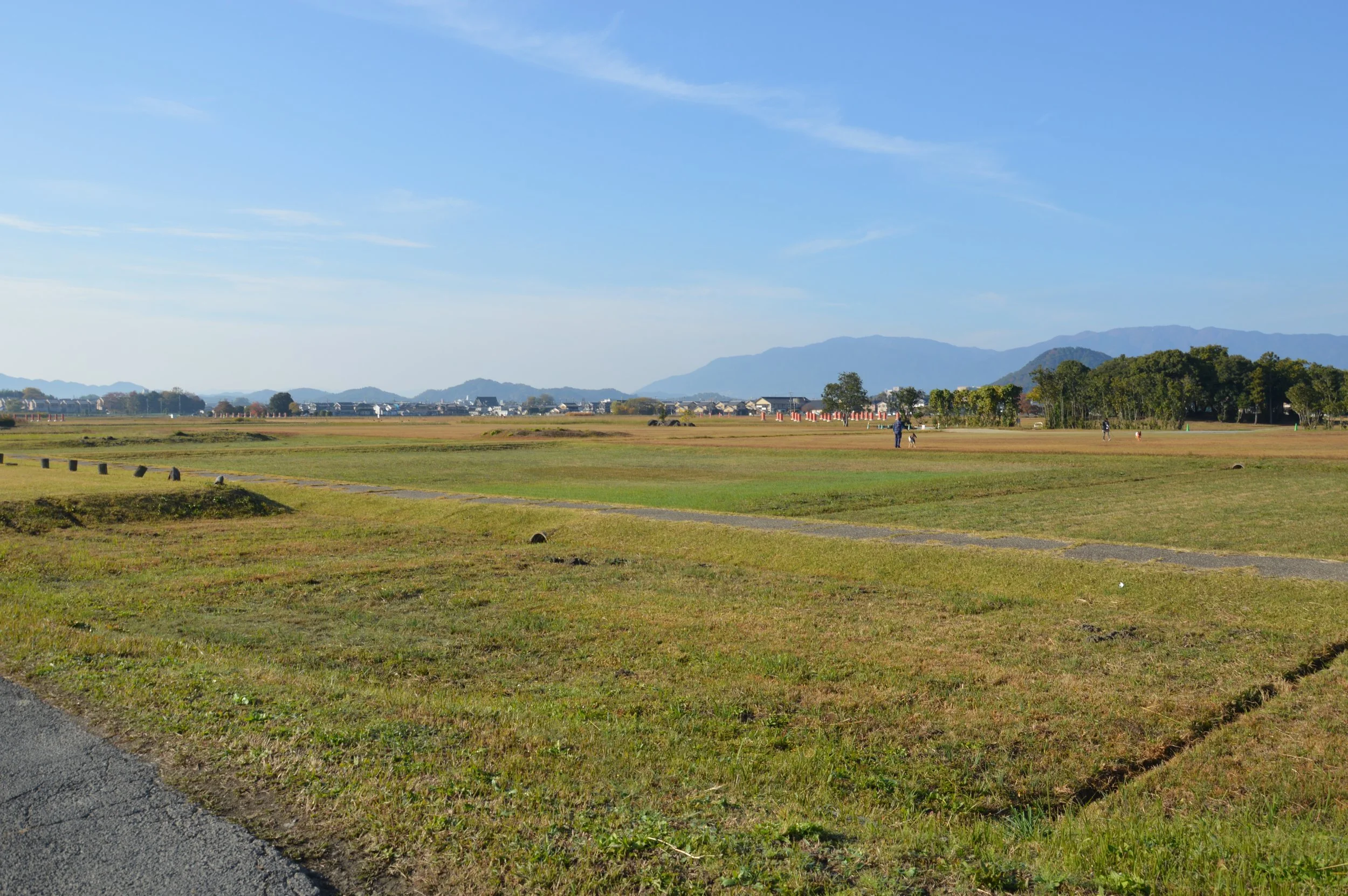
Fujiwara palace ruins site

Photo by author.

Fujiwara Palace Ruins Site and Mt. Unebi

Photo by author.

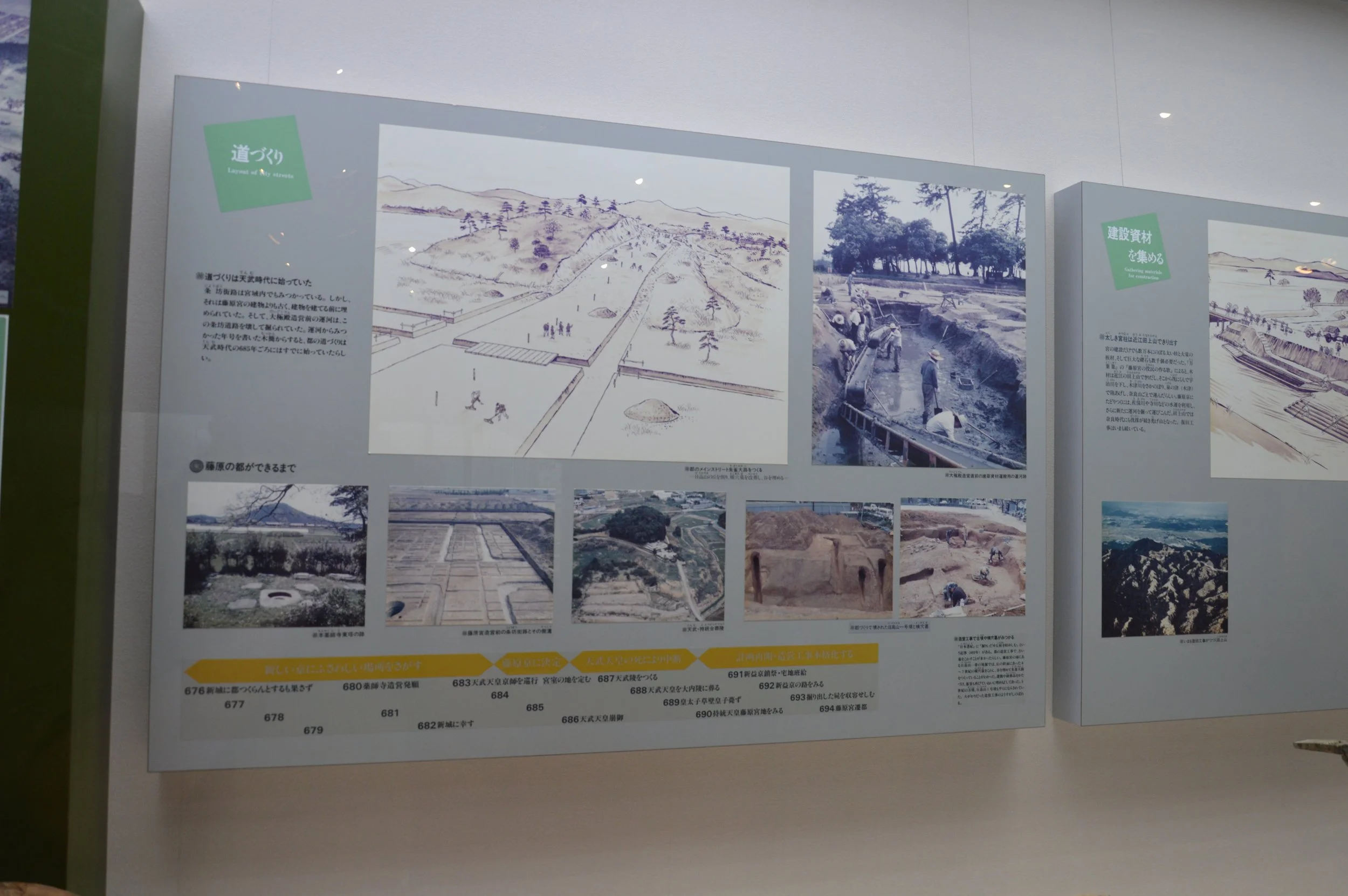
Fujiwara Capital Roads

Diagram showing the excavated roads and how they may have been built. From the Exhibition Room of the Fujiwara Palace Site. Photo by author.

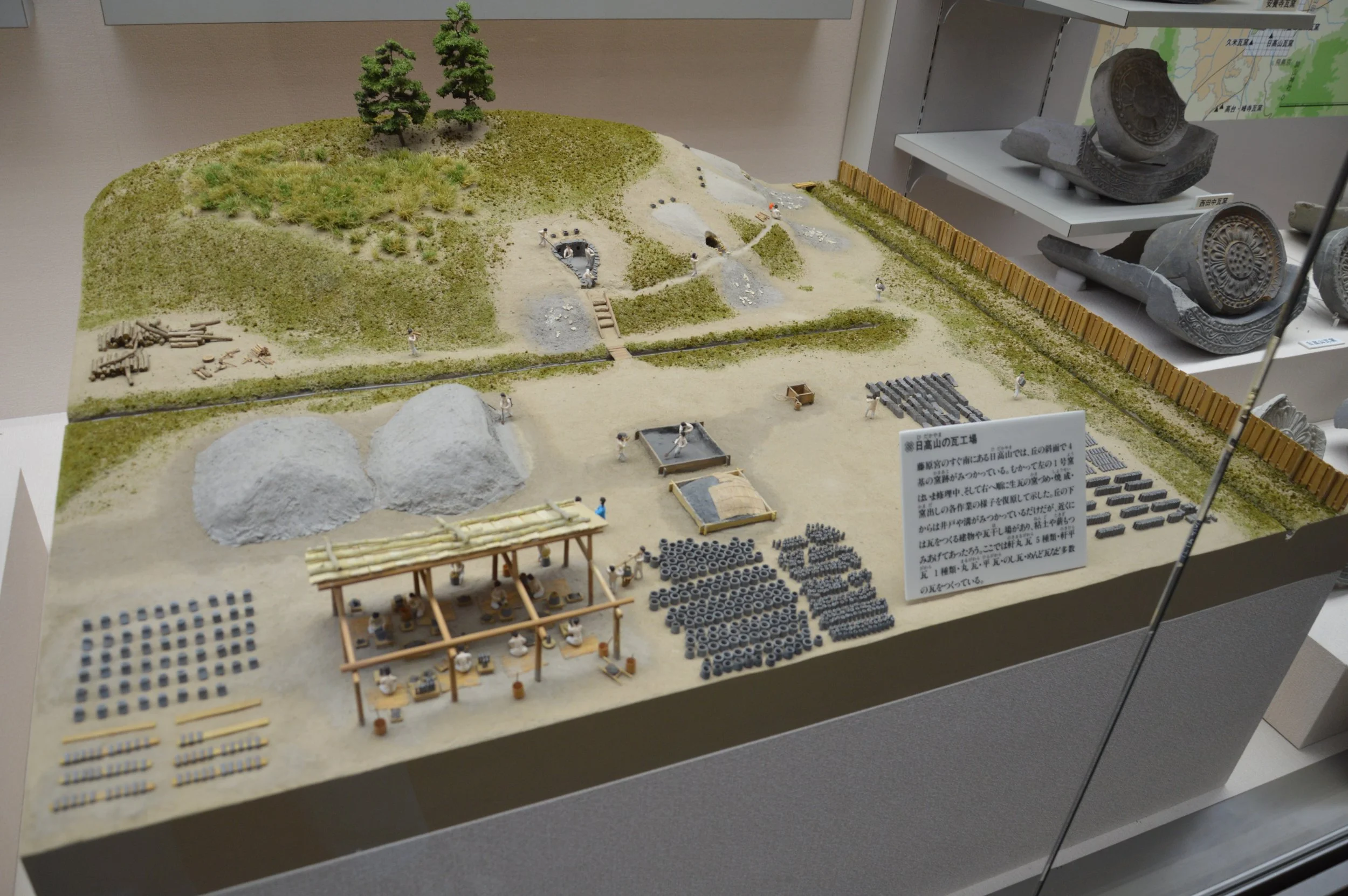
Kiln diorama
Kiln diorama

From the Exhibition Room of the Fujiwara Palace Site. Photo by author.

Palace comparisons Excavation of the Palace site Layout of the city Fujiwara palace ruins site Fujiwara Palace Ruins Site and Mt. Unebi Fujiwara Capital Roads Kiln diorama


  • Welcome to Sengoku Daimyo’s Chronicles of Japan.  My name is Joshua and this is Episode 143: Temmu’s Monumental Projects

    Ohoama sat astride his horse and looked out at the land in front of him.   He could still see the image of the rice fields, now long fallow, spreading out on the plain.  To the north, east, and west, he could see the mountains that would frame his vision.  As his ministers started to rattle off information about the next steps of the plan, Ohoama began to smile.  He thought of the reports his embassies to the Great Tang had brought back, about the great walled cities of the continent.  In his mind’s eye, Ohoama envisioned something similar, rising up on the plain in front of him.

    There would be an earth and stone wall, surrounding the great city.  The gates would be grand, much like the temples, but on an even greater scale.  Houses would be packed in tight, each within their own walled compounds.  In the center painted red and white, with green accents, would be a palace to rival any other structure in the archipelago.  The people would stream in, and the city would be bustling with traffic.

    This was a new center, from which the power of Yamato would be projected across the islands and even to the continent.


    Greetings everyone, and welcome back.  This episode we are still focused on the reign of Ohoama, aka Temmu Tennou, between the years 672 and 686.

    Last episode we talked about the Four Great Temples—or the Four National Temples.  Much of this episode was focused on the rise and spread of Buddhism as we see in the building of these national temples, but also on the changes that occurred as the relationship between Buddhism and the State evolved.  This was part of Ohoama’s work to build up the State into something beyond what it had been in the past—or perhaps into something comparable to what they believed it to have been in the past.  After all, based on the size of the tomb mounds in the kofun period, it does seem that there was a peak of prosperity in the 5th century, around the time of Wakatakeru, aka Yuryaku Tennou, and then a decline, to the point that the lineage from Wohodo, aka Keitai Tennou, seemed to have come in during a time when they were rebuilding Yamato power and authority.

    This episode we are going to talk about two projects that Ohoama kicked off during his reign.  He wouldn’t see the completion of either one, since both took multiple decades to complete, but both focused on linking the past and the future. 

    The first we’ll talk about is a new attempt to gather historical documents and records—the last time that was done was in the time of Kashikiya Hime, over 50 years ago.  That was during the height of Soga power.  Since then a lot had changed, and presumably there were even more stories and records that had been written down.  Plus the tide had changed.  So they needed to update—and maybe even correct—the historical record. But beyond that, there was a greater goal: Ohoama and his court also needed to make sure that the past was something that they wanted to go back to, among other things.

    The other thing we are going to discuss is the start of a project to build a brand new capital city.  And when we talk a bout city, we really mean a city.  This was a massive undertaking, likely unlike anything that we’ve seen so far.  Sure, there had been monumental building projects, but this was something that was going to take a lot more work - how much more monumental could you get than a new city?  And it would create a physical environment that would be the embodiment of the new centralization of power and authority, and the new state that Ohoama was building, with his administration—and Yamato—at the center.  

    Let’s start with the big ones.  First and foremost, we have the entry from the 17th day of the 3rd month of the 681.  Ohoama gave a decree from the Daigokuden to commit to writing a Chronicle of the sovereigns and various matters of high antiquity.  Bentley translates this as saying that they were to record and confirm the Teiki, which Aston translated as the Chronicle of the Sovereigns, and various accounts of ancient times.  This task was given out to a slew of individuals, including the Royal Princes Kawashima and Osakabe; the Princes Hirose, Takeda, Kuwada, and Mino; as well as Kamitsukenu no Kimi no Michichi, Imbe no Muraji no Kobito, Adzumi no Muraji no Inashiki, Naniwa no Muraji no Ohogata, Nakatomi no Muraji no Ohoshima, and Heguri no Omi no Kobito.  Ohoshima and Kobito were specifically chosen as the scribes for this effort. 

    We aren’t told what work was started at this time.  Aston, in his translation of the Nihon Shoki, assumes that this is the start of the Kojiki.  Bentley notes that this is the first in a variety of records about gathering the various records, including gathering records from the various families, and eventually even records from the various provinces.  And I think we can see why.  Legitimizing a new state and a new way of doing things often means ensuring that you have control of the narrative.  Today, that often means doing what you can to control media and the stories that are in the national consciousness.  In Ohoama’s day, I’d argue that narrative was more about the various written sources, and how they were presented.  After all, many of the rituals and evidence that we are looking at would rely on the past to understand the present.  The various family records would not only tell of how those families came to be, but would have important information about what else was going on, and how that was presented could determine whether something was going to be seen as auspicious, or otherwise.  Even without getting rid of those records, it would be important to have the official, State narrative conform to the Truth that the state was attempting to implement.

    Ultimately, there is no way to know, exactly, how everything happened.  If the Nihon Shoki had a preface, it has been lost.  The Kojiki, for its part, does have a preface, and it points to an origin in the reign of Ohoama—known as the sovereign of Kiyomihara.  In there we are told that the sovereign had a complaint—that the Teiki and Honji, that is the chronicles of the sovereigns and the various other stories and legends, that had been handed down by various houses had come to differ from the truth.  They said they had many falsehoods, which likely meant that they just didn’t match the Truth that the State was trying to push.  Thus  they wanted to create a so-called “true” version to pass down.

    This task was given to 28 year old Hieda no Are.  It says they were intelligent and had an incredible memory.  They studied all of the sources, and the work continued beyond the reign of Ohoama.  Later, in 711 CE, during the reign of Abe, aka Genmei Tennou, Oho no Yasumaro was given the task of writing down everything that Hieda no Are had learned. 

    The astute amongst you may have noticed that this mentions none of the individuals mentioned in the Nihon Shoki.  Nor does the Nihon Shoki mention anything about Hieda no Are.  So was this a separate effort, or all part of the same thing?  Was Are using the materials collected by  the project?

    As you may recall, we left the Kojiki behind some time ago, since it formally ends with the reign of Kashikiya hime, aka Suiko Tennou, but realistically it ended with Wohodo, aka Keitai Tennou—after that point there are just lists of the various heirs.  As such, there is some speculation that this was originally built off of earlier histories, perhaps arranged during the Soga era.

    The general explanation for all of this is that Hieda no Are memorized the poems and stories, and then Yasumaro wrote them down.  Furthermore, though the language in the Kojiki does not express a particular gender, in the Edo period there was a theory that Hieda no Are was a woman, which is still a popular theory.

    Compare all of that to the Nihon Shoki.  Where the Kojiki was often light on details and ends with Suiko Tennou, the Nihon Shoki often includes different sources, specifically mentions some of them by name, and continues up through the year 697.  Furthermore, textual analysis of the Nihon Shoki suggests that it was a team effort, with multiple Chroniclers, and likely multiple teams of Chroniclers.   I have to admit, that sounds a lot more like the kind of thing that Ohoama was kicking off.

    We have an entry in the Shoku Nihongi, the work that follows the Nihon Shoki, that suggests 720 for the finished compilation of the Nihon Shoki.  So did it take from 681 to 720 to put together?  That is a really long project, with what were probably several generations of individuals working on it.

    Or should this be read in a broader sense?  Was this a historiographical project, as Bentley calls it, but one that did not, immediately, know the form it would take?  It isn’t the first such project—we have histories of the royal lineage and other stories that were compiled previously—much of that attributed to Shotoku Taishi, but likely part of an earlier attempt by the court.  In fact, given that the Kojiki and Sendai Hongi both functionally end around the time of Kashikiya hime, that is probably because the official histories covered those periods.  Obviously, though, a lot had happened, and some of what was written might not fit the current narrative.  And so we see a project to gather and compile various sources.  While this project likely culminated in the projects of the Kojiki and the Nihon Shoki, I doubt that either work was necessarily part of the original vision.  Rather, it looks like the original vision was to collect what they could and then figure things out.

    It would have been after they started pulling the accounts together, reading them, and noticing the discrepancies that they would have needed to then edit them in such a way that they could tell a cohesive story.  That there are two separate compilations is definitely interesting.  I do suspect that Oho no Yasumaro was working from the efforts of Hieda no Are, either writing down something that had been largely captured in memory or perhaps finishing a project that Are had never completed.  The Nihon Shoki feels like it was a different set of teams, working together, but likely drawing from many of the same sources.

    And as to why we don’t have the earlier sources?  I once heard it said that for books to be forgotten they didn’t need to be banned—they just needed to fall out of circulation and no longer be copied anymore.  As new, presumably more detailed, works arose, it makes sense that older sources would not also be copied, as that information was presumably in the updated texts, and any information that wasn’t brought over had been deemed counterfactual.  Even the Nihon Shoki risked falling into oblivion; the smaller and more digestible Kojiki was often more sought after.  The Kojiki generally presents a single story, and often uses characters phonetically, demonstrating how to read names and places.  And it just has a more story-like narrative to it.  The Nihon Shoki, comparatively, is dense, written in an old form of kanbun, often relying more on kanbun than on phonetic interpretations.  It was modeled on continental works, but as such it was never going to be as easy to read.  And so for a long time the Kojiki seems to have held pride of place for all but the most ardent scholars of history.

    Either way, I think that it is still fair to say that the record of 681 was key to the fact that we have this history, today, even if there was no way for Ohoama, at the time, to know just what form it would take.

    Another ambitious project that got started under Ohoama was the development of a new and permanent capital city.

    Up to this point we’ve talked about the various capitals of Yamato, but really it was more that we were talking about the palace compounds where the sovereign lived.  From the Makimuku Palace, where either Mimaki Iribiko or possibly even Himiko herself once held sway, to the latest palace, that of Kiyomihara, the sovereigns of Yamato were known by their palaces.  This is, in part, because for the longest time each successive sovereign would build a new palace after the previous sovereign passed away.  There are various reasons why this may have been the case, often connected to insular concepts of spiritual pollution brought on by the death of an individual, but also the practical consideration that the buildings, from what we can tell, were largely made of untreated wood.  That made them easier to erect, but also made them vulnerable to the elements, over time, and is probably one of the reasons that certain shrines, like the Shrine at Ise, similarly reconstitute themselves every 20 years or so.

    Furthermore, we talk about palaces, but we don’t really talk about cities.  There were certainly large settlements—even going back to the Wei chronicles we see the mention of some 70 thousand households in the area of Yamateg.  It is likely that the Nara basin was filled with cultivated fields and many households.  Princes and noble households had their own compounds—remember that both Soga no Umako and Prince Umayado had compounds large enough that they could build temples on the compounds and have enough left over for their own palatial residences, as well.  However, these compounds were usually distributed in various areas, where those individuals presumably held some level of local control.

    It is unclear to me how exactly the early court functioned as far as housing individuals, and how often the court was “in session”, as it were, with the noble houses.  Presumably they had local accommodations and weren’t constantly traveling back and forth to the palace all the time.  We know that some houses sent individuals, men and women, to be palace attendants, even though they lived some distance away.  This was also likely a constraint on the Yamato court’s influence in the early days.

    We do see the sovereign traveling, and various “temporary” palaces being provided.  I highly doubt that these were all built on the spot, and were likely conversions of existing residences, and similar lodging may have been available for elites when they traveled, though perhaps without such pomp and circumstance.

    What we don’t really see in all of this, are anything resembling cities.  Now, the term “city” doesn’t exactly have a single definition, but as I’m using it, I would note that we don’t see large, permanent settlements of significant size that demonstrate the kind of larger civil planning that we would expect of such a settlement.  We certainly don’t have cities in the way of the large settlements along the Yangzi and Yellow rivers.

    We talked some time back about the evolution of capital city layouts on the continent.  We mentioned that the early theoretical plan for a capital city was based on a square plan, itself divided into 9 square districts, with the central district constituting the palace.  This design works great on paper, but not so much in practice, especially with other considerations, such as the north-south orientation of most royal buildings.  And then there are geographic considerations.  In a place like Luoyang, this square concept was interrupted by the river and local topography.  Meanwhile, in Chang’an, they were able to attain a much more regular rectangular appearance.  Here, the court and the palace were placed in the center of the northernmost wall.  As such, most of the city was laid out to the south of the palace.

    In each case, however, these were large, planned cities with a grid of streets that defined the neighborhoods.  On each block were various private compounds, as well as the defined markets, temples, et cetera.

    The first possible attempt at anything like this may have been with the Toyosaki palace, in Naniwa.  There is some consideration that, given the size of the palace, there may have been streets and avenues that were built alongside it, with the intention of having a similar city layout.  If so, it isn’t at all clear that it was ever implemented, and any evidence may have been destroyed by later construction on the site.  Then we have the Ohotsu palace, but that doesn’t seem to be at the same scale as the Toyosaki palace—though it is possible that, again, we are missing some key evidence.  Nonetheless, the records don’t really give us anything to suggest that these were large cities rather than just palaces.

    There is also the timeline.  While both the Toyosaki palace and the Ohotsu palace took years to build, they did not take the time and amount of manpower that would be needed to create a true capital city.  We can judge this based on what it took to build the new capital at Nihiki.

    This project gets kicked off in the 11th month of 676.  We are told that there was an intent to make the capital at Nihiki, so all of the rice-fields and gardens within the precincts, public and private property alike, were left fallow and became totally overgrown.

    This likely took some time.  The next time we see Nihiki is in the 3rd month of 682, when Prince Mino, a minister of the Household Department, and others, went there to examine the grounds.  At that point they apparently made the final decision to build the capital there.  Ohoama came out to visit later that same month.

    However, a year later, in the 12th month of 683, we are told that there was a decree for there to be multiple capitals and palaces in multiple sites, and they were going to make the Capital at Naniwa one of those places.  And so public functionaries were to go figure out places for houses.  So it wasn’t just that they wanted to build one new, grand capital.  It sounds like they were planning to build two or three, so not just the one at Nihiki.  This is also where I have to wonder if the Toyosaki Palace was still being used as an administrative center, at the very least.  Or was it repurposed, as we saw that the Asuka palaces had been when the court moved to Ohotsu?

    This is further emphasized a few months later, when Prince Hirose and Ohotomo Yasumaro, at the head of a group of clerks, officials, artisans, and yin yang diviners were sent around the Home Provinces to try and divine sites suitable for a capital.  In addition, Prince Mino, Uneme no Oni no Tsukura, and others were sent to Shinano to see about setting up a capital there as well.  Perhaps this was inspired by the relationship between the two Tang capitals of Chang’an and Luoyang.  Or perhaps it was so that if one didn’t work out another one might.

    Regardless, Nihiki seemed to be the primary target for this project, and in the third lunar month of 684 Ohoama visited the now barren grounds and decided on a place for the new palace.  A month later, Prince Mino and others returned with a map of Shinano, but there is no indication of where they might want to build another capital.

    After that, we don’t hear anything more of Shinano or of a site in the Home Provinces.  We do hear one more thing about Naniwa, which we mentioned a couple of episodes back, and that is that in 686 there was a fire that burned down the palace at Naniwa, after which they seem to have abandoned that as a palace site.  And so we are left with the area of Nihiki.

    This project would take until the very end of 694 before it was ready.  In total, we are looking at a total of about 18 years—almost two decades, to build a new capital.  Some of this may have been the time spent researching other sites, but there also would have been significant time taken to clear and level.  This wasn’t just fields—based on what we know, they were even taking down old kofun; we are later told about how they had to bury the bodies that were uncovered.  There was also probably a pause of some kind during the mourning period when Ohoama passed away.  And on top of it, this really was a big project.  It wasn’t just building the palace, it was the roads, the infrastructure, and then all of the other construction—the city gates, the various private compounds, and more.  One can only imagine how much was being invested, especially if they were also looking at other sites and preparing them at the same time.  I suspect that they eventually abandoned the other sites when they realized just how big a project it really was that they were undertaking.

    Today we know that capital as Fujiwara-kyo, based on the name of the royal palace that was built there, and remarkably, we know where it was.  Excavations have revealed the site of the palace, and have given us an idea of the extent of the city:  It was designed as a square, roughly 5.3 kilometers, or 10 ri, on each side.  The square itself was interrupted by various terrain features, including the three holy mountains.  Based on archaeological evidence, the street grid was the first thing they laid out, and from what we can tell they were using the ideal Confucian layout as first dictated in the Zhouli, or Rites of Zhou.  This meant a square grid, with the palace in the center.

    Indeed, the palace was centered, due south of Mt. Miminashi, and you can still go and see the palace site, today.  When they went to build the palace, they actually had to effectively erase, or bury, the roads they had laid out.  They did the same thing for Yakushi-ji, or Yakushi-temple, when they built it as part of the city; one of the reasons we know it had to have been built after the roads were laid out. 

    We will definitely talk about this more when we get to that point of the Chronicles, but for now, know that the Fujiwara palace itself, based on excavations of the site, was massive.  The city itself would surpass both Heijo-kyo, at Nara, and Heian-kyo, in modern Kyoto.  And the palace was like the Toyosaki Naniwa palace on steroids.  It included all of the formal features of the Toyosaki Palace for running the government, but then enclosed that all in a larger compound with various buildings surrounding the court itself.  Overall, the entire site is massive.  This was meant as a capital to last for the ages.

    And yet, we have evidence that it was never completed.  For one thing, there is no evidence that a wall was ever erected around it—perhaps there was just no need, as relations with the mainland had calmed down, greatly.  But there is also evidence that parts of the palace, even, were not finished at the time that they abandoned it.  Fujiwara-kyo would only be occupied for about 16 years before a new capital was built—Heijo-kyo, in Nara.  There are various reasons as to why they abandoned what was clearly meant to be the first permanent capital city, and even with the move to a new city in Nara it would be clear that it was going to take the court a bit of time before they were ready to permanently settle down—at least a century or so.

    Based on all the evidence we have, and assuming this was the site of the eventual capital, Nihiki was the area of modern Kashihara just north of Asuka, between—and around—the mountains of Unebi, Miminashi, and Kagu.  If these mountains are familiar, they popped up several times much earlier in the Chronicles--Mostly in the Age of the Gods and in the reign of the mythical Iware-biko, aka Jimmu Tennou.  Yet these three mountains help to set out the boundaries of the capital city that was being built at this time.

    There is definitely some consideration that they were emphasized in the early parts  of the Chronicles—the mythical sections, which were bolstering the story of Amaterasu and the Heavenly Grandchild, setting up the founding myths for the dynasty.  Even though the Chronicles  were not completed until well after the court had moved out, the Fujiwara capital is the climax of the Nihon Shoki, which ends in 697, three years into life at the new palace.  And so we can assume that much of the early, critical editing of the Kojiki and Nihon Shoki were done with the idea that this would be the new capital, and so it was woven into the histories, and had it continued as the capital, the very landscape would have recalled the stories of the divine origins of the Royal family and the state of Yamato itself. 

    This was the stage on which Ohoama’s state was built.  He, and his successors, didn’t just change the future path of the Yamato government.  They rearranged the physical and temporal environment, creating a world that centered them and their government.  I suspect that Ohoama didn’t originally consider that these wouldn’t be finished during his reign.  That said, he came to power in his 40s, only slightly younger than his brother, who had just died.  He would live to be 56 years old—a respectable age for male sovereigns, around that time.  From a quick glance, Naka no Oe was about 45 or 46 years old, while Karu lived to about 57 or 58.  Tamura only made it to 48.  The female sovereigns seem to have lasted longer, with Ohoama’s mother surviving until she was 66 or 67 years old, and Kashikiya Hime made it to the ripe old age of 74.  That said, it is quite likely that he thought he would make it longer.  After all, look at all the merit he was accruing!  Still, he passed away before he could see these projects fully accomplished.  That would have to be left for the next reign—and even that wasn’t enough.  The Fujiwara Capital would only be occupied for a short time before being abandoned about two reigns later, and the histories as we know them wouldn’t be complete for three more reigns. 

    So given all of this, let’s take another quick look at Ohoama himself and where he stands at this pivotal moment of Yamato history.When we look at how he is portrayed, Ohoama is generally lionized for the work he is said to have accomplished.  I would argue that he is the last of three major figures to whom are attributed most of the changes that resulted in the sinification of the Yamato government. 

    The first is prince Umayado, aka Shotoku Taishi, who is said to have written the 17 article constitution, the first rank system, and the introduction of Buddhism.  To be fair, these things—which may not have been exactly as recorded in the Chronicles—were likely products of the court as a whole.  Many people attribute more to Kashikiya Hime, aka Suiko Tennou, as well as Soga no Umako.  Of course, Soga no Umako wasn’t a sovereign, or even a member of the royal family, and Kashikiya Hime, aka Suiko Tennou, seems to have likewise been discounted, at least later, possibly due to the fact that she is thought to have come to power more as a compromise candidate than anything else—she was the wife of a previous sovereign and niece to Soga no Umako.  Many modern scholars seem to focus more on the agency of Kashikiya Hime and suggest that she had more say than people tend to give her credit for.  That said, Shotoku Taishi seems to have been the legendary figure that was just real enough to ascribe success to.  That he died before he could assume the throne just meant that he didn’t have too many problematic decisions of his own to apparently work around.

    The next major figure seems to be Naka no Oe, aka Tenji Tennou.  Naka no Oe kicks off the period of Great Change, the Taika era, and is credited with a lot of the changes—though I can’t help but notice that the formal sovereign, Naka no Oe’s uncle, Karu, seems to have stuck with the new vision of the Toyosaki Palace and the administrative state while Naka no Oe and his mother moved back to the traditional capital.  And when Naka no Oe moved the capital to Ohotsu, he once again built a palace more closely aligned to what we see in Asuka than the one in Naniwa, which brings some questions about how the new court was operating.  But many of his reforms clearly were implemented, leveraging the new concepts of continental rulership to solidify the court’s hegemony over the rest of the archipelago.

    Ohoama, as represented in the Chronicles, appears to be the culmination of these three.  He is building on top of what his brother had implemented through the last three reigns.  Some of what he did was consolidate what Naka no Oe had done, but there were also new creations, for which Ohoama is credited, even if most of the work was done outside of Ohoama’s reign, but they were attributed to Ohoama, nonetheless.  Much of this was started later in Ohoama’s reign, and even today there seem to be some questions about who did what.  Nonetheless, we can at least see how the Chroniclers were putting the story together.

    There are a lot of scholars that point to the fact that the bulk of the work of these projects would actually be laid out in the following reigns, and who suggest that individuals like the influential Uno no Sarara, who held the control of the government in Ohoama’s final days, may have had a good deal more impact on how things turned out, ultimately.  In fact, they might even have been more properly termed her projects—there are some that wonder if some of the attributions to Ohoama were meant to bolster the authority of later decrees, but I don’t really see a need for that, and it seems that there is enough evidence to suggest that these projects were begun in this period.

    All of this makes it somewhat ironic that by the time the narrative was consolidated and published to the court, things were in a much different place—literally.  The Fujiwara capital had been abandoned.  The court, temples, and the aristocracy had picked up stakes and moved north.  Fujiwara no Fuhito had come on the scene, and now his family was really taking off.  This was not the same world that the Chronicles had been designed around.

    And yet, that is what was produced.  Perhaps there is a reason that they ended where they did.

    From that point on, though, there were plenty of other projects to record what was happening.  Attempts to control the narrative would need to do a lot more.  We see things like the Sendai Kuji Hongi, with its alternative, and perhaps even subversive, focus on the Mononobe family.  And then later works like the Kogoshui, recording for all time the grievances of the Imbe against their rivals—for all the good that it would do.  With more people learning to write, it was no longer up to the State what did or did not get written down.

    But that has taken us well beyond the scope of this reign—and this episode, which we should probably be bringing to a close.  There are still some things here and there that I want to discuss about this reign—so the next episode may be more of a miscellany of various records that we haven’t otherwise covered, so far. 

    Until then if you like what we are doing, please tell your friends and feel free to rate us wherever you listen to podcasts.  If you feel the need to do more, and want to help us keep this going, we have information about how you can donate on Patreon or through our KoFi site, ko-fi.com/sengokudaimyo, or find the links over at our main website,  SengokuDaimyo.com/Podcast, where we will have some more discussion on topics from this episode.

    Also, feel free to reach out to our Sengoku Daimyo Facebook page.  You can also email us at the.sengoku.daimyo@gmail.com. 

    Thank you, also, to Ellen for their work editing the podcast.

    And that’s all for now.  Thank you again, and I’ll see you next episode on Sengoku Daimyo’s Chronicles of Japan.


References

  • Wittkamp, Robert F. (2026). Reading the Nihon Shoki: Chinese Encyclopedias, Source Criticism and Historical Writing in Old Japan. ISBN 9783695198436

  • Bentley, John R. (2025). Nihon Shoki: The Chronicles of Japan. ISBN 979-8-218634-67-4 pb

  • Bentley, J.R. (2020). The Birth of Japanese Historiography (1st ed.). Routledge. https://doi.org/10.4324/9780367809591

  • McCallum, Donald F. (2009). The Four Great Temples: Buddhist Archaeology, Architecture, and Icons of Seventh-Century Japan. ISBN 978-0-8248-3114-1

  • Bentley, John. (2006). The Authenticity of Sendai Kuji Hongi: a New Examination of Texts, with a Translation and Commentary. ISBN-90-04-152253.

  • Aston, W. G. (1972). Nihongi, chronicles of Japan from the earliest times to A.D. 697. London: Allen & Unwin. ISBN0-80480984-4.

  • Philippi, D. L. (1968). Kojiki. Princeton, N.J.: Princeton University Press. ISBN4-13-087004-1

In Podcast Tags Yamato, Japan, Japanese History, Temmu, Nihon Shoki, Kojiki, Fujiwara Palace, Fujiwara Capital, Fujiwara-kyo, Jito Tenno
Comment

Episode 133: Reimagining Yamato

September 1, 2025 Joshua Badgley

Copies of the Nihon Shoki, which has continued to influence the concept of Japan down to the modern day. Photo by author.

RSS
Previous Episodes
  • February 2026
  • January 2026
  • December 2025
  • November 2025
  • October 2025
  • September 2025
  • August 2025
  • July 2025
  • June 2025
  • May 2025
  • April 2025
  • March 2025
  • February 2025
  • January 2025
  • December 2024
  • November 2024
  • October 2024
  • September 2024
  • August 2024
  • July 2024
  • June 2024
  • May 2024
  • April 2024
  • March 2024
  • February 2024
  • January 2024
  • December 2023
  • November 2023
  • October 2023
  • September 2023
  • August 2023
  • July 2023
  • June 2023
  • May 2023
  • April 2023
  • March 2023
  • February 2023
  • January 2023
  • December 2022
  • November 2022
  • October 2022
  • September 2022
  • August 2022
  • July 2022
  • June 2022
  • May 2022
  • April 2022
  • March 2022
  • February 2022
  • January 2022
  • December 2021
  • November 2021
  • October 2021
  • September 2021
  • August 2021
  • July 2021
  • June 2021
  • May 2021
  • April 2021
  • March 2021
  • February 2021
  • January 2021
  • December 2020
  • November 2020
  • October 2020
  • September 2020
  • August 2020
  • July 2020
  • June 2020
  • May 2020
  • April 2020
  • March 2020
  • February 2020
  • January 2020
  • December 2019
  • November 2019
  • October 2019
  • September 2019
Archives
 

With the end of the Jinshin War, Oama, posthumously known as Temmu Tenno, came to the throne.  And though they would need a new Great Council of State, they continued to build up and bolster the Ritsuryo state.  They were imagining a new Yamato based on continental models of what a state should look like, but also influenced by tradition.  This episode we take a look at that reimagining in broad strokes, asking a few questions--what was Oama's relationship with his brother, and touching on the relationship of Nakatomi no Kamatari and his brother, Nakatomi no Kane.  We also take a look at some of the literary propaganda that also helped to codify this new imaginary--the Nihon Shoki and the Kojiki.  We also touch on other sourcesof information, like the Fudoki and Man'yoshu.

  • With the end of the Jinshin War, Oama, posthumously known as Temmu Tenno, came to the throne.  And though they would need a new Great Council of State, they continued to build up and bolster the Ritsuryo state.  They were imagining a new Yamato based on continental models of what a state should look like, but also influenced by tradition.  This episode we take a look at that reimagining in broad strokes, asking a few questions--what was Oama's relationship with his brother, and touching on the relationship of Nakatomi no Kamatari and his brother, Nakatomi no Kane.  We also take a look at some of the literary propaganda that also helped to codify this new imaginary--the Nihon Shoki and the Kojiki.  We also touch on other sourcesof information, like the Fudoki and Man'yoshu.

    For more information, check out our blog:  https://sengokudaimyo.com/podcast/episode-133


    Rough Transcript

    Welcome to Sengoku Daimyo’s Chronicles of Japan.  My name is Joshua, and this is episode 133: Reimagining Yamato

    As the bells of Houkouji tolled, Ohoama and his wife, Uno, surveyed the construction on going in the Asuka valley.  Hordes of workers had been called up, and now they were working furiously towards the deadline of the new year.  Where once stood the later Wokamoto palace of Takara Hime, aka Ohoama’s mother, Saimei Tennou, now the land was being prepared for a palace on a much grander scale.  And just as the palace was being remade, Ohoama’s thoughts went beyond the valley, to the entire archipelago.  His brother, Naka no Oe, had started something profound.  Now here he was, helming the Ship of State, and Ohoama had plans of his own, built upon his brother’s ideas.  He would build a new state, ensuring that the reforms that started back in 645 would continue for generations.

    Greetings everyone and welcome back.  As we dive back in, let’s recap where we are.

    The year is now 673, and the fighting from the previous year—the Jinshin war—is over.  Prince Ohoama and his Yoshino forces were victorious and he is now poised to ascend the throne in the recently built Palace of Kiyomihara, in Asuka.  He will be known to future generations by his posthumous name:  Temmu Tennou.

    Ohoama would go ahead and continue to centralize the government under the continental model.  That said, he also would pay a not insignificant amount of attention to local tradition as well.  His reign would lead to the establishment of the first permanent capital city: Fujiwara-kyo.  He is also credited with initiating the projects collecting various historical records, which culminated in the Kojiki and the Nihon Shoki, the very chronicles on which this podcast is based – and both of which seem to have been designed specifically to promote the authority of the throne, specifically Ohoama and his descendants.

    Those descendants—the Temmu dynasty—would rule for almost a century, including four of the eight official female sovereigns (those eight become ten if you count the unofficial Himiko and Okinaga Tarashi-hime, aka Jingu Tennou).  This dynasty would reign from the end of the Asuka period up through to the Nara period, and it would see the evolution of the Yamato state into the kingdom of Nihon—which is to say the kingdom of Japan.

    The politics of this period were also quite something.  It is during this coming period that we see the rise of the famous Fujiwara family, who would come to dominate the political landscape.  We also see the continued contact with the mainland, with numerous trade goods coming over, many of which would be included in the famous Shousouin storehouse of Toudaiji temple, in Nara.

    Buddhism would also thrive, with Kokubunji, or provincial temples, being set up in a network around the archipelago.  There was also the building of the famous Daibutsu, or Giant Buddha statue, of Toudaiji.

    Art would also flourish.  The Man’yoshu would be published at this time—a collection of around 4,500 Japanese poems, or waka.  Meanwhile, the court would also focus on continental styles as well.  From this point on, not only do we have more evidence of what was happening through the written record, but the writing itself changed.  Different Sinitic characters were borrowed solely for their sound to help spell out Japanese words.  These would eventually be simplified, and known as “kana”.  The earliest use of these characters is known as “Man’yo-gana” because so many are traced back to the Man’yoshu itself.  They would eventually be standardized and simplified, becoming the hiragana and katakana we know and use today.

    But in 673, all of this is still on the horizon. So this is a great time to pause for a bit in our journey through the chronicles and set the stage for this next, incredibly transformative period in the archipelago by going over these larger patterns in some depth, so that, as we start to go through this period we get a better idea of just what was happening, and perhaps why.  That’s what we’ll do this episode.

    To start with, let’s go back to the relationship between Naka no Oe and Ohoama.  As far as we can tell, these brothers were fairly close to one another.  Not only was Ohoama married to one of Naka no Oe’s daughters, Princess Uno, he had actually taken as consort at least four of Naka no Oe’s other daughters—all of which were Ohoama’s nieces.  In turn, one of Ohoama’s own daughters, Princess Touchi, had been married off to Ohotomo, aka the ill-fated Koubun Tennou.  On top of that, Naka no Oe and Ohoama both had taken as consorts daughters of Soga no Akaye, and both Ohotomo and Ohoama had consorts from Nakatomi—or Fujiwara—no Kamatari.  This demonstrates just how interrelated everyone was at court, presumably as a means of strengthening the ties between them.  Of course, as we’ve seen time and again, those ties were more symbolic than anything else, and certainly did not prevent the occasional use of violence, nor did it protect the fathers of those women from political repercussions when they found themselves on the wrong side.

    On the other hand, beyond the initial mention of their births, we don’t see the two brothers together until Naka no Oe came to the throne.  Why?  Well, to be fair, we don’t see much of anyone but the sovereign in the Chronicles unless there is a specific thing they are called out for—like an embassy, presenting something to the throne, etc.  Even Naka no Oe often isn’t mentioned directly, even when he was the Crown Prince and supposedly helping run the government.  So that could be it.

    There are two apparent counter arguments to the idea that Naka no Oe and his brother, Ohoama, were tight.  First is a mention in the Toushi Kaden, the Family History of the Fujiwara Family, about Ohoama thrusting a spear into a board, which rattled Naka no Oe enough that he was apparently wondering if he needed to have his own brother taken out.  Then there is Ohoama’s resignation at the time of Naka no Oe’s death, presumably because he was warned that a plot was afoot, and that if he accepted Naka no Oe’s offer to take the reins of the state in his own two hands then something—we aren’t told what—would unfold.

    I can’t rule out the idea that neither of those accounts is quite accurate either, however.  It is possible that the Toushi Kaden account is embellished to heighten Fujiwara no Kamatari’s own role as peacemaker between the brothers.  I also have to wonder if the warning to Ohoama around Naka no Oe’s death wasn’t so much about Naka no Oe, but about his ministers.  After all, they seem to have had no problem supporting the much younger—and likely more malleable—Prince Ohotomo.  So it seems to me entirely possible that there were other threats that Ohoama was concerned with.

    That brings me to one of those ministers:  Nakatomi no Kane.  We talked about him before and during the war.  He first showed up participating in ritual and speaking on kami matters.  He would later rise to be one of the Great Ministers of State, and was one of the six ministers who had pledged themselves to Prince Ohotomo.  At the end of the Jinshin War, he was put to death and his family was banished. 

    That said, in period leading up to all of that,  we spent a good amount of time with another Nakatomi: Nakatomi no Kamatari. He was the head of the Nakatomi clan and the Naidaijin, the Interior Minister, a special position placing him on par, or even above, the Ministers of the Left and Right, but which did not have a well defined portfolio noted in the literature. 

    Interestingly, this position also doesn’t seem to have survived Kamatari, at least in the short run.  From the time of Naka no Oe, aka Tenji Tennou, to the time of Ohoama, aka Temmu Tennou, it seems that the office of Naidaijin fell out of favor, possibly due, in part, to Prince Ohotomo being raised to a different post, that of Dajou Daijin, placing him in charge of the Great Council of State. The Naidaijin role wouldn’t be revived until 717 for Kamatari’s grandson, Fujiwara no Fusasaki (interestingly,  only three years before the completion of the Nihon Shoki).

    Nakatomi no Kane was, as far as we can tell, the brother to Kamatari.  When Kamatari passed away, Kane seems to have taken on the role as head of the Nakatomi family and he was also made Minister of the Right.  This mirrors, in its way, the relationship between Naka no Oe and Ohoama, and the common system of inheritance that would often go brother to brother. 

    And yet, while Kamatari was a hero of the Taika era, Nakatomi no Kane was executed for his role in the Jinshin War.  So in the context of the rise of the Fujiwaras to greater prominence later on in Ohoama’s reign, it is significant that Kamatari’s line would be set apart from the rest of the Nakatomi to the extent of giving it the new Fujiwara name.  Although the Chronicles claim that the “Fujiwara” name was actually granted by Naka no Oe, there is a thought that this was granted posthumously, and may have even been retconned by later members of the family, possibly to distance themselves from Nakatomi no Kane and his role on the losing side of the Jinshin War, and tie themselves clearly to Kamatari and his founding role in Naka no Oe’s and Ohoama’s new vision, instead. 

    This all brings me to my next point: the creation of the national histories.  The projects that culminated in what we know today as the Kojiki and the Nihon Shoki are said to have been started under Ohoama’s reign, though they wouldn’t be finished until much later, well into the 8th century. 

    A lot of what went into them was work under Ohoama’s wife Uno, who succeeded him as Jitou Tennou, as well as her successors.  Prince Toneri, one of Ohoama’s sons, is said to have overseen the Nihon Shoki’s compilation. Prince Toneri was son of Ohoama and princess Niitabe, one of Naka no Oe’s daughters, and while he never sat the throne, himself, one of his sons would eventually do so.  As such, we can see a strong royal hand on the project, even though the actual composition was probably by several teams of Chroniclers—we touched on this briefly back in Episode 131.

    The Kojiki, on the other hand, is said to have been written by Oho no Yasumaro based on the oral history that had been maintained by Hieda no Are.  We don’t know much about Hieda no Are—there are some that believe they may have been a woman, since a passage in a later work, the Seikyuuki, suggests that they were a member of the Sarume no Kimi family, descended from Ame no Uzume no Mikoto, who is said to have danced and helped lure Amaterasu out of the rock cave.  And so they were particularly known for their role as shrine maidens—a particularly female role.  That said, Are received the title of “toneri”, which is often assumed to be male, and there is nothing else that explicitly says they were not.

    Either way, Hieda no Are is said to have been commanded by the sovereign, Ohoama, to memorize the history of the nation, presumably to then perform it as needed, for the court.  Only later was Oho no Yasumaro asked to write it down in what became known as the Kojiki.

    Both of these chronicles were attempts to organize the history of the nation and to put together all the stories in a way that would establish a foundation for the new state that was evolving out of ancient Yamato.  A large part of that effort was going to be to justify those who were in power at the time—including both the royal family and the various noble houses at the time, including the powerful Fujiwara.

    Now, when we talk about how these histories were created to bolster the state, I want to be careful.  It may not have necessarily been the case that the chroniclers were actively and consciously promoting a fictional account.  From what we can tell, the chroniclers drew from a collection of stories, some written down in diaries and court records, works like the Baekje annals and continental histories, and some that were likely just memorized tales that were part of the general culture.  

    There were a couple of existing histories—we are told, for example, that there was a Teiki and a Kyuji floating around, both attributed to the legendary Shotoku Taishi, and both supposedly including the royal lineage at least to Toyomike-kashikiya-hime, aka Suikou Tennou.  However, the copies that were being passed around were apparently suspect, and we are told that there were inconsistencies.  Which probably means that the way they told the story did not conform to the way that Ohoama and the royal family wanted it told, though it could also refer to the fact that different accounts had slight variations on the stories, many of which had probably started as oral traditions that were only later written down.  It is also likely that there was only so much detail in those ancient texts, but we can’t know for sure.  The Sendai Kuji Hongi purports to be the text of the original Kyuuji, or Kyuujiki, but that claim is dubious, at best, though it may have used an older, no longer extant history to crib its own notes from.

    So there were probably some writings, already, but there was also so much more.  There were stories from various familial records, stories told by various shrines about their kami and their histories, and stories passed down as local history that had never been captured, previously.  All of this was good material for the project of creating an official national history that aimed to tell the whole story.

    To get an idea of what the Chroniclers of that time might have been going through, imagine that you have some 2,000 random facts about the United States, or any country of your choice, in no particular order—stories of heroes, presidents, wars, etc.  On top of that, only a few of them ever give you any kind reference dates, and when they do, those dates are only in relationship to the presidents in office – the third year of the presidency of Roosevelt, for example - or maybe they reference another event.  In addition, some of the facts have been lost, or they come from history books with a slightly different format.  Or they come from diaries with different perspectives and takes on the same event.  And then, without the aid of the Internet or any other reference material, you are asked to put all of that together into a coherent narrative.

    In all likelihood you would be able to generally construct many of the broad strokes.  You would leverage what you know to be true and do your best to put things in place, but there is no guarantee that everything would be in the right order.  And in places where there wasn’t any clear through line, you may have needed to come up with your best, most plausible explanation and write that down.

    Also, imagine you had, in the interests of completeness, thrown in some of the more, shall we say, apocryphal stories.  George Washington cutting down a cherry tree, for instance, or the story of Johnny Appleseed, or even the more fantastical stories of Davy Crockett.  Without other reference points, would you know where they went, or how true they actually were?

    Add to all of that the lack of a referential calendar.  The sexagesimal system helps for units of 60 years, but there was nothing comparable to a western calendar in use at the time.  Instead, everything was based on the number of years in a given reign.  So instead of thinking about it as “did this happen in 584 or 524?” it was more like “Did this happen in the years of the sovereign reigning from X palace or Y palace?”

    Now that said, there do appear to have been individuals whose job was to memorize the stories and the histories and recite them.  We have, for example, the Kataribe, the guild of storytellers.  It may have been out of this tradition that we get the eventual commission of the previously mentioned Hieda no Are, who was to memorize all of the historical events and recite them back, which I can only imagine would have been a kind of performance for the court, helping to reinforce the narrative. 

    But still, as Are was putting everything together, what were the assumptions and guidelines they were working under? After all, there were no doubt certain truths, whether factual or not, that were pushed by the court.  Things like the idea of an unbroken line of sovereigns going all the way back to the mythical founding, just like in continental stories.  Or, the idea that worship centered from the beginning around the sun goddess, Amaterasu.

    There is plenty of evidence that while the early Wa people practiced various forms of sun worship, with traces found in their language as well as stories, cultural traditions, etc., it was not necessarily Amaterasu who was the primary deity of worship.  Back in the Age of the Gods we talked about the creator deities, Izanagi and Izanami, and about the High god of Heaven, Takami Musubi, who seems to at one point been the most prominent central deity, but who had since been eclipsed, if you will, by the likes of Amaterasu.

    We also see evidence that there were other sun deities.  The language around Sarutahiko no Ohokami suggests that he may have once been worshipped as a sun deity as well.  And there is the early primacy of Mt. Miwa as a place of worship, and the spirit of Ohomononushi.  This is to say nothing of Ohokuninushi, and all of his stories, up in Izumo.

    Furthermore, it seems telling that Amaterasu is not even central to the rituals conducted in the palace itself, which likely went back to an even earlier period.  If Amaterasu were central, and the ancestral kami of the royal family since its inception, one would expect that Amaterasu would also be central to the rites carried out by her descendants in the royal palace.  And yet most of her worship appears to have continued to be set apart from the palace ritual, and conducted out of Ise shrine (albeit after a certain point ceremonially led by a designated female member of the royal line).

    Even Ise shrine itself isn’t the primary shrine in the Ise area—the Ichi-no-miya, or most important shrine, of Ise is actually said to be Tsubaki shrine, worshipping Saruta Hiko no Ohokami and Ame no Uzume.

    So how did Amaterasu come to be so central in Ohoama’s vision? There are stories that say that worship at Ise Shrine—and worship of Amaterasu—was specifically conducted by Ohoama’s wife during the Jinshin campaign.  This is to say Ohoama’s wife, primary consort, eventual queen and then queen regnant, Uno, later known as Jitou Tennou.  Remember, Uno had fled with Ohoama and had been on the trail with him at first, but had stayed behind in Ise.  Worship towards Ise seems to have later been counted as foundational to Ohoama and Uno’s victory, and many suspect that they themselves may subsequently have encouraged greater worship of Amaterasu and placed her in the central position of sacral authority amongst the various kami.

    If so, that could explain why their histories focus so much on Amaterasu and her Heavenly descendant, from which the royal line claimed direct lineage.  It might also be around this time that the story of Iwarebiko, aka Jimmu Tennou, and the conquest of Yamato from Himuka may have been introduced: telling how Iwarebiko justifiably took away the land from the descendants of Nigi Hayahi, and then connecting Iwarebiko, in an extremely loose fashion, to Mimaki Iiribiko no Mikoto, aka Sujin Tennou.

    Another influence on all of this was likely the continental concept that time is a circle, and history repeats itself.  Chroniclers seeking to place events in a narrative context would have likely seen reflections of more recent events and used that to help order their compilation. 

    And of course, if there were events that seemed to run counter to the truth as known by the court, well, those could be smoothed over.  In this way, co-rulers were probably serialized, inconvenient interim rulers may have been excised altogether, and different dynasties, which may have only had tenuous connections, at best, were written down as direct lineal descendants.  It also seems telling that the Chroniclers may have reduced the role of what appears to be matrilineal succession to a more patriarchal and patrilineal determination of legitimacy.  Similarly, connections could be made for families to ancient ancestors through whom they were able to claim a certain proximity to the royal family.  Likewise, rules for legitimacy could be imposed—or perhaps just assumed—for previous reigns, doing their best to bring them into harmony with the social norms and the cultural imaginaries of the late 7th and early 8th centuries.

    So that’s the general context the Chroniclers were working under. But at this point it’s illuminating to take a look at the two histories and how they differ, to see what we can understand about where those differences came from.

    The work of Hieda no Are, eventually recorded and written down as the Kojiki, seems to have dealt with history that was far enough back that it was likely hard to argue with—it isn’t like there was anyone alive who could counter with their own facts.  And the Kojiki reads as a fairly straightforward narrative, relatively speaking.

    The Nihon Shoki, on the other hand, is a different beast.  While the Kojiki may have captured the official narrative, the Nihon Shoki seems to have been designed to include more—including some of the competing accounts.  Thus you’ll get a lot of things like “another source says…” with a different take on the same event.  This is much more prevalent in the Age of the Gods, but still pops up occasionally throughout the rest of the text.  Nonetheless, it is still very much focused on the royal line from Amaterasu down to Naka no Oe and Ohoama.  Even their posthumous names, Tenji and Temmu, specifically reference Ten, also pronounced Ama, at the start of their names, in what appears to be a bid to further connect them to the sun goddess of Heavenly Brightness--Amaterasu.

    Both of these works have their own character, and while the dates they were presented to the throne—713 for the Kojiki and 720 for the Nihon Shoki—suggest that they were published in succession, there are those that argue that the Kojiki is largely a reaction against the Nihon Shoki.

    In all likelihood the contents of the Nihon Shoki were known to many people before it was presented.  There were groups of Chroniclers involved, after all -- which meant teams of scribes pouring through sources, seeking out myths and legends, and generally trying to bring everything they could to the table.  And there is no indication that this was done in secret.  So it is quite possible that the writers of the Kojiki had seen some of the early drafts and cribbed from those notes.

    Some of the ways that the the history differ are in their portrayal of certain accounts.  For example, the Kojiki presents Iwarebiko and the pacification of Yamato and archipelago more generally in terms of that mythical sovereign conversing with the spirits.  And so he converses with, for instance, Ohomononushi, the deity of Mt. Miwa, a spirit whose name might be translated as the Great Lord of the Spirits, or “Mono”.  This idea places the sovereign as an intercessor between the mortal and the spirit world.  It hearkens back to earlier systems of sacral kingship, where power and authority came, at least in part, from supposed power of one’s sacred sites and protective spirits.

    The Kojiki is also written in a much more vernacular style, using kanji and what we know of as man’yogana, the kanji used for their sound, rather than meaning, to provide a syllabary with which to write out Japanese words.  This may have been done for similar reasons to why it was also used in the Man’yoshu itself—because the Kojiki was meant to be recited aloud, not just read for meaning.

    The Nihon Shoki, in contrast, is clearly attempting to emulate the continental style.  It relies much more heavily on not just the characters but the grammar of Chinese, though not without its own idiosyncrasies.  The Nihon Shoki incorporated classical references that mirrored the references found in the histories of the Tang and earlier dynasties.  I suspect, for instance, that this is one of the main reasons that Naka no Oe and Ohoama are given the posthumous names of “Tenji” and “Temmu”.  Tenji means something like the Wisdom of Heaven while Temmu is more like the Martial Virtue of Heaven.  This immediately brings to mind, for me, the continental concepts of Wen and Wu—Culture and Warefare, or Bunbu in Japanese.  This even mirrors the founding Zhou kings, King Wen and King Wu.  Later, in the Han dynasty, you have Emperor Wu of Han, the grandson of Emperor Wen of Han, and Wu was considered to be one of the greatest emperors of the Han dynasty.  And so I can’t help but think that there was a similar attempt at mythmaking going on here, connecting these two reigns with the reigns of famous emperors of the continent.  Of course, “Wu” was a popular name amongst the imperial dynasties from that period onward, with emperors of Jin, Chen, Liang, and others all being given the same name.

    This all accords with the way that the sovereign in the Nihon Shoki is less of a sacral king, interceding and speaking with the kami, and more along the continental model of an absolute ruler who ruled by divine right and heavenly mandate. 

    The lands outside of Yamato are subdued and, except for the occasional uprising, stay subdued—or at least that is what the narrative would seemingly have us believe.

    Now, I would argue that these distinctions are not absolute.  The Kojiki contains plenty of concepts of imperial trappings, and the Nihon Shoki contains plenty of examples of the sovereign playing a more traditional role.  But it is something to consider in the broad strokes of what they are saying, and I would argue that it also speaks to the duality of what was going on in this period.  Clearly the Ritsuryo State was built on the continental model, with an absolute ruler who ruled through a Heavenly mandate.  And yet at the same time, we see Ohoama patronizing the traditional spiritual sites and kami worship, like the emphasis on Amaterasu and Ise shrine. 

    Besides the Kojiki and the Nihon Shoki, we have one more set of official records that were compiled just as the major histories were beginning to be finished.  These were the Fudoki.  Fudoki were texts about the various provinces, and they include information on the various places, population, soil quality, as well as various local myths and legends attached to such things.  Rather than supporting the royal lineage, the Fudoki were more geared towards supporting the process begun under Karu and Naka no Oe with the Ritsuryo system whereby knowledge of the archipelago was being centralized such that the State could know about its territories.  Still, there are many times that the various Fudoki refer to different sovereigns, often to help situate a given event roughly within the historical narrative.

    The Fudoki were commissioned in 713.  At least 48 chronicles were said to have been compiled, but only a handful of them remain extant today.  Most are only partial texts, though even those can still contain significant information.  We also have purported text from certain fudoki that were reprinted in later histories.  The Shaku Nihongi seems to have been one such work, expressly commissioned to try and compile various older records that were likely aging and in danger of being lost altogether.  However, there is a concern regarding just how faithful those later transcriptions might have been, meaning that we cannot rely on them, entirely.  Still, they are an invaluable addition to our study of the history of this period.

    I mention all of this because much of this period seems dedicated to remaking the nation of Yamato into what we know as Japan.  This evolution didn’t happen overnight, and it seems clear that it started gradually, but had now come to a head.  There is some consideration, though, that many of the things attributed to earlier reigns—the work done by Shotoku Taishi, for example, or even that of Naka no Oe—may have been embellished in this period.  After all, consider the difference between Ohoama trying to institute something entirely new versus pointing back to a previous sovereign and claiming that he wasn’t innovating, he was just following tradition.

    But there are still unmistakable signs of innovation in the following reigns.  The creation of the first permanent capital city, for one.  There was also the blending of Buddhist and local kami-based traditions.  While Buddhism had been ascendant for a while, now, we see Ohoama seemingly paying equal homage to Amaterasu and the local kami.  Even while instituting new fangled continental ideas, he is also hearkening back to traditions that I can only imagine helped assuage some of the fears of any traditionalists who saw the rapid speed at which the archipelago was adopting at least the trappings of continental imperial culture.

    Speaking of culture, there was one other work that we should probably mention, and that is the famous Man’yoshu—the collection of 10,000 Leaves.  I mentioned this briefly earlier in the episode, but I do want to discuss it a bit, because as much as we may glean from the official histories, as well as the various fudoki texts, the Man’yoshu provides an invaluable view into the minds of the people of the time, and contains some incredibly useful tidbits of information that, when put together, help give us a better idea of what was happening during this period.

    The Man’yoshu is a collection of more than 4500 poems attributed to various historical figures, from sovereigns, such as Ohoama and Naka no Oe, to common soldiers.  It is remarkable in that the poems are largely in native Japanese and are not using the Sinitic poetry styles that were popular with scholars of the time.

    These poems are waka, Japanese verse, which typically follows a pattern of repeating verses of 5-7-5 syllables or morae, ending with two lines of 7-7.  The most simple of these are tanka—one top verse of 5-7-5, and one bottom verse of 7-7.  However, the poems in the collection can vary quite a bit.

    They are also remarkable in that they are written in what we know as Man’yogana.  That is to say they use Sinitic characters—kanji—but for their sound rather than their meaning in many cases.  This practice allowed for much more nuanced writing, such that the author could be more certain that the correct meaning could be taken away, since Japanese grammar differs greatly from various Chinese languages, and leverages particles and suffixes that are non-existent in Sinitic script.  Often times, when reading something like the Nihon Shoki, one has to infer the Japanese word order, particles, and suffixes from the text as a whole.  This is common with any kanbun—a very Japanese style of Chinese writing that often requires its own study to fully understand.

    Meanwhile, the Man’yogana allowed someone to more easily sound out the letters in the Man’yoshu.  This must have been important when morae or syllable count was important to the art form.  Furthermore, it gives us tremendous insight into how spoken Japanese may have sounded  back in the 8th century.

    And of course it is great that we have all of these poems, but almost more important is the other information contained in the collection.  Most poems not only are attributed to a particular author, but they often give a brief introduction to lay out the circumstance in which the poem was composed.  These poems are, in many ways, more straightforward than many later poetic styles, which relied much more heavily on so-called “pillow words”, poetic allusions, or callbacks to previous poems—not that they were completely devoid of such references, especially to other, often continental, works.

    Some poems are actually paired—a type of call and response.  A man would often be expected to send a poem to a lady with whom he had recently had assignations, and she would often respond.  Through such correspondence, preserved in the poetic record, we can see connections that might not be as clear in the various historical texts.

    Now, 4500 is a lot of poems and I’ll be honest, I’m probably not going to be researching all of them for historical tidbits, but it is nonetheless important to understand.  One should also be careful—while the poems are often attributed to various artists and famous persons, this may sometimes be misleading.  The attribution may have been garbled or forgotten, and recreated.

    Most of the poems in the Man’yoshu are presented with at least some amount of framing around them.  They are grouped loosely by various themes.  We are then told, for each poem, the composer and the occasion for which it was created.  Sometimes this may be as simple as “when they were out hunting”, but that still gives us some context on which to go by as for why the author was writing the poem in the first place.

    The poems themselves vary in size.  There are short poems, or tanka, but also longer form chōka poems, with multiple verses.  Some may allude to previous poems, but many of the poems are just about the author’s feelings.  Unlike haiku, they were not quite so proscribed in terms of “pillow words” or requisite seasonal descriptions.

    And yet these poems, just as much as the histories, were important in capturing some part of the cultural zeitgeist from that time.  We can see what was considered popular or important, and it was there for future generations down until today.

    Ultimately the Kojiki would largely be overshadowed by the more comprehensive and prestigious seeming history in the Nihon Shoki.  The Nihon Shoki would become the official history, inspiring future historical records, such as the Shoku Nihongi, the continuation of the records.  The Man’yoshu, likewise, would be emulated, with future compilations like the Kokinshu.

    These, in turn, would impact the cultural imaginary of the time.  They would shape people’s ideas about the past, about art, and even about the nature of the kami themselves.  During this period it is hard to understate just how much they were setting in place a new system.  It is even difficult to tell how much of that system had actually been instituted by previous sovereigns, even though it’s hard to tell how much that actually happened as opposed to simple claims by Ohoama and, later, Uno, to justify what they were doing.  Up to this point, the Ritsuryou State and the various reforms had been an experiment, but under Ohoama we truly see that the new government upgrades would be fully installed. 

    At the same time, we also see a shake up in the court.  Those who had been loyal to Ohoama during the Jinshin conflict of 672 received various rewards—increased rank and stipend, for one thing.  As famous individuals passed away, they were also granted posthumous rank, which might not seem like much, but it increased the family’s prestige and that of the individual’s descendants without actually handing out a higher level stipend that would be a drain on the coffers.  All of this also continued to build up the elites’ reliance on not just the court, but on the throne itself for their status, wealth, and position.  Thus they had a vested interest in seeing that the project succeeded.

    And that is the world that we are about to dive into.  Thank you, I know we didn’t get into too much of the immediate history, and some of this is spoilers—after all, this took time and in the moment it could have turned out quite differently.  What if Ohoama had gotten sick and died?  What if there had been a rebellion?  What if Silla or Tang had attacked?  While we know what happened from the safety of our vantage point, far in the future, it is important to remember that at the time the people in the court didn’t know what would happen next, so please keep that in mind.

    Next episode, we’ll start to get into the actual events of the reign, starting with Ohoama’s ascension to the throne at the newly built Kiyomihara palace in Asuka.

    Until then, if you like what we are doing, please tell your friends and feel free to rate us wherever you listen to podcasts.  If you feel the need to do more, and want to help us keep this going, we have information about how you can donate on Patreon or through our KoFi site, ko-fi.com/sengokudaimyo, or find the links over at our main website,  SengokuDaimyo.com/Podcast, where we will have some more discussion on topics from this episode.

    Also, feel free to reach out to our Sengoku Daimyo Facebook page.  You can also email us at the.sengoku.daimyo@gmail.com. 

    Thank you, also, to Ellen for their work editing the podcast.

    And that’s all for now.  Thank you again, and I’ll see you next episode on Sengoku Daimyo’s Chronicles of Japan.

References

  • Duthie, T. (09 Jan. 2014). Man’yōshū and the Imperial Imagination in Early Japan. Leiden, The Netherlands: Brill. https://doi.org/10.1163/9789004264540

  • Bentley, John. (2006). The Authenticity of Sendai Kuji Hongi: a New Examination of Texts, with a Translation and Commentary. ISBN-90-04-152253

  • Piggott, Joan R. (1997). The Emergence of Japanese Kingship. Stanford, Calif : Stanford University Press. ISBN9780804728324

  • Chamberlain, B. H. (1981). The Kojiki: Records of ancient matters. Rutland, Vt: C.E. Tuttle Co.  ISBN4-8053-0794-3

  • Aston, W. G. (1972). Nihongi, chronicles of Japan from the earliest times to A.D. 697. London: Allen & Unwin. ISBN0-80480984-4.

  • Philippi, D. L. (1968). Kojiki. Princeton, N.J.: Princeton University Press. ISBN4-13-087004-1.

Tags Temmu, Oama, Jito, Uno, Kamatari, Fujiwara, Nihon Shoki, Kojiki
Comment

Episode 27: 9 Fictional Sovereigns and 1 (Possibly) Real One

October 16, 2020 Joshua Badgley
RSS
Previous Episodes
  • February 2026
  • January 2026
  • December 2025
  • November 2025
  • October 2025
  • September 2025
  • August 2025
  • July 2025
  • June 2025
  • May 2025
  • April 2025
  • March 2025
  • February 2025
  • January 2025
  • December 2024
  • November 2024
  • October 2024
  • September 2024
  • August 2024
  • July 2024
  • June 2024
  • May 2024
  • April 2024
  • March 2024
  • February 2024
  • January 2024
  • December 2023
  • November 2023
  • October 2023
  • September 2023
  • August 2023
  • July 2023
  • June 2023
  • May 2023
  • April 2023
  • March 2023
  • February 2023
  • January 2023
  • December 2022
  • November 2022
  • October 2022
  • September 2022
  • August 2022
  • July 2022
  • June 2022
  • May 2022
  • April 2022
  • March 2022
  • February 2022
  • January 2022
  • December 2021
  • November 2021
  • October 2021
  • September 2021
  • August 2021
  • July 2021
  • June 2021
  • May 2021
  • April 2021
  • March 2021
  • February 2021
  • January 2021
  • December 2020
  • November 2020
  • October 2020
  • September 2020
  • August 2020
  • July 2020
  • June 2020
  • May 2020
  • April 2020
  • March 2020
  • February 2020
  • January 2020
  • December 2019
  • November 2019
  • October 2019
  • September 2019
Archives

Welcome back. This episode we go over sovereign’s 2-9, covering what the chronicles claim to be about 500 years, from only a few centuries after the introduction of rice to the end of the early Yayoi period. And while it is certainly possible that some of the stories in the Chronicles could go back to the Yayoi period, there is no evidence for the kind of state that the chronicles seem to imply.

That said, most of these sovereigns stories do have a connection to the Nara Basin—particularly the area of Shiki. In the below map you can see the modern Shiki district of Nara Prefecture, north of Kashihara but in ancient times it was much larger, and would have included much of Sakurai, Mt. Miwa, Tenri, and many of the areas believed to be associated with the early Yamato state.

Speaking of “Yamato”, one of the things I note in the podcast is that “Yamato” is often written with an old character: 倭. This is the character used in many of the Chinese chronicles, from which we get the term “Wo” or “Wa” for the early Japonic speaking people of the archipelago and the peninsula. Occasionally we find it as 大倭 (Great Yamato), which I suspect is in imitation of the continental practice, where you have the 大唐帝国 (Great Tang) and later the Great Yuan (大元) and the Great Ming (大明), though how it was used and when it started to be used various polity’s names I’m not sure. Interesting side note, there is a “Great Qin” (大秦) used from the time of the Han until the Tang, but it actually refers to Rome and not to the Qin state.

Regardless, the 倭 (Wa) character eventually is swapped out for the less derogatory character for peace (和), which seems to be why Yamato, today, is spelled 大和.

Speaking of imported concepts, the idea of the Heavenly-Stems and Earthly-Branches I mentioned as a time keeping mechanism. Rather than rehashing it here, I recommend you check out this page in the Miscellany. There, we talk about this system and how it applies to time-keeping in general.

This was part of the continental arts that would eventually fall under what became known as the Yin-Yang Bureau, or Onmyō-ryō. It is sometimes associated with Daoism, though this is something of a debate—there are many aspects of continental thought that are found in Daoism that made their way over to the archipelago, but the structures that we would recognize as Daoism (as paradoxical as that statement may seem, to some) really aren’t there. There are thoughts and concepts from traditional practice, and plenty of Sinitic themes show up in the archipelago on imported goods and concepts, but that seems to be it. Still, this system was largely rooted in many of the continent’s scientific concepts, including geomancy and a complex elemental system that is used to describe all sorts of micro and macro interactions in the natural world.

Seimei Shrine in Kyoto, dedicated to perhaps the most famous Yin Yang diviner, or Onmyōji, in Japanese history: Abe no Seimei. Photo by author.

At some point I’ll probably get into this, because it really is fascinating and helps to understand the way that many of the continental thinkers conceived of the natural world around them. There are generative and degenerative cycles, and elements associated with color, direction, and more. It was like a Grand Unified Theory, but going beyond just forces to the very nature of the universe. A common symbol for all of this is the pentagram—a five pointed star, usually in a circle, indicating all the different interactions between the various elements—found at the star’s tips. So no, that is not a satanic symbol on Seimei shrine, thank you very much.

As for the zodiac, it is also found outside of just the temporal realm but also in the spatial. Indeed, if the Rat (子) is North, then Ushitora (丑寅) is northeast, U (卯) is due east, Tatsumi (辰巳) is southeast, etc. Even today, these will sometimes be encountered when discussing directions, rather than the more straight forward North, East, South, West (北東南西) and associated combinations.

Alright, so like any good clickbait article, we need to leave you wanting for more, so next episode we’ll address the possibly real Mimaki Iri-biko, aka Sujin Tennō.

References

References

  • Ō, Yasumaro, & Heldt, G. (2014). The Kojiki: An account of ancient matters. ISBN978-0-231-16389-7

  • Bentley, John. (2006). The Authenticity of Sendai Kuji Hongi: a New Examination of Texts, with a Translation and Commentary. ISBN-90-04-152253

  • Chamberlain, B. H. (1981). The Kojiki: Records of ancient matters. Rutland, Vt: C.E. Tuttle Co.  ISBN4-8053-0794-3

  • Aston, W. G. (1972). Nihongi, chronicles of Japan from the earliest times to A.D. 697. London: Allen & Unwin. ISBN0-80480984-4

  • Philippi, D. L. (1968). Kojiki. Princeton, N.J.: Princeton University Press. ISBN4-13-087004-1

In Podcast Tags Japanese History, Shiki, Yamato, Time, Nihon Shoki, Kojiki
Comment

This page and all contents copyright ©2019 by Sengoku Daimyo, LLC and the authors.
Copying or transmission in all or part without express written permission is forbidden.

POWERED BY SQUARESPACE