• Home
    • Table of Contents
    • Introduction
    • 1. History of Armor
    • 2. Armour Parts
    • 3. Before Beginning
    • 4. The Kozane
    • 5. The Odoshi
    • 6. The Dō
    • 7. Making a Dō
    • 8. The Kabuto
    • 9. Making a Kabuto
    • 10. The Men Yoroi
    • 11. The Kote
    • 12. The Sode
    • 13. The Haidate
    • 14. The Suneate
    • 15. Misc. Armour
    • 16. Underneath It All
    • 17. Putting It On
    • 18. Chests and Stands
    • 19. Glossary
    • Bibliography
    • Introduction
    • Men's Garments
    • Men's Outfits
    • Men's Accessories
    • Men's Headgear
    • Women's Garments
    • Women's Outfits
    • Garment Construction
    • Fabric Colors
    • Kasane no Irome
    • Table of Contents
    • Introduction
    • About the Text
    • 1 - Fish of the Sea
    • 2- Shore Grass
    • 3 - Fish of the River
    • 4 - Birds
    • 5 - Beasts
    • 6 - Mushrooms
    • 7 - Vegetables
    • 8 - Dashi, Namare, Irizake
    • 9 - Broths (Shiru)
    • 10 - Namasu
    • 11 - Sashimi
    • 12 - Simmered Dishes
    • 13 - Grilled Food
    • 14 - Clear Broths
    • 15 - Savory Sakes
    • 16 - Snacks with Sake
    • 17 - Noodles, Etc.
    • 18 - Sweets
    • 19 - Teas
    • 20 - Misc. Advice
    • Introduction
    • A Brief History of Japan
    • Japanese in the SCA
    • Japanese Names
    • Modes of Address
    • Japanese Heraldry
    • Banners & Flags
    • Etiquette
    • Courts
    • The "Ninja" Thing
    • Calendar and Time
    • Poetry
    • Kai-awase
    • Card Games
    • Go
    • Shōgi
    • Sugoroku
    • Kemari
    • Japanese Campsites
    • Camp Curtains
    • Tents
    • Camp Furniture
    • Tate
    • Tatami
    • Dress & Accessories
    • Swords
    • Inrō
    • Dining
    • Books
    • Heian Estates
    • Forced Affection
    •  Divination, Astrology, and Magic in Ancient China and Japan
    • Introduction
    • Speaking Issues
    • Vocabulary Problems
    • Orthography
    • Stem Elements
    • Adjectives
    • Verbs
    • Paradigm Chart (PDF)
    • Copulas
    • Useful Particles
    • Expressing Concepts
    • Bibliography
  • Podcast
    • Links
    • Anthony J. Bryant
    • Joshua L. Badgley
    • Ko-Fi
    • Patreon
    • Direct Donation
Menu

Sengoku Daimyo

Street Address
City, State, Zip
Phone Number
A resource for Japanese historical studies

Your Custom Text Here

Sengoku Daimyo

  • Home
  • Armor Manual
    • Table of Contents
    • Introduction
    • 1. History of Armor
    • 2. Armour Parts
    • 3. Before Beginning
    • 4. The Kozane
    • 5. The Odoshi
    • 6. The Dō
    • 7. Making a Dō
    • 8. The Kabuto
    • 9. Making a Kabuto
    • 10. The Men Yoroi
    • 11. The Kote
    • 12. The Sode
    • 13. The Haidate
    • 14. The Suneate
    • 15. Misc. Armour
    • 16. Underneath It All
    • 17. Putting It On
    • 18. Chests and Stands
    • 19. Glossary
    • Bibliography
  • Clothing and Accessories
    • Introduction
    • Men's Garments
    • Men's Outfits
    • Men's Accessories
    • Men's Headgear
    • Women's Garments
    • Women's Outfits
    • Garment Construction
    • Fabric Colors
    • Kasane no Irome
  • Ryōri Monogatari
    • Table of Contents
    • Introduction
    • About the Text
    • 1 - Fish of the Sea
    • 2- Shore Grass
    • 3 - Fish of the River
    • 4 - Birds
    • 5 - Beasts
    • 6 - Mushrooms
    • 7 - Vegetables
    • 8 - Dashi, Namare, Irizake
    • 9 - Broths (Shiru)
    • 10 - Namasu
    • 11 - Sashimi
    • 12 - Simmered Dishes
    • 13 - Grilled Food
    • 14 - Clear Broths
    • 15 - Savory Sakes
    • 16 - Snacks with Sake
    • 17 - Noodles, Etc.
    • 18 - Sweets
    • 19 - Teas
    • 20 - Misc. Advice
  • Miscellany
    • Introduction
    • A Brief History of Japan
    • Japanese in the SCA
    • Japanese Names
    • Modes of Address
    • Japanese Heraldry
    • Banners & Flags
    • Etiquette
    • Courts
    • The "Ninja" Thing
    • Calendar and Time
    • Poetry
    • Kai-awase
    • Card Games
    • Go
    • Shōgi
    • Sugoroku
    • Kemari
    • Japanese Campsites
    • Camp Curtains
    • Tents
    • Camp Furniture
    • Tate
    • Tatami
    • Dress & Accessories
    • Swords
    • Inrō
    • Dining
    • Books
  • Essays
    • Heian Estates
    • Forced Affection
    •  Divination, Astrology, and Magic in Ancient China and Japan
  • Classical Japanese
    • Introduction
    • Speaking Issues
    • Vocabulary Problems
    • Orthography
    • Stem Elements
    • Adjectives
    • Verbs
    • Paradigm Chart (PDF)
    • Copulas
    • Useful Particles
    • Expressing Concepts
    • Bibliography
  • Podcast
  • Other
    • Links
    • Anthony J. Bryant
    • Joshua L. Badgley
  • Support Us
    • Ko-Fi
    • Patreon
    • Direct Donation

Episode 150: Nobles of Jitou Tennou’s Court

June 1, 2026 Joshua Badgley

7th century stone sculpture of a man and a woman from the Asuka Historical Museum. The Chronicles focus on the royal family, but the court and larger state were made up of people. Photo by author.

RSS
Previous Episodes
  • June 2026
  • May 2026
  • April 2026
  • March 2026
  • February 2026
  • January 2026
  • December 2025
  • November 2025
  • October 2025
  • September 2025
  • August 2025
  • July 2025
  • June 2025
  • May 2025
  • April 2025
  • March 2025
  • February 2025
  • January 2025
  • December 2024
  • November 2024
  • October 2024
  • September 2024
  • August 2024
  • July 2024
  • June 2024
  • May 2024
  • April 2024
  • March 2024
  • February 2024
  • January 2024
  • December 2023
  • November 2023
  • October 2023
  • September 2023
  • August 2023
  • July 2023
  • June 2023
  • May 2023
  • April 2023
  • March 2023
  • February 2023
  • January 2023
  • December 2022
  • November 2022
  • October 2022
  • September 2022
  • August 2022
  • July 2022
  • June 2022
  • May 2022
  • April 2022
  • March 2022
  • February 2022
  • January 2022
  • December 2021
  • November 2021
  • October 2021
  • September 2021
  • August 2021
  • July 2021
  • June 2021
  • May 2021
  • April 2021
  • March 2021
  • February 2021
  • January 2021
  • December 2020
  • November 2020
  • October 2020
  • September 2020
  • August 2020
  • July 2020
  • June 2020
  • May 2020
  • April 2020
  • March 2020
  • February 2020
  • January 2020
  • December 2019
  • November 2019
  • October 2019
  • September 2019
Archives

This episode we discuss some of the various nobles at court

Yakuchi no Ason on Otokashi (八口朝臣音橿)

A noble of Jiki-ko-shi (直廣肆) rank. He was one of those named in the conspiracy of Prince Ōtsu. We don’t have much more information on him.

Iki no Muraji no Hakatoko (壱伎連博徳)

Another noble named in the Prince Ōtsu conspiracy. He is mentioned under the old rank system’s Lower Shōsen rank. Hakatoko had been to the Tang court and had been an escort envoy for a Tang embassy. He was later trusted to go to Silla to represent Yamato as a vice-envoy, by which time he was Mu-dai-ni rank. He would work on the Taihō Code, with no more mention in the records after 703.

Nakatomi no Ason no Omimaro (中臣朝臣臣麻呂)

Said to be the son of Kunitari, cousin to Nakatomi no Kamatari. Omimaro is thought to have been adopted by Kamatari as Kamatari’s biological son, Fubito, was still underage. He was likely impacted by the fact that Nakatomi no Kane was one of the leaders of the Afumi court, and on the losing side of the Jinshin no Ran. He was also implicated in the conspiracy around Prince Ōtsu. Nonetheless he was made a judge and eventually received the rank of Jiki-kō-shi rank. He is sometimes called Fujiwara no Omimaro, as the Fujiwara name had been bestowed on Kamatari’s family, which theoretically extended it to all of the Nakatomi at this time. He passed away in 711.

Kose no Ason no Tayasu (巨勢朝臣多益須)

Also named in the Prince Ōtsu conspiracy, he was likewise made a judge and also awarded the rank of Jiki-kō-shi. He was also made a “commissioner of good words” and would become the head of the Ministry of Ceremonies (Shikibu-shō) as well as a secretary to the Viceroy of Tsukushi as the Dazai Daini. He passed away in 710.

Fuse no Ason no Miushi (布勢朝臣御主人)

Also transliterated by Aston as “Miaruji”. He was the son of the former Sadaijin, or Minister of the Left, Abe no Uchimaro, and was part of the Fuse no Abe, one of the two houses into which the Abe had been split. He served Ōama during the Jinshin no Ran and pronounced a eulogy for him as a Nagon on behalf of the Great Council of State—the Dajō-kan. In fact, he performed several eulogies, and even presented the congratulations to the Queen on her ascension. He received Jiki Dai Ichi rank, along with 80 households, bringing his total up to 300. He was later raised to Shō-kō-shi and acknowledged as the senior member—or head of household—for the Fuse no Abe. He was later given 80 retainers and would go on to become Dainagon and, eventually, Udaijin, minister of the Right.

Ōtomo no Ason no Miyuki (大伴宿禰御行)

Born 646 to Ōtomo no Nagatoko, the Udaijin, or Minister of the Right, under Naka no Ōe. The Ōtomo fought for Ōama at the Jinshin no Ran, and he was made Tayu. he would later recite eulogies with Fuse no Miushi, and the two would rise in rank, together. He also held the position of Dainagon, but in the year that Miushi was given the position of Udaijin, Miyuki passed away. He was posthumously granted the position of Udaijin in the period between the death of the previous Minister of the Right and Miushi taking the job.

Rank and Court Clothing

Per the edict of 690, we see the tiers of rank and appropriate clothing. For colors for different periods, you can also check out our color charts.

Rank Robe Color Gauze Other
Jodaichi Dark Purple
黒紫
(Kuro Murasaki)
Silk Gauze of 1 breadth and 1 kind Obi of variegated silk and white trousers.
Jokwoichi
Jodaini
Jokwoni
Jodaisan Bright Purple
赤紫
(Aka Murasaki)
Silk Gauze of 1 breadth and 2 kinds
Jokwosan
Jodaishi
Jokwoshi
Shodaiichi Bright Purple
赤紫
(Aka Murasaki)
Shokwoichi
Shodaini
Shokwoni
Shodaisan
Shokwosan
Shodaishi
Shokwoshi
Jikidaichi Dark Red
緋
(Ake)
Jikikwoichi
Jikidaini
Jikikwoni
Jikidaisan
Jikikwosan
Jikidaishi
Jikikwoshi
Gondaichi Dark Green
深緑
(Fukaki Midori)
NA
Gonkwoichi
Gondaini
Gonkwoni
Gondaisan
Gonkwosan
Gondaishi
Gonkwoshi
Mudaiichi Light Green
淺緑
(Asa Midori)
Mukwoichi
Mudaini
Mukwoni
Mudaisan
Mukwosan
Mudaishi
Mukwoshi
Tsuidaiichi Deep Blue
深縹
(Fukaki Hanada)
Tsuikwoichi
Tsuidaini
Tsuikwoni
Tsuidaisan
Tsuikwosan
Tsuidaishi
Tsuikwoshi
Shindaiichi Light Blue
淺縹
(Asa Hanada)
Shinkwoichi
Shindaini
Shinkwoni
Shindaisan
Shinkwosan
Shindaishi
Shinkwoshi


  • Welcome to Sengoku Daimyo’s Chronicles of Japan.  My name is Joshua and this is episode 150: Nobles of Jitou Tennou’s Court


    Maro donned his light blue robes and made his way to the court.  As he arrived, the sun was just peaking over the horizon, and as it bathed the court in the golden morning light the dark shadows were dispelled, leaving in their wake a colorful scene, as various court officials headed this way and that, gathering in their offices to pick up on the work that they had left unfinished the day before.

    As an ohotoneri, Maro was often sent to and fro between the offices of the different departments. As such, he was able to see how they worked, and he wondered to himself which department would have the best opportunity for advancement.  His family had connections over at the Department of Prisons, and it was definitely a place he could make a name for himself, especially if he attached himself to one of the newly minted magistrates.  On the other hand, the Jingikan, the Ministry for Kami Matters, had some of the most important and sought after positions.  After all, no matter what the secular administration did, when there was no rain for the fields, it was the kami to whom the court turned.  And the members of the Jingikan who helped make those ceremonies happen were known to be well rewarded for their troubles.

    Perhaps he would be better off taking a more modest position, such as with the Jibu-sho, the Department of Civil Administration.  It was mostly focused on the maintenance and execution of the bureaucracy, and wasn’t necessarily a place to seek the limelight, but perhaps that also offered some opportunity.  Do well in one position, and who knows what that could open up to you in the long run?  Maybe one day Maro could make it up to become a Nagon, a Counsellor, or even one of the Daijin, the great ministers at the very head of the council of state.Maro almost laughed at the thought, but he didn’t put it aside entirely.  After all, as impossible as it might seem now, the world was still changing, and who knew what opportunities might be waiting just around the corner?


    This episode continues our look at the reign of Uno no Sarara, aka Jitou Tennou. 

    I would note that we have now reached the last chapter of the Nihon Shoki, which ends with the end of Uno no Sarara’s reign in 697.  In this chapter, we have not quite 11 years to cover, and we’ve already talked about the first three of those years, which featured succession issues and a long mourning time for Uno’s husband Ohoama, aka Temmu Tennou, culminating in the sudden death of her only son, the Crown Prince and heir apparent, Prince Kusakabe, in 689.  We also went over what was happening on the continent, with powerful women like Uno no Sarara either on or behind the throne in Silla and the Tang dynasty.

     To quickly recap the succession issues: When Kusakabe died, tthat left the throne in a somewhat tenuous position.  There were two other male heirs that would seem to have a claim on the throne as well.  The first was Prince Takechi, who was technically Ohoama’s eldest son, but the Chroniclers claim that his late mother was not sufficiently royal for him to have a serious claim.  Then there was Prince Karu, the only known son of the late Crown Prince Kusakabe, and had been born 6 years earlier, in 683, to the Crown Prince and his wife, Princess Abe.  Princess Abe was a daughter of Naka no Oe, and a half-sister to Uno no Sarara.  She was actually a year older than Kusakabe, and would continue to look after the young Prince Karu.  So, Prince Karu was only about 7 years old when his father passed away: much too young to be taking the throne, let alone a firm hand in the politics of the time.  And given the mortality statistics of the time, there is so much that could happen to him before he reached the age of majority. 

    And remember, there were already some questions about legitimacy, and we already discussed the fact that about 30 nobles had gathered in support of Prince Ohotsu right after Ohoama’s death.  Uno no Sarara had that whole issue quashed and Prince Ohotsu had died, but it was nonetheless a stark reminder that things could change quickly.

    So at this point in Uno no Sarara’s reign, there is a great deal of uncertainty afoot, and there are quite a few individuals named in the Chronicles who stand to benefit from sticking their fingers into politics in one way or another.  This episode, we’re going to look at some of those individuals, their roles in the court, and the effect they had on Yamato.  Some of those people named are particularly interesting in that they were involved in the conspiracy with Prince Ohotsu, and would continue to be highly influential in the government.  For example, Iki no Hakatoko, Nakatomi no Omimaro, and Kose no Tayasu, and Yakuchi no Wotokashi are all name-dropped, which we’ll get into more later.  It feels significant, however, that there were some 30 nobles all told, and beyond these four and the apparent ringleaders, we don’t learn anyone else’s names.  

    The importance of prominent individuals in the court has been a constant theme in the Chronicles and in this podcast, so getting to know the court is definitely important. Moreover, during this time period as we get more and more written sources from which to work from we will see more and more information on individuals.  Some of that will come from the Nihon Shoki and the records that come after—the Shoku Nihongi.  Others, however, are from sources like the Man’yoshu, where bits of biographical data are found about the authors that they mention.  There are also family diaries and later genealogies.  Some of these sources are a bit more trusted than others, especially when they were compiled centuries later and we don’t exactly know what sources they, themselves, were working on.  Still, even if it isn’t 100% accurate, it does give us a picture of what was going on beyond just the royal family.

    I think it is also helpful to understand some of the overall court dynamics.  If you are familiar with the Heian period, especially around the time of things like the Tale of Genji, you are probably well acquainted with the Fujiwara family—I’ll probably need to do an entire episode just on them at some point.  Essentially, there would come a time where almost the entire court was made up either of royals or of members of the Fujiwara clan, or uji.  In fact, even that distinction wasn’t really accurate as the Fujiwara family had so intermarried with the Royal family that every sovereign—every Tennou and even most of their consorts—were directly related to members of the Fujiwara.  Not only that, but members of the Fujiwara family held the position of regent—whether the sovereign was of age or not—and effectively ruled the country, with the Tennou being largely relegated to a mouthpiece with ceremonial duties.  It would get so bad that we would see the splitting of the Fujiwara uji into smaller households, and the political fights were often between members of the different households of the same family.  There is a reason that a good portion of the Heian period is sometimes called the Fujiwara period.

    However, now during the late Asuka period, we see something a little different.  The marriage politics of the Soga had been violently suppressed about a half century earlier, and a lot of different names flourished in the Yamato court, as youmay have noticed any time I’ve rattled off a bunch of names and your eyes started crossing because of it.  But that’s the reality we see: there were a lot of different families, and individuals, all jockeying for influence.  And they were in a period of disruption, where lots of change was happening.  That change meant there was also a lot of potential.

    And I hope you don’t mind if I take a quick time-out here, but so often we read history and we forget to learn lessons from it, and one overarching lesson is:  if you are a part of an organization—a company, a club, government, school, or anything like that—one thing you are going to have to deal with is change.  It comes in many forms and happens whether or not you personally agree with it. It can be destructive and it can be frightening, because we often don’t know what is on the other side of it, but it also presents opportunities.  After all, if you don’t know what comes next it probably means other people don’t, either.  And if you can be the one to provide direction you can have a huge influence on what comes next. 

    And change has been a constant theme in this period of Yamato history, in so many ways.  Take the reorganization of the government as one example: they had introduced these 8 departments, which had names and were set up in various ways, but it wasn’t like you had experienced people to run them as they had been on the continent.  So you had names and the forms of things, but there were a lot of people figuring out just how to actually put this new structure into practice, and leverage them to do what they were supposed to do.  In the process, there were a lot of opportunities to innovate and figure out how to do it within the cultural milieu of the archipelago.  So all of these individuals, from these various families, all had opportunities staring them in the face.  They just had to figure out how to make the best of it.

    Now, don’t get me wrong:  Those with the money, the connections, and the influence still had a leg up, and this was still a hierarchical society, where your family dictated, to some extent, your position in society.  The introduction of individual court rank, as opposed to just the kabane that ranked uji, was pushing against that, and had already caused a reformation that flattened a lot of the previous kabane into just eight distinctions, but those distinctions still existed.  Even had they not, simple matters of inherited wealth and the value of goods produced in a family’s home territory would still have provided tremendous advantages.  But there isn’t an indication of the kind of large-scale consolidation of resources that we will see in later periods, such as the Fujiwara example that we were just discussing.  Oh, sure, we aren’t going to see a farmer suddenly make it big at court in some kind of rags-to-riches story, but at the upper end of society we still have a lot of apparent diversity.

    And so, let’s get to know some of these individuals that the Chronicles tell us about.  Before we do that, though, let’s recap a little bit about how the court worked.

    Every member of the court was effectively employed by the State.  They had an official job with duties they were supposed to oversee.  In the case of lower level functionaries, they were likely expected to actually do most of the work, while at the top of the hierarchy you had nobles who were more likely decision-makers, who would approve or disapprove of the work and direct strategic resources.

    Those working in the court had official uniforms—the round-necked garments of the continent.  What would be called a “caftan” farther west.  These were based on the foreign garments popular in the Tang court and elsewhere.

    The color and pattern of official clothing appears to be something that goes back to early in this new continental style government, and we see suggestions of color schemes from a relatively early age.  However, in 690 we see the clearest such outline of just what everyone was wearing.

    As a reminder, the court rank system of the day was made up of a Princely and a Commoner system.  Princely ranks originally included two ranks of the Myo class, and four of the Jou class, each rank divided into either “Great” or “Broad”, for twelve Princely ranks, though honestly we only ever really see the four Jou class of ranks in use.

    Below that were the ranks for the common nobles—those with family names who did not have any kind of royal claim.    For them there were six classes of rank—Shou, Jiki, Gon, Mu, Tsui, and Shin, in that order.  Each class was made up of four ranks, which were further divided into upper and broad categories, creating 48 total ranks.

    Your rank determined your precedence at court—where you were sat, what jobs you were allowed to take on and, most importantly, the amount of money that you could expect to receive as part of a stipend.  Naka no Oe had previously consolidated the land-holdings and asserted claim over all of it.  The taxes from the households on the land went to the government to pay the stipends of the nobles in the court, who were, ostensibly, employees of that same government.  Your rank determined what you were owed, though this could also be augmented by various edicts.

    So there you go: rank in the court was tied to many of the things that the elites wanted, from wealth to status and access to various opportunities.

    The color of official clothing followed the rank system.  So Princes of the first two ranks of the Jou class were given robes of dark purple, and the third and four ranks were given robes of bright purple, which they shared with highest class of rank of the common nobles, the Shou rank class.

    Below that, nobles of the Jiki class would wear robes of dark red, and those of Gon would wear dark green.  The Mu rank class, the next down, was Light Green, and then Tsui was Deep Blue and Shin was Light blue.

    So in order you would see robes of Dark Purple, Bright Purple, Dark Red, Dark Green, Light Green, Deep Blue, and Light Blue.  The color gave you a certain indication of where the person sat in the overall hierarchy of the court, and provided you clues as to how you should address them, who would give deference, etc.  In later centuries, we are even told that deference was given in meetings, which is to say that once a person of higher rank provided input on a topic, nobody of lower rank was able to contradict them for fear of the consequences.  So it also told you who got the last word.

    This then was the world that the nobles of the court inhabited.  As we’ve seen in previous episodes it wasn’t just bureaucratic work, but also banquets, archery contests, and Buddhist congregations and sutra readings.  There were rituals, dances, and diplomatic embassies—not to mention all of the ceremonies around the death or ascension of the sovereign.  In this world, one’s reputation was everything.  You wanted to be seen as good at your job, but also, just like today, people were more likely to promote and support those they knew, and so it helped to have friends.  However, there were also a limited number of top spots, and so every promotion would have likewise meant plenty of disappointed nobles who didn’t get the job. 

    But that is enough background.  Let’s take a look at some of the nobles themselves, starting with the four from the Prince Ohotsu conspiracy.


    The first name in the list is perhaps the least interesting.  His name is Yakuchi no Wotokashi.  Although he was the highest ranking of the four, he is also the least mentioned in the Chronicles and elsewhere, and we know very little about him.  So we’ll talk about him later on, for completeness, but for now it may be best to skip him until we have a better handle on others in the court.

    In contrast, we know a bit more about his co-conspirators.  In fact, we’ve already talked about one of them at length:  Iki no Hakatoko.  We first heard about Iki no Hakatoko when talking about the Tang dynasty, and discussed him at length in Episode 123.  He was one of the members of the embassy to the Tang dynasty back in the early 660s that got delayed on account of Tang Gaozong initiating the war against Yamato’s ally Baekje.  The fact that the Nihon Shoki directly pulls from Hakatoko’s work, known to us, today, as the Iki no Hakatoko Sho, makes it one of the few early named written works that we know about.  Unfortunately, it is no longer extant except for what is preserved in the Chronicles, but it is still incredible that we have essentially an eyewitness account of what happened.  He would later be one of the escort envoys for one of the Tang embassies during the reign of Naka no Oe. 

    That he was then embroiled in the conspiracy with Prince Ohotsu would seem to be at odds with his standing, and yet after his pardon he eventually got back into the court’s good graces.  In 695, about 9 years after the incident, he was assigned as an assistant envoy to Silla.  By that point he was of Mudaini rank, which was only about 35th in the overall scheme of things.  Later on we know he would work on the famous Taiho code, which was published in 701, and enacted a couple of years later.  It was here that he worked with the famous Fujiwara no Fubito—about whom we will discuss more, later—and although he would pass away in 703, this may be how his own writings came to find their way into the Chronicles, since Fubito is said to have had a large influence on them—as he had on many of the court’s projects.

    Overall, Iki no Hakatoko may not have been the one in charge, but we see in his life an incredible career, much of it spent on multiple voyages across the ocean, whether on an embassy or as an escort.  He likely was highly proficient in the language of the Tang court—what we typically refer to, broadly, as Middle Chinese.  He also had direct experience with the Tang court and system, and so it makes sense that he was one of those helping to build an administrative state based on that system.

    If we were to imagine Hakatoko in the court of the day, at least in 695, he would have likely had light green colored robes, indicating that he was of the “Mu” class of ranks.  He would have worn the black gauze cap of the court and worn white hakama, or trousers, underneath.  His long, continental style, round-necked robes—likely relatively slim, with overly long, but narrow, sleeves—would have been tied closed in the front with a braided silk cord.  He likely worn black leather boots, covered in a light lacquer to protect them from the elements, with cloth insoles and perhaps a hint of brocade along the top.  He likely kept with him a ruler, and perhaps a few slips of paper or even just wood on which to take occasional notes.  A mid-level functionary of the court.

    We can compare and contrast Hakatoko to two other co-conspirators:  Nakatomi no Omimaro and Kose no Tayasu.

    We are given neither Omimaro’s rank nor Tayasu’s at this time.  It is interesting that they listed after Hakatoko, who is actually listed as having “Lower Shousen” rank—an older rank that was no longer in use at this point in time.  Also, both Nakatomi and Kose were Ason level families while Iki no Hakatoko is listed as being merely “Muraji”.  So it seems that the Chroniclers were probably pulling from what they could find elsewhere, although where they found that Wotokashi had Jikikwoshi rank I have no idea, as we don’t have any other record for him.  And it is possible that deference to Wotokashi and Hakatoko are as much a nod to their age as anything else, though probably not by much.

    Of four co-conspirators mentioned here—and I’m leaving out the two who were exiled or banished, as they were clearly not hanging around the court later—Nakatomi no Omimaro and Kose no Tayasu were probably from the most established families.  Indeed, we see both of their names show up multiple times in the record, giving us a better idea of who they might have been.

    Of the two, the name Nakatomi probably is more likely to ring a bell, as that as the surname of the famous Nakatomi no Kamatari—as well as the later Nakatomi no Kane.   Nakatomi no Kamatari was the head of court ritual when he and Naka no Oe kicked things off with the Isshi Incident and the Taika reforms, at which point he became the “Inner Prime Minister”, or Naidaijin.

    Much of what we know of Omimaro comes from outside of the Chronicles themselves.  For instance, we are told that he was the son of Nakatomi no Kunitari, a cousin to the famous Kamatari, at least according to the 10th century Engi Shiki.  However, we have no other records of Kunitari, and so there is more than a little doubt cast as to whether or not that was actually the case.  Similarly, we are told that Omimaro married one of Kamatari’s daughters, and was eventually adopted by Kamatari.

    Once again, the evidence for this is pretty thin, and it is unclear to me just how adoption worked at this point.  Certainly in later periods, adoption was often a way to ensure that a family had a male heir to ensure the family’s continuity, and marrying someone’s daughter and being adopted into the family is an age old tradition in the archipelago and Japan more generally.  At the same time, give some thought to what we know about this period: male primogeniture was not exactly the norm, although Confucian values had definitely made inroads into court.   The family headship often went to the eldest—or most prominent—family member.  This wasn’t necessarily a son and often was a brother, a nephew, or even a cousin.  We have a few famous Nakatomi at this point in time, and all I can say for certain is that they were part of the same family.  Later traditions would make things a bit more clear.

    Whatever his parentage, our first encounter with Omimaro appears to be in the Ohotsu conspiracy, when he was arrested and then pardoned.  He shows up again in the record just three years later, along with Kose no Tayasu, as both were made judges, along with Fujiwara no Fubito—Nakatomi no Kamatari’s biological son and eventual heir.

    In fact, there were nine judges, or magistrates, made that year, and they are listed in rank order.  The first is Prince Takeda, said to be a great-grandson of Nunakura, aka Bidatsu Tennou.  He was Joukwoshi rank, meaning he wore bright purple court robes, sitting in the lower half of the princely ranks.  He had been quite prolific ever since 681, when he was one of the Princes called to help bring together the Chronicles.  After being made a judge, he would continue in that position, it seems, and by 708 he would become the head of the Ministry of Prisons.

    After him we have Haji no Nemaro, in the dark red robes of the Jiki rank class.  Though someone of rank, less is known about Nemaro.  His father is said to be Haji no Mi, who was part of the forces that set out to Yamada-dera to capture—and likely kill—Soga no Kurayamadera.  Haji no Nemaro’s son is Haji no Oi, who was sent to the Tang court but returned in 684, along with several repatriated soldiers.  Oi would assist with the Taihou code, but little more is said about him or his father.

    Other judges were Ohoyake no Maro, Fujiwara no Fubito—also of the Jiki class rank. Maro would go on to take a job as a jusenshi, responsible for minting coins, and Fubito would go on to reach the highest levels of government.

    Then there was Tahema no Sakurawi, Hodzumi no Yamamori, Nakatomi no Omimaro, Kose no Tayasu, and Ohomiwa no Yasumaro.  They were all Mudaishi rank at this point, wearing dark green.  Sakurai would go on to become the governor of Ise in 705, and then the governor of Musashi in 708.  Hodzumi no Yamamori we don’t have as much information on, other than that he kept climbing the ranks, by 704 he had made Junior 5th rank, lower grade in the system that replaced the cap-ranks, and by 712 he made it to the senior fifth rank, lower grade. Ohomiwa no Yasumaro, on the other hand, would make it to the Senior 5th rank, lower grade by 707, and the upper grade by 708, when he was made the Dayu—the high minister in charge—of Settsu.  He would eventually make it into the Junior Fourth rank, upper grade, as the Minister of the Military Department, or Hyobu-sho.

    So this gives you an idea of the people with whom Nakatomi no Omimaro and Kose no Tayasu were rubbing elbows.  That they were made judges, responsible for justice, seems to say something as that would seem to be a powerful position.  At the same time, they are both lower ranked than the much younger Fujiwara no Fubito—but once again, he was the direct son of Nakatomi no Kamatari.  He also seems to have avoided any unpleasantness from the Jinshin no Ran as he was only 14 at the time, and though it does seem that the Nakatomi were generally knocked down a peg or two in court—thanks in large part  to the fact that Nakatomi no Kane had been one of the leaders of the Afumi court.  That and the whole thing with Prince Ohotsu may be why Omimaro was not exactly in the top ranks, but his appointments weren’t nothing, either.  By 693, Omimaro would be granted the rank of Jikikwoshi, the lower fourth rank of the Jiki class.  In that entry he is recorded as Fujiwara no Omimaro.  I believe we discussed this a few episodes back, but the Fujiwara name was still new.  It had been granted to Nakatomi no Kamatari on his deathbed—or possibly even posthumously—by Naka no Oe, and to his family.  So technically that would seem to extend to the entire Nakatomi family.  And with Nakatomi no Kane having been one of the main figures on the losing side of the Jinshin no Ran, it was no doubt a savvy political move for Nakatomi courtiers to lean into the Fujiwara name, and they seem to have done just that.  It wouldn’t be until later, in the reign just following this, that a new decree would straighten everything out, such that only the actual descendants of Fujiwara no Kamatari, such as Fujiwara no Fubito, would be allowed to use the Fujiwara name.

    Throughout this, I have focused mostly on Omimaro, but Kose no Tayasu was in the mix as well.  He, too, was made a judge and in 693 he would also be awarded the same Jikikwoshi rank.  In addition, in 689, he was made a “commissioner of good words”, along with the Royal Prince Shiki and others.  This seems to be a singular position, and Aston suggests that it was their job to figure out the kind of auspicious language that should be used in the court.  What kind of language should be used by the sovereign and the courtiers in drawing up official edicts.  I imagine that they were figuring out the form to give to formal court documents as well as the kinds of titles and honorifics to use for the sovereign and the state more generally.  Of course, that is just an assumption based on Aston’s understanding of what is, ultimately, a single line.  Still, it is clear that Tayasu was helping to make things happen.

    Tayasu would eventually go on to become the Minister of the Department of Ceremonies, the Shikibu-sho, and would later serve as a secretary to the Viceroy in Tsukushi—the Dazai Daini.  He would pass away in 710, one year before Omimaro.

    Before leaving Tayasu behind completely, I would like to point out his family name:  Kose.  The Kose family were one of the families granted the kabane of Ason, or Asaomi.  They had previously been known as the Kose no Omi, and had a long history in the court, claiming descent from the famous Takeuchi no Sukune, legendarily known as the first Oho-omi of Yamato.  Kose no Tokuda had been a supporter of Soga no Iruka, but after the Isshi Incident he supported Naka no Oe and eventually replace Abe no Uchimaro as Sadaijin—Minister of the Left.  Another Kose, Kose no Hito, would also rise in the government, becoming one of two Goshi-daibu made when Prince Ohotomo was appointed Dajodaijin.  The other was Ki no Ushi.  They were both in attendance and counted among the six who swore to protect and support Ohotomo, along with Nakatomi no Kane and others.  So they, too, found themselves on the wrong side of the Jinshin no Ran.

    In this case, however, it is unclear how much Tayasu was impacted by that.  He may have been the son of Kose no Shitano, brother to Kose no Hito, but the Kose were prolific in the court, with many people of the name.  The family would continue going through the Heian period.  Their fortunes ebbed and flowed, as did so many families, but they would eventually find themselves as Hatamoto to the Tokugawa shogun, so they never actually disappeared.

    Finally, let’s talk about Yakuchi no Wotokashi.  As I mentioned earlier, he is actually one of the first names mentioned in the list of co-conspirators with Prince Ohotsu, suggesting that he outranked others in the group.  Indeed, he is noted as being of Jikikwoshi rank—fourth lower Jiki rank.  The bottom of the Jiki class, but that was still the third class from the top.  However, despite this, very little is actually said about him.  In fact, this is the only instance I could find of the name Yakuchi in the Nihon Shoki, at least in that spelling—there is also a Yakuchi no Uneme, but it is spelled differently and is probably not related.  It is also the only evidence of the name Wotokashi.  That means we don’t even see him in the list of names being granted Ason in the first place.

    It is quite possible that Yakuchi was a name he took later and that he was from another family.  Indeed, there are a couple of traditions around Wotokashi that suggest he was the founder of the Yakuchi family in Shinano.  Indeed, there is a Yakuchi family that comes out of Shinano, near Adzumino.  And Shinano was one of the places that Ohoama had sent people to examine as another site for an alternative capital, and Prince Mino and others had gone to check it out.  So maybe Wotokashi headed out there—or his descendants, anyway—and decided to try and make a go of it.  Proponents of this theory also connect Wotokashi to a line descended from the Soga family, which would certainly explain his prominence.  There are others, however, who claim that the Yakuchi family out of Shinano is actually descended from the Otomo, suggesting that the similarities in the name are just coincidental, which is also possible.  Ultimately, our sources fail us here, and so we just have speculation.  It is possible that even with the pardon, Wotokashi was just never able to regain the trust of the sovereign or his position in court, and so whether he took a hike for the hinterlands or just faded from the picture it is hard to say.

    With that, let’s take a look at just two more courtiers, and what kinds of lives and careers they had at court, at least from what we can see.  These two we’ve also mentioned in passing:  Fuse no Miushi—whom Aston transliterates as Miaruji—and Ohotomo no Miyuki.

    Fuse no Miushi and Ohotomo no Miyuki were both mentioned as performing eulogies for Ohoama, though there is more to them than just that.  We’ll start with Fuse no Miushi, who is said to have been the son of none other than the Taika era Sadaijin, or Minister of the Left, Abe no Uchimaro.  You may recall that Abe no Uchimaro was the Sadaijin under Karu no Ohokimi, aka Koutoku Tennou, along with the Udaijin, Soga no Kurayamadera.  They were both supporters of Naka no Oe, though much of the Chronicles focus appeared to be more on Kurayamadera than on Uchimaro.

    We don’t know when Miushi was born, nor when he received the name “Fuse”, the name by which he is known when we first meet him in the Chronicles.  That family name only shows up two other times in the Chronicles.  Based on other sources, it seems that the Abe family was divided at some point into the Fuse and the Hikida, likely because it became too large and they needed to distinguish the different parts of the family. 

    It is said that Fuse no Miushi served as a retainer to Ohoama during the Jinshin no Ran.  That, along with his family connections, helped secure him a good place in the government.  By 686, we see him pronouncing the eulogy for Ohoama’s funeral on behalf of the Dajokan, the Counil of State.  He was already Jikidaishi, one rank above the standard Jikikwoshi, but still clothed in the same dark red robes.  In 687, he is again pronouncing the eulogy, but this time we are told that his a Nagon, or councilor, a rather prestigious posting that would later get broken up into three different levels:  Dainagon, Chunagon, and Shonagon.  For my Heian fans out there, that last is the same Shonagon as in the name of the famous poet, author, diary-keeper, and all around queen of snark, Sei Shonagon.  By 688, pronouncing the Eulogy seems to have become an annual event for Miushi, only this time he teamed up with Ohotomo no Miyuki.  The two of them seem to have had similar careers, and would, for a time, come up together through the ranks.

    Ohotomo no Miyuki is said to have been born in 646, though that isn’t recorded in the Nihon Shoki and comes from other sources.  The Ohotomo family goes back quite a ways, and we are told that his father was Ohotomo no Nagatoko, who served as Minister of the Right under Naka no Oe.  However, in 672, the Ohotomo, including Miyuki, sided with Ohoama in the Jinshin no ran.  In 675 he was made Tayu while Prince Kurikuma was made Director of Military Affairs.  He then drops out of the narrative until 688, when he is pronouncing the eulogy with Fuse no Miushi.

    Miushi would go on, two years later, to present the formal congratulations from the court to the Queen upon her ascencion to the throne, and then the following year, 691, both Miushi and Miyuki were granted the rank of Jikidaiichi, the highest rank in the Jiki class, along with 80 households to support them and their families.  This brought both of their stipends up to roughly 300 households each.  Then, in 694, they were both raised in rank again, this time to Shoukwoushi.  Only one rank up, yet they went from the top of the Jiki class to the bottom of the Shou class.  They would have gotten new robes of Bright Purple to indicate their new status, and they each had their stipends increased by the taxes of 200 households each.  At the same time, they were also acknowledged as senior members of their houses.  That means that Miushi was considered the head of the Fuse branch of the Abe family and Miyuki was now acknowledged as the head of the entire Ohotomo family.

    Two years after that, in 696, they were each given 80 retainers to support them.  Fuse no Miushi is actually mentioned at that time as Abe no Miushi.  That same year, we again see Fujiwara no Fubito show up, but with only 50 retainers.  Fubito would eventually rise to the top of the court food chain, but at this point, it was still in the hands of courtiers like Fuse no Abe no Miushi and Ohotomo no Miyuki.

    Fuse no Miushi would go on to have an incredible career.  He would become Dainagon and eventually he would become the Udaijin, the Minister of the Right, one of the highest positions anyone could hope to achieve at court.

    Ohotomo no Miyuki would not make it quite so far.  Like Miushi, he made it to Dainagon, but he died in the first month of 701, just 55 years old.  He had made it to the third rank, and he was posthumously granted the title of Udaijin—the position was vacant at the time—and granted second rank.  His colleague, Abe no Miushi, would go on to take the position only four months later and serve for a couple of years before passing away himself.

    These two would have worked closely together throughout their careers, and the fact that they were raised in rank and position on similar timelines suggests to me that they ran together in very close circles.  They would have been working in similar positions, at the same levels of the government.  They would have been going to the same parties and partaking in the same banquets and entertainments.   They were no doubt rivals, in a sense, but also equals.  Both families would go on, even as the Fujiwara clan came to dominate the politics of the era, the Ohotomo and Abe would continue to hold power in the court during the Nara period, though eventually it would decline.  The Ohotomo would eventually become just the Tomo, to avoid conflicting with the name of a slater sovereign, and the main house would eventually decline, though branch families would continue to claim descent from the Ohotomo into to the Edo period.

    The Abe would continue, similarly pushing against the Fujiwara.  The most famous Abe was probably Abe no Seimei, who became known for his skills as an Onmyouji, or master of Yin-yang divination and magic.  The Tsuchimikado branch of the Abe family would continue that tradition, and it would come to largely define the main branch of the family.

    I hope that gives a bit of an idea of what was going on in the court and the kinds of careers that people were looking at and what was happening.  We cannot get into every single person, but I’m going to try and note some of the more prominent courtiers and what they were doing.  It isn’t always clear from the Chronicles what was going on between the various houses, but one can largely assume that the court was highly political.  Different factions were vying for power and position.  Sitting atop all of it, Uno no Sarara would have to perform her own kind of balancing act, doling out rewards and punishments as necessary, and ensuring to place the right people in positions of power and authority.  On the one hand, that ambition was a motivating factor, keeping the people of the court focused on the tasks at hand and ensuring that the court was running smoothly.  On the other hand, too much power in the hands of any one individual could cause them to get ideas that they should have even more.  The main bulwark against this was everyone else in the system—the checks and balances were literally the other court nobles, who weren’t going to just let someone  take power unless there was something in it for them as well. 

    More on that as we watch this reign unfold.

    But for now, thank you so much for listening and downloading the podcast.  If you like what we are doing, please tell your friends and feel free to rate us wherever you listen to podcasts.  If you feel the need to do more, and want to help us keep this going, we have information about how you can donate on Patreon or through our KoFi site, ko-fi.com/sengokudaimyo, or find the links over at our main website,  SengokuDaimyo.com/Podcast, where we will have some more discussion on topics from this episode.

    Also, feel free to reach out to our Sengoku Daimyo Facebook page.  You can also email us at the.sengoku.daimyo@gmail.com. 

    Thank you, also, to Ellen for their work editing the podcast.

    And that’s all for now.  Thank you again, and I’ll see you next episode on Sengoku Daimyo’s Chronicles of Japan.


References

  • Bentley, John R. (2025). Nihon Shoki: The Chronicles of Japan. ISBN 979-8-218634-67-4 pb

  • Aston, W. G. (1972). Nihongi, chronicles of Japan from the earliest times to A.D. 697. London: Allen & Unwin. ISBN 0-80480984-4.

In Podcast Tags Yamato, Japan, Japanese History, Nihon Shoki, Jito Tenno, Tang, Gaozong, Wu Zhao, Wu Zetian, Tang Dynasty, Silla, King Munmu, King Sinmun, King Hyoso, Queen Sinmok
Comment

Episode 149: Kings, Queens, and an Empress

May 16, 2026 Joshua Badgley

Photo of one of the tombs at the Qianling mausoleum in Xi’an, where Emperor Tang Gaozong, Empress Wu Zhao, and many other members of the royal Li family are buried. You can see the murals on the wall and architectural details, which give us key insights into the life of people in the Tang dynasty in the late 7th and early 8th century. Photo by author.

RSS
Previous Episodes
  • June 2026
  • May 2026
  • April 2026
  • March 2026
  • February 2026
  • January 2026
  • December 2025
  • November 2025
  • October 2025
  • September 2025
  • August 2025
  • July 2025
  • June 2025
  • May 2025
  • April 2025
  • March 2025
  • February 2025
  • January 2025
  • December 2024
  • November 2024
  • October 2024
  • September 2024
  • August 2024
  • July 2024
  • June 2024
  • May 2024
  • April 2024
  • March 2024
  • February 2024
  • January 2024
  • December 2023
  • November 2023
  • October 2023
  • September 2023
  • August 2023
  • July 2023
  • June 2023
  • May 2023
  • April 2023
  • March 2023
  • February 2023
  • January 2023
  • December 2022
  • November 2022
  • October 2022
  • September 2022
  • August 2022
  • July 2022
  • June 2022
  • May 2022
  • April 2022
  • March 2022
  • February 2022
  • January 2022
  • December 2021
  • November 2021
  • October 2021
  • September 2021
  • August 2021
  • July 2021
  • June 2021
  • May 2021
  • April 2021
  • March 2021
  • February 2021
  • January 2021
  • December 2020
  • November 2020
  • October 2020
  • September 2020
  • August 2020
  • July 2020
  • June 2020
  • May 2020
  • April 2020
  • March 2020
  • February 2020
  • January 2020
  • December 2019
  • November 2019
  • October 2019
  • September 2019
Archives

So Uno no Sarara, aka Jitō Tennō, was going to rule after her husband passed away, but what was happening on the mainland? Well, for one thing, Silla had taken de facto control of the southern half of the peninsula, and we would see some powerful women in charge both in Silla and in the Tang capital at Luoyang. In fact, we have one of the arguably most powerful women in Chinese history: Wu Zhao, aka Wu Zetian, the only woman to formally sit upon the imperial throne unchallenged. It was quite the period in history.

Silla

King Munmu of Silla

Born in 626, he came to the throne in 661, in the midst of the Silla-Tang alliance and their wars against Baekje and Goguryeo. Once Baekje and Goguryeo were conquered, however, King Munmu went to war against their former ally to avoid subjugation and to attempt to consolidate their hold on the peninsula. To do this, he also sided with Goguryeo rebels who were seeking to restore their own kingdom.

He passed away in 681, turning over control of Silla to his son, who became known as King Sinmun

King Sinmun of Silla

King Sinmun ruled for a decade, during which time he worked to centralize authority and to secure the peninsula against the Tang forces. That said, he did keep up relations with the Tang, and was even enfeoffed by them as ruler of Silla.

He died in 691 and was succeeded by his five year old son.

King Hyoso and Queen Sinmok

King Hyoso ascended the throne at the age of 5 and would go on to rule until 702. However, given his age, the majority of his reign was actually under the regency of his mother, Queen Sinmok. She continued the work of her late husband, King Sinmun. Queen Sinmok passed away in 700, several years after the reign of Uno no Sarara would come to an end.

Silla Rank System

This episode we talk a lot about the Silla Bone Rank System. The issue with this is that most of what we know is from the Samguk Sagi, and it seems to capture the system at a particular time. But based on the names we see in the Nihon Shoki, it seems that either the names changed or the Yamato court wasn’t writing them down the same way. There are sources that suggest translations, and we still have some general idea of the order, at least.

The Bone Rank system was broken up by families. Certain families were in a given class, and certain ranks and governmental positions were only open to members of that class. There was some overlap, but effectively it meant that the upper ranks of government were closed off to certain families. This led to a very rigid and inflexible system that would last until the 10th century, when the Silla Kingdom fell to the kingdom of Goryeo, a successor state to Goguryeo.

Great Tang

Tang Gaozong

Successor to Tang Taizong, Gaozong was the emperor of the Tang Dynasty from 649-683. Through much of his reign he shared power with powerful ministers and, eventually, with his wife, Empress Wu Zhao. It is unclear how much he was doing by the end of his life, and how much Empress Wu was doing on his behalf.

Tang Zhongzong

Third eldest son of Gaozong and Wu Zhao, Zhongzong was married to his wife, known as Empress Wei. Zhongzong came to the throne, but showed signs of being more faithful to his wife than to his mother, and so was forced to abdicate only 6 weeks into his reign. He was succeed by his younger brother. He would eventually return to the throne after the death of his mother, Empress Wu.

Tang Ruizong

Ruizong’s rule is described as little more than a puppet government. It is said that Empress Dowager Wu openly sat on the dais with him and whispered responses and edicts to him, openly. He never moved into the royal apartments, which his mother continued to control, and we are told that he was not allowed to have unsupervised contact with the various ministers and officials. He eventually abdicated in favor of his mother.

Wu Zhao, aka Wu Zetian

Wu Zhao originally came to the Tang court as a consort of Tang Taizong, but later married his son, Tang Gaozong, and was made Empress. After her husband’s death she spent some time as a regent during the reigns of her sons, but eventually discarded any pretense and ruled openly. She is said to be the only truly regnant empress in her own right in all of Chinese history.

Wu Zhao is often maligned in the histories that were written about her, but these were written by writers who supported a very patriarchal philosophy. Thus her reign was seen by them as an aberration, and things that may have been excused for a reigning emperor were considered improper by an empress. Unfortunately, there is not a lot of contemporary evidence to counter the narrative that was written, which means we have to take a lot of what we hear with a grain of salt.

Lai Junchen

Lai Junchen worked for Wu Zhao as a minister in her secret police force, which aimed to root out disloyalty to the crown, and thus to the state. Lai Junchen is remember for making false accusations and having numerous people, including court ministers, executed. He was powerful and ruled through fear.

One of the officials he targeted was the famous Di Renjie. Di Renjie was able to get a message out while he was in prison awaiting execution, which then made its way to Empress Wu Zhao. Along with other officials who also mentioned Lai Junchen’s overreach, Wu Zhao commuted the sentence of execution to exile, instead.

Lai Junchen’s power after that was diminished for a time, but he was still ambitious. He went after various princes and preincesses of the Li and Wu families. The Li were the royal family of the Tang emperors, and the Wu were the family of Wu Zhao. Lai Junchen’s plot to accuse them was discovered and they accused him first, eventually bringing about his own execution.

Di Renjie

While barely even tangential to our story, Di Renjie has become quite famous. Not only did he escape the schemes of Lai Junchen, but he eventually worked his way back into the good graces of the Empress Wu and the court, regaining some amount of status.

Di Renjie is remembered by many due to an 18th or 19th century fictional character based on him, known to us as Judge Dee. Judge Dee has been described as the “Chinese Sherlock Holmes”, and he was made particularly famous by the 20th century ambassador, scholar, and author, Robert van Gulik, who translated several of the stories about him and various cases, and wrote numerous others.

  • Welcome to Sengoku Daimyo’s Chronicles of Japan.  My name is Joshua and this is episode 149: Kings, Queen, and an Empress 

    Uno no Sarara and her son, Crown Prince Kusakabe, sat in court.  The trappings of the recent mourning period had been put aside with the recent burial of Uno’s husband, Ohoama, and they were now preparing for Crown Prince Kusakabe’s coronation.  However, the matter in front of them had nothing to do with that.  Instead, they listened to an official recounting of what had transpired on the peninsula.  The court had explicitly sent an envoy to Silla to inform them of Ohoama’s death, but it took much longer than it should have for Norimaro and his party to return.  There had even been an envoy mission from Silla while they were away.

    As Uno no Sarara listened intently, she found it harder and harder to keep her emotions in check.  She listened as the story of the Yamato mission was told, and as she heard of how her messengers were treated—how they weren’t even allowed to tell the Silla court their news all because someone in Silla had decided that they weren’t appropriate ambassadors.

    Silla had finally come to learn of Ohoama’s death, and the mission returned home, but this treatment was inexcusable.  These were not just Yamato’s messengers, they were carrying the royal word of Queen Uno no Sarara, head of the state and de facto ruler as they mourned the loss of her husband and predecessor.  To have them kept waiting because of some invented protocol was an affront to the nation, but it was also an affront to her.

    This.

    Would.

    Not.

    Do...


    Greetings, everyone!  Thank you once again for tuning in.  As you may recall, last episode we covered the ceremonies around the death and burial of Ohoama, aka Temmu Tennou, as well as the unceremonious death of Crown Prince Kusakabe, leading to the throne being taken by his mother, Queen Uno no Sarara, aka Jitou Tennou. 

    One aspect of everything that was going on was the relations with the continent.  This included missions from Yamato to the continent—especially those involved with communicating information about the changes in the Yamato court.  So this episode I thought we could look at some of the things we see in the record and go over where things sat with regards to the continent.

    First things first, let’s brush up on where we left off.  Back in episode 140 we talked about how the Silla-Tang alliance had broken down.  With Baekje and Goguryeo both defeated, the Tang had set up commanderies to oversea captured territory in both kingdoms, and even though Emperor Tang Taizong had promised Silla suzerainty over Baekje, his successor, Gaozong, had not adhered to that agreement.  In response, and with the help of Goguryeo rebels, Kind Munmu of Silla had fought back against the Tang forces, eventually consolidating everything south of the Taedong river, approximating the extent of the modern country of South Korea.

    Meanwhile, Goguryeo rebels continued to trouble the Tang, and King Bojang set up by the Tang dynasty would eventually betray them, allying with the northern Malgal people.  They would continue to fight to restore their sovereignty.  With pressure from Silla and Goguryeo, the Tang commandery pulled back from Pyongyang to Liaoyang—effectively putting the mountainous regions at the head of the Korean peninsula between them and their enemies.  Silla control was de facto, but would not be recognized formally by the Tang dynasty until the early 8th century.  That didn’t meant they were completely at odds, however.  Silla would resume diplomatic mission to the Tang, despite their territorial disagreements.

    Silla’s King Munmu, who had pushed back against the Tang, was succeed by his son, known as King Sinmun.  Sinmun had been Crown Prince during the wars against Baekje and Goguryeo.  Much as Ohoama and Uno no Sarara had been doing on the archipelago, he was working to centralize royal authority in Silla.

    In 681, as Silla was still mourning the death of King Munmu, a rebellion broke out.  It was led by a high ranking Silla official, and father-in-law to Sinmun, Kim Humdol.  It was quickly put down, and Kim Humdol and other officials who were implicated were executed.  This was actually a golden opportunity for the new King Sinmun to help purge the court of any rivals or ministers with less than absolute dedication to his plan to centralize authority.

    I kind of get the feeling that, for all of the past conflicts between their nations, Sinmun, Ohoama, and Uno might have gotten along quite well.  However, that didn’t stop the fact that they were rulers of rival nations, and while they may have had similar concepts of leadership, they also were focused on their own rule and authority.

    To that end, Sinmun also reached out to the Tang court with tribute missions, and in so doing was at least recognized by the Tang court, who enfeoffed him as King of Silla.  This appears to have been a bit of polite fiction, but that was how a lot of this operated, ultimately.  King Sinmun would have held power in Silla regardless of the Tang court’s approval, but the fiction that the court had bestowed his authority no doubt provided some diplomatic benefits, and a context within which to operate on the international stage.  It also no doubt allowed for increased trade, bringing in exotic and high status items, which would have been useful for boosting approval ratings back home.

    King Sinmun ruled until his death in 691.  He was succeeded by his son, known as King Hyoso.  However, Hyoso was young—about 5 years old when he took the throne.  And so his mother, Queen Sinmok, acted as regent for much of his reign—right up until her death in 700.  Hyoso ended up reigning for a decade, until 702, meaning that he and his mother reigned throughout Uno no Sarara’s period as sovereign in Yamato.

    Hyoso’s reign saw continued progress towards centralization of authority, as well as improved relationships with the Tang court.  Silla maintained diplomatic ties and tribute missions, and the Tang court conferred recognition on Hyoso as the King of Silla, in return.

    Speaking of the Tang Court, Emperor Tang Gaozong passed away before Ohoama had, departing this world in 683.  However, for all that he was the emperor, he had not really been the one running things for some time.  Gaozong came to the throne at roughly 21 years of age, and throughout most of his reign he had to share power with others in the court.  Originally this meant high ranking minister, but there was also his wife, Wu Zhao, aka Wu Zetian.  Wu had been a consort under Tang Taizong, and then continued as a consort for Gaozong as well.  Then, in 655, she was officially made empress.

    In 660, Gaozong began to suffer from an unknown illness, characterized by headaches, dizziness, , and occasional seizures and loss of vision.  Some have suggested it was a stroke or some form of hypertension.  Either way, these symptoms would plague him for the rest of his reign, and so he began to delegate more and more authority to Wu Zhao, who would handle things on his behalf.

    Thus, Wu was effectively already running things by the time of Gaozong’s death in 683.  At that point, she became the Empress Dowager, and her third son became emperor Zhongzong—at least in name.  Because Wu Zhao maintained all of the power and authority at court.  She was, in fact, the regent, and a mere six weeks after Zhongzong took the throne he was removed by his own mother.  It seems that Zhongzong, who came to the throne at the age of 28, was showing signs of being a little too much under the influence of his wife, Empress Wei.  In fact, he is said to have considered giving her the Empire.  And so Wu had him deposed and exiled.  She then had his younger brother made Emperor Ruizong, though still under Wu Zhao’s term as regent.

    Ruizong was about 22 when he took the throne under his mother in 684.  He would continue to reign until 690, when he abdicated the throne in favor of his mother.  From that point on, Wu Zhao ruled as the sovereign for another 15 years, until the year 705, declaring it a return of the ancient Zhou dynasty.  In other words, for all of Uno no Sarara’s reign in Yamato, another woman, Wu Zhao, sat atop the traditionally patriarchal seat of power in the Tang—and later Zhou—court.

    Wu Zhao is more commonly known to us, today, as Wu Zetian.  This comes from her final title as reigning monarch:  Zetian Dasheng Huangdi, or Heaven-following Great Holy Emperor.  She is often depicted as a ruthless and politically savvy ruler who usurped the throne through her feminine wiles and violence.  We see how she dethroned her own son to avoid him giving up the throne to his wife.  She is also said to have had another son killed because of her ambitions, and is even accused of killing her own daughter just to blame a rival at court.  She is also depicted performing plenty of other unflattering acts.

    Of course, it is worth noting that she was not the one to write her own history.  After her reign, her epitaph was inscribed by her own political rivals.   It is notable that she is the only Empress to be recognized as ruling in her own right in the entire history of China.  Certainly there were others who reigned as regents, and women with tremendous power and influence, but none of them really held the throne uncontested.

    Given the animosity of the authors who wrote about her reign, we have to take anything we hear about Wu Zhao with a bit of salt.  On the other hand, Tang dynasty imperial politics were ruthless, and you didn’t get to the top because you had a charming demeanor.   While there is no doubt more than a little slander written into the history books, one only has to look at the men who ruled before and after her to wonder whether she really did anything that was so much better or worse than what they did.  Just keep that in mind as we go through some of what she was accused of.

    Now what we are told is that with her younger son, Emperor Ruizong, she was only nominally pretending to be regent.  She didn’t bother to hide behind a screen with him out front and we are told she openly whispered answers and commands that Ruizong would immediately parrot.  Ruizong never moved into the imperial suites of the palace, which his mother maintained.  Ruizong didn’t even attend imperial functions, and officials were not allowed to meet with him privately. 

    An uprising in Yang state was said to be in part because of her rule, and it was suggested that she should step aside and let her son truly rule to restore confidence, but she was having none of it and had those who suggested it arrested.  Later, she would institute post boxes around government buildings for people to snitch on those around them who might be disloyal, and she instituted secret police, who investigated various rumors and false accusations with torture, leading to numerous executions.

    In 685 she is said to have had an affair with a Buddhst monk, Huaiyi, who was then conferred with various honors.  Then, in 686, she offered to return the throne to Ruizong, but Ruizong, realizing that there was no way she would let go of power, saw it as a test of his obedience, and declined.  In 688 she summoned senior members of the Li Family, the family of the Tang emperors, under the pretense of making sacrifices to the spirit of the Luo river, which flowed through the Eastern Capital of Luoyang.  Several of the Princes of the Li house were worried that she was going to slaughter them all, Red Wedding style, if they showed up, in order to secure the throne to herself, and so they plotted to rebel, but coordination was not the greatest back then, and two princes rose up before the others were ready.  They were crushed, and many other members of the Li family were implicated, arrested, and forced to commit suicide. 

    In 690, she completely did away with any dissembling and declared a new dynasty—the Zhou dynasty—declaring herself Shengshen Huangdi, or Holy Divine Emperor of the Zhou dynasty.  And yes, this is the same Zhou as the ancient Zhou dynasty—she was apparently claiming descent from the ancient rulers of Zhou.

    Her son was thus deposed and she ruled uncontested from 690 until her death in705.  She would go by various names.  Three years in and she would add “Jinlun”, or “Golden Wheel” to her title, referring to the Buddhist concept of a Chakravartin, or Golden Wheel Turning Monarch.

    This latter title came in part as she is said to have elevated the foreign religion of Buddhism over the native Taoist religion.  She is also said to have built numerous temples around the capital cities and elsewhere. 

    In 692, the rising power of the secret police appeared to have been halted.  One of the officials in charge, Lai Junchen, attempted to have a handful of officials executed for false accusastions.  He told them that if they confessed to the accusations, their lives would be spared, and so many of them confessed to the false accusations, but Junchen conspired to have them executed anyway.  One of the officials was none other than the famous Di Renjie.  Renjie wrote a petition on his blanket and then hid that with the laundry that he sent to his family when it was time to change from winter to summer robes.  His family found it and submitted the petition to Wu Zhao, who became suspicious of Junchen.  For his part, Junchen has submitted forged petitions from the prisoners, thanking Empress Wu for preparing to execute them.

    Other accusations against Junchen’s methods came to light, and so Empress Wu interrogated the prisoners personally.  They all disavowed their confessions, and so Wu commuted their sentences from death to exile.  Junchen continued to operate until 697, but there seems to have been a notable decrease in the number of executions after that point.  He would eventually go too far, and planning to accuse the Li and Wu princes and princesses of treason, but they acted first and he ended up being executed.  Without Lai Junchen, the secret police seem to have largely fallen apart.

    As for Di Renjie, he eventually worked his way back into the good graces of Wu and the court, eventually being recalled to Luoyang to serve.  Di Renjie’s own legend grew, and in the 18th or 19th century he was recast as a kind of Tang dynasty detective in the historical crime drama genre popular at the time.  The book, “Di Gong An”, or “Celebrated Cases of Judge Dee”, was found by a Dutch Ambassador to China, Robert van Gulik, in a used bookstore in Tokyo, of all places.  Van Gulik would go on to translate the stories and penned a number of others using the style and characters of the original.  Judge Dee was cast as the “Sherlock Holmes of China” and has since become popular in both China and the West.  The first novel in the series was actually set in the time of Empress Wu.

    Robert van Gulik also had several scholarly works, including a translation of the Tang Yin Pi Shih, a 13th century manual for magistrates with examples of cases spanning approximately 1400 years, from the Qin to Song dynasty.  This work really helps to illuminate how the ancient justice system worked back then.

     Fictional detectives aside, Empress Wu would continue to reign over an impressive period in history.  There were plenty of deadly politics, various attacks by outside forces, and more. Overall, it was a fairly prosperous time for the empires.

    When Wu passed away in 705, her son, Emperor Zhongzong, resumed the throne, ending the Zhou dynasty and resuming the Tang dynasty of the Li family.  Still, Wu Zhao, aka Wu Zetian, would be well remembered.  She was buried in the Qianling Mausoleum, near Chang’an, alongside her late husband, Emperor Gaozong.  Various other members of the Royal Li family were also buried there, and many of their tombs have been opened.  The paintings, statues, and artwork and funerary goods provide a tremendously detailed look at Tang court culture and society at this time.  Statues outside indicate officials and ambassadors from across the Tang courts sphere of influence.  There are depictions of court dress and the elaborate hairstyles, fabrics, and more, as the tombs generally include court men and women.  The famous mural of the Ambassadors is shown with Korean, western, and possibly even a Japanese envoy.  The murals also show architectural elements of ancient Chang’an and more.

    The tombs of Gaozong and Zetian clearly known, but currently have not undergone excavation.  Much like with the tomb of Qin Shihuangdi, the government has put a moratorium on opening the tombs until they can be sure that everything can be properly protected as they do so.  There is a huge concern that the tombs could be robbed or that priceless works could be damaged if they are opened improperly or without sufficient techniques to adequately preserve them.

    As noted above, although Empress Wu is often demonized by historians, we have to ask if her reign was truly so much different from others.  She was certainly a woman taking power in a male-dominated system.  Where a man projecting power was seen as normal, Empress Wu was seen as perverting the natural order.  An emperor taking to bed numerous consorts and concubines was considered only natural.  However, Empress Wu taking to bed various men for her own enjoyment was seen as licentious and indecent.  The double-standard seems pretty clear.

    I even have to wonder about things like the secret police.  While it certainly is alarming to see a government sending people out to arrest and charge people on the barest of evidence, often with little or no accountability or transparency, one should consider what justice looked like at the time, more generally.  Tang dynasty justice was often harsh, and torture was considered a standard practice to elicit a confession.  Once someone was accused of a crime, their guilt was assumed, and it was on them to prove their innocence.  This was a tall order, as the thinking of the day was often that if you hadn’t done anything wrong, why would anyone risk falsely accusing you?  So clearly you had done something to disrupt the social order, even if it wasn’t what you were actually accused of.

    Furthermore, there is a fine line between rooting out disloyalty to the regime and rooting out corruption.  Anonymous tips can be used to call SWAT to someone’s house, but it can also be a way for a whistleblower to alert those in authority that something untoward is going on.  And something begun with the best of intentions, can easily be corrupted, especially in the wrong hands.

    And so I think we can give Empress Wu at least the benefit of the doubt that she seems to have tried to do right by the people and her country.  The Tang court, by all accounts, was a nest of vipers, and I don’t think she was a saint, but neither was she the devil incarnate.

    In fact, a lot of the accusations against Empress Wu would appear to be paralleled, years later, in the archipelago—possibly being parroted by men who were aware of the anti-Wu propaganda.  Kouken Tennou—who would also reign a second time as Shoutoku Tennou, was embroiled in conflict.

    Like Wu, she came to power in a court embroiled in familial politics.  She was known to be a supporter of Buddhism, and she was also said to have had an affair with a monk, Doukyou, upon whom she is said to have lavished power and authority.  She is also said to have modeled her nengo, the auspicious names for the year, off of Empress Wu.  After her death, her reign was used as a reason why there was not another regnant female sovereign on the throne until the Edo period, and she is often seen as the Last Female Sovereign, much as there was never another Empress regnant amongst the various Sinic dynasties.

    However, returning ourselves back to the 7th century, those histories had yet to be written.  Instead, one has to wonder how much communication there was between the continent and the archipelago.  Did Uno no Sarara realize that she was not the only woman taking charge at that time?  Was Empress Wu considered a model for her?  Or was she seen as more of a rival?  Or was it neither?  Did either one regard the other at all, embroiled as they were in their own, local and domestic pursuits?

    If they did, there isn’t much, if anything, in the record.

    There is plenty to be said about relations with both Silla and the Tang dynasty in general, however.  Most of the focus was actually on Silla, to be honest—not surprising given Silla’s place in the international arena in relation to Yamato.

    Last episode we mentioned that an embassy was sent to Silla to announce the death of Ohoama.  It was only several months after he had passed away, on the 19th day of 687.  The chief and assistant envoys were Tanaka no Ason no Norimaro and Mori no Kimi no Karita.  Norimaro is listed as Jikikwoshi rank—the lowest of the Jiki category, which was the 3rd of 6.  This put him about 24 ranks down in the 48 rank system.  Karita, on the other hand, was Tsuidaini, putting him at about 43 of 48 court ranks.  Normally, I don’t pay too much attention to the ranks that are given in the Chronicles, mainly for two reasons.  First off is that you aren’t always sure that the rank given in the Chronicle corresponds with the rank at the time of the event—sometimes we see ranks that are clearly anachronistic—typically later in their life.  Since people don’t typically drop in rank, unless they are demoted, this usually gives you some information, but not always.

    The second reason I often don’t pay attention is because it usually isn’t germane to the story.  It is why I’ll also drop the uji and the kabane, once we establish a particular person.  Otherwise it feels like word salad.

    Every once in a while I do like to look at the ranks, however, because they do give us information about things like the individual’s general position in the court hierarchy.  In this case we see that, of the officials selected for this assignment, one was near the bottom of the upper half of the court, while the other was really in a much more junior position.  I believe this may also be important later on, because there was a certain expectation that the person representing a sovereign in diplomatic situations would have sufficient rank to indicate some amount of pull, back home.

    The mission of Norimaro and Karita to Silla may have been ordered in the first month of the year, but it seems it likely took time before it actually left—or something happened.  I say this because in the 9th month we see an embassy from Silla arrive, and they are apparently unaware of any changes in the archipelago.  The embassy was headed by the Prince Gim Sangnim.  We are also told that there were two other officials, Gim Salmo and Gim Insyul, both of Geupson rank.  Then there was So Yangsin of Daesa rank.  That was two of vice ministerial rank and one of lower official rank.  These ranks were connected both to their office and to their family, as Silla still used a fairly rigid system based on the rank of one’s family, similar to the way that the old Kabane system worked before it was reformed under Ohoama in the previous reign.

    The embassy from Silla also included a student-priest, Chiryu.  Presumably Chiryu was from Yamato and had gone abroad to study, and was now making his way back home.

    It appears as though the embassy had no idea that Ohoama had passed away as we are told that they had to be informed by the Dazai—the Viceroy of Tsukushi.  Once they were informed, they all put on mourning clothing, turned towards the east—towards the capital of Yamato—and they bowed three times and then cried out lamentations three times.

    I would note that there is another record in the first month of the following year, which states that Gim Sangnim and his colleagues were informed of Ohoama’s death and lamented three times.   That could just be a misplaced duplicate of the previous entry, about the embassy—possibly it got recorded multiple times and different ways and on different dates.  It isn’t exactly clear.  Either way, it seems that this was not meant to be an official condolence envoy, but just a regular embassy bringing trade goods disguised as tribute.  In fact, in the 2nd month of 688 we are told that the Viceroy of Tsukushi presented the tribute from Silla to the capital.  It is said to have included gold and silver, thin silks, cloth, skins, copper, and iron.  There were also images of the Buddha, all kinds of coloured fine silks, birds, and horses.  Sangnim himself had presents of gold and silver, colored stuffs, and various rarieties—80 items all told. 

    Sangnim and his crew probably didn’t travel to Asuka, because we are told that as of the 10th day of the 2nd month of 688 they were being entertained in the Tsukushi government house, where they were given various gifts by the court, and then they headed out on the 29th day of that month.

    A year after that, in the first month of 689, Norimaro and Karita returned from Silla, suggesting that the two embassies really had just passed each other—such were the issues with international travel back in the day.

    Now, normally, we don’t hear much about what happened during these embassies.  The Nihon Shoki doesn’t typically record anything, possibly because they just didn’t have any records.  And the records in the Samguk Sagi often don’t mention anything, either.  It is possible that it was just considered too routine to mention the ins and outs.  However, in this instance, we may have some insight, because it is mentioned later in the narrative.

    You see, four months behind Norimaro and Karita came the formal Silla condolence envoy.  It was headed by Gim Dona, of Geupson rank—so a vice minister instead of a prince heading up the embassy.  Silla also sent student-priests Meiso, Kwanchi, and others, along with a gold-copper image of Amida Buddha and a gold-copper image of Kannon and an image of Daiseishi Boddhisatva, along with colored silks and brocades.

    A month after they arrived, the condolence envoy received a message from none other than Queen Uno no Sarara herself, but this was not necessarily a good thing.  In fact, she appears to be dressing down the Silla envoys and the Silla court more generally, because of how things had gone with Norimaro and Karita—and this possibly also explains why it took so long for them to get to Silla and back.

    According to the Yamato court, Norimaro and Karita were sent to Silla to announce the death of Ohoama.  However, Silla protocol stated that persons charged to deliver a royal message had always had the rank of Sopan. This appears to be equivalent to the rank of Japchan, and indicates the third rank in Silla’s system.  Because of this, Queen Uno’s message goes on to state, Norimaro and Karita were not allowed to deliver their message about Ohoama’s passing to the court.  However, back when Karu—Koutoku Tennou—had passed away in 654, Kose no Inamochi went to announce the funerals dates, and he was received by Gim Shunshun listened to the report.  So saying that it is someone of the third rank that is needed goes against precedent.

    Furthermore, when Naka no Oe passed away in 671, Silla sent Gim Salyu, who was of 7th rank, but now they send someone of 9th rank.  So if precedent was to be followed, wouldn’t that also be a problem?

    This whole thing is really fascinating in that it demonstrates the kind of delicate balance and back and forth that was going on—and I suspect that it was growing even more specific as each country was adopting more rules and laws, and compiling them into codes.  It is notable that the Chronicles make sure to state the rank of each ambassador from Silla, at least in the last several reigns.  That suggests that the government was tracking such things, and that it was important.

    The rest of the screed by the Yamato court seems a little more about setting out Yamato’s position on Silla-Yamato relations.  Here Yamato puts words into the mouths of former Silla officials, claiming that they always addressed Yamato’s sovereign with deference.  Yamato claimed Silla had promised service to Yamato since the remote royal ancestors, promising that the oars of the ships bringing tribute to the archipelago would “never become dry”, and yet this time, there was only one ship that came to offer condolences.  Furthermore, the Silla kings were to serve the sovereigns of Yamato faithfully, but they had now broken the faith.

    Therefore their tribute goods were sealed up and returned back.

    That said, they weren’t completely breaking off communications.  This was a rebuke, certainly, but they were willing to keep channels open with hopes that relations might improve in the future.

    My read on all of this is that the Yamato envoys to Silla had been snubbed by that court for not being of appropriate station by Silla’s rules.  Therefore, in a tit-for-tat move, Yamato was treating the condolence envoy similarly.

    That doesn’t mean they didn’t show them any hospitality, though.  Queen Uno no Sarara had the Viceroy, Awada no Mabito no Ason, give the student-priests Meiso and Kanchi, who had just come back with the condolence envoy, 140 kin of floss silk for their teachers back in Silla, in apparent gratitude.  And then a few days later they were entertaining the condolence envoys in Wogohori in Tsukushi, and giving them various presents for their trouble.

    This is likely the kind of “don’t shoot the messenger”.  Sure, they were returning the tribute and sending a message to Silla, but that wasn’t the fault of Gim Dona and his colleagues.  And they were now taking a rather disappointing message back with them—I doubt anyone wanted to be in Gim Dona’s shoes as he told the court what had transpired.

    Gim Dona and crew left shortly after that.  From there, we don’t have a lot of information on what happened.  The Silla annals of the Samguk Sagi don’t record Gim Dona’s embassy, let alone what happened when they came back.  However, Silla  would send future envoys, and diplomatic relations between the two countries continued throughout the reign. 

    The Silla embassies from that point on are largely, for our purposes, unremarkable.  I may mention them if they relate to other items of note, but for the most part there is really only two other embassies of note, and they were in the year 693.  The first was from Silla, led by Gim Gangnam of Sasan rank, along with Gim Yangweon of Hannama rank—so 8th and 11th rank in the Silla hierarchy, apparently.  They had come to announce the death of King Sinmun, who had passed away the previous year.    And so, on the 16th day of the 3rd month, an embassy was prepared to depart for Silla.  It was headed up by Okinaga no Mabito no Oyu, of Jikikwoshi rank—much as Norimaro had been.  He and his proposed vice envoy, Ohotomo no Sukune no Kogimi, who was Gondaini rank—27th of 48—were both given gifts prior to their election as ambassadors, and were sent as condolence envoys, themselves.

    Meanwhile, let’s take a look at Yamato’s interactions with the Tang dynasty.

    First of all, we see a note in the 6th month of 689 that presents of rice were given to Xu Shouyen, Sa Hungko, and others from the land of the Great Tang.  So was this an embassy?  Not quite.

    Remember that little scuffle back in the 660s on the Korean Peninsula?  That special military operation by Silla and Tang forces against Baekje, where Yamato had tried to assist, only to have their navy bested by Tang forces?

    Well during the fighting , there had been numerous prisoners taken, on both sides.  Xu Shouyen and Sa Hungko were two such prisoners.  Except that “prison” in this case was largely being sent to live off the land.  They were probably forced to do labor, though if they had special skills, such as reading and writing, they may have been put to work in another way.  Indeed, we later see these two mentioned not as prisoners or even slaves, but as teachers of “pronunciation”.  They were even given rice-land and stipends of their own.  Granted, this is decades after they first came to  Yamato, so this wasn’t exactly a smooth ride.

    But it wasn’t just Tang prisoners in Yamato.  Yamato soldiers had also been captured and taken prisoner by Tang forces.  And so, in the 9th month of 690, we see three priests who had gone to the land of Tang to study returned in the company of a Silla escort envoy, and they brought back with them a soldier, Ohotomobe no Hakama, from the Upper Yame district in Tsukushi.

    The three priests, Chishiu, Gitoku, and Jougwan all made their way to the capital, arriving several weeks after they first made landfall in Tsukushi.  At this point, Prince Kawachi was the Dazai in charge of affairs out there, and soon after the priests arrived at Naniwa and made their way to the capital, in Asuka, messengers going the other way made it out to Tsukushi with orders to give presents and gifts to the Gim Gohun, the escort envoy who had shuttled them all back from the continent.

    But even more impressive was the royal edict that was dated a week later for Ohotomobe no Hakama.  It lays out the circumstances of his capture and what happened to him that he stayed in the land of the Tang for so long.  You see, Hakama was one of many soldiers who was captured during the war to defend Baekje.  But three years after that conflict, the Tang dynasty was no longer trying to keep them prisoner.  This was a time when you didn’t necessarily need to have buildings with walls to keep people prisoner—you just moved them to a new area where they could farm or otherwise set up a livelihood, or starve.  Travel was dangerous and expensive, especially if you didn’t speak the language.  Nonetheless, if you did wish to return, there wasn’t a lot stopping you, beyond just having the means to do so.

    And so this group of Wa soldiers got together and debated what to do.  We are told that it was four men—Hashi no Hoto, Kohori no Oyu, Tsukuhi no Satsuyama, and Yuge no Gen Jitsuni—the last one apparently having taken a local name on the continent.  Amongst themselves, they wanted to return to the archipelago not just to see their families and friends, but also to let people back home know about the changing conditions on the mainland.  As you may recall, around this time, Yamato was fiercely building up forces and defenses because they were convinced that there was going to be an attack by the Tang and Silla forces at any moment.

    The only problem that these four had in getting back was that they had, well, nothing.  They had neither the clothing nor provisions to make such a journey.  What would they eat and how would they pay for passage?  As such, they were unable to get back.  Hearing this, Ohotomobe no Hakama spoke up.  He declared that, as much as he also wished to return, he could at least help them out.  He offered to be sold into slavery so that his companions could obtain money with which to buy food and clothing.

    And so they did.  Hakama was sold, and he probably had no idea what happened to the four after that. It turns out, however, that they did make it back and were able to give the Yamato court some idea of what had happened.  Meanwhile, Hakama remained in a foreign land as a slave for some 30 years, until he was finally able to make it back to Yamato, apparently with the help of the three monks.

    This whole story was relayed to the court, and when the Queen heard it, she decided to act.  And thus the edict.  Not only did she recount his story and praise him for his loyalty, but he was granted certain honors.  First off, he was granted the rank of Mudaishi—the 39th rank in the court hierarchy, which gave him not a small amount of status, especially if he stayed in Tsukushi.  He was also granted5 pieses of coarse silk, 10 bundles of floss silk, 30 tan of cloth, and 1000 sheaves of rice.  On top of that, though, he received four chou of rice-land, which was given to him and his descendants, until at least his great-grandchildren.  Finally, his parents, siblings, and children, were also exempted from having to ever provide corvee labor.

    Now, nobody could give him back his 30 years, but this was quite the consolation prize, at the time.  To basically get rank and status, a stipend down four generations, and exemption from forced labor for him and his relatives, that was pretty incredible, if you think about it.

    Hakama wasn’t the only one who had suffered in the country of the Great Tang and was rewarded for it.  Mononobe no Kusuri, from Iyo, and Mibu no Moroshi, in Higo, were also paid out handsomely in consolation for their sufferings,  though we aren’t given details on their stories, or even when they came back.

    There are also other descriptions of Tang men, but it seems that these were individuals in a similar position to Xu Shouyen and Sa Hungko—they had been captured and were now living in Yamato.  That they were integrating into Yamato society seems clear from the fact that they were given rank and similarly treated like vassals of the throne.

    What we don’t see, however, are any further diplomatic missions.  Those wouldn’t start up for a while, and so even if Queen Uno no Sarara had wanted to confer with another female monarch, it would have to have been done through the auspices of Silla, who at t his point seem to have largely controlled the flow of goods, people, and thus information between the straits.

    And with that, I think we can close out this episode.  Moving forward, we have more details about a lot of different things, and yet others are still lacking.  It is my goal to try and be a little more selective about the passages we pull from the Chronicles.  We don’t need to go over every natural disaster or prayer to the wind-gods.  We will take a look at things like the completion of the Fujiwara capital, as well as the 22 volumes of the Asuka-Kiyomihara law codes.  And then there are a few persons of note that we should probably mention as well, such as the appearance of Fujiwara no Fubito.  We should also talk about some of the other royal edicts that were made.

    All of that for later.  For now, if you like what we are doing, please tell your friends and feel free to rate us wherever you listen to podcasts.  If you feel the need to do more, and want to help us keep this going, we have information about how you can donate on Patreon or through our KoFi site, ko-fi.com/sengokudaimyo, or find the links over at our main website,  SengokuDaimyo.com/Podcast, where we will have some more discussion on topics from this episode.

    Also, feel free to reach out to our Sengoku Daimyo Facebook page.  You can also email us at the.sengoku.daimyo@gmail.com. 

    Thank you, also, to Ellen for their work editing the podcast.

    And that’s all for now.  Thank you again, and I’ll see you next episode on Sengoku Daimyo’s Chronicles of Japan.


References

  • Bentley, John R. (2025). Nihon Shoki: The Chronicles of Japan. ISBN 979-8-218634-67-4 pb

  • Kim, P., & Shultz, E. J. (2013). The 'Silla annals' of the 'Samguk Sagi'. Gyeonggi-do: Academy of Korean Studies Press.

  • Lewis, Mark Edward (2009). China’s Cosmopolitan Empire: The Tang Dynasty. The Belknap Press of Harvard University Press, Cambridge, Massachusetts / London, England. ISBN 978-0-674-03306-1

  • Gui Wanrong & Gulik, Robert Hans van, 1910-1967. (republished 2007). Crime and punishment in ancient China : T'ang-yin-pi-shih = Tang yin bi shi / [translated with an introduction and notes by] R.H. van Gulik. Bangkok, Thailand : Orchid Press. ISBN 9789745240919

  • Aston, W. G. (1972). Nihongi, chronicles of Japan from the earliest times to A.D. 697. London: Allen & Unwin. ISBN 0-80480984-4.
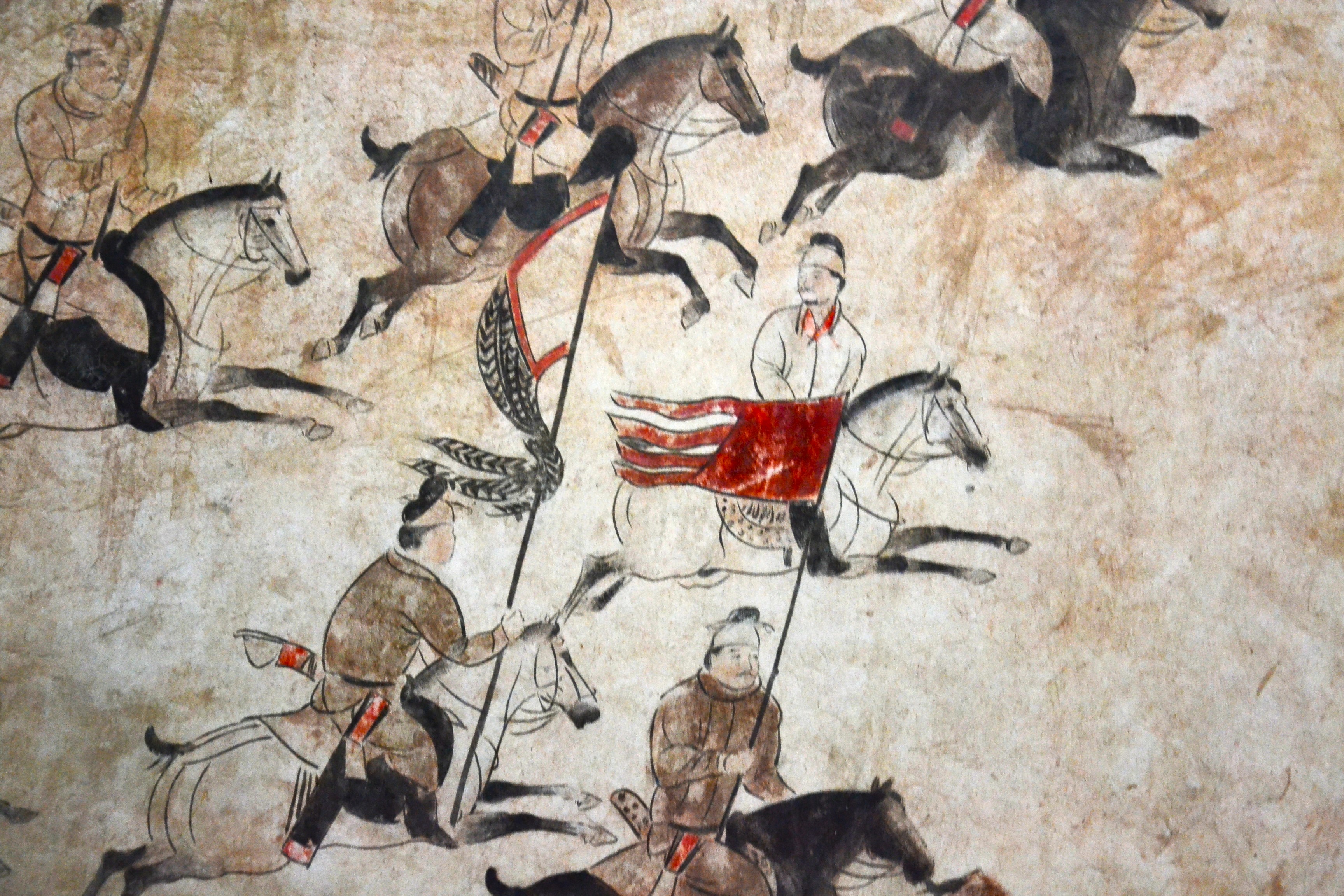
In Podcast Tags Yamato, Japan, Japanese History, Nihon Shoki, Jito Tenno, Tang, Gaozong, Wu Zhao, Wu Zetian, Tang Dynasty, Silla, King Munmu, King Sinmun, King Hyoso, Queen Sinmok
Comment

Episode 140: Improving Diplomatic Ties

December 16, 2025 Joshua Badgley

Great King Munmu of Silla, according to a 1908 Korean textbook. Munmu is the king that oversaw the conquest of Baekje and Goguryeo and the expulsion of the Tang from the Peninsula. He is generally considered the founder of Unified Silla. Photo in the public domain courtesy of Wikimedia Commons.

RSS
Previous Episodes
  • June 2026
  • May 2026
  • April 2026
  • March 2026
  • February 2026
  • January 2026
  • December 2025
  • November 2025
  • October 2025
  • September 2025
  • August 2025
  • July 2025
  • June 2025
  • May 2025
  • April 2025
  • March 2025
  • February 2025
  • January 2025
  • December 2024
  • November 2024
  • October 2024
  • September 2024
  • August 2024
  • July 2024
  • June 2024
  • May 2024
  • April 2024
  • March 2024
  • February 2024
  • January 2024
  • December 2023
  • November 2023
  • October 2023
  • September 2023
  • August 2023
  • July 2023
  • June 2023
  • May 2023
  • April 2023
  • March 2023
  • February 2023
  • January 2023
  • December 2022
  • November 2022
  • October 2022
  • September 2022
  • August 2022
  • July 2022
  • June 2022
  • May 2022
  • April 2022
  • March 2022
  • February 2022
  • January 2022
  • December 2021
  • November 2021
  • October 2021
  • September 2021
  • August 2021
  • July 2021
  • June 2021
  • May 2021
  • April 2021
  • March 2021
  • February 2021
  • January 2021
  • December 2020
  • November 2020
  • October 2020
  • September 2020
  • August 2020
  • July 2020
  • June 2020
  • May 2020
  • April 2020
  • March 2020
  • February 2020
  • January 2020
  • December 2019
  • November 2019
  • October 2019
  • September 2019
Archives
 

This episode we look at some of the improving foreign relations.

Silla

Silla is the most prominent foreign entity in contact with the Yamato court at this time. Furthermore, under King Munmu the Great they are at a high point in their history. With the help of the Tang Empire they have defeated Baekje and Goguryeo. Then, after years of struggle, they would also push the Tang out of the peninsula, at least past the Taedong river, which runs through Pyongyang. From the Taedong south—or Southeast—was what we often refer to as Unified Silla. For the first time, the peninsula was under a single authority, and it would start to bring a unification of culture as well as politics. It seems that Silla was also interested in mending fences with Yamato. The two had long had an adversarial relationship, but it seems that was changing.

Goguryeo

For a kingdom that was destroyed, Goguryeo continued to have quite the presence in the Chronicles. While Baekje and Nimna had both largely been given up as lost, Goguryeo, despite its apparent non-existence, refused to give up the ghost, as it were. This appears to be in part due to local rebellions and restoration efforts, but also thanks to official sponsorship by Silla, who no doubt realized that Goguryeo’s restoration kept the Tang dynasty busy. And so we see Goguryeo envoys to the Yamato court, though each time accompanied by Silla escorts.

Tamna

Tamna is on the island of Jeju, in the ocean south of the Korean peninsula. Though archaeological evidence suggests that they have had close ties with Yayoi Japan and with Baekje, among others, from at least the 1st century, we don’t see them show up in the Chronicles until the 7th. This may be because they were dealing with groups other than Yamato. With the fall of Baekje, the appearance of Tamna at the Yamato court appears to have grown. This could be coincidence just having to do with timing, though it is interesting that Tamna appears to show a lot of linguistic similarities in terms of names with the people of the Japanese archipelago. Alexander Vovin suggested that they were one of the last hold-outs of a continental proto-Japonic speaking group. Their language and entire way of life would eventually come under the sway of the rest of the peninsula before they were able to record too much of their own history, and so mostly we know of them through the writings of others.

Tang Empire

The Tang Empire was expansive, dwarfing Yamato or Silla, but that expanse was also a problem. They had a massive border to defend, and they were regularly moving between fighting with Tibet and fighting on the Korean peninsula, which was no small feat. Eventually the peninsula would prove too much trouble, and they would relocate to Liaodong and focus on the former Goguryeo territory. The Tang court was also dealing with other issues. Tang Gaozong was the nominal ruler, but his wife, the Empress Wu Zetian, had been given unprecedented power, so that often it was her edicts that were actually being followed. For all of its power and might, we don’t see any more Tang envoys during this reign.

Mishihase

The Mishihase, or Sushen, are most likely the people also known as the Ohkotsk Sea Culture. We don’t have any of their own writings, and the term the Chronicles use for them appears to be appropriated from mainland references to another people altogether. But based on their activities and timeframe, the Ohkotsk Sea Culture is likely the group we can best identify them as. The Ohkotsk Sea Culture, itself, is a name for the culture that produced a variety of material goods found in archaeological excavations around the Ohkotsk Sea dated to around this time. The Ohokotsk Sea Culture appears to have had influence from or on the people we know today as the Nivkh and the Ainu—modern indigenous groups in Hokkaido, Sakhalin, and the area near the mouth of the Amur River.

Non-Yamato Cultures on the Archipelago

We don’t hear much about the Emishi at this point in time, but there are plenty of other people who are outside of the Yamato political sphere, and who are often represented as culturally unique or distinct.

Hayato

The Hayato are perhaps the most famous group of the ones mentioned. They are from Southern Kyushu—the regions of Ata and Osumi. Ata is thought to be the area of Satsuma, and Osumi refers to the Osumi peninsula. We do see some differences in the material culture of these areas, but also plenty of similarities, suggesting that they may not be entirely distinct, just outside of Yamato’s formal political reach.

Tanegashima and Yakushima

These are two islands south of Kyushu, at the head of the chain of islands made from the volcanic sea ridge that travels from the archipelago all the way to the island of Taiwan, many of the islands of which make up the Ryukyuan, or Okinawan, island chain. Tanegashima is known to us, today, because it was one of the first places that Europeans landed and became an early hub of firearms production—but that was still centuries off. Yakushima is known today as a UNESCO world heritage site for its pristine forests. It has long been inhabited, but never tremendously so.

  • Welcome to Sengoku Daimyo’s Chronicles of Japan.  My name is Joshua and this is episode 140: Improving Diplomatic Ties

    Garyang Jyeongsan and Gim Hongsye looked out from the deck of their ship, tossing and turning in the sea.  The waves were high, and the winds lashed at the ship, which rocked uncomfortably beneath their feet.  Ocean spray struck them from below while rain pelted from above.

    Through the torrential and unstable conditions, they looked out for their sister ship.  It was their job to escort them, but in these rough seas, bobbing up and down, they were at the mercy of the elements.  One minute they could see them, and then next it was nothing but a wall of water.  Each time they caught a glimpse the other ship seemed further and further away.  They tried calling out, but it was no use—even if they could normally have raised them, the fierce winds simply carried their voices out into the watery void.  Eventually, they lost sight of them altogether.

    When the winds died down and the seas settled, they looked for their companions, but they saw nothing, not even hints of wreckage on the ocean.  They could only hope that their fellow pilots knew where they were going.  As long as they could still sail, they should be able to make it to land—either to the islands  to which they were headed, or back to the safety of the peninsula.

    And so the escort ship continued on, even without a formal envoy to escort.  They would hope for the best, or else they would explain what would happen,  and hope that the Yamato court would understand.

    The seas were anything but predictable, and diplomacy was certainly not for the faint of heart.


    We are going through the period of the reign of Ohoama, aka Temmu Tennou.  It started in 672, with the death of his brother, Naka no Oe, remembered as the sovereign Tenji Tenno, when Temmu took the throne from his nephew, Ohotomo, aka Kobun Tenno, in what would become known as the Jinshin no Ran.  From that point, Ohoama continued the work of his brother in creating a government based on a continental model of laws and punishments—the Ritsuryo system.  He accomplished this with assistance from his wife, Uno, and other members of the royal family—his own sons, but also nephews and other princes of the time.  And so far most of our focus has been on the local goings on within the archipelago.

    However, there was still plenty going on in the rest of the world, and though Yamato’s focus may have been on more local affairs, it was still engaged with the rest of the world—or at least with the polities of the Korean Peninsula and the Tang Dynasty.  This episode we are going to look at Yamato’s foreign relations, and how they were changing, especially as things changed on the continent.

    Up to this point, much of what had been happening in Yamato had been heavily influenced by the mainland in one way or another.  And to begin our discussion, we really should backtrack a bit—all the way to the Battle of Baekgang in 663, which we discussed in Episode 124.  That defeat would lead to the fall of Baekje, at the hands of the Silla-Tang alliance.  The loss of their ally on the peninsula sent Yamato into a flurry of defensive activity.  They erected fortresses on Tsushima, Kyushu, and along the Seto Inland Sea.  They also moved the capital up to Ohotsu, a more easily defended point on the shores of Lake Biwa, and likewise reinforced various strategic points in the Home Provinces as well.  These fortresses were built in the style and under the direction of many of the Baekje refugees now resettled in Yamato.

    For years, the archipelago braced for an invasion by the Silla-Tang alliance.  After all, with all that Yamato had done to support Baekje, it only made sense, from their perspective, for Silla and Tang to next come after them.  Sure, there was still Goguryeo, but with the death of Yeon Gaesomun, Goguryeo would not last that long.  With a unified peninsula, then why wouldn’t they next look to the archipelago?

    And yet, the attack never came.  While Yamato was building up its defenses, it seems that the alliance between Silla and Tang was not quite as strong as their victories on the battlefield may have made it seem.  This is hardly surprising—the Tang and Silla were hardly operating on the same scale.  That said, the Tang’s immense size, while bringing it great resources, also meant that it had an extremely large border to defend.  They often utilized alliances with other states to achieve their ends.  In fact, it seems fairly common for the Tang to seek alliances with states just beyond their borders against those states that were directly on their borders.  In other words, they would effectively create a pincer maneuver by befriending the enemy of their enemy.  Of course.  Once they had defeated said enemy well, wouldn’t you know it, their former ally was now their newest bordering state.

    In the case of the Silla-Tang alliance, it appears that at the start of the alliance, back in the days of Tang Taizong, the agreement, at least from Silla’s perspective, was that they would help each other against Goguryeo and Baekje, and then the Tang dynasty would leave the Korean peninsula to Silla.  However, things didn’t go quite that smoothly.  The fighting against Goguryeo and Baekje can be traced back to the 640s, but Tang Taizong passed away in 649, leaving the throne to his heir, Tang Gaozong.  The Tang forces eventually helped Silla to take Baekje after the battle of Baekgang River in 663, and then Goguryeo fell in 668, but the Tang forces didn’t leave the peninsula.  They remained in the former territories of Baekje and in Goguryeo, despite any former agreements.  Ostensibly they were no doubt pointing to the continuing revolts and rebellions in both regions.  While neither kingdom would fully reassert itself, it didn’t mean that there weren’t those who were trying.  In fact, the first revolt in Goguryeo was in 669.  There was also a revolt each year until 673.  The last one had some staying power, as the Goguryeo rebels continued to hold out for about four years.

    It is probably worth reminding ourselves that the Tang dynasty, during this time, had reached out on several occasions to Yamato, sending diplomatic missions, as had Silla.  While the Yamato court may have been preparing for a Tang invasion, the Tang perspective seems different.  They were preoccupied with the various revolts going on, and they had other problems.  On their western border, they were having to contend with the kingdom of Tibet, for example.  The Tibetan kingdom had a powerful influence on the southern route around the Taklamakan desert, which abuts the Tibetan plateau.   The Tang court would have had to divert resources to defend their holdings in the western regions, and it is unlikely that they had any immediate designs on the archipelago, which I suspect was considered something of a backwater to them, at the time.  In fact, Yamato would have been much more useful to the Tang as an ally to help maintain some pressure against Silla, with whom their relationship, no longer directed at a common enemy, was becoming somewhat tense.

    In fact, just before Ohoama came to the throne, several events had occurred that would affect the Silla-Tang alliance.

    The first event is more indirect—in 670, the Tibetan kingdom attacked the Tang empire.  The fighting was intense, and required serious resources from both sides.  Eventually the Tibetan forces were victorious, but not without a heavy toll on the Tibetan kingdom, which some attribute to the latter’s eventual demise.  Their pyrrhic victory, however, was a defeat for the Tang, who also lost troops and resources in the fighting.  Then, in 671, the Tang empire would suffer another loss as Silla would drive the Tang forces out of the territory of the former kingdom of Baekje.

    With the Baekje territory under their control, it appears that Silla was also working to encourage some of rebellions in Goguryeo.  This more than irked the Tang court, currently under the formal control of Tang Gaozong and the informal—but quite considerable—control of his wife, Wu Zetian, who some claim was the one actually calling most of the shots in the court at this point in time.  Silla encouragement of restoration efforts in Goguryeo reached the Tang court in 674, in and in 675 we see that the Tang forces were sent to take back their foothold in the former Baekje territory.  Tang defeated Silla at Gyeonggi, and Silla’s king, Munmu, sent a tribute mission to the Tang court, apologizing for their past behavior.

    However, the Tang control could not be maintained, as they had to once again withdraw most of their troops from the peninsula to send them against the Tibetan kingdom once more.  As soon as they did so, Silla once again renewed their attacks on Tang forces on the peninsula.  And so, a year later, in 676, the Tang forces were back.  They crossed the Yellow Sea to try and take back the Tang territories on the lower peninsula, but they were unsuccessful.  Tang forces were defeated by Silla at Maeso Fortress in modern day Yeoncheon.  After a bit more fighting, Silla ended up in control of all territory south of the Taedong River, which runs through Pyongyang, one of the ancient capitals of Goguryeo and the capital of modern North Korea.  This meant that the Tang dynasty still held much of the territory of Goguryeo under their control.

    With everything that was going on, perhaps that explains some of the apparently defensive measures that Yamato continued to take.  For example, the second lunar month of 675, we know that Ohoama proceeded to Takayasu castle, likely as a kind of formal inspection.  Then, in the 10th lunar month of 675 Ohoama commanded that everyone from the Princes down to the lowest rank were to provide the government with weapons.  A year later, in the 9th month of 676, the Princes and Ministers sent agents to the capital and the Home Provinces and gave out weapons to each man.  Similar edicts would be issued throughout the reign.  So in 679 the court announced that in two years time, which is to say the year 681, there would be a review of the weapons and horses belonging to the Princes of the Blood, Ministers, and any public functionaries.  And in that same year, barrier were erected for the first time on Mt. Tatsta and Mt. Afusaka, along with an outer line of fortifications at Naniwa.

    While some of that no doubt also helped to control internal movements, it also would have been useful to prepare for the possibility of future invasions.  And the work continued.  In 683  we see a royal command to all of the various provinces to engage in military training.  And in 684 it was decreed at that there would be an inspection in the 9th month of the following year—685—and they laid out the ceremonial rules, such as who would stand where, what the official clothing was to look like, etc. 

    Furthermore, there was also an edict that all civil and military officials should practice the use of arms and riding horses.  They were expected to supply their own horses, weapons, and anything they would wear into battle. If they owned horses, they would be considered cavalry soldiers, while those who did not have their own horse would be trained as infantry.  Either way, they would each receive training, and the court was determined to remove any obstacles and excuses that might arise.   Anyone who didn’t comply would be punished.  Non compliance could mean refusing to train, but it could also just mean that they did not provide the proper horses or equipment, or they let their equipment fall into a state of disrepair.  Punishments could range from fines to outright flogging, should they be found guilty.  On the other hand, those who practiced well would have any punishments against them for other crimes reduced by two degrees, even if it was for a capital crime.  This only applied to previous crimes, however—if it seemed like you were trying to take advantage of this as a loophole to be able to get away with doing your own thing than the pardon itself would be considered null and void.

    A year later, the aforementioned inspection was carried out by Princes Miyatokoro, Hirose, Naniwa, Takeda, and Mino.  Two months later, the court issued another edict demanding that military equipment—specifically objects such as large or small horns, drums, flutes, flags, large bows, or catapults—should be stored at the government district house and not kept in private arsenals.  The “large bow” in this case may be something like a ballista, though Aston translates it to crossbow—unfortunately, it isn’t exactly clear, and we don’t necessarily have a plethora of extant examples to point to regarding what they meant.  Still, these seem to be focused on things that would be used by armies—especially the banners, large bows, and catapults.  The musical instruments may seem odd, though music was often an important part of Tang dynasty military maneuvers.  It was used to coordinate troops, raise morale, provide a marching rhythm, and more.  Granted, much of this feels like something more continental, and it is unclear if music was regularly used in the archipelago.  This could be more of Yamato trying to emulate the Tang dynasty rather than something that was commonplace on the archipelago.  That might also explain the reference to the Ohoyumi and the catapults, or rock throwers.

    All of this language having to do with military preparations could just be more of the same as far as the Sinicization of the Yamato government is concerned; attempts to further emulate what they understood of the civilized governments on the mainland—or at least their conception of those governments based on the various written works that they had imported.  Still, I think it is relevant that there was a lot of uncertainty regarding the position of various polities and the potential for conflict.  Each year could bring new changes to the political dynamic that could see military intervention make its way across the straits.  And of course, there was always the possibility that Yamato itself might decide to raise a force of its own.

    Throughout all of this, there was continued contact with the peninsula and other lands.  Of course, Silla and Goguryeo were both represented when Ohoama came to the throne—though only the Silla ambassador made it to the ceremony, apparently.  In the 7th lunar month of 675, Ohotomo no Muraji no Kunimaro was sent to Silla as the Chief envoy, along with Miyake no Kishi no Irishi.  They likely got a chance to witness first-hand the tensions between Silla and the Tang court.  The mission would return in the second lunar month of the following year, 676.  Eight months later, Mononobe no Muarji no Maro and Yamashiro no Atahe no Momotari were both sent.  That embassy also returned in the 2nd lunar month of the following year.

    Meanwhile, it wasn’t just Yamato traveling to Silla—there were also envoys coming the other way.  For example, in the 2nd lunar month of 675 we are told that Silla sent Prince Chyungweon as an ambassador.  His retinue was apparently detained on Tsukushi while the actual envoy team went on to the Yamato capital.  It took them about two months to get there, and then they stayed until the 8th lunar month, so about four months in total.

    At the same time, in the third month, Goguryeo and Silla both sent “tribute” to Yamato.  And in the 8th month, Prince Kumaki, from Tamna, arrived at Tsukushi as well.  Tamna, as you may recall, refers to nation on the island known today as Jeju.  The late Alexander Vovin suggested that the name originated from a proto-Japonic cognate with “Tanimura”, and many of the names seem to also bear out a possible Japonic influence on the island nation. Although they only somewhat recently show up in the Chronicles from our perspective, archaeological evidence suggests that they had trade with Yayoi Japan and Baekje since at least the first century.  With the fall of Baekje, and the expansion of Yamato authority to more of the archipelago, we’ve seen a notable uptick in the communication between Tamna and Yamato noted in the record.  A month after the arrival of Prince Kumaki in Tsukushi, aka Kyushu, it is noted that a Prince Koyo of Tamna arrived at Naniwa.  The Tamna guests would stick around for almost a year, during which time they were presented with a ship and eventually returned in the 7th lunar month of the following year, 676.   Tamna envoys, who had also shown up in 673, continued to be an annual presence at the Yamato court through the year 679, after which there is an apparent break in contact, picking back up in 684 and 685.

    676 also saw a continuation of Silla representatives coming to the Yamato court, arriving in the 11th lunar month.  That means they probably passed by the Yamato envoys heading the other way.  Silla, under King Mumnu, now had complete control of the Korean peninsula south of the Taedong river.  In the same month we also see another mission from Goguryeo, but the Chronicle also points out that the Goguryeo envoys had a Silla escort, indicating the alliance between Silla and those attempting to restore Goguryeo—or at least the area of Goguryeo under Tang control.  The Tang, for their part, had pulled back their commandary to Liaodong, just west of the modern border between China and North Korea, today.  Goguryeo would not go quietly, and the people of that ancient kingdom—one of the oldest on the peninsula—would continue to rise up and assert their independence for years to come.

    The chronicles also record envoys from the somewhat mysterious northern Mishihase, or Sushen, thought to be people of the Okhotsk Sea culture from the Sakhalin islands.  There were 11 of them, and they came with the Silla envoys, possibly indicating their influence on the continent and through the Amur river region.  Previously, most of the contact had been through the regions of Koshi and the Emishi in modern Tohoku and Hokkaido.  This seems to be their only major envoy to the Yamato court recorded in this reign.

    Speaking of outside groups, in the 2nd lunar month of 677 we are told that there was an entertainment given to men of Tanegashima under the famous Tsuki tree west of Asukadera.  Many people may know Tanegashima from the role it played in the Sengoku Period, when Europeans made contact and Tanegashima became a major hub of Sengoku era firearm manufacturing.  At this point, however, it seems that it was still a largely independent island in the archipelago off the southern coast of Kyushu.  Even southern Kyushu appears to have retained some significant cultural differences at this time, with the “Hayato” people being referenced in regards to southern Kyushu—we’ll talk about them in a bit as they showed up at the capital in 682. 

    Tanegashima is actually closer to Yakushima, another island considered to be separate, culturally, from Yamato, and could be considered the start of the chain of islands leading south to Amami Ohoshima and the other Ryukyuan islands.  That said, Tanegashima and Yakushima are much closer to the main islands of the archipelago and show considerable influence, including Yayoi and Kofun cultural artifacts, connecting them more closely to those cultures, even if Yamato initially saw them as distinct in some way.

    A formal Yamato envoy would head down to Tanegashima two years later, in the 11th lunar month of 679.  It was headed up by Yamato no Umakahibe no Miyatsuko no Tsura and Kami no Sukuri no Koukan.  The next reference to the mission comes in 681, when the envoys returned and presented a map of the island.  They claimed that it was in the middle of the ocean, and that rice was always abundant. With a single sowing of rice it was said that they could get two harvests.  Other products specifically mentioned were cape jasmine and bulrushes, though they then note that there were also many other products that they didn’t bother to list.  This must have been considered quite the success, as the Yamato envoys were each awarded a grade of rank for their efforts.   They also appear to have returned with some of the locals, as they were entertained again in Asuka—this time on the riverbank west of Asukadera, where various kinds of music were performed for them.

    Tanegashima and Yakushima would be brought formally under Yamato hegemony in 702 with the creation of Tane province, but for now it was still considered separate.  This was probably just the first part of the efforts to bring them into Yamato, proper.

    Getting back to the Silla envoys who had arrived in 676, they appear to have remained for several months.  In the third lunar month of 677 we are told that they, along with guests of lower rank—thirteen persons all told—were invited to the capital.  Meanwhile, the escort envoys and others who had not been invited to the capital were entertained in Tsukushi and returned from there.

    While this was going on, weather out in the straits drove a Silla boat to the island of Chikashima.  Aboard was a Silla man accompanined by three attendants and three Buddhist priests.  We aren’t told where they were going, but they were given shelter and when the Silla envoy, Kim Chyeonpyeong, returned home he left with those who had been driven ashore, as well.

    The following year, 678, was not a great one for the Silla envoys.  Garyang Jyeongsan and Gim Hongsye arrived at Tsukushi, but they were just the escorts.  The actual envoys had been separated by a storm at sea and never arrived.  In their place, the escort envoys were sent to the capital, probably to at least carry through with the rituals of diplomacy.  This was in the first month of the following year, 679, and given when envoys had previously arrived, it suggests to me that they waited a few months, probably to see if the envoys’ ship eventually appeared and to give the court time to figure out what to do.  A month later, the Goguryeo envoys arrived, still being accompanied by Silla escorts, also arrived.

    Fortunately the Yamato envoys to Silla and elsewhere fared better.  That year, 679, the envoys returned successfully from Silla, Goguryeo, and Tamna.  Overall, though, I think it demonstrates that this wasn’t just a pleasure cruise.  There was a very real possibility that one could get lost at sea.  At the same time, one needed people of sufficient status to be able to carry diplomatic messages and appropriately represent the court in foreign lands.  We often seen envoys later taking on greater positions of responsibility in the court, and so you didn’t have to go far to find those willing to take the risk for later rewards.

    That same year, another tribute mission from Silla did manage to make the crossing successfully.  And in this mission we are given more details, for they brought gold, silver, iron, sacrificial cauldrons with three feet, brocade, cloth, hides, horses, dogs, mules, and camels.  And those were just the official gifts to the court.  Silla also sent distinct presents for the sovereign, the queen, and the crown prince, namely gold, silver, swords, flags, and things of that nature.

    This appears to demonstrate increasingly close ties between Silla and Yamato. All of that arrived in the 10th lunar month of 679, and they stayed through the 6th lunar month of 680—about 7 to 9 months all told, depending on if there were any intercalary months that year.  In addition to entertaining the Silla envoys in Tsukushi—it is not mentioned if they made it to the capital—we are also told that in the 2nd lunar month, halfway through the envoys’ visit, eight labourers from Silla were sent back to their own country with gifts appropriate to their station.

    Here I have to pause and wonder what exactly is meant by this.  “Labourer” seems somewhat innocuous.  I suspect that their presence in Yamato may have been less than voluntary, and I wonder if these were captured prisoners of war who could have been in Yamato now for over a decade.  If so, this could have been a gesture indicating that the two sides were putting all of that nastiness with Baekje behind them, and Yamato was accepting Silla’s new role on the peninsula.  Or maybe I’m reading too much into it, but it does seem to imply that Silla and Yamato were growing closer, something that Yamato would need if it wanted to have easy access, again, to the wider world.

    Speaking of returning people, that seems to have been something of a common thread for this year, 680, as another mission from Goguryeo saw 19 Goguryeo men also returned to their country.  These were condolence envoys who had come to mourn the death of Takara Hime—aka Saimei Tennou.  They must have arrived in the midst of all that was happening peninsula, and as such they were detained.  Their detention is somewhat interesting, when you think about it, since technically Baekje and Goguryeo—and thus Yamato—would have been on the same side against the Silla-Tang alliance.  But perhaps it was just considered too dangerous to send them home, initially, and then the Tang had taken control of their home.  It is unclear to me how much they were being held by Yamato and how much they were just men without a country for a time.  This may reflect how things on the mainland were stabilizing again, at least from Yamato’s perspective.  However, as we’ll discuss a bit later, it may have also been another attempt at restoring the Goguryeo kingdom by bringing back refugees, especially if they had connections with the old court.  The Goguryeo envoys—both the recent mission and those who had been detained—would remain until the 5th lunar month of 681, when they finally took their leave.  That year, there were numerous mission both from and to Silla and Goguryeo, and in the latter part of the year, Gim Chyungpyeong came once again, once more bearing gives of gold, silver, copper, iron, brocade, thin silk, deerskins, and fine cloth.  They also brought gold, silver, flags of a rosy-colored brocade and skins for the sovereign, his queen, and the crown prince.

    That said, the 681 envoys also brought grave news:  King Munmu of Silla was dead.  Munmu had reigned since 661, so he had overseen the conquest of Silla and Goguryeo.  His regnal name in Japanese might be read as Monmu, or even “Bunbu”, referencing the blending of literary and cultural achievements seen as the pinnacle of noble attainment.  He is known as Munmu the Great for unifying the peninsula under a single ruler—though much of the Goguryeo territory was still out of reach.  Indeed he saw warfare and the betterment of his people, and it is no doubt significant that his death is recorded in the official records of the archipelago.   He was succeeded by his son, who would reign as King Sinmun, though the succession wasn’t exactly smooth.

    We are told that Munmu, knowing his time was short, requested that his son, the Crown Prince, be named king before they attended to Munmu’s own funerary arrangements, claiming that the throne should not sit vacant.  This may have been prescient, as the same year Munmu died and Sinmun ascended to the throne there was a revolt, led by none other than Sinmun’s own father-in-law, Kim Heumdol.  Heumdol may, himselve, have been more of a figurehead for other political factions in the court and military.  Nonetheless, the attempted coup of 681 was quickly put down—the envoys in Yamato would likely only learn about everything after the dust had settled upon their return.

    The following year, 682, we see another interesting note about kings, this time in regards to the Goguryeo envoys, whom we are told were sent by the King of Goguryeo.  Ever since moving the commandery to Liaodong, the Tang empire had claimed dominion over the lands of Goguryeo north of the Taedong river.  Originally they had administered it militarily, but in 677 they crowned a local, Bojang as the “King of Joseon”, using the old name for the region, and put him in charge of the Liaodong commandery.  However, he was removed in 681, and sent into exile in Sichuan, because rather than suppressing revolt, he had actually encouraged restoration attempts, inviting back Goguryeo refugees, like those who had been detained in Yamato.  Although Bojang himself was sent into exile, his descendants continued to claim sovereignty, so it may have been one of them that was making the claim to the “King of Goguryeo”, possibly with Silla’s blessing.

    Later that year, 682, we see Hayato from Ohosumi and Ata—possibly meaning Satsuma—the southernmost point of Kyushu coming to the court in 682.  They brought tribute and representatives of Ohosumi and Ata wrestled, with the Ohosumi wrestler emerging victorious.  They were entertained west of Asukadera, and various kinds of music was performed and gifts were given. They were apparently quite the sight, as Buddhist priests and laiety all came out to watch.

    Little is known for certain about the Hayato.  We have shields that are attributed to them, but their association may have more to do with the fact that they were employed as ceremonial guards for a time at the palace.  We do know that Southern Kyushu had various groups that were seen as culturally distinct from Yamato, although there is a lot of overlap in material culture.  We also see early reports of the Kumaso, possibly two different groups, the Kuma and So, in earlier records, and the relationship between the Kumaso and the Hayato is not clearly defined.

    What we do know is that southern Kyushu, for all that it shared with Yamato certain aspects of culture through the kofun period, for example, they also had their own traditions. For example, there is a particular burial tradition of underground kofun that is distinct to southern Kyushu.  A great example of this can be found at the Saitobaru Kofun cluster in Miyazaki, which contains these unique southern Kyushu style burials along with more Yamato style keyhole shaped and circular type kofun.  Miyazaki sits just north of the Ohosumi peninsula, in what was formerly the land of Hyuga, aka  Himuka.  This is also where a lot of the founding stories of the Heavenly grandchild were placed, and even today there is a shrine there to the Heavenly Rock Cave.  In other words there are a lot of connections with Southern Kyushu, and given that the Chronicles were being written in the later 7th and early 8th centuries, it is an area of intense interest when trying to understand the origins of Yamato and Japanese history.

    Unfortunately, nothing clearly tells us exactly how the Hayato were separate, but in the coming century they would both come under Yamato hegemony and rebel against it, time and again.  This isn’t the first time they are mentioned, but it may be the first time that we see them as an actual people, in a factual entry as earlier references in the Chronicles are suspect.

    Continuing on with our look at diplomacy during this period, the year 683 we see a continuation of the same patterns, with nothing too out of the ordinary.  Same with most of 684 until the 12th lunar month.  It is then that we see a Silla ship arrive with Hashi no Sukune no Wohi and Shirawi no Fubito no Hozen.  They had both, previously been to the Tang empire to study, though we don’t have a record of them leaving for that or any other purpose.  They are accompanied by Witsukahi no Muraji no Kobito and Tsukushi no Miyake no Muraji no Tokuko, both of whom had apparently been captured and taken by the Tang dynasty during the Baekje campaign.  Apparently they had all traveled back from the Tang empire together to Silla, who then provided them passage to Yamato.

    The timing of this suggests it may have had something to do with the changes going on in the Tang empire—changes that I desperately want to get into, but given that we are already a good ways into this current episode, I think I will leave it for later.  But I will note this:  Emperor Gaozong had passed away and his wife, Empress Wu Zetian, was now ruling as regent for her sons.  Wu Zetian is probably the most famous empress in all of Chinese history, and while she held de facto power as a co-regent during her husband’s reign and as a regent during her sons’ reigns, she would actually ascend the throne herself in 690.  Her reign as a woman during a time of heightened patriarchal tradition is particularly of note, and it leads us to wonder about the vilification that she received by the men who followed her rule.  And I really want to get into all of that but, thematically, I think it better to wait.  Those of you reading ahead in the syllabus—which is to say the Chronicles—probably know why.  So let us just leave it there and say that the Tang was going through a few things, and that may explain why students were returning back in the company of former war captives.

    A few months later, the Silla escort, Gim Mulyu, was sent home along with 7 people from Silla who had been washed ashore—presumably during a storm or other such event, again illustrating the dangers of taking to the ocean at this time.  Perhaps related to that theme is the entry only a month later, which merely stated that Gim Jusan of Silla returned home.  Gim Jusan was an envoy sent to Yamato in the 11th lunar month of 683.  He was entertained in Tsukushi, and we are told that he returned to his own country on the 3rd month of 684.  Now we are seeing an entry in the 4th month of 685 that this same person apparently returned home.

    It is possible that something got mixed up, and that the Chroniclers were dealing with a typo in the records that made it seem like this took place a year later than it did.  This was certainly an issue at this time, given all the math one had to do just to figure out what day it was.  There is also the possibility that he returned on another embassy, but just wasn’t mentioned for some reason.  The last possible explanation is that he somehow got lost and it took him a year to find his way back.  Not entirely impossible back then, though I am a bit skeptical.  Among other things, why would that note have found its way into the Chronicles in Yamato?  While they were certainly using some continental sources, this seems like something they were talking about as far as him leaving the archipelago, rather than discussion of something happening elsewhere.

    Speaking of happening elsewhere, I’m wondering about another event that happened around this time as well.  In fact, it was while Gim Mulyu was still in the archipelago.  For some reason the Yamato court granted rank to 147 individuals from Tang, Baekje, and Goguryeo.  Interestingly, they don’t mention Silla.  Furthermore, there is no real mention of any Tang envoys during this reign.  In fact, there is hardly mention of the Tang dynasty at all.  There is a mention of some 30 Tang men—captives, presumably—being sent to the Yamato court from Tsukushi.  Those men were settled in Toutoumi, so there were men of Tang in the archipelago.  But beyond that, there are only three other mentions of the Tang dynasty.  One was when the students and war captives came back.  Another was this note about giving rank to 147 individuals.  Finally there is a similar record in 686, at the very end of the reign, where it is 34 persons who were given rank.  This time it was to carpenters, diviners, physicians, students from Tang—possibly those who had just come back a year or so earlier. 

    So if there weren’t envoys from Tang, Goguryeo, and Baekje, who were these people and why were they being granted Yamato court rank?  My assumption is that it was foreigners living in the archipelago, and being incorporated into the Yamato court system.  Still, it is interesting that after the overtures by the Tang in the previous reign we have heard virtually nothing since then.  Again, that is likely largely due to the conflicts between Tang and Silla, though now, things seem to be changing.  The conflicts have settled down, and new rulers are in place, so we’ll see how things go.

    Speaking of which, let’s finish up with the diplomatic exchanges in this reign.  I’m only hitting some of the highlights here.  First is the return from Silla, in the 5th month of 685, of Takamuku no Asomi no Maro and Tsuno no Asomi no Ushikahi.  They had traveled to Silla in 684, and they did not come back emptyhanded.  The new King of Silla presented them with gifts, including 2 horses, 3 dogs, 2 parrots, and 2 magpies.  They also brought back the novice monks Kanjou and Ryoukan.  Not bad, overall.

    Then, 6 months later, another tribute mission came, but this one has an interesting—if somewhat questionable—note attached to it.  It is said that the envoys Gim Jisyang and Gim Geonhun were sent to request “governance” and to bring tribute.  This certainly go the court’s attention.  They didn’t bring the envoys all the way to the capital, but they did send to them, in Tsukushi, Prince Kawachi, Ohotomo no Sukune no Yasumaro, Fujiwara no Asomi no Ohoshima, and Hodzumi no Asomi no Mushimaro. About three months later they send the musical performers from Kawaradera to provide entertainment during a banquet for the Silla envoy, and in payment some 5,000 bundles of rice rom the private lands attached to the queen’s palace were granted to the temple in gratitude.

    The Silla tribute was then brought to the capital from Tsukushi.  This time it was more than 100 items, including one fine horse, one mule, two dogs, a gold container inlaid with some kind of design, gold, silver, faint brocade, silk gauze, tiger and leopard skins, and a variety of medicines.  In addition, as was now common, the envoys, Gim Jisyang and Gim Geonhun, apparently had personal gifts to give in the form of gold, silver, faint brocade, silk gauze, gold containers, screens, saddle hides, silk cloth, and more medicine.  There were also gifts specifically for the sovereign, the queen, the Crown Prince, and for the various princes of the blood.

    The court returned this favor with gifts to the envoys, presented at a banquet just for them, before sending them on their way.

    A couple of notes.  First off, it is interesting that they are entertained at Tsukushi rather than being invited to the capital, and I wonder if this was because the sovereign, Ohoama, wasn’t doing so well.  This was all happening in 685 and 686, and the sovereign would pass away shortly afterwards.  So it is possible that Ohoama just was not up to entertaining visitors at this time.  Of course, the Chronicles often don’t tell us exactly why a given decision was made, only that it was.  And sometimes not even that.

    The other thing that seems curious is the mention of a request for governance.  That almost sounds like Silla was asking to come under Yamato hegemony, which I seriously doubt.  It may be that they were asking something along the lines of an alliance, but it is also possible that the scribes recording things for Yamato heard what they wanted to hear and so wrote it down in the light most favorable to Yamato laying claim to the peninsula.

    Or perhaps I’m misunderstanding exactly what they were asking for.  Maybe “governance” here means something else—perhaps just some kind of better relationship.

    And with that, we’ll leave it for now.  There is more developing in the next reign, but I think we want to wait until we get there.  There are still a lot more things to cover in this reign before we move on—we haven’t even touched on the establishment of the new capital, on the various court events, not to mention some of the laws and punishments that this period is named for.  And there is the minor issue of a rebellion.  All of that will be dealt with.  And then, after that, we get to the final reign of the Chronicles: the reign of Jitou Tennou.  From there?  Who knows.

    It is the winter holiday season, so I hope everyone is enjoying themselves.  Next episode will be the New Year’s recap, and then we should finish with this reign probably in January or early February.

    Until then, if you like what we are doing, please tell your friends and feel free to rate us wherever you listen to podcasts.  If you feel the need to do more, and want to help us keep this going, we have information about how you can donate on Patreon or through our KoFi site, ko-fi.com/sengokudaimyo, or find the links over at our main website,  SengokuDaimyo.com/Podcast, where we will have some more discussion on topics from this episode.

    Also, feel free to reach out to our Sengoku Daimyo Facebook page.  You can also email us at the.sengoku.daimyo@gmail.com. 

    Thank you, also, to Ellen for their work editing the podcast.

    And that’s all for now.  Thank you again, and I’ll see you next episode on Sengoku Daimyo’s Chronicles of Japan.

References

  • Bentley, John R. (2025). Nihon Shoki: The Chronicles of Japan. ISBN 979-8-218634-67-4 pb

  • Aston, W. G. (1972). Nihongi, chronicles of Japan from the earliest times to A.D. 697. London: Allen & Unwin. ISBN0-80480984-4.

Tags Temmu, Oama, Nihon Shoki, Asuka, Munmu, Sinmu, Wu Zetian, Gaozong, Silla, Tang, Mishihase, Sushen, Tanegashima, Tamna
Comment

Episode 104: A Bloody Start to Golden Age

March 16, 2024 Joshua Badgley
A series of men on horseback, dressed in the round-necked collars typical of the Western regions with Chinese style hats, carrying flags with streamers.

Image of courtiers out on horseback dressed in the style of the Western Regions but with traditional ethnic Han headgear. From a Tang dynasty era tomb mural in modern Xian (ancient Chang’an). Photo by author.

RSS
Previous Episodes
  • June 2026
  • May 2026
  • April 2026
  • March 2026
  • February 2026
  • January 2026
  • December 2025
  • November 2025
  • October 2025
  • September 2025
  • August 2025
  • July 2025
  • June 2025
  • May 2025
  • April 2025
  • March 2025
  • February 2025
  • January 2025
  • December 2024
  • November 2024
  • October 2024
  • September 2024
  • August 2024
  • July 2024
  • June 2024
  • May 2024
  • April 2024
  • March 2024
  • February 2024
  • January 2024
  • December 2023
  • November 2023
  • October 2023
  • September 2023
  • August 2023
  • July 2023
  • June 2023
  • May 2023
  • April 2023
  • March 2023
  • February 2023
  • January 2023
  • December 2022
  • November 2022
  • October 2022
  • September 2022
  • August 2022
  • July 2022
  • June 2022
  • May 2022
  • April 2022
  • March 2022
  • February 2022
  • January 2022
  • December 2021
  • November 2021
  • October 2021
  • September 2021
  • August 2021
  • July 2021
  • June 2021
  • May 2021
  • April 2021
  • March 2021
  • February 2021
  • January 2021
  • December 2020
  • November 2020
  • October 2020
  • September 2020
  • August 2020
  • July 2020
  • June 2020
  • May 2020
  • April 2020
  • March 2020
  • February 2020
  • January 2020
  • December 2019
  • November 2019
  • October 2019
  • September 2019
Archives
 

This episode we head over to the continent to kick off the Tang dynasty.  The Tang dynasty was extremely influential on Yamato and later Japan, as well as the rest of East Asia.  And so we'll take a look at how it got its start and how it expanded along the silk road, while at the same time talking about the literally cutthroat politics of the period.  Especially in the royal house.  Nobody fights like family.

Who’s Who

Li Yuan

Li Yuan (aka Emperor Tang Gaozu) is the founder of the Tang empire. Likely related to families from the Western Regions that intermarried with ethnic Han to become elites during the chaotic Sixteen Kingdoms period, they made claims to a royal ancestor in the Western Liang. In the Sui they were an elite family providing military service. The “Li” family surname is a common one, with many different branches of the Li family.

Li Er

Aka Laozi, or “Old Sage”, a likely apocryphal name for the supposed author of the Dao De Jing and thus founder of Daoism. In all likelihood he is a fictional character or an amalgamation of many different philosophers whose ideas came to form the core of Daoist philosophy and religion. By the Sui dynasty there were some Daoists who believed that a person with the surname of “Li” would come to power and usher in a Daoist millennia. This may have made the Sui Emperor suspicious of anyone surnamed “Li” and was certainly used by Li Yuan to help justify his new dynasty.

Li Shimin

Li Shimin (aka [spoiler alert] Tang Taizong) was a son of Li Yuan and given the historical narrative he is portrayed as one of the key figures pushing Li Yuan to dethrone the Sui and take over. Eventually he maneuvered to put himself on the throne, and is generally regarded as having one of the best reigns despite all of the political bloodshed that seems to have occurred.

Li Jiancheng

The eldest son of Li Yuan, and one of his generals in his fight to form the Tang dynasty. He was named Crown Prince until the Xuwanwu gate incident.

Li Yuanji

Another son of Li Yuan, he was close with his brother Jiancheng and opposed the rise of his brother, Li Shimin.

Princess Pingyang

Pingyang was one of the daughters of Li Yuan, and the only full-blooded sister to Li Shimin, Li Jiancheng, and Li Yuanji. She was married to Chai Shao, an ally of Li Yuan, and during Li Yuan’s effort to take the throne she commanded an army, the “Army of the Lady”, in support of him and her brothers. She became the first female Tang General, and even when she and her husband were united on the field, they kept separate headquarters for their different forces.

Li Chengqian

Son of Li Shimin, and the Crown Prince. He was brought down by infighting with his brother, Li Tai

Li Tai

Son of Li Shimin, who was quite popular and so threatened Li Chengqian’s position as Crown Prince. The politics of the day, however, led to him being removed from court.

Li Zhi

Youngest son of Li Shimin, he would eventually come to the throne as emperor Tang Gaozong. He would rule with his wife, Empress Wu Zetian.

  • Welcome to Sengoku Daimyo’s Chronicles of Japan. My name is Joshua, and this is episode 104: A Bloody Start to a Golden Age

    It was early in the morning on the fourth day of the sixth month of the ninth year of Wu De. Brothers Li Jiancheng, Crown Prince, and his younger brother, Li Yuanji, were more than a bit annoyed--Their brother had apparently slandered them to their father, the Emperor, claiming that they had had illicit relationships with his concubines. Although the accusations were false, they still had to come to the palace to clear their names. So they left the crown prince’s residence at the Eastern Palace and were traveling on horseback with a retinue of men through the private, forested royal park north of the city towards the Xuanwu Gate—the northern gate to the palace and to the great city of Chang’an.

    As they approached Linhu Hall, they noticed something was afoot: there were soldiers in the park, headed their way. It was immediately apparent that the accusations had been a ruse, and their brother meant for more than just to tarnish their honor. As they fled eastward, back towards the Eastern palace, their brother, Li Shimin, came galloping towards them and called out to them. Li Yuanji tried to draw his bow, but couldn’t get to it in time, and Li Shimin shot and killed Li Jiancheng, their older brother and the crown prince.

    Li Yuanji himself fell from his horse as he dodged arrows from the attacking troops, but Li Shimin also became entangled in the brush of the park and had to dismount. Li Yuanji ran up to his brother and tried to strangle him with his bow string, but soon he was chased off by reinforcements. Li Yuanji fled on foot to Wude Hall, where he was finally caught and struck down with arrows. Li Shimin’s forces struck off the heads of the two murdered princes, and took them to the Xuanwu gate, where opposing forces were still fighting. Seeing the heads of the two princes, it was clear that Li Shimin’s ambush was victorious, and the princes’ forces quickly dispersed.

    Three days later, the victorious Li Shimin was instated as the new crown prince. Two months later, his father, Li Yuan, known to history as emperor Tang Gaozu, abdicated in favor of his son, who came to power as Emperor Taizong. This was the start of the Zhenguan era, which would come to be seen as a golden age in the history of the various Chinese empires.

    ---------------

    Alright, so as may be apparent, we are deviating a bit from our discussion of Yamato to look at some of the events on the continent. This is because the rise of the Tang dynasty would have an incredible impact on the Japanese archipelago. For one, it was the alliance between the Tang and Silla that would eventually mean the removal of Yamato and its allies from the Korean peninsula. In addition, however, the Tang dynasty’s access to the silk road and its grandiose government would become an exemplar for Yamato and many other polities who wished to demonstrate their political and cultural sophistication. Many of the laws and even court dress would mimic that of the Tang court—with a local flare, of course. In addition, the Tang dynasty brought a relative stability to the continent that would last for over two hundred years. Of course, none of that was known at the outset, and like many previous kingdoms, the Tang dynasty was born out of bloodshed.

    We’ve mentioned several times how the Sui Dynasty was growing increasingly unpopular in the late 6th and early 7th centuries. Wars continued to cost money and lives, as did the giant public works projects of the periods - though the Grand Canal would be one of the greatest constructions of any age, uniting the Yangzi and Yellow River basins in myriad ways, powering the regions’ economies for centuries to come.

    Into this Sui period came a man of the Li family named Yuan. We mentioned him back in episode 102, but I figured he could do with a little more backstory. Li Yuan’s family originated in the frontier regions. Official biographies had connected him to the founder of the Western Liang dynasty, and his family had served in various roles as the different northern kingdoms rose and fell. The Li family had been providing military service since the time of Yuan’s great-grandfather, and Li Yuan himself had been serving since the early 600s. He was made a general and placed in charge of the Dongguang pass in the Taihang mountains. There, he largely stayed out of the limelight.

    At one point, he was summoned to the palace and rather than going he feigned illness, instead. You see, around this time there was a prophecy flying around that someone with the surname of Li would try to take the throne from Sui Emperor, Emperor Yang, so it may have been in Li Yuan’s best interest to avoid the court and anything that could draw Emperor Yang’s suspicions. He continued to do everything in his power to make himself seem unthreatening, even as rebellions were breaking out across the Empire.

    In 614, the Sui army was defeated by Goguryeo, and the Sui court was plagued by numerous uprisings. Li Yuan may have sat it out if it weren’t for his son, Li Shimin. Like many youthful individuals, Li Shimin was less than invested in the current administration. He and several of his close acquaintances began to scheme behind his father’s back, with plans to join the other uprisings and hope to take a piece of the pie. Eventually, they blackmailed Li Yuan into marching on the capital of Daxingcheng in 617, threatening to expose several illicit relationships from his time at the court—relationships that would have surely put him at odds with the Emperor. At the same time, Emperor Yang had fled to the southern capital along the banks of the Yangzi River, but his son and heir, Yang You, was still in the capital. Li Yuan marched on imperial city of Daxingcheng, near the ancient capital of Chang’an, claiming that he was coming to protect the young heir.

    Taking control of the capital city put Li Yuan at odds with imperial forces, who did not necessarily accept Li Yuan’s altruistic claims. Li Yuan and his sons, including Li Shimin and Li Jiangcheng, were drawn into fighting. Even Li Yuan’s daughter, Pingyang, the wife of general Chai Shao, contributed to the war effort. She personally raised an army and led it into battle, becoming the first female general of what would be known as the Tang dynasty.

    In 618, Emperor Yang of Sui was assassinated by another general, Yuwen Huaji, and the throne passed to his son, Yang You, known as Emperor Gong of Sui. However, Li Yuan pressured the newly made Emperor Gong to yield the throne to him. Since Li Yuan had inherited the title “Duke of Tang” from his paternal line, he used that as the name of his new dynasty, and became known as Tang Gaozu—the High Founder of Tang.

    It wasn’t enough to simply take the throne, though. There were still many other warlords looking to take his place. After all, unification had only come about some thirty or forty years prior. Up to that point, there had been numerous, often competing kingdoms, especially in the north. It was quite possible that the Sui dynasty was just a fluke, and most people no doubt expected the empire to fall once more into chaos.

    Still, although he definitely had to back it up with military might, often led by his sons and close confidants, Li Yuan went about the process of enacting his sovereignty. This included various state rituals, as well as a reform of the administration. For one thing, they renamed the capital. Daxingcheng had been built nearby the ancient capital of Chang’an, and so they renamed Daxingcheng to the ancient name of Chang’an.

    In addition, he sought out various supernatural portents. He also enjoyed the support of various Daoists, who believed that the founder of Daoism, Laozi, was from the Li family. There was a belief at the time that a messianic ruler from the Li family would bring about the Daoist millennium. And to better understand that, it may be useful to understand a little bit about Daoism.

    Daoism, first and foremost, is one of the more well known religions to come out of China, and often is found side by side what would seem to be its polar opposite, Confucianism. However, the two have more in common than one might at first assume.

    The believed founder of Daoism is known as Laozi, though some later sources, including the Qin dynasty “Records of the Grand Historian”, by Sima Chen, would claim for him the name Li Er. Laozi was said to have been a scholar who abandoned the world, and as he was leaving the empire for parts unknown, an astute guard recognized him and requested that before he left that he write down his accumulated wisdom before he would let the old sage leave. That became the work known as the Dao De Jing, or the Classic of the Way and Virtue.

    The opening of the Dao De Jing is rather famous:

    Dao ke Dao, feichang Dao.

    Or, according to one translation: The Dao that can be known is not the eternal Dao.

    However, no English translation truly does the original justice.

    Traditionally, Laozi is said to have been a contemporary of Confucius, and some of the earliest writings on him, in the Warring States period writings of Zhuangzi, often show Confucius in awe of Laozi. That said, most tend to agree that Laozi himself likely never existed, and that the Dao De Jing was assembled over the years from various poems and sayings that fit with the general theme of formlessness and a general concept of following the Way, a rather ill defined concept of natural order, one which humans are constantly pushing against, often to our detriment.

    Truth is that both Confucius and Laozi—or whomever compiled the Dao De Jing—wrote about a thing called the “Dao” or “Way”. Confucius was often talking about the “Way of Heaven”, describing an ordered universe where balance was kept by everyone remaining in their proper place, creating a series of rules around strict, hierarchical relationships, such as those between a father and son, or the ruler and subject. According to Confucian thought, as long as things on Earth were properly ordered, that order would be reflected in the Heavens, and all of creation would be ordered as well.

    In Daoism, it is much less about attempting to order the universe, but rather about giving in to your natural place in the universe. This is a much simplified version of both religions, but in general, where Confucianism tended to see serving at court as a virtue, Daoism tended to reject official life. For many court officials, they would embrace Confucian ideals in their official lives, but often seek out Daoist pleasures in their free time.

    Religious Daoism, where it became more than simply a philosophical ideal, appears to have coalesced around the Han dynasty. There are Daoist temples, though in this instance it is often intertwined with many other Sinitic philosophies and beliefs. Thus things like the Queen Mother of the West and the Peaches of Immortality could be included in Daoist practice. Things like the Yijing, the Book of Changes, and various divination methods could also be included.

    In many cases, “Daoist” seems to be used less to refer to a strict adherent to the philosophy of the supposed Laozi, and more as a general catchall for various folk beliefs. Thus many people see the images of the Queen Mother of the West on Han Dynasty mirrors imported to Japan as evidence of a Daoist influence on the archipelago, while others note the lack of the further panoply of religious accoutrements that we would expect if it was truly a “Daoist” influence, and not just a few folk beliefs that made their way across the straits.

    However, by the time that Li Yuan was coming to the throne there was a thriving Daoist community in the Sui and burgeoning Tang dynasties, and if they believed that Li Yuan was an incarnation of Laozi—or at least a messianic descendant—who was he to dissuade them of such a notion?

    Li Yuan reached back into the past in other ways as well. For one, he would reinstitute the Northern Wei “equal-field” system of state granted land, along with a system of prefectures and districts to help administer it. This was largely an effort to help fill up the coffers, which had been emptied by the Sui and constant warfare, while also emphasizing state ownership of land, with individuals being mere tenants. It also helped bring back into cultivation lands that had long lain fallow, often due to the constant fighting of the previous centuries.

    In 621, Li Yuan ordered the minting of new copper coins to help stabilize the currency. Later Sui currency had been devalued by numerous forgeries as well as official debasement—mixing in less valuable metals to make the coins, while attempting to maintain the same denominations as before. These new coins were meant to restore faith in the currency, but shortages would continue to plague the dynasty throughout its history, leading to the use of cloth as a common medium of exchange and tax payment, something that was also common on the archipelago, along with other goods, in lieu of rice or money.

    By 624, Li Yuan also announced a new legal code based on the old Han era code, although this was quickly expanded, since the needs of the code from the 3rd century

    Now initially, for all of their claims to the entire geographic area of the Sui dynasty, the newly established Tang dynasty really only had effective control over a small are of Guanzhou—the area around Chang’an itself. Li Yuan hadn’t been the only one to rise up, and just because he had declared himself the new emperor didn’t mean that the other warlords were just giving up. It wasn’t like they had reached the end of a football match and everyone was now just going to go home.

    And so he and his sons found themselves campaigning for at least the next five years, and that was against the active threats. Plenty of local elites, especially along the Yellow River basin, simply opted to hole up in their fortified settlements. After all, they had no guarantees that this new Tang dynasty would last longer than any of the others in the past several centuries. Often these local elites came under nominal vassalage of the Tang—and probably any other warlord that showed up—but in reality, based on how we see the Tang administration at work, it seems they were primarily left to their own devices, at least early on. After all, Li Yuan and his sons had plenty of active threats to worry about.

    And it was definitely his sons who bore the brunt of the work. Li Jiancheng, the eldest son, who would eventually be named Crown Prince, and Li Shimin each took charge of various troops against the threats to the new Tang empire. And they were, for the most part, successful. They eventually brought a majority of the former Sui territory under their control, such that by 623 internal resistance had begun to wane, and by 624 the situation was largely under control.

    At least internally. To the north and west there was another threat: The khaganate of the Göktürks.

    Now for many people, if you hear “Turks” you might immediately think of the Ottomans in the region of modern Turkiye. However, that is not where the Turkish people originated from. In fact, the first mention of Turkic people appears to be out of the Altai mountains, in modern Mongolia, from around 545. They appear to have been a nomadic group, as were many of the people of the steppes of central Eurasia. By 551, only a short time after they were first documented by outside groups, they had established the Göktürk, or Celestial Turk, Khaganate, based in the Mongolian plateau. From there they expanded in the 6th century, at one point spanning from the Byzantine and Sassanid Persian empires in the west all the way to the kingdoms and empires of the Yellow River basin in the east.

    Many of the ethnic Han kingdoms that clashed with the Göktürks instituted practices of basically paying them off to prevent raids and invasions of their territory. Shortly after the founding of the Sui dynasty, the Turkic Khaganate split in two, after the death of the khagan, and so the Sui and Tang were actually dealing with what we know as the Eastern Turkic Khaganate. They were known to the ethnic Han people as the Thuk-kyat people, a term that today is often transcribed as Tujue, due to the shift in Sinic pronunciation over time. “Tujue” is often how you’ll see it rendered in sources referencing Chinese documents.

    The Eastern Turkic Khaganate remained an issue for the Sui and Tang dynasties. Initially, when the uprisings against the Sui began, the Göktürks actually pulled back for a bit, hoping to allow the internal conflicts to weaken their eastern neighbors, but as they saw the direction things were taking, with the Tang dynasty solidifying their power, they began to launch invasions and harass the border, forcing the Tang dynasty to send troops. Initially Li Yuan attempted to by off the Eastern Turks, as previous dynasties had done, but while they were happy to take his money, the invasions did not stop.

    Eventually, things got so bad—and the internal conflicts were in a stable enough state—that Li Yuan, decided to send a force against them. A fairly straightforward decision, supposedly, except, well…

    Throughout all of this conflict, Li Jiancheng and Li Shimin had been building up their own influence. Li Jiancheng, as the eldest son of Li Yuan, was the Crown Prince, but Li Shimin had built up his own power and influence, to the point that Li Jiancheng and his other brother, Li Yuanji, were starting to look at how they could take care of him before he got so powerful and popular that Li Yuan was tempted to make him Crown Prince instead of Jiancheng. At one point, Li Yuanji proposed inviting Li Shimin over and just having him killed, but Li Jiancheng balked at such direct and obvious fratricide.

    Instead, Li Jiancheng reportedly pushed his younger brother into positions that would possibly get him killed, but Li Shimin continued to succeed, thwarting his brother’s plans and growing his own fame and power in the process.

    Finally, Li Jiancheng decided to take a different approach, and he suggested to his father that the army to defend the empire against the Turks should be led by none other than Li Yuanji. This would mean moving a large portion of the army out from under Li Shimin’s command to his brother, Li Yuanji, who would also accrue much of the fame and respect if he proved successful. This was a huge blow to Li Shimin, who had heard rumors that his brothers were out to get him.

    Before setting out on such a campaign, it would have been expected that Li Shimin and his other brothers turn out to wish Li Yuanji success in his campaign. That would have put Li Shimin in an extremely vulnerable position, where he could be arrested or even killed, without the usual protection of his own forces. And so Li Shimin decided to be proactive.

    Before the campaign could set out, Li Shimin submitted accusations against Li Jiancheng and Li Yuanji that they were having illicit relations with the concubines of their father, the emperor. This got Li Yuan’s attention, and he called both of his sons back to the palace to investigate what was going on. This is what led to that fateful incident known as the Xuanwu Gate Incident. Unbeknownst to Li Yuan or his other sons, Li Shimin had forces loyal to him take over the Xuanwu gate the night before Li Jiancheng and Li Yuanji were to have their audience. Ideally, at least from Li Shimin’s position, they would have both been assassinated at Xuanwu gate, but as I noted at the start of the episode, things did not go exactly to plan. There were several moments where a single stray arrow could have completely changed the course of things, but in the end, Li Shimin was triumphant.

    As the fighting was going on, Li Yuan heard the commotion. Apparently he had been out in a boat on the lake in the palace enclosure—and yes, you heard that right, the palace included a lake, or at least a very large pond, such that the emperor could partake in a lazy morning upon the water. When he heard the commotion, he guessed that the tensions between his sons must be at the heart of it, and even surmised that Li Shimin was likely behind it. He got to shore and surrounded himself with courtiers, including known comrades and acquaintances of his son, Li Shimin.

    Eventually, a representative of Li Shimin arrived, and he told the court that Li Jiancheng and Li Yuanji had risen up in rebellion, but that Li Shimin had had them both put to death. With Li Shimin’s troops literally at the gates of the palace, and Li Jiancheng and Li Yuanji not exactly able to defend themselves, the accusation stood. Several days later, no doubt under pressure from Li Shimin, Emperor Tang Gaozu, aka Li Yuan, officially made Li Shimin the Crown Prince. Two months later, he abdicated in favor of Li Shimin, who came to power as Tang Taizong in 626 CE. Li Yuan himself took on the title of Retired Emperor, and continued to live life in the palace, but with a much reduced impact on the political affairs of the empire.

    Li Shimin himself took the reins of power immediately, and set about cementing his rule in several different ways. First off, to offset his particularly unfilial method of coming to the throne, Li Shimin engaged in performative Confucian virtue signaling. He played the part of the dutiful son, at least in public, providing for his retired father and attempting to act the part of the sage ruler. This was somewhat impeded by the cold relationship he and his father appear to have maintained after that point—apparently killing your siblings and forcing your father to abdicate are not exactly the kinds of bonding experiences that bring a father and son closer together. Still, that was mostly kept in the confines of the private areas of the palace. Publicly, he gathered accomplished military and civilian officials, and made sure to seek out their opinion.

    The era of emperor Tang Taizong is known as the Zhenguan era, lasting from roughly 627 to 649, and it was considered to be synonymous with good governance by later historians and philosophers. Granted, most of the examples of good governance only lasted long enough for Li Shimin to establish himself in his position as emperor. Once he had solidified his power, and felt secure in his position, his rule changed to a more traditional and authoritarian model.

    Regarding the threat of invasion from the Eastern Turkic Khaganate, Li Shimin met the Turks at the Wei River, where he accused them of invading Tang territory and demanded restitution. The Turks were impressed enough by his forces that they agreed to settle, offering thousands of horses and other goods, but Li Shimin declined their attempts to make it good. Eventually, Li Shimin supported some of the more disaffected members of the Turkic Khaganate in a coup, and by 630 the Eastern Turkic Khaganate and their gateway to the Silk Road was under Tang dynasty control. The Turks granted Li Shimin the title of Heavenly Khagan, placing him over both the Tang dynasty and the Eastern Turkic Khaganate.

    He then went about resettling surrendered Eastern Turks while sending agents to foment rebellions and civil wars in the Western Turkic Khaganate, which controlled the area from Yumenguan, the Jade Gate, west of Dunhuang, all the way to Sassanid Persia. Dunhuang is an oasis city at the western end of the Gansu corridor, and the Jade Gate was considered to be the entry way to the Western Regions.

    As Emperor Taizong, Li Shimin placed a puppet Khagan on the throne of the Western Turkic Khaganate in 642, and then sent numerous campaigns against the Western Turks in a series of wars against those who hadn’t simply given in to his will—first against the kingdom of Gaochang, a city cut from the rock of a giant plateau, and then on to the cities Karashr—known today by the Chinese name of Yanqi—and on to Kuqa. The campaigns would outlive Emperor Taizong himself, and the khaganate was completely annexed by 657, giving the Tang dynasty complete mastery over at least one part of the silk road out to Sassanid Persia and the west.

    This would be huge, not only for the Tang dynasty, but for all of the cultures on the far eastern end of that silk road. There would be an increase in material and cultural items that traversed the routes. Chinese court dress even came to incorporate Turkic and Sogdian dress and clothing styles, which would eventually make their way to the Japanese archipelago, where they would take the tailored, round-necked collar designs for their own, eventually changing them, by the late Heian era, into their own distinctive garments.

    It also opened a route to India for those Buddhist scholars who wished to go and study at the source, such as it was.

    As for Emperor Taizong, by the 630s, with his title as Heavenly Khagan, Li Shimin seems to have stopped worrying about performative Confucian virtues. He took more direct control, and more often would quarrel with his ministers on various issues. In 637 he also reworked the Tang legal code, further refining the law.

    At the same time, there were family matters he also had to attend to. It seems like father, like son—while Li Shimin’s eldest son, Li Chengqian was the Crown Prince, Shimin appeared to favor another son, Li Tai. As such, these two brothers became bitter rivals. Li Chengqian started to worry about his position as Crown Prince, and he consulted with some of his close advisors and confidants. Their solution was not to take his brother out of the picture, but rather to take his own father out of the picture. And so Li Chengqian reportedly entertained the idea of overthrowing his father, Emperor Taizong, at least as a thought experiment.

    And really, at this point, I have some suspicions that Li Shimin might very well have been a bit of an absentee father, because does Chengqian even know whom he is talking about trying to coup?

    Sure enough, Li Shimin learned about his sons extracurricular activities in 643 and he was less than happy with all of this. Li Chengqian’s defense, appears to have been that they only discussed it, they never went through with anything. As such, some of Chengqian’s conspirators were put to death, but Chengqian himself was simply reduced in rank to commoner status, stripped of his titles. When he died a few years later, though, Li Shimin had him buried as a Duke, and a later emperor would even posthumously restore his rank as an imperial prince.

    Of course, the question came up as to just what to do about the Crown Prince. Li Tai seemed the obvious choice, as he had clearly impressed his father with his apparent talent and skill. However, it was pointed out that Li Tai’s competition with his brother is what had led to Chengqian’s fear and thoughts of rebellion in the first place. He hadn’t exactly been the model of filial virtue. In fact, if he hadn’t been scheming, none of this would have taken place. And so it was decided to pass him over and to create Li Zhi, a younger brother, as Crown Prince. Li Tai himself was demoted, though only down to a minor princely state, and exiled from Chang’an, making it extremely difficult for him to influence politics. Records of the time suggest this was an extremely difficult decision by his father, but one that he considered necessary for the responsible administration of government.

    All of this was taking place in the early 640s, but it wasn’t the only thing that Li Shimin had on his mind. With the Turkic threat being handled in the west, the emperor let his ambitions get the better of him, and he turned his eyes towards Goguryeo, to his northeast. Previously, Emperor Yang of Sui had failed in his campaigns against Goguryeo, and that was one of the things that had led to the popular uprisings and rebellion that had taken down the dynasty. Now, Emperor Taizong seemed determined to succeed where the prior dynasty failed.

    And so the Tang dynasty allied with the kingdom of Silla, hoping to force Goguryeo into a war on two fronts. Silla was already expanding on the Korean peninsula, and a natural ally for the Tang dynasty. Furthermore, they were far enough away that they weren’t an immediate threat if they decided to go back on their part of the deal.

    Unfortunately for the Tang, these campaigns in 645 were not exactly a cake walk, and they handed Li Shimin his first defeat since the attempts to unify everyone under the Tang dynasty. Not exactly a great look. Relations with Goguryeo were normalized for a brief time, but then Emperor Taizong decided to give it another try. They started gathering ships and men for another invasion, no doubt having played out why they had lost the previous go round and hoping that it would be better in round two.

    The invasions, however, would come to naught. As it was being prepared, Tang Taizong grew ill. He called off the invasion, and then, in 649, he passed away. His youngest son, the Crown Prince Li Zhi, came to the throne as Emperor Gaozong. The reign of him and his wife, Empress Wu Zetian, would have an enormous impact on the rest of the 7th century.

    Through all of this fighting, bloodshed, and politics, this set the stage for the future of the Tang dynasty, which would once again place the area of modern China in the center of what many considered to be the civilized world. Besides being a center for Buddhist, Confucian, and Daoist religion, Chang’an became an extremely cosmopolitan city, with Sogdian and Turkic traders visiting the markets and establishing themselves in the city. Many foreign families would adapt over time, integrating into the culture of their new home.

    These foreigners brought other ideas with them as well. Zoroastrianism, a Persian religion, may have come eastward much earlier, but in the 6th and 7th centuries, both Manichaeism and Christianity—at least an eastern version of Christianity—had made inroads into the capital of Chang’an. Manichaeism would have its ups and downs, especially in conflict with Buddhism. Christianity, on the other hand, was not necessarily the Christianity of Rome, but typically connected with the Syriac church that existed in the Persian empire, where it was a decidedly minority religion. Later proponents of Rome and the Latin rite would connect it with the supposed heresies of Nestorius, referring to the Church of the East as Nestorian Christianity, but this is not a term they would have used for themselves. These religions kept some of their traditions, but also incorporated some aspects of the culture of their new home, such as the use of rice in place of bread in some rituals.

    This was an exciting time, and the court at Chang’an was fascinated with various customs of the Western Regions. Music, clothing, and even pasttimes were influenced by contact with the western lands. This would, in time, be passed on even to the archipelago. For instance, the pipa was an instrument that had origins in the Western regions. It is found in the area of modern China in at least the Northern Wei dynasty, but no doubt it grew more popular over time. A version of this same instrument traveled west to Persia, where it became the oud, and further on to Europe, where it became the famous lute. In the archipelago, the pipa became the Biwa, and while we can never be one hundred percent certain about early music, we have instructions from the Tang dynasty on music for the pipa, and Tang dynasty and early music, along with music from Goguryeo, came over to the Japanese courts in the form of gagaku, traditional Japanese court music, in the early 8th century.

    Moving forward in our story about the Japanese archipelago, we are going to see more and more about the kentoushi, the Japanese embassies to the Tang dynasty, and just what they would bring back. At the same time, we will also see the reaction of the court to the alliance between the Tang and Yamato’s largest competitor on the Korean peninsula, Silla. That alliance, which outlived emperor Taizong and even the king of Silla, would dramatically shift the balance of power on the peninsula and in all of northeast Asia.

    But we need to get there, first. For now, let’s move our gaze back across the waters to the archipelago, where Prince Tamura was about to take the throne, later becoming known as Jomei Tennou. Of course, he was dealing with his own politics, especially regarding the Soga house and the powerful hold they had over government. Next episode we will get back to just what was happening over there.

    Until then, thank you for listening and for all of your support.

    If you like what we are doing, tell your friends and feel free to rate us wherever you listen to podcasts. If you feel the need to do more, and want to help us keep this going, we have information about how you can donate on Patreon or through our KoFi site, ko-fi.com/sengokudaimyo, or find the links over at our main website, SengokuDaimyo.com/Podcast, where we will have some more discussion on topics from this episode.

    Also, feel free to Tweet at us at @SengokuPodcast, or reach out to our Sengoku Daimyo Facebook page. You can also email us at the.sengoku.daimyo@gmail.com.

    Thank you, also, to Ellen for her work editing the podcast.

    And that’s all for now. Thank you again, and I’ll see you next episode on Sengoku Daimyo’s Chronicles of Japan.

References

  • Lewis, Mark Edward (2009). China’s Cosmopolitan Empire: The Tang Dynasty. The Belknap Press of Harvard University Press, Cambridge, Massachusetts / London, England. ISBN 978-0-674-03306-1

  • Benn, Charles (2002). China’s Golden Age: Everyday Life in the Tang Dynasty. Oxford University Press. ISBN 0-19-517665-0

In Podcast Tags Japanese History, Tang, Taizong, Gaozu, Gaozong, Sui, Yang, Shimin, Li Shimin, Li Yuan, Li Zhi, Turks, Gokturk, Khagan, Khaganate, Silk Road
Comment

This page and all contents copyright ©2026 by Sengoku Daimyo, LLC and the authors.
Copying or transmission in all or part without express written permission is forbidden.

POWERED BY SQUARESPACE