• Home
    • Table of Contents
    • Introduction
    • 1. History of Armor
    • 2. Armour Parts
    • 3. Before Beginning
    • 4. The Kozane
    • 5. The Odoshi
    • 6. The Dō
    • 7. Making a Dō
    • 8. The Kabuto
    • 9. Making a Kabuto
    • 10. The Men Yoroi
    • 11. The Kote
    • 12. The Sode
    • 13. The Haidate
    • 14. The Suneate
    • 15. Misc. Armour
    • 16. Underneath It All
    • 17. Putting It On
    • 18. Chests and Stands
    • 19. Glossary
    • Bibliography
    • Introduction
    • Men's Garments
    • Men's Outfits
    • Men's Accessories
    • Men's Headgear
    • Women's Garments
    • Women's Outfits
    • Garment Construction
    • Fabric Colors
    • Kasane no Irome
    • Table of Contents
    • Introduction
    • About the Text
    • 1 - Fish of the Sea
    • 2- Shore Grass
    • 3 - Fish of the River
    • 4 - Birds
    • 5 - Beasts
    • 6 - Mushrooms
    • 7 - Vegetables
    • 8 - Dashi, Namare, Irizake
    • 9 - Broths (Shiru)
    • 10 - Namasu
    • 11 - Sashimi
    • 12 - Simmered Dishes
    • 13 - Grilled Food
    • 14 - Clear Broths
    • 15 - Savory Sakes
    • 16 - Snacks with Sake
    • 17 - Noodles, Etc.
    • 18 - Sweets
    • 19 - Teas
    • 20 - Misc. Advice
    • Introduction
    • A Brief History of Japan
    • Japanese in the SCA
    • Japanese Names
    • Modes of Address
    • Japanese Heraldry
    • Banners & Flags
    • Etiquette
    • Courts
    • The "Ninja" Thing
    • Calendar and Time
    • Poetry
    • Kai-awase
    • Card Games
    • Go
    • Shōgi
    • Sugoroku
    • Kemari
    • Japanese Campsites
    • Camp Curtains
    • Tents
    • Camp Furniture
    • Tate
    • Tatami
    • Dress & Accessories
    • Swords
    • Inrō
    • Dining
    • Books
    • Heian Estates
    • Forced Affection
    •  Divination, Astrology, and Magic in Ancient China and Japan
    • Introduction
    • Speaking Issues
    • Vocabulary Problems
    • Orthography
    • Stem Elements
    • Adjectives
    • Verbs
    • Paradigm Chart (PDF)
    • Copulas
    • Useful Particles
    • Expressing Concepts
    • Bibliography
  • Podcast
    • Links
    • Anthony J. Bryant
    • Joshua L. Badgley
    • Ko-Fi
    • Patreon
    • Direct Donation
Menu

Sengoku Daimyo

Street Address
City, State, Zip
Phone Number
A resource for Japanese historical studies

Your Custom Text Here

Sengoku Daimyo

  • Home
  • Armor Manual
    • Table of Contents
    • Introduction
    • 1. History of Armor
    • 2. Armour Parts
    • 3. Before Beginning
    • 4. The Kozane
    • 5. The Odoshi
    • 6. The Dō
    • 7. Making a Dō
    • 8. The Kabuto
    • 9. Making a Kabuto
    • 10. The Men Yoroi
    • 11. The Kote
    • 12. The Sode
    • 13. The Haidate
    • 14. The Suneate
    • 15. Misc. Armour
    • 16. Underneath It All
    • 17. Putting It On
    • 18. Chests and Stands
    • 19. Glossary
    • Bibliography
  • Clothing and Accessories
    • Introduction
    • Men's Garments
    • Men's Outfits
    • Men's Accessories
    • Men's Headgear
    • Women's Garments
    • Women's Outfits
    • Garment Construction
    • Fabric Colors
    • Kasane no Irome
  • Ryōri Monogatari
    • Table of Contents
    • Introduction
    • About the Text
    • 1 - Fish of the Sea
    • 2- Shore Grass
    • 3 - Fish of the River
    • 4 - Birds
    • 5 - Beasts
    • 6 - Mushrooms
    • 7 - Vegetables
    • 8 - Dashi, Namare, Irizake
    • 9 - Broths (Shiru)
    • 10 - Namasu
    • 11 - Sashimi
    • 12 - Simmered Dishes
    • 13 - Grilled Food
    • 14 - Clear Broths
    • 15 - Savory Sakes
    • 16 - Snacks with Sake
    • 17 - Noodles, Etc.
    • 18 - Sweets
    • 19 - Teas
    • 20 - Misc. Advice
  • Miscellany
    • Introduction
    • A Brief History of Japan
    • Japanese in the SCA
    • Japanese Names
    • Modes of Address
    • Japanese Heraldry
    • Banners & Flags
    • Etiquette
    • Courts
    • The "Ninja" Thing
    • Calendar and Time
    • Poetry
    • Kai-awase
    • Card Games
    • Go
    • Shōgi
    • Sugoroku
    • Kemari
    • Japanese Campsites
    • Camp Curtains
    • Tents
    • Camp Furniture
    • Tate
    • Tatami
    • Dress & Accessories
    • Swords
    • Inrō
    • Dining
    • Books
  • Essays
    • Heian Estates
    • Forced Affection
    •  Divination, Astrology, and Magic in Ancient China and Japan
  • Classical Japanese
    • Introduction
    • Speaking Issues
    • Vocabulary Problems
    • Orthography
    • Stem Elements
    • Adjectives
    • Verbs
    • Paradigm Chart (PDF)
    • Copulas
    • Useful Particles
    • Expressing Concepts
    • Bibliography
  • Podcast
  • Other
    • Links
    • Anthony J. Bryant
    • Joshua L. Badgley
  • Support Us
    • Ko-Fi
    • Patreon
    • Direct Donation

Episode 137: Courtly Fashion

November 1, 2025 Joshua Badgley

Depiction from the Takamatsuzuka tumulus of four women—possibly Palace attendants. This is a late 7th or early 8th century tomb with some of the best—and dare I say the only—preserved images of this particular style of clothing from the Asuka period. The originals have deteriorated significantly, but fortunately we have images of the painted sections from around the time when they were first pulled out of the ground. Image in public domain, via Wikimedia Commons.

RSS
Previous Episodes
  • December 2025
  • November 2025
  • October 2025
  • September 2025
  • August 2025
  • July 2025
  • June 2025
  • May 2025
  • April 2025
  • March 2025
  • February 2025
  • January 2025
  • December 2024
  • November 2024
  • October 2024
  • September 2024
  • August 2024
  • July 2024
  • June 2024
  • May 2024
  • April 2024
  • March 2024
  • February 2024
  • January 2024
  • December 2023
  • November 2023
  • October 2023
  • September 2023
  • August 2023
  • July 2023
  • June 2023
  • May 2023
  • April 2023
  • March 2023
  • February 2023
  • January 2023
  • December 2022
  • November 2022
  • October 2022
  • September 2022
  • August 2022
  • July 2022
  • June 2022
  • May 2022
  • April 2022
  • March 2022
  • February 2022
  • January 2022
  • December 2021
  • November 2021
  • October 2021
  • September 2021
  • August 2021
  • July 2021
  • June 2021
  • May 2021
  • April 2021
  • March 2021
  • February 2021
  • January 2021
  • December 2020
  • November 2020
  • October 2020
  • September 2020
  • August 2020
  • July 2020
  • June 2020
  • May 2020
  • April 2020
  • March 2020
  • February 2020
  • January 2020
  • December 2019
  • November 2019
  • October 2019
  • September 2019
Archives
 

This episode we are digging into (pun intented) the material culture of Ōama’s court in Asuka. This will hopefully help us to have a better understand of what things may have looked like, but it also helps to understand changes more generally, at least at court. The move towards more continental styles of clothing and fashion demonstrate the popularity of continental ideas, which follows with the importation of Buddhism and new government structures. We might also have a better idea of the cultures that were particularly influential at this time.

Unfortunately, clothing is notorious ephemeral. Silk, in particular, deteriorates quickly, and many colors fade. Even various paintings that may have been created are no longer extant. As such, we have only a few key references from which to draw our conclusions.

Before delving much further into this blogpost, I would be remiss if I didn’t point out our own resources—though mostly focused on later fashion, you may find our section on Clothing and Accessories useful, which you can search for many of the terms we use.

Sources

There are a few different sources that we have for our understanding of clothing prior to the Nara period. All of these have their own problems, not the least of which being that each one is only a snapshot in time and even place. For example, is a 6th century image from modern Gunma prefecture relevant to Kyushu of the 6th century, let alone the 5th century? Without any contradictory evidence, we generally go with what we have.

Weizhi

The Wei Chronicles describe the clothing of the people in quite general terms that give us very little to go on, and which are not necessarily verifiable to the archipelago of the 3rd century:

All the men wear their topknots uncovered, with cotton cloths draped over their heads. Their clothes are made of wide strips of cloth tied together, with little or no sewing. The women's hair was tied in a knot, and their clothes were made like a single-layered robe with a hole in the middle, through which they stuck their heads.

It also contains mention of silk, as well as the use of tattoos.

Archaeological Evidence

Archaeologically speaking, we have pulled up certain things from sites, but nothing like a full set of clothes. There are fragments of cloth—or the impressions of cloth left in clay—which can help us understand the types of fabric, and even some of the dyes and colors that were used. We have examples of various ornaments and adornments that were a bit more sturdy—lacquered combs, shell bracelets, and the famous magatama come to mind. These come from a variety of sites, from the Yayoi through Kofun periods. It includes sites from different regions and time periods, including Yoshinogari, in Kyushu, clearly situated in the Yayoi period, to the Haruna eruption site of 550. There are also numerous items found in kofun, those ancient mounded tumuli, but that doesn’t always mean we have a clear idea of how they were worn, and by whom. In some cases we have multiple examples, but often we just have a single example of something here or there.

Embassies to the Liang Court

The Zhigongtu records embassies in the early 6th century. While the original is not extant, we have copies that were made. They show a variety of embassies from different countries including one from the “Wo” or “Wa”; the people of the Japanese archipelago. The images are great, but we have to wonder: how accurate are they? For one thing, they were likely drawn from memory, and the artist, the future Emperor Yuan of Liang, aka Xiao Yi, probably wasn’t examining their clothing too carefully. It is also possible that they were using the description in the Weizhi to guide their depiction.

Image of a copy of the original, showing ambassadors with notes on each figure. Public domain image via Wikimedia Commons

Image (and updated conceptual drawing) of the “Wo” ambassador in the Liang Zhigongtu. Image from Wikimedia Commons. For another take on this outfit, see the Kyoto Costume Museum’s reconstruction.

Haniwa

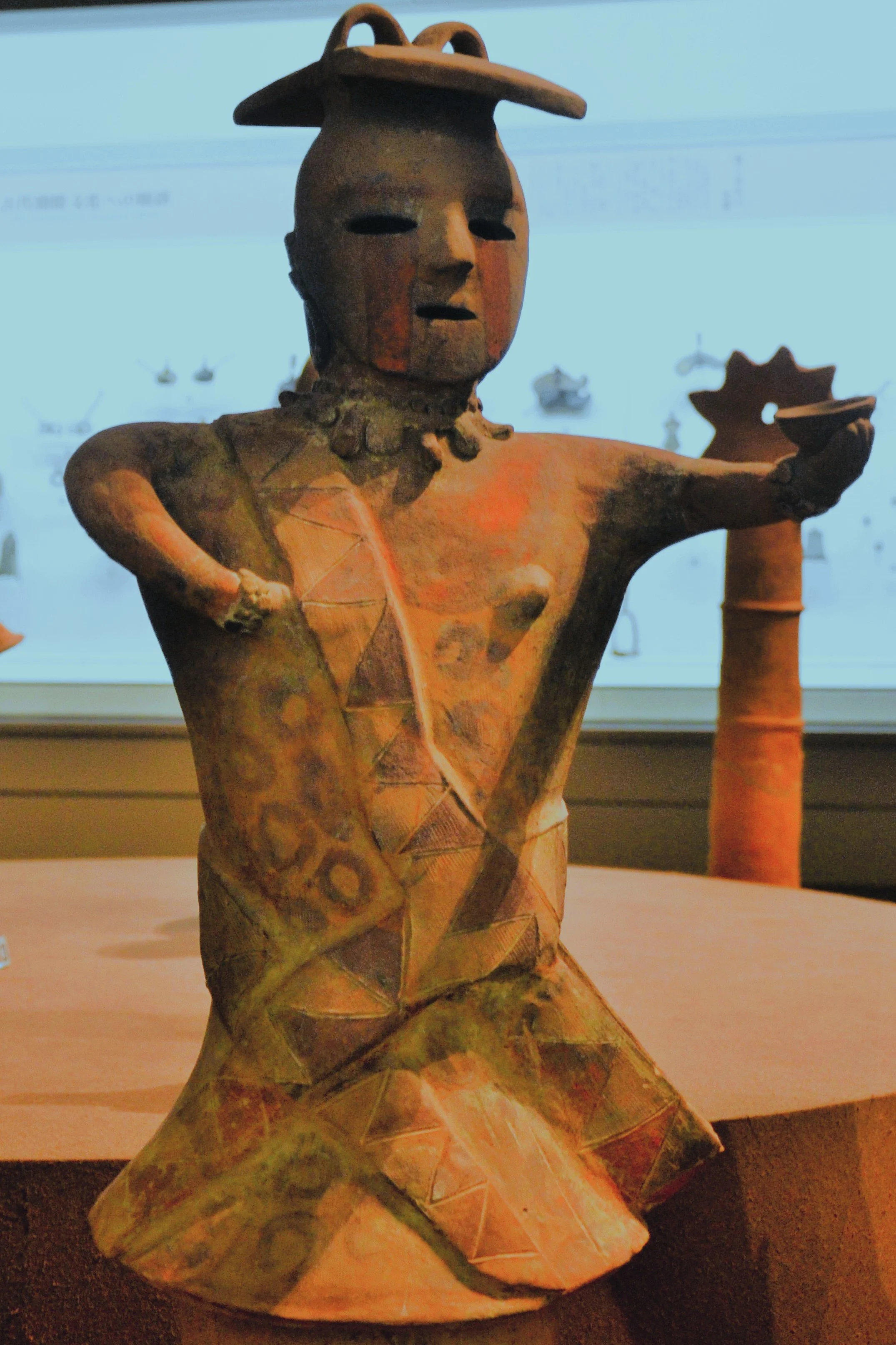
Another source that we have are Haniwa figures. While the majority of the haniwa were simply clay cylinders, there were certainly others that were topped with bowls and various figures. Some of these were quite abstract, while others were fairly detailed. Most of the human figures show up only in the latter part of the kofun period, and styles vary greatly from region to region. It also isn’t like any of this is clearly labeled as to what they mean to represent, so we have to make some educated guesses based on what we know and context, but that could still be missing important pieces of information.

BritishMuseum_Haniwa_6thC.jpg
Rekihaku_Haniwa_6thC_Foreigner.jpg
TNM_6thC_Color.jpg
TNM_6thC_Simple.jpg
TNM_Haniwa6thC_Pants.jpg
TNM_Haniwa6thC_Seat.jpg
TNM_Haniwa6ttC.jpg
NecklacedHaniwa6thC-TamatsukuriJinja.jpg

Based on those models, the Kyoto Costume Museum reconstructed them as follows:

  • Young Man in Shirt and Trousers

  • Young Man in Shirt, Trousers, and Skit (mo)

  • Woman in Formal Attire

  • Woman wearing a colorful sash

Tenjūkoku Mandala

This embroidered mandala was made for Chūgūji, the temple built for Princess Anahobe, the mother of the famous Shōtoku Taishi, in 621. This mandala is thought to be from the 7th century.

Tenjyukoku_embroidery.jpg Tenjyukoku_embroidery_detail1.jpg Tenjyukoku_embroidery_detail2.jpg

Takamatsuzuka Kofun

Takamatsuzuka, a circular kofun in the Asuka area, is extremely important to our understanding of the clothing at the time for the intricate paintings which were in incredible condition when the tomb was first found and opened. The paintings depict eight women and eight men, which give us some idea of what people of the time wore. Or so we presume. The tomb shares characteristics with Goguryeo style tombs, and it is possible that the images are not depicting locals, but they do seem to accord well with the outfits in the mandala.

Takamatsuzuka_Kofun,_replica_3D-N2.jpg
Takamatsuzuka_Kofun,_replica_3D-N2_1.jpg
Takamatsuzuka_Kofun,_replica_3D-N2_2.jpg
Takamatsuzuka_Kofun,_replica_3D-N2_3.jpg
Takamatsuzuka_Kofun,_replica_3D-N2_4.jpg
Takamatsuzuka_Kofun,_replica_3D-N2.jpg Takamatsuzuka_Kofun,_replica_3D-N2_1.jpg Takamatsuzuka_Kofun,_replica_3D-N2_2.jpg Takamatsuzuka_Kofun,_replica_3D-N2_3.jpg Takamatsuzuka_Kofun,_replica_3D-N2_4.jpg

Click the below links to see images of the Kyoto Costume Museum’s reconstructions of these outfits:

  • Man in formal court garb based on the Tenjūkoku mandala

  • Woman in court outfits based on the Tenjūkoku mandala

  • Man in formal court outfit based on the Takamatsuzuka kofun

  • Court lady in formal outfit based on the Takamatsuzuka kofun

Court Rank Color Chart

Click here for a color chart of the formal garments of the Asuka period onwards. Please note that the colors you see on the screen may be affected by many factors, just as dye lots for actual clothes wouldn’t always match exactly. So these are what we think they meant, but the color may be more of a range rather than just one, pure color.

  • Welcome to Sengoku Daimyo’s Chronicles of Japan.  My name is Joshua and this is Episode 137:  Courtly Fashion.

    In the New Year’s ceremony, the court officials lined up in front of the Kiyomihara Palace, arranged by their relative court rank, dressed in their assigned court robes.  The effect was impressive—the rows of officials painting the courtyard like the bands of color in a rainbow, albeit one with only a couple of hues.  The fact that they were all wearing the same style of dress and black, stiffened gauze hats only added to the effect.  The individual officers were all but lost in what was, at least in outward form, a single, homogenous machine of government, just waiting for the command of their monarch to attend to the important matters of state.

    We are covering the reign of Ohoama no Ohokimi, aka Ama no Nunahara oki no mabito no Sumera no Mikoto, aka Temmu Tennou.  Last episode we went over the changes he had made to the family titles—the kabane—as well as to the courtly rank system.  For the former, he had consolidated the myriad kabane and traditional titles across Yamato into a series of eight—the Yakusa no Kabane.   These were, from highest to lowest: Mabito, Asomi, Sukune, Imiki, Michinoshi, Omi, Muraji, and Inaki.  By the way, you might notice that “Mabito” actually occurs in Ohoama’s posthumous name:  Ama no Nunahara oki no mabito, which lends more credence to the idea that that kabane was for those with a special connection to the royal lineage.

    Besides simplifying and restructuring the kabane, Ohoama also reformed the court rank system.  He divided the Princely ranks into two categories:  Myou, or Bright, and Jou, or Pure.  For the court nobles the categories were:

                   Shou – Upright

                   Jiki – Straight

                   Gon – Diligent

                   Mu – Earnest

                   Tsui – Pursue

                   Shin – Advancement

    Each category was further divided into four grades (except for the very first princely category, Myou, which was only two).  Each grade was then further divided into large, “dai”, or broad, “kou”.

    And this brings us to our topic today. Along with this new rank system, Ohoama’s administration also instituted a new set of court sumptuary laws. Some are vague in the record—we can just make assumptions for what is going on based on what we know from later fashion choices.  Others are a little more clear.  We’ll take a look at those sumptuary laws, particularly those that were directly associated with the new court rank system, but we’ll also look at the clothing styles more generally.

    To start with, let’s talk about what we know about clothing in the archipelago in general.  Unfortunately, fabric doesn’t tend to survive very well in the generally acidic soils of the Japanese archipelago.  Cloth tends to break down pretty quickly.  That said, we have fragments here and there and impressions in pottery, so we have some idea that there was some kind of woven fabric from which to make clothing out of.

    And before I go too far I want to give a shout out to the amazing people at the Kyoto Costume Museum.  They have a tremendous website and I will link to it in the comments.  While there may be some debate over particular interpretations of historical clothing, it is an excellent resource to get a feel for what we know of the fashion of the various periods.  I’ll also plug our own website, SengokuDaimyo.com, which has a “Clothing and Accessory” section that, while more geared towards Heian and later periods, may still be of some use in looking up particular terms and getting to know the clothing and outfits.

    At the farthest reaches of pre-history, we really don’t have a lot of information for clothing.  There is evidence of woven goods in the Jomon period, and we have Yayoi burials with bits of cloth here and there, but these are all scraps.  So at best we have some conjecture as to what people were wearing, and possibly some ability to look across the Korean peninsula and see what people had, there.

    There are scant to no reliable records from early on in Japanese history, and most of those don’t really do a great job of describing the clothing.  Even where we do get something, like the Weizhi, one has to wonder given how they tended to crib notes from other entries.

    There is at least one picture scroll of interest: Portraits of Periodical Offering of Liang, or Liáng -Zhígòngtú.  It is said to have been painted by Xiao Yi in the early 6th century, and while the original no longer exists there is an 11th century copy from the time of the Song Dynasty.  The scroll shows  various ambassadors to the Liang court, including one from Wa.  The Wa ambassador is shown with what appears to be a wide piece of cloth around his hips and legs, tied in front.  His lower legs are covered in what we might call kyahan today: a rather simple wrap around leg from below the knee to the foot.  He has another, blue piece of cloth around his shoulders, almost like a shawl, and it is also tied in front.  Then there is a cloth wrapped and tied around his head. It’s hard to know how much of this depiction is accurate and how much the artist was drawing on memory and descriptions from things like the Weizhi or Wei Chronicles, which stated that the Wa people wore wide cloths wrapped around and seamlessly tied

    As such, it may be more helpful to look at depictions actually from the archipelago: specifically, some of the human-figured haniwa, those clay cylinders and statues that adorned the burial mounds which gave the kofun period its name.  Some of these haniwa are fairly detailed, and we can see ties, collars, and similar features of clothing. These haniwa primarily seem to cluster towards the end of the Kofun period, in the later 6th century, so it is hard to say how much they can be used for earlier periods, though that is exactly what you will typically see for periods where we have little to know evidence.  I’m also not sure how regional certain fashions might have been, and we could very much be suffering from survivorship bias—that is we only know what survived and assume that was everything, or even the majority. Still, it is something.

    Much of what we see in these figures is some kind of upper garment that has relatively tight sleeves, like a modern shirt or jacket might have, with the front pieces overlapping create a V-shaped neckline.  The garment hem often hangs down to just above the knee, flaring out away from the body, and it’s held closed with ties and some kind of belt, possibly leather in some cases, and in others it looks like a tied loop of cloth.  There is evidence of a kind of trouser, with two legs, and we see ties around the knee.  In some cases, they even have small bells hanging from the ties.  Presumably the trousers might have ties up towards the waist, but we cannot see that in the examples we have. We also see individuals who have no evidence of any kind of bifurcated lower garment.  That may indicate an underskirt of some kind, or possibly what’s called a “mo”—but it could also be just a simplification for stability, since a haniwa has a cylindrical base anyway.  It is not always obvious when you are looking at a haniwa figure whether it depicts a man or woman: in some cases there are two dots on the chest that seem to make it obvious, but the haniwa do come from different artisans in different regions, so there is a lot of variability.

    We also see evidence of what seem to be decorative sashes that are worn across the body, though not in all cases.  There are various types of headgear and hairstyles.  Wide-brimmed and domed hats are not uncommon, and we also see combs and elaborate hairstyles depicted.  On some occasions we can even see that they had closed toed shoes.  For accessories, we see haniwa wearing jewelry, including necklaces (worn by both men and women), bracelets, and earrings.  In terms of actual human jewelry, early shell bracelets demonstrate trade routes, and the distinctive magatama, or comma shaped jewel, can be found in the archipelago and on the Korean peninsula, where it is known as “gogok”. 

    Based on lines or even colored pigment on the haniwa, it appears that many of these outfits were actually quite heavily decorated.  Paint on the outfits is sometimes also placed on the face, suggesting that they either painted or tattooed themselves, something mentioned in the Wei Chronicles.  We also have archaeological examples of dyed cloth, so it is interesting that people are often depicted in undyed clothing. 

    There is one haniwa that I find particularly interesting, because they appear to be wearing more of a round-necked garment, and they have a hat that is reminiscent of the phrygian cap: a conical cap with the top bent forward.  These are traits common to some of the Sogdians and other Persian merchants along the silk road, raising the possibility that it is meant to depict a foreigner, though it is also possible that it was just another local style.

    If we compare this to the continent, we can see some immediate difference.  In the contemporaneous Sui dynasty, we can see long flowing robes, with large sleeves for men and women.  The shoes often had an upturned placket that appears to have been useful to prevent one from tripping on long, flowing garments.  Many of these outfits were also of the v-neck variety, with two overlapping pieces, though it is often shown held together with a fabric belt that is tied in front.  The hats appear to either be a kind of loose piece of fabric, often described as a turban, wrapped around the head, the ends where it ties together trailing behind, or black lacquered crowns—though there were also some fairly elaborate pieces for the sovereign.

    As Yamato started to import continental philosophy, governance, and religion, they would also start to pick up on continental fashion.  This seems particularly true as they adopted the continental concept of “cap rank” or “kan-i". Let’s go over what we know about this system, from its first mention in the Chronicles up to where we are in Ohoama’s reign. As a caveat, there is a lot we don’t know about the details of these garments, but we can make some guesses.

    The first twelve cap-ranks, theoretically established in 603, are somewhat questionable in their historicity, as are so many things related to Shotoku Taishi.  And their names are clearly based on Confucian values:  Virtue, Humanity, Propriety, Faith, Justice, and Wisdom, or Toku, Nin, Rei, Shin, Gi, and Chi.  The five values and then just “Virtue”, itself. The existence of this system does seem to be confirmed by the Sui Shu, the Book of Sui, which includes a note in the section on the country of Wa that they used a 12 rank system based on the Confucian values, but those values were given in the traditional Confucian order vice the order given in the Nihon Shoki.


    The rank system of the contemporaneous Sui and Tang dynasties was different from these 12 ranks, suggesting that the Yamato system either came from older dynasties—perhaps from works on the Han dynasty or the Northern and Southern Dynasty, periods—or they got it from their neighbors, Baekje, Silla, and Goguryeo.  There does seem to be a common thread, though, that court rank was identifiable in one’s clothes.

    As for the caps themselves, what did they look like?  One would assume that the Yamato court just adopted a continental style cap, and yet, which one? It isn’t fully described, and there are a number of types of headwear that we see in the various continental courts. Given that, we aren’t entirely sure exactly what it looked like, but we do have a couple of sources that we can look at and use to make some assumptions. 

    These sources l ead us to the idea of a round, colored cap made of fabric, around the brim that was probably the fabric or image prescribed for that rank.  It is also often depicted with a bulbous top, likely for the wearer’s hair, and may have been tied to their top knot.


    Our main source for this is the Tenjukoku Mandala Embroidery (Tenjukoku-mandara-shuuchou) at Chuuguuji temple, which was a temple built for the mother of Prince Umayado, aka Shotoku Taishi.


     This embroidery was created in 622, so 19 years after the 12 ranks would have been implemented. It depicts individuals in round-necked jackets that appear to have a part straight down the center.  Beneath the jacket one can see a pleated hem, possibly something like a “hirami”, a wrapped skirt that is still found in some ceremonial imperial robes.  It strikes me that this could also be the hem of something like the hanpi, which was kind of like a vest with a pleated lower edge.  Below that we see trousers—hakama—with a red colored hem—at least on one figure that we can see.  He also appears to be wearing a kind of slipper-like shoe.

    As for the women, there are a few that appear to be in the mandala, but it is hard to say for certain as the embroidery has been damaged over the years. That said, from what we can tell, women probably would have worn something similar to the men in terms of the jacket and the pleated under-skirt, but then, instead of hakama, we see a pleated full-length skirt, or mo.  We also don’t have a lot of evidence for them wearing hats or anything like that.

    The round necked jacket is interesting as it appears to be similar to the hou that was common from northern China across the Silk Road, especially amongst foreigners.  This garment  came to displace the traditional robes of the Tang court and would become the basis for much of the court clothing from that period, onwards.  The round necked garment had central panels that overlapped, and small ties or fastenings at either side of the neck to allow for an entirely enclosed neckline.  This was more intricate than just two, straight collars, and so may have taken time to adopt, fully.

    The next change to the cap-rank system was made in 647, two years into the Taika Reform.  The ranks then were more directly named for the caps, or crowns—kanmuri—and their materials and colors.  The ranks translate to Woven, Embroidered, Purple, Brocade, Blue, Black, and finally “Establish Valor” for the entry level rank.

    The system gets updated two years later, but only slightly.  We still see a reference to Woven stuff, Embroidery, and Purple, but then the next several ranks change to Flower, Mountain, and Tiger—or possibly Kingfisher.  These were a little more removed from the cap color and material, and may have had something to do with designs that were meant to be embroidered on the cap or on the robes in some way, though that is just speculation based on later Ming and Qing court outfits.

    Naka no Ohoye then updates it again in 664, but again only a little.  He seems to add back in the “brocade” category, swapping out the “flower”, and otherwise just adds extra grades within each category to expand to 26 total rank grades.

    And that brings us to the reforms of 685, mentioned last episode.  This new system was built around what appear to be moral exhortations—Upright, Straight, Diligent, Earnest, etc.  And that is great and all, but how does that match up with the official robes? What color goes with each rank category? 

    Fortunately, this time around, the Chronicle lays it out for us pretty clearly. First off we are given the color red for the Princely ranks—not purple as one might have thought.  Specifically, it is “Vermillion Flower”, hanezu-iro, which Bentley translates as the color of the “Oriental bush” or salmon.  In the blogpost we’ll link to a table of colors that the founder of Sengoku Daimyo, Anthony Bryant, had put together, with some explanation of how to apply it.  I would note that there is often no way to know exactly what a given color was like or what shades were considered an acceptable range.  Everything was hand-dyed, and leaving fabric in the dye a little longer, changing the proportions, or just fading over time could create slightly different variants in the hue, but we think we can get pretty close.

    From there we have the six “common” ranks for the nobility.  Starting with the first rank, Upright, we have “Dark Purple”.  Then we have “Light Purple”.  This pattern continues with Dark and Light Green and then Dark and Light Grape or Lilac.  Purple in this case is Murasaki, and green here is specifically Midori, which is more specifically green than the larger category of “Aoi”, which covers a spectrum of blue to green.  The grape or lilac is specifically “suou”, and based on Bentley’s colors it would be a kind of purple or violet.

    The idea is that the official court outfits for each rank would be the proper color.  And yes, that means if you get promoted in rank, your first paycheck—or rice stipend—is probably going to pay for a new set of official clothes.  Fortunately for the existing court nobles at the time, in the last month of 685, the Queen provided court clothing for 55 Princes and Ministers, so they could all look the part.

    And the look at court was important.  In fact, several of the edicts from this time focus specifically on who was allowed—or expected—to wear what.  For instance, in the 4th month of 681, they established 92 articles of the law code, and among those were various sumptuary laws—that is to say, laws as to what you could wear.  We are told that they applied to everyone from Princes of the blood down to the common person, and it regulated the wearing of precious metals, pearls, and jewels; the type of fabric one could use, whether purple, brocade, embroidery, or fine silks; and it also regulated woollen carpets, caps, belts, and the colors of various things.

    And here I’d like to pause and give some brief thought to how this played into the goals of the court, generally, which is to say the goal of creating and establishing this new system of governance in the cultural psyche of the people of the archipelago.  From the continental style palaces, to the temples, and right down to the clothing that people were wearing, this was all orchestrated, consciously or otherwise, to emphasize and even normalize the changes that were being introduced.  When everything around you is conforming to the new rules, it makes it quite easy for others to get on board.

    The court had surrounded themselves with monumental architecture that was designed along continental models and could best be explained through continental reasoning.  Even if they weren’t Confucian or Daoist, those lines of reasoning ran through the various cultural and material changes that they were taking up.  Sure, they put their own stamp on it, but at the same time, when everything is right in front of you, it would become that much harder to deny or push back against it.

    And when you participated in the important rituals of the state, the clothing itself became a part of the pageantry.  It reinforced the notion that this was something new and different, and yet also emphasized that pushing against it would be going against the majority.  So court uniforms were another arm of the state’s propaganda machine, all designed to reinforce the idea that the heavenly sovereign—the Tennou—was the right and just center of political life and deserving of their position. 

    Getting back to the sumptuary laws and rank based regulations: It is unfortunate that the record in the Nihon Shoki doesn’t tell us exactly how things were regulated, only that they were, at least in some cases.  So for anything more we can only make assumptions based on later rules and traditions.  A few things we can see right away, though.  First is the restriction of the color purple.  Much as in Europe and elsewhere in the world, getting a dark purple was something that was not as easy as one might think, and so it tended to be an expensive dye and thus it would be restricted to the upper classes—in this case the princely and ministerial rank, no doubt.  Similarly brocade and fine silks were also expensive items that were likely restricted to people of a particular social station for that reason.

    The mention of woolen rugs is particularly intriguing.  Bentley translates this as woven mattresses, but I think that woolen rugs makes sense, as we do have examples of woolen “rugs” in Japan in at least the 8th century, stored in the famous Shousouin repository at Toudaiji temple, in Nara.  These are all imported from the continent and are actually made of felt, rather than woven.  As an imported item, out of a material that you could not get in the archipelago, due to a notable lack of sheep, they would have no doubt been expensive.

    The funny thing is that the carpets in the Shousouin may not have been meant as carpets.  For the most part they are of a similar size and rectangular shape, and one could see how they may have been used as sleeping mattresses or floor coverings.  However, there is some conjecture that they came from the Silk Road and may have been originally meant as felt doors for the tents used by the nomadic steppe peoples.  This is only conjecture, as I do not believe any of these rugs have survived in the lands where they would have been made, but given the size and shape and the modern yurt, it is not hard to see how that may have been the case.  Either way, I tend to trust that this could very well have meant woolen rugs, as Aston and the kanji themselves suggest, though I would understand if there was confusion or if it meant something else as wool was not exactly common in the archipelago at that time or in the centuries following.

    The last section of the regulations talks about the use of caps and belts.  The caps here were probably of continental origin:  The kanmuri, or official cap of state of the court nobles, or the more relaxed eboshi—though at this time, they were no doubt closely related.

    In fact, a year later, we have the most specific mention to-date of what people were actually wearing on their heads: there is a mention of men tying up their hair and wearing caps of varnished gauze.  Earlier caps related to the cap rank system are often thought to be something like a simple hemisphere  that was placed upon the head, with a bulbous top where the wearer’s hair could be pulled up as in a bun.

    The kanmuri seems to have evolved from the soft black headcloth that was worn on the continent, which would have tied around the head, leaving two ends hanging down behind.  Hairstyles of the time often meant that men had a small bun or similar gathering of hair towards the back of their head, and tying a cloth around the head gave the effect of a small bump.  This is probably what we see in depictions of the early caps of state.  Sometimes this topknot could be covered with a small crown or other decoration, or wrapped with a cloth, often referred to as a “Tokin” in Japanese.  But over time we see the development of hardened forms to be worn under a hat to provide the appropriate silhouette, whether or not you actually had a topknot (possibly helpful for gentlemen suffering from hair loss).  And then the hat becomes less of a piece of cloth and more just a hat of black, lacquered gauze made on a form, which was much easier to wear. 

    At this point in the Chronicle, the cap was likely still somewhat malleable, and would made to tie or be pinned to that bun or queue of hair.  This explains the mention of men wearing their hair up.  This pin would become important for several different types of headgear, but ties were also used for those who did not have hair to hold the hat on properly.

    Two years after the edict on hats, we get another edict on clothing, further suggesting that the court were wearing Tang inspired clothing.  In 685 we see that individuals are given leave to wear their outer robe either open or tied closed. This is a clue that this outer robe might something akin to the round-necked hou that we see in the Tenjukoku Mandala, where the neck seems to close with a small tie or button.  However, we do see some examples, later, of v-necked garments with a tie in the center of the neck, so that may be the reference..  Opening the collar of the formal robes was somewhat akin to loosening a necktie, or unbuttoning the top button of a shirt.  It provided a more relaxed and comfortable feeling.  It could also be a boon in the warm days of summer.  Leaving it closed could create a more formal appearance.

    The courtiers also had the option of whether or not to wear the “Susotsuki”, which Bentley translates as “skirt-band”.  I believe this refers to the nai’i, or inner garment.  This would often have a pleated hem—a suso or ran—which would show below the main robe as just a slight hem.  Again, this is something that many would dispense with in the summer, or just when dressing a bit more casually, but it was required at court, as well as making sure that the tassles were tied so that they hung down. 

    This was the uniform of the court.  We are also told that they would have trousers that could be tied up, which sounds like later sashinuki, though it may have referred to something slightly different.  We are also given some regulations specifically for women, such as the fact that women over 40 years of age were allowed the discretion on whether or not to tie up their hair, as well as whether they would ride horses astride or side-saddle.  Presumably, younger women did not get a choice in the matter.  Female shrine attendants and functionaries were likewise given some leeway with their hairstyles.

    A year later, in 686, they do seem to have relaxed the hairstyles a bit more: women were allowed to let their hair down to their backs as they had before, so it seems that, for at least a couple of years, women under the age of 40 were expected to wear their hair tied up in one fashion or another.

    In that same edict, men were then allowed to wear “habakimo”.  Aston translates this as “leggings” while Bentley suggests it is a “waist skirt”.  There are an example of extant habakimo in the Shousouin, once again, and they appear to be wrappings for the lower leg.  It actually seems very closely related to the “kyahan” depicted all the way back in the 6th century painting of the Wo ambassador to Liang.

    Even though these edicts give a lot more references to clothing, there is still plenty that is missing.  It isn’t like the Chroniclers were giving a red carpet style stitch-by-stitch critique of what was being worn at court.  Fortunately, there is a rather remarkable archaeological discovery from about this time.

    Takamatsuzuka is a kofun, or ancient burial mound, found in Asuka and dated to the late 7th or early 8th century.  Compared to the keyhole shaped tombs of previous centuries, this tomb is quite simple: a two-tiered circular tomb nestled in the quiet hills.  What makes it remarkable is that the inside of the stone burial chamber was elaborately painted.  There are depictions of the four guardian animals, as well as the sun and the moon, as well as common constellations.  More importantly, though, are the intricate pictures of men and women dressed in elaborate clothing.

    The burial chamber of Takamatsuzuka is rectangular in shape.  There are images on the four vertical sides as well as on the ceiling.  The chamber is oriented north-south, with genbu, the black tortoise, on the north wall and presumably Suzaku, the vermillion bird, on the south wall—though that had been broken at some point and it is hard to make out exactly what is there.

    The east and west walls are about three times as long as the north and south walls.  In the center of each is a guardian animal—byakko, the white tiger, on the west wall and seiryuu, the blue—or green—dragon on the east.  All of these images are faded, and since opening of the tomb have faded even more, so while photos can help, it may require a bit more investigation and some extrapolation to understand all of what we are looking at.

    On the northern side of both the east and west wall we see groups of four women.  We can make out green, yellow, and red or vermillion outer robes with thin fabric belt sashes, or obi, tied loosely and low around the waist.  There is another, lightly colored—possibly white, cream or pink—that is so faded it is hard to make out, and I don’t know if that is the original color.  These are v-necked robes, with what appear to be ties at the bottom of the “v”.  Around the belt-sash we see a strip of white peaking out from between the two sides of the robe—most likely showing the lining on an edge that has turned back slightly.  The cuffs of the robe are folded back, showing a contrasting color—either the sleeves of an underrobe or a lining of some kind.  Below the outer robe is a white, pleated hem—possibly a hirami or similar, though where we can make it out, it seems to be the same or similar color as the sleeves.  Under all of that, they then have a relatively simple mo, or pleated skirt.  The ones in the foreground are vertically striped in alternating white, green, red, and blue stripes.  There is one that may just be red and blue stripes, but I’m not sure.  In the background we see a dark blue—and possibly a dark green—mo.  At the base of each mo is a pleated fringe that appears to be connected to the bottom of the skirt.  The toe of a shoe seems to peek out from underneath in at least one instance.  They don’t have any obvious hair ornaments, and their hair appears to be swept back and tied in such a way that it actually comes back up in the back, slightly.  They appear to be holding fans and something that might be a fly swatter—a pole with what looks like tassels on the end.

    In comparison, at the southern end of the tomb we have two groups of men.  These are much more damaged and harder to make out clearly.  They have robes of green, yellow, grey, blue, and what looks like dark blue, purple, or even black.  The neckline appears to be a v-necked, but tied closed, similar to what we see on the women.  We also see a contrasting color at the cuff, where it looks like the sleeves have turned back, slightly.  They have belt-sashes similar to the women, made of contrasting fabric to the robe itself.  Below that we see white trousers, or hakama, and shallow, black shoes.  On some of the others it is suggested that maybe they have a kind of woven sandal, but that is hard to make out in the current image.  On their heads are hats or headgear of black, stiffened—probably lacquered—gauze.  They have a bump in the back, which is probably the wearer’s hair, and there is evidence of small ties on top and larger ties in the back, hanging down.  Some interpretations also show a couple with chin straps, as well, or at least a black cord that goes down to the chin.  They carry a variety of implements, suggesting they are attendants, with an umbrella, a folding chair, a pouch worn around the neck, a pole or cane of some kind, and a bag with some kind of long thing—possibly a sword or similar.

    The tomb was originally found by farmers in 1962, but wasn’t fully examined until 1970, with an excavation starting in 1972.  The stone at the entryway was broken, probably from graverobbers, who are thought to have looted the tomb in the Kamakura period.  Fortunately, along with the bones of the deceased and a few scattered grave goods that the robbers must have missed, the murals also survived, and somehow they remained largely intact through the centuries.  They have not been entirely safe, and many of the images are damaged or faded, but you can still make out a remarkable amount of detail, which is extremely helpful in determining what clothing might have looked like at this time—assuming it is depicting local individuals.

    And there is the rub, since we don’t know exactly whom the tomb was for.  Furthermore, in style it has been compared with Goguryeo tombs from the peninsula, much as nearby Kitora kofun is.  Kitora had images as well, but just of the guardian animals and the constellations, not of human figures.

    There are three theories as to who might have been buried at Takamatsuzuka.  One theory is that it was one of Ohoama’s sons.  Prince Osakabe is one theory, based on the time of his death and his age.  Others have suggested Prince Takechi.  Based on the teeth of the deceased, they were probably in their 40s to 60s when they passed away.

    Some scholars believe that it may be a later, Nara period vassal—possibly, Isonokami no Maro.  That would certainly place it later than the Asuka period.

    The third theory is that it is the tomb of a member of one of the royal families from the Korean peninsula—possibly someone who had taken up refuge in the archipelago as Silla came to dominate the entire peninsula.  This last theory matches with the fact that Takamatsuzuka appears to be similar to tombs found in Goguryeo, though that could just have to do with where the tomb builders were coming from, or what they had learned.

    That does bring up the question of the figures in the tomb.  Were they contemporary figures, indicating people and dress of the court at the time, or were they meant to depict people from the continent?  Without any other examples, we may never know, but even if was indicative of continental styles, those were the very styles that Yamato was importing, so it may not matter, in the long run.


    One other garment that isn’t mentioned here is the hire, a scarf that is typically associated with women.  It is unclear if it has any relationship to the sashes we see in the Kofun period, though there is at least one mention of a woman with a hire during one of the campaigns on the Korean peninsula.  Later we see it depicted as a fairly gauzy piece of silk, that is worn somewhat like a shawl.  It is ubiquitous in Sui and Tang paintings of women, indicating a wide-ranging fashion trend.  The hire is a fairly simple piece of clothing, and yet it creates a very distinctive look which we certainly see, later.

    Finally, I want to take a moment to acknowledge that almost everything we have discussed here has to do with the elites of society—the nobles of the court.  For most people, working the land, we can assume that they were probably not immediately adopting the latest continental fashions, and they probably weren’t dressing in silk very much.  Instead, it is likely that they continued to wear some version of the same outfits we see in the haniwa figures of the kofun period.  This goes along with the fact that even as the elite are moving into palaces built to stand well above the ground, we still have evidence of common people building and living in pit dwellings, as they had been for centuries.  This would eventually change, but overall they stuck around for quite some time.  However, farmers and common people are often ignored by various sources—they aren’t often written about, they often aren’t shown in paintings or statues, and they did often not get specialized burials.  Nonetheless, they were the most populous group in the archipelago, supporting all of the rest.

    And with that, I think we will stop for now.  Still plenty more to cover this reign.  We are definitely into the more historical period, where we have more faith in the dates—though we should remember that this is also one of the reigns that our sources were specifically designed to prop up, so we can’t necessarily take everything without at least a hint of salt and speculation, even if the dates themselves are more likely to be accurate.

    Until then, if you like what we are doing, please tell your friends and feel free to rate us wherever you listen to podcasts.  If you feel the need to do more, and want to help us keep this going, we have information about how you can donate on Patreon or through our KoFi site, ko-fi.com/sengokudaimyo, or find the links over at our main website,  SengokuDaimyo.com/Podcast, where we will have some more discussion on topics from this episode.

    Also, feel free to reach out to our Sengoku Daimyo Facebook page.  You can also email us at the.sengoku.daimyo@gmail.com. 

    Thank you, also, to Ellen for their work editing the podcast.

    And that’s all for now.  Thank you again, and I’ll see you next episode on Sengoku Daimyo’s Chronicles of Japan.

References

  • Bentley, John R. (2025). Nihon Shoki: The Chronicles of Japan. ISBN 979-8-218634-67-4 pb

  • Izutsu, Yohei; et al (Last Reviewed 2025). The Kyoto Costume Museum Website. https://www.iz2.or.jp.

  • Aston, W. G. (1972). Nihongi, chronicles of Japan from the earliest times to A.D. 697. London: Allen & Unwin. ISBN0-80480984-4.

Tags Temmu, Oama, Nihon Shoki, Naniwa, Asuka, Asuka no miya, Uji-kabane, kabane, Rank
Comment

Episode 136: Kabane and Court Rank

October 16, 2025 Joshua Badgley

An artist’s depiction of Ōama no Ōkimi, aka Temmu Tennō. He continued the work of his brother, Naka no Ōe, and made significant changes to the social and political landscape of Yamato. Image in public domain, from Wikimedia Commons.

RSS
Previous Episodes
  • December 2025
  • November 2025
  • October 2025
  • September 2025
  • August 2025
  • July 2025
  • June 2025
  • May 2025
  • April 2025
  • March 2025
  • February 2025
  • January 2025
  • December 2024
  • November 2024
  • October 2024
  • September 2024
  • August 2024
  • July 2024
  • June 2024
  • May 2024
  • April 2024
  • March 2024
  • February 2024
  • January 2024
  • December 2023
  • November 2023
  • October 2023
  • September 2023
  • August 2023
  • July 2023
  • June 2023
  • May 2023
  • April 2023
  • March 2023
  • February 2023
  • January 2023
  • December 2022
  • November 2022
  • October 2022
  • September 2022
  • August 2022
  • July 2022
  • June 2022
  • May 2022
  • April 2022
  • March 2022
  • February 2022
  • January 2022
  • December 2021
  • November 2021
  • October 2021
  • September 2021
  • August 2021
  • July 2021
  • June 2021
  • May 2021
  • April 2021
  • March 2021
  • February 2021
  • January 2021
  • December 2020
  • November 2020
  • October 2020
  • September 2020
  • August 2020
  • July 2020
  • June 2020
  • May 2020
  • April 2020
  • March 2020
  • February 2020
  • January 2020
  • December 2019
  • November 2019
  • October 2019
  • September 2019
Archives
 

This episode we look at “kabane”—ancient titles used in the Japanese archipelago that were often, though not exclusively, attached to the uji, the large corporate families, or clans, set up as part of the early Yamato government. We’ll also talk about the newest innovations in the court rank system.

Kabane (姓)

The kanji for “kabane” actually translates, today, as family name.

Kabane according to MillerNew Kabane (684)
Kimi (公)Mabito (眞人)
Omi (臣) Asomi (朝臣)
Sukune (宿禰)
Kimi (君) Asomi (朝臣)
Muraji (連) Asomi (朝臣)
Sukune (宿禰)
Obito (首) Muraji (連) and then…
Sukune (宿禰)
Imiki (忌寸)
(Kuni no) Miyatsuko (国造) Muraji (連) and then…
Sukune (宿禰)
Imiki (忌寸)
Kishi (吉士) Muraji (連) and then…
Sukune (宿禰)
Imiki (忌寸)
Atahe (値)
also: Atahi/Atai
Muraji (連) and then…
Imiki (忌寸)
Fubito (史) Muraji (連)
Agata-nushi (県主) Muraji (連)
Suguri (村主)Muraji (連)
Kurabito (蔵人)Muraji (連)

The above lacks data for the last four of the new kabane, so here are the Eight Kabane of 684:

  1. Mabito (眞人)

  2. Asomi [aka Ason] (朝臣)

  3. Sukune (宿禰)

  4. Imiki (忌寸)

  5. Michinoshi (道師)

  6. Omi (臣)

  7. Muraji (連)

  8. Inaki (稲置)

Court Ranks of 685

Ranks for those not lower than Prince (王):

  1. Myō-dai-ichi-i 明大一位 (Great Bright First Rank)

  2. Myō-kō-ichi-i 明黄一位 (Broad Bright First Rank)

  3. Myō-dai-ni-i 明大二位 (Great Bright Second Rank)

  4. Myō-kō-ni-i 明黄二位 (Broad Bright Second Rank)

  5. Jō-dai-ichi-i 浄大一位 (Great Pure First Rank)

  6. Jō-kō-ichi-i 浄黄一位 (Broad Pure First Rank)

  7. Jō-dai-ni-i 浄大二位 (Great Pure Second Rank)

  8. Jō-kō-ni-i 浄黄二位 (Broad Pure Second Rank)

  9. Jō-dai-san-i 浄大三位 (Great Pure Third Rank)

  10. Jō-kō-san-i 浄黄三位 (Broad Pure Third Rank)

  11. Jō-dai-shi-i 浄大四位 (Great Pure Fourth Rank)

  12. Jō-kō-shi-i 浄黄四位 (Broad Pure Fourth Rank)

Ranks for other court officials:

  1. Shō-dai-ichi-i 正大一位 (Great Upright First Rank)

  2. Shō-kō-ichi-i 正黄一位 (Broad Upright First Rank)

  3. Shō-dai-ni-i 正大二位 (Great Upright Second Rank)

  4. Shō-kō-ni-i 正黄二位 (Broad Upright Second Rank)

  5. Shō-dai-san-i 正大三位 (Great Upright Third Rank)

  6. Shō-kō-san-i 正黄三位 (Broad Upright Third Rank)

  7. Shō-dai-shi-i 正大四位 (Great Upright Fourth Rank)

  8. Shō-kō-shi-i 正黄四位 (Broad Upright Fourth Rank)

  9. Jiki-dai-ichi-i 直大一位 (Great Straight First Rank)

  10. Jiki-kō-ichi-i 直黄一位 (Broad Straight First Rank)

  11. Jiki-dai-ni-i 直大二位 (Great Straight Second Rank)

  12. Jiki-kō-ni-i 直黄二位 (Broad Straight Second Rank)

  13. Jiki-dai-san-i 直大三位 (Great Straight Third Rank)

  14. Jiki-kō-san-i 直黄三位 (Broad Straight Third Rank)

  15. Jiki-dai-shi-i 直大四位 (Great Straight Fourth Rank)

  16. Jiki-kō-shi-i 直黄四位 (Broad Straight Fourth Rank)

  17. Gon-dai-ichi-i 勤大一位 (Great Diligent First Rank)

  18. Gon-kō-ichi-i 勤黄一位 (Broad Diligent First Rank)

  19. Gon-dai-ni-i 勤大二位 (Great Diligent Second Rank)

  20. Gon-kō-ni-i 勤黄二位 (Broad Diligent Second Rank)

  21. Gon-dai-san-i 勤大三位 (Great Diligent Third Rank)

  22. Gon-kō-san-i 勤黄三位 (Broad Diligent Third Rank)

  23. Gon-dai-shi-i 勤大四位 (Great Diligent Fourth Rank)

  24. Gon-kō-shi-i 勤黄四位 (Broad Diligent Fourth Rank)

  25. Mu-dai-ichi-i 務大一位 (Great Earnest First Rank)

  26. Mu-kō-ichi-i 務黄一位 (Broad Earnest First Rank)

  27. Mu-dai-ni-i 務大二位 (Great Earnest Second Rank)

  28. Mu-kō-ni-i 務黄二位 (Broad Earnest Second Rank)

  29. Mu-dai-san-i 務大三位 (Great Earnest Third Rank)

  30. Mu-kō-san-i 務黄三位 (Broad Earnest Third Rank)

  31. Mu-dai-shi-i 務大四位 (Great Earnest Fourth Rank)

  32. Mu-kō-shi-i 務黄四位 (Broad Earnest Fourth Rank)

  33. Tsui-dai-ichi-i 追大一位 (Great Pursuit First Rank)

  34. Tsui-kō-ichi-i 追黄一位 (Broad Pursuit First Rank)

  35. Tsui-dai-ni-i 追大二位(Great Pursuit Second Rank)

  36. Tsui-kō-ni-i 追黄二位 (Broad Pursuit Second Rank)

  37. Tsui-dai-san-i 追大三位(Great Pursuit Third Rank)

  38. Tsui-kō-san-i 追三位 (Broad Pursuit Third Rank)

  39. Tsui-dai-shi-i 追大四位(Great Pursuit Fourth Rank)

  40. Tsui-kō-shi-i 追黄四位 (Broad Pursuit Fourth Rank)

  41. Shin-dai-ichi-i 進大一位 (Great Advancement First Rank)

  42. Shin-kō-ichi-i 進黄一位 (Broad Advancement First Rank)

  43. Shin-dai-ni-i 進大二位 (Great Advancement Second Rank)

  44. Shin-kō-ni-i 進黄二位 (Broad Advancement Second Rank)

  45. Shin-dai-san-i 進大三位 (Great Advancement Third Rank)

  46. Shin-kō-san-i 進黄三位 (Broad Advancement Third Rank)

  47. Shin-dai-shi-i 進大四位 (Great Advancement Fourth Rank)

  48. Shin-kō-shi-i 進黄四位 (Broad Advancement Fourth Rank)

  • Welcome to Sengoku Daimyo’s Chronicles of Japan.  My name is Joshua, and this is Episode 136: Kabane and Court Rank


    Mononobe no Muraji no Ujimaro was in a foul mood.  Once more he had been passed over for promotion, and so he continued to toil away, tallying reports as they came in from the various provinces across the kingdom. Meanwhile, Hasama no Atahe no Woshibi was now his superior, with an exalted rank and the generous stipend that came with it.  Ujimaro fumed—he was Mononobe, and his family had once all but ruled Yamato.  Though they had been perhaps reduced in circumstances since then, they still proudly held to their place as a Muraji family—a distinction that demonstrated their superior pedigree.  Meanwhile, Woshibi was from the Hasama family.  Sure, his relative, Nemaro, had been one of those on the front lines in the recent conflict, but still, his family was only atahe.  Honestly, a Mononobe was supposed to take orders from someone of an Atahe family?

    But this was the new way of things.  The ancient traditions were no longer enough—you had to work hard and make sure way up through this new court rank system if you wanted to succeed.  Ujimaro grumbled, but there was little he could do in the moment.  Nonetheless, he couldn’t help but think about how the natural order of the world was somehow turned upside down…


    Greetings and welcome back, everyone. We are working our way through the reign of Ohoama, aka Temmu Tennou.  This reign spanned fourteen years, if you include the Jinshin year of 672, though it is broken into two narratives in the Nihon Shoki.  The first chapter covers the year of the disturbance, the Jinshin no Ran, when Ohoama fought with the Afumi court, who supported his nephew, Ohotomo, on the throne.  We’ve covered that turbulent period previously.  The second chapter covers the other 13 years of Ohoama’s reign.

    Last episode we covered the first year of Ohoama sitting properly on the throne.  The year 673 included Ohoama’s ascension; the confirmation, continuation, and evolution of the Ritsuryou system instituted during Naka no Oe’s time; as well as various ceremonies around Ohoama’s ascension to the throne, including the first verifiable “Daijosai”, the specialized harvest ceremony for the first harvest season of the reign.

    This episode we are going to try and tackle something that people have sent in questions about.  We’ve touched on it here and there, but I really want to get into the Kabane system—that ancient practice of family titles that were like a collective rank system.  It was during Ohoama’s reign that the court made major reforms to the kabane system and restructured it pretty extensively.  At the same time, the kabane system was gradually being replaced by other systems of displaying one’s status in society—such as the court rank system, which was also revised this reign.  Eventually, without the same purpose as before, kabane would fade away, with a few remaining as honorifics and titles, but at this point they were still important. 

    So we’ll get into both of these status systems  and discuss a little bit about what that meant for the people of the late 7th century court.

    From the beginning of Ohoama’s reign, the court had continued to implement the cap-rank system, most recently amended in 664, by Ohoama’s brother, Naka no Ohoye.  With the new rank system of 685, the format changed considerably. To better understand this, let’s talk about the rank systems in Yamato and how we have gotten to this point.  We’ll want to start with the kabane, and to do that, I want to take us back to a much earlier time.

    As you may recall, in the oldest stories in the Nihon Shoki, the Kojiki, and the Sendai Kuji Hongi, most individuals only have a single name, or they are known by the name of a location and a title.  Iware Hiko, for example, with Hiko and Hime being general masculine and feminine terms for elites from a given area. 

    From this, it would appear as though there was no such thing as a “family” name in early Wa societies. As I’ve pointed out before, that does not mean that there were not families, of course, or that lineage and family relationships were not important; we do see familial relationships, and we see concepts of lateral inheritance—from brother to brother rather than necessarily from father to son.  The rules behind such inheritance seem to have been rather malleable, however.

    And that all makes some sense in a society where most people are dealing with the people of their village and surrounding communities—there is no need for anything more than a given name.  Otherwise one’s place of origin or their profession could easily be used to identify any given individual.  Even the elites would be known by the territory they control.

    I mention all of this because some of the earliest terms we see as “kabane” appear to be titular in nature—that is to say they are derived from ancient titles.  Hiko, Hime, Wake, Mimi, and Ushi are all terms we see from the ancient past, commonly found in the names of sovereigns, among other things.

    It isn’t until some time in about the 5th century that we start to see the family units arise.  These started as something like a corporate group or guild: Those who looked after horses were all labelled as Umakai, while those who worked jade and made magatama jewels were labelled as Tamatsukuribe.  These groups or “be” were familial in that they were structured much as a family, with a single family head.  That gave the ruler a single point of contact to presumably administer all of the work that particular corporate group was expected to perform.  Furthermore, the name passed to their children, who would presumably have been brought up in the family business. 

    For some of these families, rather than overseeing a business, craft, or similar thing, they were, instead, administrators of a given region or locality.  We might think of these as chiefly families, overseeing domains of varying sizes. 

    These families were known as “uji”.  This is often translated in English as “clan”, which is an overloaded term used to describe a group that all claim familial descent from a single putative ancestor—whether real or fictional.  Many of the earliest uji were created as “-be” groups:  Abe, Mononobe, Imbe, Kataribe, etc., but they eventually started dropping “-be” altogether: Inukahi, Umakahi, Soga, Nakatomi, Wani, and the like.  For these Uji, many were connected to various deities, or kami, from which they claimed descent.  These kami are thought to be some of the original ujigami, though that term later came to be applied to various kami that were seen as guardians of a particular locale, and later uji need not claim direct descent from a kami for it to be special.  For example, the main deity of Kasuga Taisha, the shrine built in Nara in the 8th century, said to house the ujigami of the Nakatomi and Fujiwara, primarily pays worship to Takemikazuchi no Mikoto and Futsunushi no Mikoto, deities brought from the east.  Takemikazuchi is considered an ujigami of the two uji, but the oyagami, the actual parent or ancestral kami from which they claim direct lineage, would be Ame no Koyane no Mikoto, who is also worshipped as the third deity at the shrine.

    The fact that these uji operate more like clans means that they were made up of numerous family units, who might be scattered across the archipelago.  At the head of each uji would have been a central family to provide the uji leadership and interface with the court.  Nonetheless, they were all considered the same uji, and a rise in the fortunes of the uji applied to all of its disparate members.

    To be clear, there were titles attached to individual names, Sukune, for example, which is one we’ve encountered several times in the narrative.

     Professor Kan’ichi Asakawa, in his work “The Early Institutional Life of Japan”, provides an overview of some of these corporate titles, that came to be known as “kabane”.   

     In all likelihood, they all had a straightforward meaning at some point.  “Omi” means minister, for example, and continues to be used in that sense—as well as as a title—up through at least the 7th century.  Another common kabane that we see is “Muraji”, which appears to originally reference someone in charge of a village or similar polity.  Asakawa suggests that it comes from Mura no Ushi, with “Ushi” meaning something like “lord” and showing up elsewhere as well.  “Kimi” also appears to be demonstrating some kind of hegemony over a land.

    Beyond that, here are a few others that we have seen:  Atahe—or Atai—as well as Suguri, which appears to truly be a lower level village headmaster.  Then there is Agata-nushi, aka Agata No Ushi, the Lord of an Agata, or district.  Asakawa also notes Wake, Inaki, Sukune, Kishi, and Tamitsukasaas other kabane.

    The kabane are interesting in that they do appear to be precedental—that is to say that there does appear to be some kind of hierarchy in terms of the social position of each uji.  The kabane did not, however, confer any particular resources.  There was no stipend attached to a given kabane, though certain court positions were only open to members of uji with the appropriate kabane.  Perhaps most notable in this are the Omi and the Muraji, which were the only two family types that held the supreme court positions—what we would likely refer to as “Prime Minister”.  These included families such as the Ohotomo no Muraji, the Mononobe no Muraji, the Kose no Omi, and the Soga no Omi.  The heads of these families had a special title—the Ohomuraji or the Oho-omi, the Great Muraji and the Great Omi.  These positions were placed at the top of the court system, allowing them unrivaled access to the levers of power.  Typically there were two to three of these individuals at any given time, down to as few as one during the height of the Soga no Omi’s power and influence.

    It is unclear if all uji at the Omi and Muraji level had a designated Oho-Omi or Oho-Muraji at their head, or if that was only for those who were in actual positions at the top of the court structure.

    It is also unclear if the precedence between the Omi and Muraji was always fixed.  Early on, we see Muraji houses that appear to be holding the majority of the powerful positions, and later we see the ascendancy of the Omi households.  By the 7th century, however, it appears that Omi came first, followed by Muraji, based on the order that individuals are frequently named in the Chronicles, among other things.

    As for the other titles, some of them we believe we know, and others are more of a mystery.  The origin of “wake” and “kimi” are rather obscure, though they both appear to have something to do with territorial rule and belong to uji that lay some kind of claim to a blood relationship with the royal house.  Some of them may have been rulers in their own lands, prior to Yamato hegemony.

    “Inaki” may be related to rice castle, or storehouse, and seems to have referred to one of the smallest local units.  That also means we rarely see it in the narrative, which tended to focus on those more closely tied to the court and the royal house.  Asakawa notes that the Atahe, or Atai, seems to be for uji who possessed some amount of private land and private soldiery, but we don’t know much more.  Asakawa also points out that the Suguri, Tamitsukasa, and the Kishi kabane all seem to be related to groups with ties to the continent—perhaps descended from immigrant groups. 

    The Kuni no Miyatsuko and the Agata-nushi are the titles with the clearest seeming ties to territorial hegemony.  “Kuni” is the term for the ancient lands, such as Yamato, Kibi, Kenu, Koshi, etc. There seem to be around 140 such “kuni” described in the archipelago.  Agata, on the other hand, were much smaller districts.  While some of these district names have survived, it is hard, if not impossible, to know exactly how many of them there were.

    Then you have this term: “Miyatsuko”.  Breaking that apart, he translates it as child or servant—ko—of the exalted house—miya.  Taken together, these appear to reference the elite families in charge of overseeing territorial lands.We also see another term that uses “Miyatsuko”:  Tomo no Miyatsuko.  Unlike Kuni no Miyatsuko, Tomo no Miyatsuko is a term representing a group, rather than a kabane attached to an individual family.  When the sovereign addresses the court, for example, he typically addresses the Omi, the Muraji, the Tomo no Miyatsuko and the Kuni no Miyatsuko.

    Asakawa proposed that, technically, all of these could fall under the term “Miyatsuko” as servants of the sovereign’s house.  Rather than focusing on specifics of all the myriad kabane, however, Asakawa treats them broadly as the Omi, Muraji, Tomo no Miyatsuko, and Kuni no Miyatsuko. 

    The Omi and the Muraji we already touched on.  They were the houses that could, among other things, supply the court with their Ohoomi and Ohomuraji—their prime ministers.  So it makes some sense.  The Tomo no Miyatsuko and the Kuni no Miyatsuko are a little more tricky  to pin down, but Asakawa suggests that, ased on what we can tell, the heads of the Omi, Muraji, and Tomo no Miyatsuko likely attended court on a regular basis and lived nearby, whereas the Kuni no Miyatsuko were those whose heads dwelt elsewhere, likely because they were the local elites in various other areas of the archipelago.  This is in the name—the term “tomo” might be thought of as being “with” someone, and at one point it is suggested  that the Tomo no Miyatsuko are related to those who traced kinship back to the kami who originally descended from the Plain of Heaven.  However, among the myriad kabane, not all of them were strictly local, and we find some kabane doing double duty for both local and geographically dispersed uji. 

    Thus he also suggested that Kuni no Miyatsuko, though it was a kabane in its own right, also represented the other forms of territorial elite titles—all those who did not regularly attend the court, but instead administered their own lands.


    Richard Miller, in his work, “Ancient Japanese Nobility”, does provide a suggested hierarchy of the kabane.  I don’t know if I completely agree, as I think that it was a lot more complicated across the entire archipelago, but nonetheless I’ll add the information to the blogpost page if you want to see at least one suggestion of relative precedence between uji of different kabane.

    Now let’s not forget that not everyone was a member of an uji.  For one thing, the royal family—both the sovereign’s immediate family and Princes who claimed a more distant relationship—were exempt from the Uji-Kabane system.  Also, the commoners, those who actually toiled and worked the land, likewise would not have been included in a given Uji.  The Uji may have directed production, and even included certain artisans, but it still only included those who were tied, in some way, to the government.

    Now while the Uji-Kabane system may have started as titles with actual meanings—that is to say that the names and titles were essentially indicative of a group’s role in society—it didn’t take too long for it to become a little more abstract.  After all, generation after generation, people change.   Individuals vied for power and position in the court and elsewhere, and one’s uji may rise, and even fall, depending on how they were able to succeed in the political climate of the day.  This was augmented with the marriage politics which no doubt was conducted as much between the elite families as well as with the royal family. 

    And then there were the branch or cadet families.  For example, let’s say that the head of a family has four children.  Each one of those children could theoretically succeed their father—if his own siblings don’t do so.  With each generation, the familial ties get weaker, and smaller, sub-houses could form.  If the uji was geographically dispersed, then local branches could become more or less independent.

    All of this seems to have caused not a small bit of confusion, and thus we get an edict in the last months of 682: it instructed all of the uji to ensure that they had a senior member—an uji-no-kami or ko-no-kami, with “kami”, in this instance, meaning top or head, rather than deity.  This family head was to be reported to the government, presumably so that the government knew exactly who was in charge of each family.  If there were too many people in a given uji, then they were encouraged to split themselves up and submit their own heads, with government officials adjudicating the decision.  Finally, they are exhorted not to include any people that do not belong.

    A few things this seems to indicate.  First is that the government did not have a handle on all of the different families out there, which makes some sense.  It had been many generations since the uji had been initially set up, and the State had gone through a lot in that period.  It may also indicate that there were those making a false claim to a family name specifically for the added prestige.  How difficult would it be to claim to be a member of a prominent family that just happened to have been from a far-flung, out of the way branch?  We see this in the 10th century with the Oushu Fujiwara—a family in Tohoku, around the region of Hiraizumi, who claimed descent from the famous Fujiwara family.  Of course, the Fujiwara family by that point had grown so large, that it was next to impossible to check any such claim.  How much moreso in the age before written records were common?

    We’ve seen examples where different parts of a given Uji were recorded separately.  For example, the Aya were split early on into different groups, with the Yamato no Aya being perhaps the most often referenced, but we also have the Kawachi no Aya—the Aya from Kawachi.  And then we have the Inukahi, where we see the Ama no Inukahi and the Agata no Inukahi, referring to the Inukahi of the Sea and the Inukahi of the District, though sometimes just a reference to “Inukahi”.

    Of course, it also seems that these branch families maintained the kabane of the original. Over time, uji were promoted, but rarely were they demoted.  And so, over time, more and more uji are counted among the ranks of the Omi and the Muraji.

    At the same time, the court was changing.  With the Taika reforms and the development of the ritsuryo codes, the Uji-kabane system was no longer required for managing the realm.  Furthermore, the government was centralizing land and the produce thereof.  And so they instituted the cap-rank system, a more explicit system of rank within the court that was held by the individual, not by the entire uji.  In addition, cap-rank could be tied directly to a stipend, making the court officers more dependent on the central government, rather than on their own uji’s resources.

    Early on, it is likely that higher cap rank was given to members of the more highly exalted uji, as those were the uji that also filled the upper echelons of government and therefore would have been best prepared to succeed in those roles.  However, as things continued, it was likely that it was going to get even more confused.  Or they would need to raise up all of the families to Omi and Muraji status, but as that happened, the meaning of the kabane themselves became less and less clear.  After all, if everyone is an “Omi” and “Muraji” than, really, nobody is.

    In 681, we are told that they began to put together a law code, and later a law code of 92 articles is said to have been established.  However, it seems it was still being updated, and wasn’t until 689, after Ohoama’s death, that all 22 volumes would be distributed to the various governors.  It became known as the Kiyomihara Codes.  In 684, Ohoama’s reforms attacked the problem of the Kabane.  The record complains that the various titles had become confused.  That there were people out there taking kabane they were not entitled to, and just a general confusion because it no longer aligned quite so well with the evolving cultural norms of the new Yamato state. 

    Early attempts to deal with this appear to have been, in the years since they began codifying it all in 681, to raise up families and individuals to the rank of “Muraji”.  There are several records where lists of families are all given “Muraji”.  In the case of individuals being granted Muraji, it is unclear if that was going just to them or to their entire family, though there are some examples where it seems an individual was granted the title and then their uji was separately awarded the same.

    This seems like an initial attempt to straighten things out.  With the new bureaucratic system and the court ranks, no doubt there were people of worth from uji with less prestigious kabane who now outranked individuals from uji that were, at least on paper, more prestigious.  This can’t really have solved the problem.  If anything, it just watered down the meaning of “muraji” even further, since now everyone and their brother seemed to have been granted that title.

    Ohoama’s solution was to pare down the system to only eight kabane, total.  Some of these were existing kabane, and others were entirely new.

    At the bottom of this new system was the title of Inaki, which had been about the lowest territorial kabane of the existing system.  I suspect that this included all of those families that were still below the rank of Muraji, who had not been raised up in the preceding years.  However, from there it immediately jumped up to the Muraji and Omi, in that order.  And so the kabane that were previously at the top of the system were now towards the bottom.  That way, they could “promote” families into greater kabane, without needing to “demote” a bunch of existing families at the same time.

    Above the Omi were mostly new kabane, except for one.  The first was “Michinoshi”, a Master of the Way.  It is unclear what this was intended for, as we aren’t told who was promoted to this kabane.  Based on the name, it is thought that this may have been for uji that had demonstrated a mastery of learning or perhaps some other pursuit, such as medicine, science, crafts, etc.

    Above the Michinoshi title was the kabane of Imiki, the fourth of eight.  This may mean something like “One who arrived”.  Some suggest that it may have originally been “imaki”.  Richard Miller, in his work “Ancient Japanese Nobility” suggests that this was effectively the equivalent of the old title of “Atahe”.  That said, most of those who received this kabane had previously been promoted to the old title of “Muraji”, though before that they were mostly Atahe, or else Obito, Kishi, or Miyatsuko.

    There is a thought that Imiki had something to do with “coming” and was meant for uji descended from immigrant families.  Miller notes that this is not immediately born out in the data from the Nihon Shoki, where we see about a 50:50 split between immigrant and native uji.  However, in the following chronicle, the Shoku Nihongi, we see about 100 of 150 of uji with the Imiki kabane  that were of immigrant origins, so 2/3rds.  That still isn’t entirely conclusive, but does add some weight to the idea.

    Continuing to the 3rd kabane from the top we are at “Sukune”.  This was previously used as a kabane, but from what I can tell it was given to an individual and was not passed down to the entire uji.  Now it was something different.  Miller suggests that this kabane was for those uji who claimed descent from one of the kami, but not necessarily from the royal lineage.

    In contrast, Asomi, later read as “Ason”, the 2nd of the 8 kabane, literally reads as “court minister”.  It appears to be for those who claimed some connection to the royal family.  It is notable that Ohoama awarded this to some 52 families during his reign.  Compare that with making 11 Imiki and 13 Mabito, the next and highest ranking kabane.  Asomi would be the most common kabane among those at the top of the court bureaucracy.  Of all of them, this one seems to linger, perhaps because it is the kabane that was given to the Fujiwara family, who then carried that with them into later centuries.

    Finally, there is Mabito.  Mabito means something like “True Person” or perhaps “Upright Person”, and it seems to have gone exclusively to families with the old kabane of “kimi”.  An examination of the thirteen uji in this group indicates that they were those with close royal ties, who claimed a descent closely related to that of the royal family. 

    So those were the new kabane.  Although they were declared in 684 and handed out through the following year, we do see some individuals referenced with these kabane earlier in the narrative.  This is likely just due to the fact that it is how they were eventually known, and so they are given an anachronistic kabane, which was probably much easier for the compilers than trying to make sure that all of the names were exactly correct for each record.

    With the kabane thus dealt with, Ohoama then went on to make some major changes to the court rank system as well.  In many ways I would say that his ranks were quite novel—previous changes to the cap-rank system had largely been additions or slight modifications but had left many of the names intact with each change.  As such, the rank system decreed in 664 was really just an update to the previous cap-rank system of 649 and earlier.  And so even through 664 you still had things like “Greater brocade” as someone’s rank.  Towards the end of his reign, though, along with other reforms to the government,

    Determining what exactly the rank system was at any given point can be a little confusing.  Depending on the record being used, names are sometimes referenced anachronistically: That is they are given with the ultimate title, kabane, or rank by which they were known. This could sometimes be after multiple phases of reform, and so the honors mentioned may not necessarily reflect that individual’s ranks and position at the date of the entry.  Also the various rank systems are close enough, sharing many of the various rank names, such that it isn’t immediately obvious if something different is being used. This is true of both kabane and court ranks.  Furthermore, as many individuals may only be mentioned once or twice, we may not always have a lot of data on how things may have changed. 


    The new system enacted in 685 was different in several ways that make it quite distinct.  In fact, we see in the record of this reign earlier mentions of individuals where their rank is given in terms of the new system even in records predating 685.  So what did that look like?

    The rank system of 685 still used various signifiers, which broke things up into categories, but these were broken up into 2-4 numerical grades:  Ichi-I, Ni-I, San-I, Shi-I, or first rank, second rank, third rank, and fourth rank.  This gets us closer to what was eventually an almost purely numerical system.  Each grade was then divided further into “Larger”: “Dai”; or “Broader”: “Kou”

    This is also where we see Princely ranks enumerated for the first time.  As we noted, previously, princely rank was something that we started to see at the beginning of this reign in the Nihon Shoki, with Prince of the third rank, etc. In 685, however, we get an actual proclamation.

    The Princely ranks are broken into two large categories—the bright, or Myou, ranks and the Pure, or Jou ranks.  There were two grades of Myou—Ichi-I and Ni-I, and four grades of Jou—Ichi-I, Ni-I, San-I, and Shi-I.  Each grade was further divided twice into large, dai, or broad, kou.  So you had Myou-dai-ichi-I, Myou-kou-ichi-I, Myou-dai-ni-I, Myou-kou, ni-i… et cetera.  That translates to something like Large First Bright rank, Broad First Bright rank, Large Second Bright rank, and Broad Second Bright rank.  This would continue with “Jou” replacing “Myou”, and provided a total of 12 princely ranks.

    As for how they were divvied out, we only see the granting of “Jou” ranks.  In fact, Kusakabe, the Crown Prince himself is given Broader Pure First Rank (Jou-kou-ichi-i).  His brother, Prince Ohotsu, was given Larger Pure Second Rank, their brother Takechi, who had helped lead the forces in the Jinshin war, was given Broader Pure Second Rank, one lower than his younger brother.  Both Kawashima and Osakabe were given Larger Pure Third Rank.  So if the highest “Pure” rank was going to the Crown Prince, then who were the Myou ranks going to?  Unfortunately, thou the system would last until the development of the Taihou code, in 703, we don’t have any clear examples of the Myou ranks being handed out, so that may be a puzzle we don’t unravel.

    Beyond the ranks for the various princes, there was another, similar set of ranks for the common court nobles.  This system had 6 categories, broken up, like the Princely ranks, into four grades, each further divided into Larger and Broader, as before.  In this case the categories were:

    Shou – Upright

    Jiki – Straight

    Gon – Diligent

    Mu – Earnest

    Tsui – Pursue

    Shin – Advancement

    This created 48 total rank divisions, which gave an unprecedented granularity for the court. 

    As for granting rank, we have a couple of examples of that, beyond just the posthumous grants.  In 686, Ohoama conferred Gon-I, the Dilligent rank, on six ministers who attended to him, personally.  There was also a request that provincial governors should select nine people of achievement who could likely be given the same.

    There is one strange account:  in 685, Awata no Asomi no Mabito—Mabito, in this case, being his given name—requested permission to transfer his rank to his father, but this was refused.

    And I think this gets to the heart of the cultural change that was underway, and which Ohoama and the court was actively encouraging.  Although the kabane titles were a collective rank, court rank, and the accompanying stipend, was for the individual.  This wasn’t something that could accrue to the head of a family.  That would have been an important point at a time when the traditions of the uji system were still quite strong.

    So there we have it.  Hopefully there was something new for you to take away as we come to better understand Ohoama and his court.

    We still have plenty more to discuss—probably enough for a few more episodes as we cover some of the natural events and disasters, the ties between the court and religion, as well as what was going on with peninsular affairs, not to mention the myriad other little random tidbits.  We’ll get to all of that as we can.

    Next episode we’ll take a look at the material culture of the court.  Specifically we’ll take a look at what we know about their dress and clothing, much of which was influenced by that sumptuary laws that were, themselves, tied in closely with this new rank system.

    Until then, if you like what we are doing, please tell your friends and feel free to rate us wherever you listen to podcasts.  If you feel the need to do more, and want to help us keep this going, we have information about how you can donate on Patreon or through our KoFi site, ko-fi.com/sengokudaimyo, or find the links over at our main website,  SengokuDaimyo.com/Podcast, where we will have some more discussion on topics from this episode.

    Also, feel free to reach out to our Sengoku Daimyo Facebook page.  You can also email us at the.sengoku.daimyo@gmail.com. 

    Thank you, also, to Ellen for their work editing the podcast.

    And that’s all for now.  Thank you again, and I’ll see you next episode on Sengoku Daimyo’s Chronicles of Japan.

References

  • Bentley, John R. (2025). Nihon Shoki: The Chronicles of Japan. ISBN 979-8-218634-67-4 pb

  • Miller, Richard J. (1973). Ancient Japanese Nobility: The Kabane Ranking System. University of California Press. ISBN 0-320-09494-8.

  • Aston, W. G. (1972). Nihongi, chronicles of Japan from the earliest times to A.D. 697. London: Allen & Unwin. ISBN0-80480984-4.

  • Asakawa, K. (1903). The Early Institutional Life of Japan: A Study in the Reform of 645 AD. Tokyo Shueisha. Reprint (1963): Paragon Book Reprint Corp., New York, N.Y. 10016

Tags Temmu, Oama, Nihon Shoki, Naniwa, Asuka, Asuka no miya, Uji-kabane, kabane, Rank
Comment

This page and all contents copyright ©2019 by Sengoku Daimyo, LLC and the authors.
Copying or transmission in all or part without express written permission is forbidden.

POWERED BY SQUARESPACE